
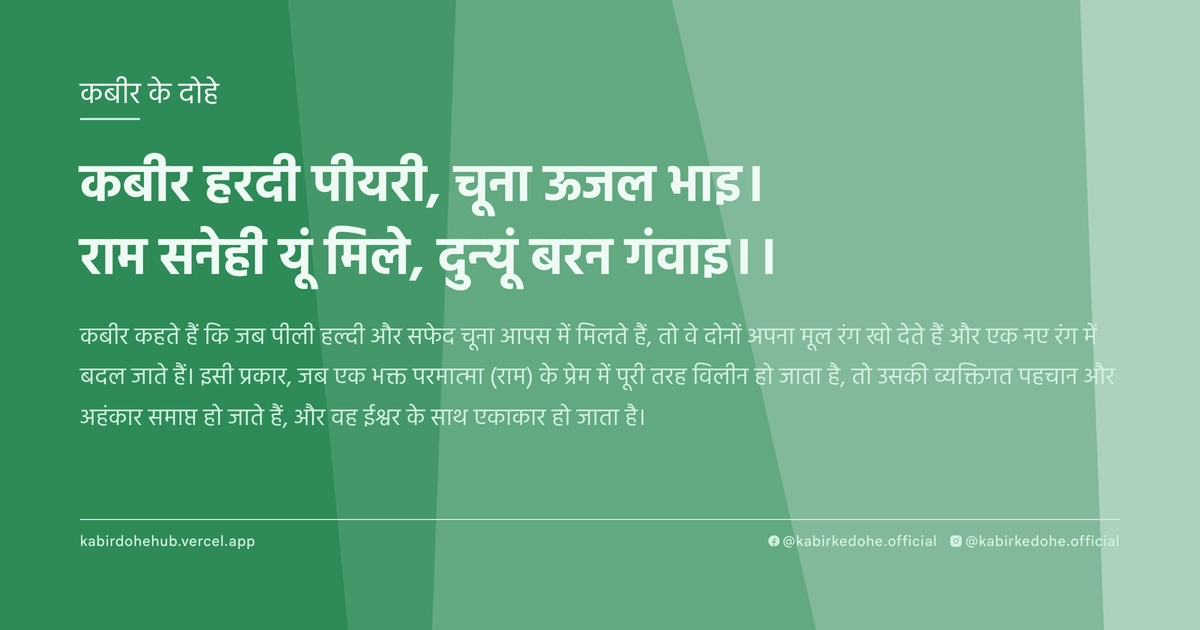
कबीर हरदी पीयरी, चूना ऊजल भाइ।
राम सनेही यूं मिले, दुन्यूं बरन गंवाइ।।
Kabir hardi peeri, choona ujal bhai. Ram sanehi yun mile, dunyoon baran ganvai.
इस पृष्ठ पर इस कबीर दोहे का अर्थ (meaning), हिंदी व्याख्या और अंग्रेज़ी अनुवाद, दार्शनिक विश्लेषण और व्यावहारिक जीवन सीख दी गई है। यह दोहा निर्गुण ब्रह्म (Nirguna Brahman) विषय से जुड़ा है — Kabir doha meaning and explanation in Hindi and English.
अर्थ (Meaning):
कबीर कहते हैं कि जब पीली हल्दी और सफेद चूना आपस में मिलते हैं, तो वे दोनों अपना मूल रंग खो देते हैं और एक नए रंग में बदल जाते हैं। इसी प्रकार, जब एक भक्त परमात्मा (राम) के प्रेम में पूरी तरह विलीन हो जाता है, तो उसकी व्यक्तिगत पहचान और अहंकार समाप्त हो जाते हैं, और वह ईश्वर के साथ एकाकार हो जाता है।
Kabir explains that when yellow turmeric and white lime merge, both lose their original colors to create a new hue. Similarly, when a seeker merges into the divine love of Ram, their individual identity and ego are dissolved, leading to a state of complete oneness where the distinction between the devotee and the Divine vanishes.
व्याख्या (Interpretation):
यह दोहा द्वैत से अद्वैत की यात्रा का प्रतीक है। हल्दी और चूना यहाँ मानव अहंकार और दैवीय चेतना के प्रतीक हैं। जब ये दोनों मिलते हैं, तो कोई एक दूसरे पर हावी नहीं होता, बल्कि दोनों का अस्तित्व मिटकर एक नई वास्तविकता का जन्म होता है। यह निर्गुण भक्ति का सार है, जहाँ ईश्वर किसी मूर्ति में नहीं बल्कि आत्मा के विलीनीकरण में है। माया वह पर्दा है जो हमें अलग दिखाता है, लेकिन प्रेम वह विलायक है जो इस अलगाव को मिटाता है। यहाँ 'राम' शब्द किसी व्यक्ति विशेष के लिए नहीं, बल्कि उस सर्वव्यापी चेतना के लिए है जो कण-कण में व्याप्त है। अंततः, यह आत्मा और परमात्मा के गैर-द्वैत (Non-duality) की स्थिति है।
This couplet symbolizes the transition from duality to non-duality. Turmeric and lime represent the human ego and the divine consciousness. When they merge, neither dominates; instead, both original identities perish to give birth to a new reality. This is the essence of Nirgun Bhakti, where the Divine is not found in idols but in the dissolution of the self. Maya is the veil that creates the illusion of separation, while divine love is the solvent that erases this boundary. Here, 'Ram' does not refer to a mythological figure but to the omnipresent consciousness pervading every atom. Ultimately, it describes the state of Atman-Brahman non-duality where the 'I' ceases to exist.
दार्शनिक विश्लेषण (Philosophical Analysis):
कबीर का यह दर्शन उनके समय के कट्टरपंथी धार्मिक अनुष्ठानों और जातिगत भेदभाव पर एक गहरा प्रहार है। उन्होंने देखा कि लोग बाहरी रंगों (जाति, धर्म, संप्रदाय) में उलझे हुए हैं, जबकि सत्य आंतरिक विलीनीकरण में है। यह विचार अद्वैत वेदांत के 'अहं ब्रह्मास्मि' के करीब है, जहाँ जीव और ईश्वर के बीच का अंतर केवल अज्ञानता के कारण है।
सूफी मत के 'फना' (Fana) के सिद्धांत के साथ इसका गहरा संबंध है, जहाँ साधक अपनी इच्छाओं और अस्तित्व को ईश्वर की इच्छा में मिटा देता है। कबीर यहाँ यह स्पष्ट करते हैं कि आध्यात्मिक उपलब्धि किसी बाहरी क्रिया से नहीं, बल्कि आंतरिक रूपांतरण से आती है। जब तक 'मैं' जीवित है, तब तक 'वह' नहीं मिल सकता।
ऐतिहासिक रूप से, कबीर ने समाज को यह सिखाया कि ईश्वर को पाने के लिए किसी विशेष वर्ण या कुल की आवश्यकता नहीं है। हल्दी और चूना साधारण वस्तुएं हैं, जो यह दर्शाती हैं कि परमात्मा तक पहुँचने का मार्ग अत्यंत सरल और सुलभ है, बशर्ते व्यक्ति अपने अहंकार का त्याग करने को तैयार हो।
मनोवैज्ञानिक स्तर पर, यह 'ईगो डेथ' (Ego Death) की प्रक्रिया है। मनुष्य अपनी पहचान को अपनी उपलब्धियों, रिश्तों और सामाजिक स्थिति से जोड़ता है। कबीर इस पहचान को 'रंग' कहते हैं। जब यह रंग मिटता है, तब केवल शुद्ध चेतना शेष रहती है।
अक्सर लोग इस दोहे का अर्थ केवल समर्पण मान लेते हैं, लेकिन यह समर्पण नहीं बल्कि रूपांतरण है। यह एक रासायनिक प्रक्रिया की तरह है जहाँ पुराना स्वरूप पूरी तरह नष्ट हो जाता है ताकि कुछ नया और शाश्वत प्रकट हो सके। यह ritualism के विरुद्ध एक सशक्त तर्क है कि सत्य किसी मंदिर या मस्जिद में नहीं, बल्कि स्वयं के विसर्जन में है।
Kabir's philosophy serves as a profound critique of the rigid religious rituals and caste hierarchies of his era. He observed that people were obsessed with external 'colors'—caste, creed, and sect—while the truth lay in internal dissolution. This aligns closely with the Advaita Vedanta concept of 'Aham Brahmasmi', suggesting that the perceived gap between the individual soul and the Universal Soul is merely an illusion born of ignorance.
There is a strong resonance here with the Sufi concept of 'Fana' (annihilation), where the seeker dissolves their will and existence into the Divine Will. Kabir emphasizes that spiritual attainment is not a result of external performance but of internal transformation. As long as the 'I' persists, the 'He' cannot be realized.
Historically, Kabir taught that reaching the Divine requires no specific caste or lineage. By using turmeric and lime—common, everyday materials—he demonstrates that the path to liberation is accessible to all, provided one is willing to sacrifice the ego.
Psychologically, this describes the process of 'Ego Death'. Humans tie their identity to achievements, relationships, and social status. Kabir refers to these as 'colors'. When these colors fade, only pure consciousness remains.
Common literalist interpretations often mistake this for simple submission. However, this is not mere submission but a total transmutation. Like a chemical reaction, the old form must be completely destroyed for something new and eternal to emerge. It is a powerful argument against ritualism, asserting that truth is found not in temples or mosques, but in the dissolution of the self.
मूल संदेश (Core Message):
- अहंकार वह पर्दा है जो हमें परमात्मा से अलग करता है।
- पूर्ण समर्पण का अर्थ है अपनी सीमित पहचान का विसर्जन।
- सत्य तब प्रकट होता है जब 'मैं' का अस्तित्व समाप्त हो जाता है।
- प्रेम वह विलायक है जो द्वैत को अद्वैत में बदल देता है।
- बाहरी पहचान के रंगों को छोड़कर आंतरिक प्रकाश को अपनाएं।
- Ego is the veil that separates the individual from the Divine.
- Total surrender means the dissolution of the limited self.
- Truth manifests only when the existence of 'I' ceases.
- Love is the solvent that transforms duality into non-duality.
- Abandon the colors of external identity to embrace the inner light.
व्यावहारिक उदाहरण (Practical Example):
वाराणसी के एक पुराने घाट पर माधव नाम का एक वृद्ध बुनकर रहता था। वह अपनी कला में इतना निपुण था कि पूरे शहर में उसके बनाए कपड़ों की चर्चा थी। लेकिन इस निपुणता ने माधव के भीतर एक गहरा अहंकार भर दिया था। वह मानता था कि उसकी कला उसे अन्य बुनकरों से श्रेष्ठ बनाती है। वह दूसरों को तुच्छ समझने लगा था।
एक दिन माधव की मुलाकात एक घुमंतू साधु से हुई, जिसने माधव के अहंकार को पहचान लिया। साधु ने माधव को एक कटोरे में हल्दी और चूना मिलाकर दिखाया। माधव ने देखा कि कैसे दोनों के रंग गायब हो गए और एक नया गहरा लाल रंग उभर आया। साधु ने कहा, "माधव, तुम्हारी कला तुम्हारा रंग है, तुम्हारा अहंकार तुम्हारा रंग है। जब तक तुम इन रंगों को पकड़े रहोगे, तुम केवल एक बुनकर रहोगे। जिस दिन तुम इस 'मैं' को मिटा दोगे, तुम उस अनंत सत्य का हिस्सा बन जाओगे।"
माधव को बात समझ आई, लेकिन बदलाव रातों-रात नहीं आया। उसने धीरे-धीरे अपनी कला को 'अपनी' उपलब्धि मानना बंद कर दिया। उसने महसूस किया कि वह केवल एक माध्यम है, कलाकार तो वह परम शक्ति है जो उसके हाथों को चला रही है। उसने अपने ज्ञान को गुप्त रखने के बजाय गरीब बच्चों को मुफ्त में सिखाना शुरू किया।
शुरुआत में उसके मन में विचार आया कि उसकी विशिष्टता खत्म हो जाएगी, लेकिन जैसे-जैसे उसने दूसरों की सेवा की, उसे एक अजीब सी शांति महसूस हुई। वह अब अपनी प्रशंसा की परवाह नहीं करता था। उसका अहंकार, जो कभी एक कठोर दीवार की तरह था, अब पिघलकर प्रेम में बदल गया था।
एक समय ऐसा आया जब माधव के लिए 'मैं' और 'मेरा' शब्द अर्थहीन हो गए। वह अब केवल काम करता था, बिना इस चिंता के कि लोग क्या कहेंगे या उसे क्या मिलेगा। उसकी कला और भी निखर गई क्योंकि अब उसमें अहंकार का बोझ नहीं था।
गाँव के लोग हैरान थे कि माधव अब पहले से कहीं अधिक विनम्र और खुश रहता था। उसने अपनी पहचान को मिटा दिया था, और इसी विलीनीकरण में उसे वह सुख मिला जो उसे अपनी श्रेष्ठता के घमंड में कभी नहीं मिला था।
उसने सीखा कि जिस तरह हल्दी और चूना मिलकर अपना अस्तित्व खोते हैं, उसी तरह जब मनुष्य अपने अहंकार को ईश्वर या मानवता के प्रेम में विलीन कर देता है, तब वह वास्तव में स्वतंत्र होता है।
अंततः, माधव अब केवल एक बुनकर नहीं था; वह प्रेम का एक जीवित उदाहरण बन गया था। उसने अपने 'रंग' खो दिए थे, लेकिन उसने संपूर्ण ब्रह्मांड का रंग पा लिया था।
On an ancient ghat in Varanasi lived an elderly weaver named Madhav. He was so skilled in his craft that his fabrics were renowned throughout the city. However, this mastery had bred a deep ego within him. Madhav believed his skill made him superior to all other weavers, and he began to look down upon them.
One day, Madhav met a wandering monk who perceived the weaver's arrogance. The monk mixed turmeric and lime in a bowl before him. Madhav watched as both original colors vanished, replaced by a deep, new red hue. The monk said, "Madhav, your art is your color, your ego is your color. As long as you cling to these colors, you remain merely a weaver. The day you erase this 'I', you will become part of the infinite truth."
Madhav understood the words, but the change did not happen overnight. Slowly, he stopped viewing his art as his own achievement. He realized he was merely a medium; the true artist was the supreme power moving his hands.
He began teaching poor children for free, sharing the secrets he had once guarded. Initially, he feared losing his uniqueness, but as he served others, a strange peace descended upon him. He no longer craved praise.
His ego, which had been like a rigid wall, began to melt into love. A time came when the words 'I' and 'mine' became meaningless to him. He worked without concern for recognition or reward.
His art actually flourished because the burden of ego was gone. The villagers were amazed that Madhav was now far more humble and joyful than ever before.
He had erased his identity, and in that dissolution, he found a happiness that his pride in superiority had never provided.
He learned that just as turmeric and lime lose their existence to create something new, when a human dissolves their ego in the love of the Divine or humanity, they truly become free.
Ultimately, Madhav was no longer just a weaver; he became a living embodiment of love. He had lost his individual 'colors', but in doing so, he had gained the colors of the entire universe.
अभ्यास मार्गदर्शन (Practice Guidance):
- प्रतिदिन 20 मिनट मौन ध्यान करें, जहाँ आप अपनी सभी सामाजिक पहचानों (नाम, पद, रिश्ता) को मानसिक रूप से उतार दें और केवल एक शुद्ध चेतना के रूप में स्वयं को देखें।
- एक 'अहंकार डायरी' लिखें: दिन भर में जब भी आपको महसूस हो कि आप दूसरों से श्रेष्ठ हैं या आप किसी बात पर 'अधिकार' जता रहे हैं, उसे लिखें और फिर विचार करें कि यह 'रंग' आपको सत्य से कैसे दूर कर रहा है।
- सेवा का अभ्यास: सप्ताह में एक बार ऐसा कार्य करें जिसमें आपकी कोई पहचान न हो और जिसका श्रेय आपको न मिले। गुमनाम रहकर मदद करना अहंकार को मिटाने का सबसे प्रभावी तरीका है।
- निदान चेकलिस्ट: क्या मैं अपनी प्रशंसा पर बहुत अधिक निर्भर हूँ? क्या मैं दूसरों की सफलता से ईर्ष्या करता हूँ? क्या मैं अपनी पहचान को अपनी उपलब्धियों से जोड़ता हूँ? यदि हाँ, तो आप अभी भी अपने 'रंग' में कैद हैं।
- Practice 20 minutes of silent meditation daily, mentally stripping away all social identities (name, title, relationship) and perceiving yourself solely as pure consciousness.
- Maintain an 'Ego Journal': Whenever you feel superior to others or feel a sense of 'ownership' over something, record it and reflect on how this 'color' distances you from the truth.
- Practice Anonymous Service: Once a week, perform an act of kindness where your identity remains hidden and you receive no credit. Anonymity is the most effective tool for erasing the ego.
- Diagnostic Checklist: Am I overly dependent on praise? Do I feel envy toward others' success? Do I tie my identity to my achievements? If yes, you are still imprisoned by your 'colors'.
चिंतन प्रश्न (Reflection Questions):
- यदि आपसे आपका नाम, पेशा और सामाजिक प्रतिष्ठा छीन ली जाए, तो वास्तव में आप कौन बचेंगे?
- आपकी कौन सी ऐसी 'पहचान' है जिसे आप खोने से सबसे ज्यादा डरते हैं, और वह डर आपको कैसे नियंत्रित करता है?
- क्या आपकी धार्मिक या आध्यात्मिक मान्यताएं आपको वास्तव में मुक्त कर रही हैं, या वे केवल एक नया 'रंग' (पहचान) बन गई हैं?
- जब आप किसी की मदद करते हैं, तो क्या आप वास्तव में उस व्यक्ति की मदद कर रहे होते हैं, या अपनी 'परोपकारी' छवि को संतुष्ट कर रहे होते हैं?
- क्या आप उस शून्य में उतरने का साहस रखते हैं जहाँ आपकी कोई व्यक्तिगत परिभाषा न हो?
- If your name, profession, and social status were stripped away, who would you actually be?
- Which part of your identity are you most afraid of losing, and how does that fear control you?
- Are your religious or spiritual beliefs truly liberating you, or have they simply become another 'color' (identity)?
- When you help someone, are you truly helping that person, or are you satisfying your image of being 'charitable'?
- Do you have the courage to descend into the void where you have no personal definition?