
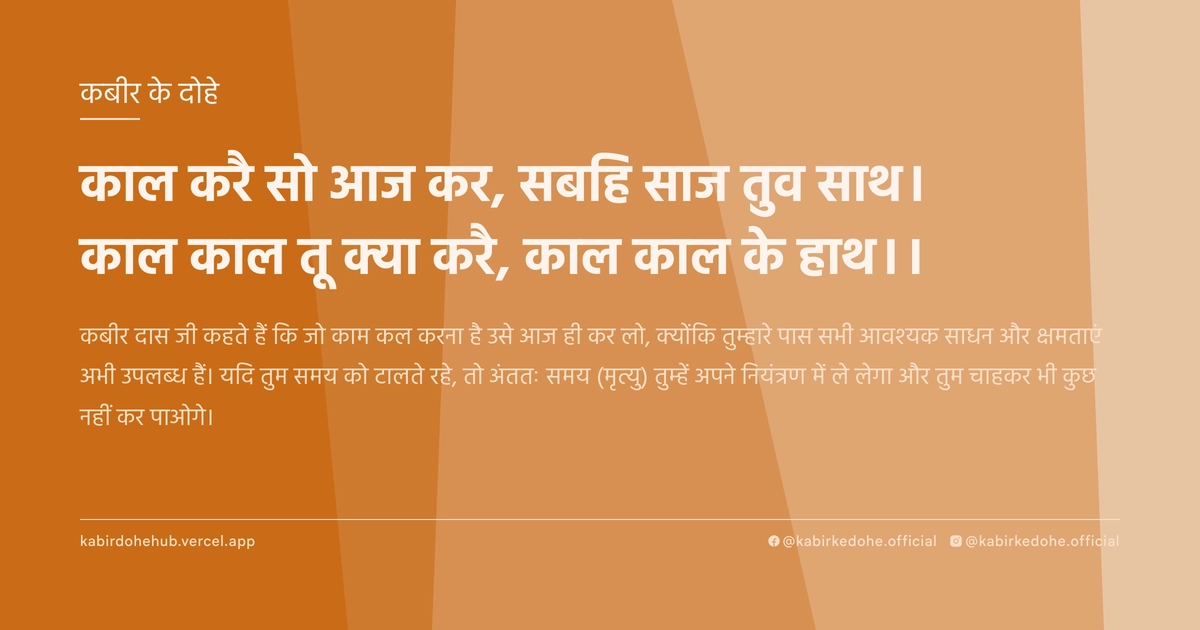
काल करै साे आज कर, सबहि साज तुव साथ।
काल काल तू क्या करै, काल काल के हाथ।।
Kaal karai so aaj kar, sabhi saaj tuv saath. Kaal kaal tu kya karai, kaal kaal ke haath.
इस पृष्ठ पर इस कबीर दोहे का अर्थ (meaning), हिंदी व्याख्या और अंग्रेज़ी अनुवाद, दार्शनिक विश्लेषण और व्यावहारिक जीवन सीख दी गई है। यह दोहा समय का महत्व (The Value of Time) विषय से जुड़ा है — Kabir doha meaning and explanation in Hindi and English.
अर्थ (Meaning):
कबीर दास जी कहते हैं कि जो काम कल करना है उसे आज ही कर लो, क्योंकि तुम्हारे पास सभी आवश्यक साधन और क्षमताएं अभी उपलब्ध हैं। यदि तुम समय को टालते रहे, तो अंततः समय (मृत्यु) तुम्हें अपने नियंत्रण में ले लेगा और तुम चाहकर भी कुछ नहीं कर पाओगे।
Kabir urges us to accomplish today what we intend to do tomorrow, for all the necessary resources and capabilities are currently within our reach. If we persist in procrastination, time—which eventually manifests as death—will seize us, leaving us powerless to act upon our spiritual or worldly intentions.
व्याख्या (Interpretation):
शाब्दिक अर्थ समय प्रबंधन का है, परंतु आध्यात्मिक स्तर पर यह 'अविद्या' और 'माया' के प्रभाव पर प्रहार है। 'काल' यहाँ दो अर्थों में है: एक बीता हुआ समय और दूसरा महाकाल (मृत्यु)। कबीर संकेत करते हैं कि मनुष्य माया के मोह में यह भ्रम पालता है कि उसके पास अनंत समय है। यह 'अहंकार' का एक सूक्ष्म रूप है जहाँ आत्मा यह मानती है कि वह समय की स्वामी है, जबकि वह समय के अधीन है। निर्गुण भक्ति में, यह तत्काल आत्म-साक्षात्कार की आवश्यकता पर बल देता है, क्योंकि मोक्ष का मार्ग केवल वर्तमान क्षण की जागरूकता से खुलता है। जब तक साधक 'कल' की प्रतीक्षा करता है, वह द्वैत में फंसा रहता है।
While the literal meaning pertains to time management, on a spiritual plane, it is an assault on the influence of 'Avidya' (ignorance) and 'Maya' (illusion). 'Kaal' serves a dual purpose here: referring to both chronological time and the inevitable Death (Mahakal). Kabir suggests that humans, blinded by worldly attachments, harbor the delusion of infinite time. This is a subtle manifestation of the ego, where the soul believes it masters time, whereas it is actually subject to it. In Nirgun Bhakti, this emphasizes the urgency of immediate self-realization, as the path to liberation opens only through present-moment awareness. As long as the seeker waits for 'tomorrow,' they remain trapped in duality.
दार्शनिक विश्लेषण (Philosophical Analysis):
कबीर का यह दोहा केवल आलस्य के विरुद्ध चेतावनी नहीं है, बल्कि यह अस्तित्ववादी संकट और आध्यात्मिक तत्परता का विश्लेषण है। उनके युग में, धार्मिक कर्मकांडों में डूबे लोग यह मानते थे कि मोक्ष केवल मृत्यु के बाद या किसी विशेष अनुष्ठान के बाद मिलेगा। कबीर ने इस 'टालमटोल' की संस्कृति को चुनौती दी और कहा कि ईश्वर या सत्य कहीं बाहर नहीं, बल्कि इसी क्षण में उपलब्ध है। यह दृष्टिकोण अद्वैत वेदांत के 'तत् त्वम असि' (वह तू ही है) से मेल खाता है, जहाँ सत्य को खोजने के लिए किसी भविष्य की तिथि की आवश्यकता नहीं है, केवल वर्तमान की जागृति पर्याप्त है।
सूफी मत के 'अन-अल-हक' (मैं सत्य हूँ) के समान, कबीर यहाँ व्यक्ति को उसकी अपनी सत्ता के प्रति सचेत कर रहे हैं। वे समझाते हैं कि समय का चक्र निरंतर चलता रहता है और मनुष्य का अहंकार उसे यह विश्वास दिलाता है कि वह समय को नियंत्रित कर सकता है। यह अहंकार ही वह पर्दा है जो आत्मा को ब्रह्म से अलग करता है। जब हम कहते हैं 'कल करेंगे', तो हम वास्तव में अपनी आध्यात्मिक यात्रा को स्थगित कर रहे होते हैं, जो कि अज्ञानता की पराकाष्ठा है।
कबीर ने जाति और धर्म के बाहरी आडंबरों को नकारते हुए आंतरिक शुद्धि पर जोर दिया। उनके लिए, ritualism (कर्मकांड) समय की बर्बादी है क्योंकि वे बाहरी दिखावे में समय व्यतीत करते हैं जबकि आंतरिक रूपांतरण को कल पर टाल देते हैं। यह दोहा मनोवैज्ञानिक रूप से 'विलंब' (procrastination) को एक आध्यात्मिक बीमारी के रूप में प्रस्तुत करता है जो आत्मा की मुक्ति में सबसे बड़ी बाधा है।
यहाँ 'काल के हाथ' का अर्थ केवल शारीरिक मृत्यु नहीं, बल्कि उस स्थिति से है जहाँ चेतना इतनी जड़ हो जाती है कि वह परिवर्तन की क्षमता खो देती है। जब अहंकार पूरी तरह हावी हो जाता है, तो व्यक्ति समय की पकड़ में ऐसा फंसता है कि वह सत्य की खोज की इच्छा ही खो देता है। यह एक प्रकार की आध्यात्मिक मृत्यु है जो शारीरिक मृत्यु से पहले घटित होती है।
अंततः, यह विश्लेषण हमें इस निष्कर्ष पर ले जाता है कि वर्तमान क्षण ही एकमात्र सत्य है। जो व्यक्ति वर्तमान में जीना सीख जाता है, वह काल के भय से मुक्त हो जाता है। कबीर का संदेश है कि साधना को जीवन का हिस्सा बनाया जाए, न कि इसे किसी अवकाश या भविष्य की योजना के रूप में देखा जाए। यही वह बिंदु है जहाँ मनुष्य अपनी सीमित पहचान को त्यागकर अनंत में विलीन होता है।
This couplet by Kabir is not merely a warning against laziness, but an analysis of existential crisis and spiritual urgency. In his era, those immersed in religious rituals believed that salvation would occur only after death or a specific ceremony. Kabir challenged this culture of 'deferment,' asserting that God or Truth is not elsewhere, but available in this very moment. This perspective aligns with the Advaita Vedanta principle of 'Tat Tvam Asi' (Thou Art That), where seeking Truth requires no future date—only present awareness is sufficient.
Similar to the Sufi concept of 'Ana al-Haqq' (I am the Truth), Kabir alerts the individual to their own essence. He explains that the wheel of time turns incessantly, and the human ego fosters the belief that it can control time. This ego is the veil that separates the Atman from Brahman. When we say 'I will do it tomorrow,' we are effectively postponing our spiritual journey, which is the pinnacle of ignorance.
Kabir emphasized internal purification over the external trappings of caste and religion. To him, ritualism is a waste of time because people spend their lives in outward displays while deferring internal transformation to an imagined future. Psychologically, he presents procrastination as a spiritual ailment—the primary obstacle to the soul's liberation.
The phrase 'in the hands of time' refers not only to physical death but to a state where consciousness becomes so rigid that it loses the capacity for change. When the ego dominates completely, the individual becomes so trapped in the grip of time that they lose the very desire to seek Truth. This is a form of spiritual death that precedes physical demise.
Ultimately, this analysis leads us to the conclusion that the present moment is the only reality. One who learns to live in the 'now' is liberated from the fear of time. Kabir's message is to integrate spiritual practice into life itself, rather than viewing it as a leisure activity or a future plan. This is the point where the human transcends limited identity and merges into the Infinite.
मूल संदेश (Core Message):
- कल का भ्रम माया का सबसे शक्तिशाली जाल है।
- वर्तमान क्षण ही एकमात्र द्वार है जहाँ आत्मा और परमात्मा मिलते हैं।
- साधनों की उपलब्धता पर्याप्त नहीं है, संकल्प की तत्परता अनिवार्य है।
- समय का प्रबंधन नहीं, बल्कि समय के साथ एकात्मता आवश्यक है।
- मृत्यु अंत नहीं, बल्कि समय की वह अंतिम सीमा है जो हमें जगाती है।
- The illusion of 'tomorrow' is Maya's most powerful trap.
- The present moment is the only portal where the Soul and Divine meet.
- Availability of resources is insufficient; urgency of resolve is mandatory.
- Not time management, but oneness with time is essential.
- Death is not the end, but the final boundary of time that awakens us.
व्यावहारिक उदाहरण (Practical Example):
एक समय की बात है, वाराणसी के घाटों पर माधव नाम का एक वृद्ध बुनकर रहता था। माधव अत्यंत कुशल था, लेकिन उसका स्वभाव टालमटोल करने का था। वह हमेशा कहता था कि वह अपने जीवन की सबसे सुंदर चादर बुनेगा, जिसमें वह ईश्वर के प्रति अपनी पूरी भक्ति उकेर देगा, लेकिन वह इस काम को 'कल' पर टालता रहा। वह सोचता था कि अभी तो वह युवा है, उसके पास बहुत समय है।
दिन हफ्तों में और हफ्ते महीनों में बदल गए। माधव ने अपनी पूरी जिंदगी दूसरों के लिए साधारण कपड़े बुनने में बिता दी। वह हर सुबह उठता और खुद से कहता, 'आज नहीं, कल से मैं अपनी दिव्य चादर बुनना शुरू करूँगा।' उसके पास रेशम के धागे थे, बेहतरीन रंग थे और अद्भुत कौशल था—अर्थात 'सबहि साज' उसके पास थे, फिर भी वह मानसिक आलस्य का शिकार था।
एक दिन, माधव ने देखा कि उसके हाथ कांपने लगे हैं और उसकी दृष्टि धुंधली हो गई है। उसे एहसास हुआ कि उसकी उम्र ढल चुकी है और अब वह वह बारीक काम नहीं कर सकता जो उसने वर्षों पहले सोचा था। वह अपनी करघे के पास बैठा और फूट-फूट कर रोने लगा। उसे समझ आया कि उसने केवल समय को नहीं खोया, बल्कि अपनी आत्मा की अभिव्यक्ति के अवसर को खो दिया।
तभी उसकी मुलाकात एक घुमंतू साधु से हुई, जिसने उसे कबीर का यह दोहा सुनाया। साधु ने कहा, 'माधव, तुमने सोचा कि समय तुम्हारा दास है, लेकिन वास्तव में तुम समय के दास बन गए। तुमने साधनों का संचय किया, लेकिन संकल्प का अभाव रखा।'
इस बात ने माधव के भीतर एक बिजली जैसी लहर पैदा की। उसने महसूस किया कि हालांकि वह अब एक भव्य चादर नहीं बुन सकता, लेकिन वह अभी भी वर्तमान क्षण में छोटे-छोटे कार्यों के माध्यम से प्रेम और करुणा बांट सकता है। उसने तय किया कि वह अब एक पल भी व्यर्थ नहीं करेगा।
उसने अपने पास बचे हुए अंतिम कुछ वर्षों में गरीब बच्चों को बुनाई सिखानी शुरू की। उसने अपनी कला को अहंकार के बजाय सेवा का माध्यम बना लिया। उसने महसूस किया कि 'दिव्य चादर' वास्तव में कपड़े का टुकड़ा नहीं, बल्कि दूसरों के जीवन में लाए गए सकारात्मक बदलाव थे।
माधव का व्यवहार पूरी तरह बदल गया। जो व्यक्ति कभी घंटों तक भविष्य की योजनाएं बनाता था, वह अब हर सांस को एक प्रार्थना की तरह जीने लगा। उसने अपने घर के छोटे से कोने को एक पाठशाला बना दिया, जहाँ वह केवल कौशल नहीं, बल्कि वर्तमान में जीने की कला सिखाता था।
जब माधव की मृत्यु का समय आया, तो उसके चेहरे पर कोई पछतावा नहीं था। उसने समय के हाथों हारने के बजाय, समय के साथ तालमेल बिठा लिया था। उसने जान लिया था कि मोक्ष किसी भविष्य के लक्ष्य में नहीं, बल्कि आज के छोटे से निस्वार्थ कार्य में छिपा है।
उसकी कहानी वाराणसी के बुनकरों के बीच एक मिसाल बन गई। लोग अब यह नहीं कहते थे कि 'कल करेंगे', बल्कि वे माधव की याद में कहते थे, 'जो करना है, अभी इसी क्षण कर लो, क्योंकि समय किसी का इंतजार नहीं करता।'
इस प्रकार, एक साधारण बुनकर ने कबीर के शब्दों के माध्यम से यह जाना कि वास्तविक आध्यात्मिक उपलब्धि समय की गणना में नहीं, बल्कि वर्तमान की सघनता में है।
Once, on the ghats of Varanasi, lived an elderly weaver named Madhav. Madhav was exceptionally skilled, but he had a habit of procrastination. He always claimed he would weave the most beautiful shawl of his life, embroidering his entire devotion to the Divine into it, but he kept pushing this task to 'tomorrow.' He believed he was still young and had plenty of time.
Days turned into weeks, and weeks into months. Madhav spent his entire life weaving ordinary clothes for others. Every morning he would wake up and tell himself, 'Not today; I shall begin my divine shawl tomorrow.' He possessed the silk threads, the finest dyes, and the exquisite skill—essentially, 'all the resources' (sabhi saaj) were with him, yet he fell prey to mental lethargy.
One day, Madhav noticed his hands beginning to tremble and his vision blurring. He realized his age had caught up with him, and he could no longer perform the intricate work he had envisioned years ago. He sat by his loom and wept bitterly. He understood that he hadn't just lost time, but the opportunity for his soul's expression.
Then, he met a wandering monk who recited this specific Doha of Kabir. The monk said, 'Madhav, you thought time was your servant, but in reality, you became a servant to time. You accumulated resources, but lacked resolve.'
These words sparked a lightning-like realization within Madhav. He felt that although he could no longer weave a grand shawl, he could still spread love and compassion through small acts in the present moment. He decided that he would not waste another second.
In the remaining few years of his life, he began teaching weaving to underprivileged children. He transformed his art from a tool of ego into a medium of service. He realized that the 'divine shawl' was not actually a piece of fabric, but the positive changes brought into the lives of others.
Madhav's behavior changed completely. The man who once spent hours planning the future began to live every breath as a prayer. He turned a small corner of his home into a school, teaching not just a craft, but the art of living in the now.
When the time for Madhav's passing arrived, there was no regret on his face. Instead of being defeated by the hands of time, he had synchronized himself with it. He had learned that salvation is not a future goal, but hidden in today's smallest selfless act.
His story became a legend among the weavers of Varanasi. People stopped saying 'I will do it tomorrow' and instead, in memory of Madhav, they said, 'Do what must be done this very moment, for time waits for no one.'
Thus, a simple weaver discovered through Kabir's words that true spiritual achievement lies not in the calculation of time, but in the intensity of the present.
अभ्यास मार्गदर्शन (Practice Guidance):
- दैनिक चिंतन: हर सुबह उठकर स्वयं से पूछें, 'यदि आज मेरा अंतिम दिन है, तो क्या मैं अपनी वर्तमान मानसिक स्थिति और कार्यों से संतुष्ट हूँ?'
- जागरूकता अभ्यास: जब भी मन में 'कल' शब्द आए, उसे तुरंत रोकें और उस कार्य का एक छोटा सा हिस्सा (कम से कम 2 मिनट के लिए) अभी करें।
- आत्म-पूछताछ जर्नल: प्रतिदिन उन तीन चीजों को लिखें जिन्हें आपने टाल दिया और विश्लेषण करें कि किस 'अहंकार' या 'भय' ने आपको ऐसा करने पर मजबूर किया।
- निदान चेकलिस्ट: यदि आप अक्सर भविष्य की चिंता में वर्तमान को अनदेखा करते हैं, या आध्यात्मिक अभ्यास को 'रिटायरमेंट' के बाद के लिए छोड़ रहे हैं, तो आप 'काल के हाथ' के प्रभाव में हैं।
- Daily Contemplation: Upon waking, ask yourself, 'If today were my last day, would I be satisfied with my current state of mind and my actions?'
- Awareness Practice: Whenever the word 'tomorrow' arises in your mind, stop it immediately and perform a small part of that task (for at least 2 minutes) right now.
- Self-Inquiry Journal: Daily list three things you procrastinated and analyze which 'ego' or 'fear' compelled you to defer them.
- Diagnostic Checklist: If you frequently ignore the present due to future anxieties, or defer spiritual practice until 'retirement,' you are under the influence of 'the hands of time'.
चिंतन प्रश्न (Reflection Questions):
- आपकी कौन सी ऐसी इच्छाएं हैं जिन्हें आप 'सही समय' आने के इंतजार में दबा रहे हैं? क्या वह समय कभी आता है या आप केवल डर रहे हैं?
- क्या आपका डिजिटल व्यक्तित्व (सोशल मीडिया) आपको यह भ्रम देता है कि आप वास्तव में उत्पादक हैं, जबकि आपकी आंतरिक आत्मा अभी भी स्थिर है?
- यदि समय एक भौतिक वस्तु होता जिसे आप देख सकते, तो आपकी 'कल' की आदतें आपके जीवन के कितने हिस्से को खाली कर चुकी होतीं?
- क्या आप वास्तव में आध्यात्मिक प्रगति करना चाहते हैं, या आप केवल 'आध्यात्मिक होने' के विचार से संतुष्ट हैं?
- आपके भीतर का वह कौन सा डर है जो आपको वर्तमान क्षण में पूरी तरह समर्पित होने से रोकता है?
- Which of your desires are you suppressing while waiting for the 'right time'? Does that time ever arrive, or are you simply afraid?
- Does your digital persona (social media) give you the illusion of being productive while your inner soul remains stagnant?
- If time were a physical object you could see, how much of your life would be empty due to your habit of 'tomorrow'?
- Do you truly wish for spiritual progress, or are you merely satisfied with the 'idea' of being spiritual?
- What is the fear within you that prevents you from surrendering completely to the present moment?