
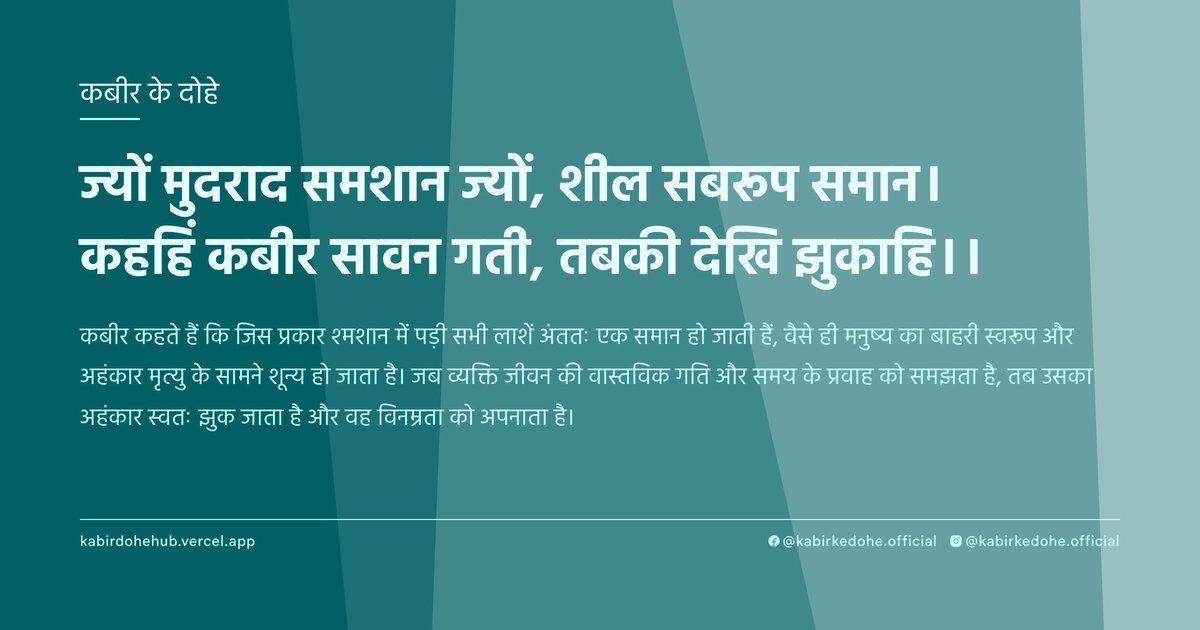
ज्यों मुदराद समशान ज्यों, शील सबरूप समान।
कहहिं कबीर सावन गती, तबकी देखि झुकाहि।।
Jyon mudraad samshaan jyon, sheel sabroop samaan. Kahahin kabeer saavan gati, tabki dekh jhukaahi.
इस पृष्ठ पर इस कबीर दोहे का अर्थ (meaning), हिंदी व्याख्या और अंग्रेज़ी अनुवाद, दार्शनिक विश्लेषण और व्यावहारिक जीवन सीख दी गई है। यह दोहा विनम्रता (Humility) विषय से जुड़ा है — Kabir doha meaning and explanation in Hindi and English.
अर्थ (Meaning):
कबीर कहते हैं कि जिस प्रकार श्मशान में पड़ी सभी लाशें अंततः एक समान हो जाती हैं, वैसे ही मनुष्य का बाहरी स्वरूप और अहंकार मृत्यु के सामने शून्य हो जाता है। जब व्यक्ति जीवन की वास्तविक गति और समय के प्रवाह को समझता है, तब उसका अहंकार स्वतः झुक जाता है और वह विनम्रता को अपनाता है।
Kabir observes that just as all corpses lying in the cremation ground eventually become identical, the external forms and egos of humans are rendered equal in the face of death. When one perceives the true velocity of time and the inevitability of the end, the pride of the ego naturally collapses, leading to a state of profound humility.
व्याख्या (Interpretation):
यह दोहा मृत्यु की अनिवार्यता के माध्यम से जीवन की नश्वरता का चित्रण करता है। 'मुदराद' (शव) और 'समशान' का उल्लेख यह दर्शाता है कि भौतिक शरीर केवल एक आवरण है। यहाँ कबीर निरगुण भक्ति के सिद्धांत को समझाते हैं कि आत्मा का कोई रूप, जाति या पद नहीं होता। माया हमें यह विश्वास दिलाती है कि हम दूसरों से श्रेष्ठ हैं, लेकिन मृत्यु इस भ्रम को तोड़ देती है। जब साधक 'सावन गती' यानी समय के चक्र को देखता है, तो उसे बोध होता है कि अहंकार केवल एक मानसिक रोग है। यह अद्वैत वेदांत की उस स्थिति की ओर संकेत है जहाँ ज्ञाता और ज्ञेय का भेद मिट जाता है और केवल शुद्ध चेतना शेष रहती है।
This couplet illustrates the transience of life through the inevitability of death. The mention of 'mudraad' (corpse) and the 'samshaan' (cremation ground) signifies that the physical body is merely a veil. Kabir invokes the principles of Nirgun Bhakti, asserting that the soul possesses no form, caste, or rank. Maya creates the illusion of superiority, but death shatters this deception. When the seeker observes 'saavan gati'—the relentless flow of time—they realize that ego is but a psychological ailment. This points toward the state of Advaita Vedanta, where the distinction between the knower and the known dissolves, leaving only pure, non-dual consciousness.
दार्शनिक विश्लेषण (Philosophical Analysis):
कबीर का यह दृष्टिकोण उनके युग के सामाजिक और धार्मिक पाखंडों पर एक कड़ा प्रहार है। उन्होंने देखा कि लोग जाति, धर्म और बाहरी कर्मकांडों के आधार पर स्वयं को श्रेष्ठ मानते थे। श्मशान का उदाहरण देकर वे यह सिद्ध करते हैं कि प्रकृति का अंतिम न्याय सबके लिए समान है, जो किसी भी प्रकार के सामाजिक स्तरीकरण को नकारता है।
दार्शनिक रूप से, यह सूफी मत के 'फना' (अहंकार का विनाश) और अद्वैत वेदांत के 'अहं ब्रह्मास्मि' के बीच का सेतु है। जब तक 'मैं' का भाव है, तब तक ईश्वर या सत्य का अनुभव असंभव है। कबीर यहाँ मृत्यु को डराने के लिए नहीं, बल्कि एक शिक्षक के रूप में उपयोग कर रहे हैं, जो हमें वर्तमान क्षण में जागृत करता है।
यह दोहा यह स्पष्ट करता है कि आध्यात्मिक प्रगति के लिए सबसे बड़ी बाधा 'अहंकार' है। यह अहंकार केवल व्यक्तिगत नहीं, बल्कि सामूहिक भी होता है—जैसे 'मेरा धर्म श्रेष्ठ है' या 'मेरी जाति उच्च है'। कबीर इन सभी कृत्रिम विभाजनों को श्मशान की राख में मिला देते हैं।
मनोवैज्ञानिक स्तर पर, यह 'Memento Mori' (मृत्यु को याद रखो) की अवधारणा है। जब मनुष्य यह स्वीकार कर लेता है कि उसका अस्तित्व क्षणभंगुर है, तो वह बाहरी प्रतिस्पर्धा और ईर्ष्या से मुक्त होकर आंतरिक शांति की ओर बढ़ता है।
अंततः, कबीर यह संदेश देते हैं कि वास्तविक भक्ति मंदिर या मस्जिद में नहीं, बल्कि उस विनम्रता में है जो यह जानती है कि हम सब एक ही मिट्टी से बने हैं और उसी में मिल जाना है। यह शून्य की अवस्था ही पूर्णता की ओर ले जाती है।
Kabir's perspective serves as a scathing critique of the social and religious hypocrisies of his era. He observed how individuals claimed superiority based on caste, creed, and external rituals. By using the cremation ground as a metaphor, he proves that nature's final judgment is egalitarian, effectively dismantling all forms of social stratification.
Philosophically, this is a bridge between the Sufi concept of 'Fana' (annihilation of the self) and the Advaita Vedanta realization of 'Aham Brahmasmi'. As long as the sense of 'I' persists, the experience of the Divine or Absolute Truth remains impossible. Kabir employs death not as a threat, but as a teacher that awakens the seeker to the present moment.
The couplet clarifies that the primary obstacle to spiritual evolution is the 'ego'. This ego is not merely individual but collective—manifesting as 'my religion is superior' or 'my caste is higher'. Kabir reduces all these artificial divisions to the common ash of the funeral pyre.
On a psychological level, this aligns with the concept of 'Memento Mori'. Once a human accepts the transience of their existence, they are liberated from external competition and envy, pivoting instead toward internal tranquility.
Ultimately, Kabir conveys that true devotion resides not in temples or mosques, but in the humility that recognizes we are all crafted from the same earth and shall return to it. This state of 'shunya' (void/zero) is the only gateway to 'purnata' (fullness/wholeness).
मूल संदेश (Core Message):
- अहंकार एक भ्रम है जो मृत्यु के सत्य से मिट जाता है।
- समानता बाहरी कपड़ों में नहीं, बल्कि अंततः राख में है।
- समय का प्रवाह सबसे बड़े अभिमानी को भी झुका देता है।
- विनम्रता ही वह द्वार है जिससे ईश्वर का अनुभव होता है।
- शरीर नश्वर है, केवल प्रेम और सत्य शाश्वत हैं।
- स्वयं को शून्य करना ही पूर्णता की ओर पहला कदम है।
- Ego is a delusion that dissolves in the truth of death.
- Equality is not found in attire, but ultimately in the ash.
- The flow of time humbles even the most arrogant soul.
- Humility is the only gateway to experiencing the Divine.
- The body is transient; only love and truth are eternal.
- Reducing oneself to zero is the first step toward wholeness.
व्यावहारिक उदाहरण (Practical Example):
वाराणसी के एक पुराने घाट पर रामदीन नाम का एक अहंकारी पंडित रहता था। वह अपनी विद्वत्ता और उच्च कुल के कारण शहर के अन्य लोगों को तुच्छ समझता था। वह अक्सर गरीब भक्तों का उपहास करता था जो बिना संस्कृत जाने ईश्वर की प्रार्थना करते थे।
एक दिन रामदीन ने देखा कि उसके सबसे घमंडी प्रतिद्वंद्वी, जो स्वयं को महान विद्वान मानता था, की मृत्यु हो गई है। वह उसे श्मशान ले जाने वाले दल में शामिल था।
वहाँ उसने देखा कि जिस शरीर ने जीवन भर सोने के वस्त्र पहने और सम्मान पाया, वह अब केवल जलती हुई लकड़ियों पर एक मांस का लोथड़ा मात्र था।
उसने गौर किया कि बगल में ही एक साधारण मजदूर की देह भी जल रही थी। आग की लपटों में दोनों के बीच का अंतर पूरी तरह समाप्त हो चुका था।
राख के ढेर में न तो कोई पंडित था और न ही कोई मजदूर; केवल धूसर रंग की राख बची थी जो हवा में उड़ रही थी।
रामदीन को अचानक एक गहरा झटका लगा। उसे अहसास हुआ कि जिस 'श्रेष्ठता' के लिए उसने अपना पूरा जीवन संघर्ष किया, वह मृत्यु के एक क्षण में शून्य हो गई।
उसने महसूस किया कि उसकी विद्वत्ता और अहंकार केवल एक पर्दा थे, जिन्होंने उसे वास्तविक प्रेम और करुणा से दूर रखा था।
उस रात रामदीन घर लौटा और उसने अपनी सारी पुरानी श्रेष्ठता की धारणाओं को त्याग दिया।
अगले दिन से उसने बिना किसी भेदभाव के सभी को ज्ञान देना शुरू किया और गरीबों की सेवा में अपना समय बिताने लगा।
उसका व्यवहार अब आदेश देने वाला नहीं, बल्कि सेवा करने वाला था, क्योंकि उसने श्मशान की उस समानता को आत्मसात कर लिया था।
On an ancient ghat in Varanasi lived a proud priest named Ramdeen. Due to his vast scholarship and high lineage, he looked down upon others in the city, often mocking poor devotees who prayed to God without knowing Sanskrit.
One day, Ramdeen witnessed the passing of his most arrogant rival, a man who considered himself the greatest scholar of the region. Ramdeen was part of the procession carrying him to the cremation ground.
There, he saw that the body which had worn gold silks and received immense honor throughout life was now nothing more than a piece of flesh on burning logs.
He noticed that right beside him, the body of a simple laborer was also being consumed by the fire. In the searing flames, the distinction between the two had completely vanished.
In the pile of ash, there was neither a priest nor a laborer; only grey ash remained, drifting away in the wind.
Ramdeen felt a sudden, profound shock. He realized that the 'superiority' he had spent his entire life fighting for had been reduced to zero in a single moment of death.
He understood that his scholarship and ego were merely veils that had kept him distanced from genuine love and compassion.
That night, Ramdeen returned home and discarded all his preconceived notions of superiority.
From the next day, he began sharing knowledge with everyone without discrimination and dedicated his time to serving the poor.
His demeanor shifted from commanding to serving, for he had internalized the absolute equality witnessed at the cremation ground.
अभ्यास मार्गदर्शन (Practice Guidance):
- प्रतिदिन 10 मिनट के लिए 'मृत्यु-ध्यान' करें: कल्पना करें कि आपका शरीर मिट्टी में मिल चुका है और केवल आपकी चेतना शेष है।
- आत्म-पूछताछ जर्नल: लिखें कि आपकी कौन सी उपलब्धियां या पहचान आपको दूसरों से श्रेष्ठ महसूस कराती हैं, और फिर सोचें कि मृत्यु के बाद उनका क्या मूल्य रहेगा।
- व्यवहार परिवर्तन: दिन में कम से कम एक बार ऐसे व्यक्ति की मदद करें जिसे समाज 'निम्न' मानता है, और यह महसूस करें कि आप दोनों की आत्मा एक ही स्रोत से है।
- निदान चेकलिस्ट: क्या आप दूसरों की गलती पर तुरंत निर्णय लेते हैं? क्या आप अपनी उपलब्धियों का उल्लेख बातचीत में बार-बार करते हैं? यदि हाँ, तो आपका अहंकार अभी सक्रिय है।
- Practice 'Death Meditation' for 10 minutes daily: Visualize your body returning to the earth, leaving only pure consciousness behind.
- Self-Inquiry Journaling: List the achievements or identities that make you feel superior to others, then contemplate their value after death.
- Behavioral Shift: At least once a day, serve someone whom society deems 'inferior,' consciously realizing that both your souls originate from the same source.
- Diagnostic Checklist: Do you judge others' mistakes instantly? Do you frequently mention your achievements in conversation? If yes, your ego is still dominant.
चिंतन प्रश्न (Reflection Questions):
- यदि आज आपकी मृत्यु हो जाए, तो आपकी कौन सी 'पहचान' दुनिया के लिए सबसे निरर्थक होगी?
- आप अपनी सामाजिक स्थिति का उपयोग दूसरों को नियंत्रित करने के लिए कैसे करते हैं, भले ही वह सूक्ष्म रूप में हो?
- क्या आपका 'डिजिटल व्यक्तित्व' (सोशल मीडिया) आपके वास्तविक आंतरिक शून्य को छिपाने का एक प्रयास है?
- जब आप किसी से घृणा करते हैं, तो क्या आप उस व्यक्ति से घृणा कर रहे हैं या अपनी ही किसी धारणा से?
- क्या आप वास्तव में समानता में विश्वास करते हैं, या आप केवल 'समानता' का ढोंग करते हैं जबकि मन में श्रेष्ठता का भाव रहता है?
- वह कौन सा डर है जो आपको पूरी तरह से विनम्र होने से रोकता है?
- If you were to die today, which of your 'identities' would be the most meaningless to the world?
- How do you use your social status to control others, even in subtle ways?
- Is your 'digital persona' (social media) an attempt to hide your actual internal void?
- When you feel hatred toward someone, are you hating the person or merely your own perception of them?
- Do you truly believe in equality, or do you merely perform 'equality' while harboring a sense of superiority?
- What is the specific fear that prevents you from becoming completely humble?