
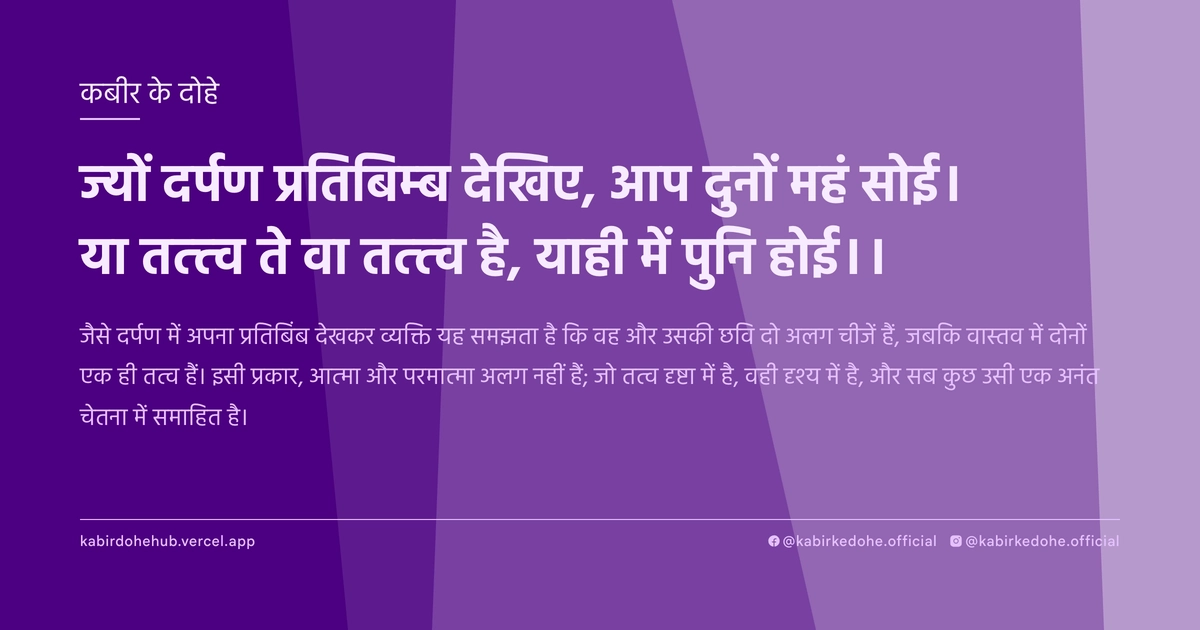
ज्यों दर्पण प्रतिबिम्ब देखिए, आप दुनों महं सोई।
या तत्त्व ते वा तत्त्व है, याही में पुनि होई।।
Jyon darpan pratibimb dekhie, aap dunon mahan soi. Ya tattva te va tattva hai, yaahi mein puni hoi.
इस पृष्ठ पर इस कबीर दोहे का अर्थ (meaning), हिंदी व्याख्या और अंग्रेज़ी अनुवाद, दार्शनिक विश्लेषण और व्यावहारिक जीवन सीख दी गई है। यह दोहा निर्गुण ब्रह्म (Nirguna Brahman) विषय से जुड़ा है — Kabir doha meaning and explanation in Hindi and English.
अर्थ (Meaning):
जैसे दर्पण में अपना प्रतिबिंब देखकर व्यक्ति यह समझता है कि वह और उसकी छवि दो अलग चीजें हैं, जबकि वास्तव में दोनों एक ही तत्व हैं। इसी प्रकार, आत्मा और परमात्मा अलग नहीं हैं; जो तत्व दृष्टा में है, वही दृश्य में है, और सब कुछ उसी एक अनंत चेतना में समाहित है।
Just as one looks into a mirror and perceives a reflection, mistakenly believing there are two separate entities, in reality, both are the same. Similarly, the individual soul and the Divine are not distinct; the essence within the observer is the same essence within the observed, all existing within a single, unified consciousness.
व्याख्या (Interpretation):
कबीर यहाँ दर्पण के रूपक के माध्यम से अद्वैत का संदेश दे रहे हैं। शाब्दिक अर्थ में, यह प्रतिबिंब और मूल के बीच के भ्रम को दर्शाता है। आध्यात्मिक स्तर पर, 'दर्पण' यह भौतिक संसार है और 'प्रतिबिंब' हमारी व्यक्तिगत पहचान या अहंकार है। यह विश्लेषण निरगुण भक्ति की ओर ले जाता है, जहाँ ईश्वर किसी मूर्ति में नहीं, बल्कि स्वयं के भीतर के शुद्ध तत्व में पाया जाता है। माया वह पर्दा है जो हमें यह विश्वास दिलाता है कि हम परमात्मा से अलग हैं। जब यह भ्रम टूटता है, तब साधक को अनुभव होता है कि आत्मा और ब्रह्म में कोई भेद नहीं है। यह विरोधाभास है कि हम जिसे बाहर खोज रहे हैं, वह वास्तव में खोजने वाला स्वयं ही है।
Kabir utilizes the metaphor of the mirror to convey the essence of Non-duality (Advaita). Literally, it addresses the illusion of separation between an object and its reflection. Spiritually, the 'mirror' represents the phenomenal world, and the 'reflection' symbolizes the individual ego or identity. This analysis aligns with Nirgun Bhakti, where the Divine is not an external deity but the formless essence within. Maya is the veil that creates the false perception of duality. Once this illusion dissolves, the seeker realizes the non-duality of Atman and Brahman. The central paradox is that the entity being sought is, in fact, the very seeker themselves.
दार्शनिक विश्लेषण (Philosophical Analysis):
कबीर का यह दोहा उस समय के सामाजिक और धार्मिक परिवेश में एक क्रांतिकारी प्रहार था, जहाँ कर्मकांड और बाहरी दिखावे को प्राथमिकता दी जाती थी। उन्होंने मंदिर, मस्जिद और तीर्थयात्राओं के बजाय 'भीतर की यात्रा' पर जोर दिया। यह दृष्टिकोण सीधे तौर पर अद्वैत वेदांत से मेल खाता है, जो कहता है कि 'ब्रह्म सत्यं जगन्मिथ्या'—केवल ब्रह्म सत्य है और यह जगत एक आभास है।
सूफी मत के 'वहदत-अल-वजूद' (अस्तित्व की एकता) के साथ इसका गहरा संबंध है, जहाँ माना जाता है कि पूरी सृष्टि ईश्वर का ही प्रतिबिंब है। कबीर यहाँ यह समझा रहे हैं कि जब तक हम स्वयं को शरीर और नाम से पहचानते हैं, हम अलग महसूस करते हैं, लेकिन जब हम अपने मूल 'तत्व' को पहचानते हैं, तो द्वैत समाप्त हो जाता है।
उनका विरोध केवल जातिवाद से नहीं, बल्कि उस मानसिक जड़ता से था जो मनुष्य को उसकी वास्तविक प्रकृति से दूर रखती है। वे तर्क देते हैं कि यदि आप दर्पण में देख रहे हैं, तो आप प्रतिबिंब को साफ करने की कोशिश नहीं करते, बल्कि मूल चेहरे को धोते हैं। इसी तरह, बाहरी अनुष्ठानों से आत्मा शुद्ध नहीं होती।
मनोवैज्ञानिक स्तर पर, यह अहंकार के विलीनीकरण (annihilation of ego) की प्रक्रिया है। अहंकार वह बिंदु है जहाँ हम स्वयं को 'अन्य' से अलग मानते हैं। जब यह 'मैं' मिट जाता है, तब केवल वह तत्व बचता है जो सर्वव्यापी है।
अक्सर लोग इस दोहे का अर्थ केवल भौतिक प्रतिबिंब से लगाते हैं, लेकिन कबीर यहाँ 'तत्व' शब्द का प्रयोग कर रहे हैं, जो पदार्थ नहीं बल्कि शुद्ध चेतना (Pure Consciousness) की ओर संकेत करता है। यह बोध कि 'मैं ही वह हूँ' (सोऽहम्), ही मोक्ष का एकमात्र मार्ग है।
This couplet was a revolutionary strike against the socio-religious climate of Kabir's era, which prioritized ritualism and external displays of piety. He emphasized the 'internal journey' over temples, mosques, and pilgrimages. This perspective aligns directly with Advaita Vedanta, which posits 'Brahman is the only truth, and the world is an illusion' (Maya).
There is a profound connection here to the Sufi concept of 'Wahdat-al-Wujud' (Unity of Existence), suggesting that the entire universe is but a reflection of the Divine. Kabir argues that as long as we identify ourselves by the body or a name, we feel separate; however, once we recognize our fundamental 'essence' (Tattva), duality vanishes.
His opposition was not merely against casteism, but against the mental inertia that separates a human from their true nature. He suggests that if one sees a smudge in a mirror, they do not clean the reflection, but the mirror itself. Similarly, external rituals cannot purify the soul.
Psychologically, this represents the process of ego-annihilation. The ego is the precise point where we perceive ourselves as 'other' than the universe. When this 'I' dissolves, only the omnipresent essence remains.
Common literalist interpretations often miss the depth of the word 'Tattva' (Element/Essence), which refers not to matter, but to Pure Consciousness. The realization of 'I am That' (So-ham) is presented as the only true path to liberation.
मूल संदेश (Core Message):
- बाहरी दुनिया केवल एक दर्पण है, सत्य भीतर है।
- अहंकार वह धूल है जो वास्तविक तत्व को छुपाती है।
- द्वैत एक भ्रम है; केवल एक ही चेतना व्याप्त है।
- स्वयं को पहचानना ही ईश्वर को पाना है।
- जब 'मैं' मिटता है, तब 'वह' प्रकट होता है।
- सच्ची भक्ति स्वयं के भीतर के अद्वैत को अनुभव करना है।
- The external world is but a mirror; truth lies within.
- Ego is the dust that obscures the true essence.
- Duality is an illusion; only one consciousness pervades.
- To know oneself is to find the Divine.
- When the 'I' vanishes, the 'Infinite' appears.
- True devotion is experiencing the non-duality within.
व्यावहारिक उदाहरण (Practical Example):
एक समय की बात है, वाराणसी के घाटों पर माधव नाम का एक वृद्ध बुनकर रहता था। माधव अपनी कला में निपुण था, लेकिन उसका मन हमेशा इस बात से दुखी रहता था कि वह समाज में एक निम्न जाति का बुनकर है और बड़े पंडितों की तरह ज्ञानवान नहीं है। वह घंटों मंदिर की सीढ़ियों पर बैठकर यह सोचता कि ईश्वर केवल उच्च कुल के लोगों के करीब होते हैं।
एक दिन उसकी मुलाकात एक फकीर से हुई। फकीर ने माधव को एक पुराना, धुंधला दर्पण दिखाया और पूछा, 'इसमें तुम्हें क्या दिख रहा है?' माधव ने कहा, 'एक थका हुआ बूढ़ा आदमी।' फकीर ने मुस्कुराते हुए दर्पण पर जमी धूल को साफ किया और कहा, 'अब देखो।' माधव ने देखा कि प्रतिबिंब अब स्पष्ट था, लेकिन वह अभी भी वही बूढ़ा आदमी था।
फकीर ने कहा, 'माधव, तू इस दर्पण को साफ करने की कोशिश कर रहा है, जबकि तू खुद वह चेहरा है जिसे देखा जाना चाहिए। तू जिसे ईश्वर मानकर बाहर खोज रहा है, वह प्रतिबिंब है, और तू स्वयं वह तत्व है जिससे वह प्रतिबिंब बना है।'
माधव को एक गहरा झटका लगा। उसने महसूस किया कि उसकी पूरी जिंदगी उसने 'प्रतिबिंब' (अपनी सामाजिक पहचान, अपनी जाति, अपनी गरीबी) को ही अपनी असलियत मान लिया था। उसने कभी यह नहीं सोचा कि वह शरीर और जाति से परे एक दिव्य चेतना का हिस्सा है।
इस बोध ने माधव के भीतर के डर और हीन भावना को पूरी तरह मिटा दिया। उसने अब कपड़े केवल जीविका के लिए नहीं, बल्कि एक साधना के रूप में बुनना शुरू किया। वह अब खुद को 'बुनकर' नहीं, बल्कि उस अनंत बुनकर का एक धागा मानने लगा जिसने इस सृष्टि को बुना है।
उसका व्यवहार बदल गया। वह अब पंडितों के सामने झुकता नहीं था, बल्कि उनसे प्रेम और समानता के साथ बात करता था। उसकी आंखों में एक ऐसी शांति थी जिसने शहर के बड़े-बड़े विद्वानों को अचंभित कर दिया।
उसने अपने घर को एक छोटा सा केंद्र बना लिया जहाँ वह गरीब बच्चों को मुफ्त में पढ़ना-लिखना सिखाने लगा। वह उन्हें सिखाता कि वे अपनी बाहरी पहचान के पिंजरे को तोड़कर अपने भीतर के 'तत्व' को पहचानें।
माधव की कहानी यह दर्शाती है कि जब हम अपनी पहचान को सामाजिक लेबल से हटाकर सार्वभौमिक चेतना से जोड़ते हैं, तो जीवन का संघर्ष समाप्त हो जाता है और केवल आनंद शेष रहता है।
Once, in the ghats of Varanasi, lived an elderly weaver named Madhav. Madhav was a master of his craft, yet his heart was heavy with the belief that as a weaver of a lower caste, he could never attain the spiritual knowledge possessed by the high priests. He spent hours on the temple steps, convinced that the Divine only favored the elite.
One day, he encountered a wandering fakir. The fakir showed Madhav an old, dusty mirror and asked, 'What do you see?' Madhav replied, 'A tired old man.' The fakir smiled, wiped away the dust from the mirror, and said, 'Look again.' Madhav saw that the reflection was now clear, but it was still the same old man.
The fakir remarked, 'Madhav, you are trying to clean the mirror, while you yourself are the face that needs to be seen. The God you seek outside is but a reflection; you are the very essence from which that reflection arises.'
This realization struck Madhav like a bolt of lightning. He understood that for his entire life, he had mistaken the 'reflection' (his social identity, his caste, his poverty) for his true self. He had never considered that he was a part of a divine consciousness beyond the body.
This insight completely dissolved his fear and sense of inferiority. He stopped weaving clothes merely for a livelihood and began to treat his loom as a site of spiritual practice. He no longer saw himself as a 'weaver' but as a single thread in the cosmic tapestry woven by the Infinite.
His behavior transformed. He no longer bowed in subservience to the priests but spoke to them with love and equality. A profound peace settled in his eyes, astonishing the city's greatest scholars.
He turned his home into a small center where he taught poor children for free. He taught them to break the cages of their external identities and recognize the 'Tattva' within.
Madhav's story illustrates that when we shift our identity from social labels to universal consciousness, the struggle of life ceases, and only bliss remains.
अभ्यास मार्गदर्शन (Practice Guidance):
- प्रतिदिन 20 मिनट मौन ध्यान करें। अपनी आँखें बंद करें और कल्पना करें कि आपकी व्यक्तिगत पहचान (नाम, पेशा, संबंध) एक प्रतिबिंब की तरह धीरे-धीरे धुंधली हो रही है, और केवल एक शुद्ध, प्रकाशमय चेतना शेष है।
- आत्म-पूछताछ जर्नल: हर रात लिखें—'आज मैंने कितनी बार अपनी पहचान को किसी बाहरी लेबल (जैसे- मैं सफल हूँ, मैं असफल हूँ, मैं इस धर्म का हूँ) से जोड़ा?' और फिर विचार करें कि यदि ये लेबल हटा दिए जाएं, तो मैं वास्तव में कौन हूँ?
- व्यवहारिक परिवर्तन: जब भी आप किसी व्यक्ति से घृणा या ईर्ष्या महसूस करें, तो रुकें और सोचें कि सामने वाला व्यक्ति भी उसी एक 'तत्व' का प्रतिबिंब है जो आपके भीतर है। इस विचार के साथ उन्हें देखें।
- डायग्नोस्टिक चेकलिस्ट: आप जान जाएंगे कि आप इस ज्ञान को जी रहे हैं यदि: 1. आपकी खुशी बाहरी प्रशंसा पर निर्भर नहीं है। 2. आप दूसरों की सफलता में अपनी सफलता देखते हैं। 3. आप सामाजिक भेदभाव को एक मानसिक भ्रम के रूप में देखते हैं।
- Practice 20 minutes of silent meditation daily. Close your eyes and visualize your personal identity (name, profession, relationships) fading away like a reflection, leaving only a pure, luminous consciousness.
- Self-Inquiry Journaling: Every night, write—'How many times today did I attach my identity to an external label (e.g., I am successful, I am a failure, I belong to this religion)?' Then contemplate: if these labels were removed, who am I really?
- Behavioral Shift: Whenever you feel hatred or jealousy toward someone, pause and realize that the person before you is a reflection of the same 'essence' that resides within you. View them through this lens.
- Diagnostic Checklist: You are living this wisdom if: 1. Your happiness is not dependent on external validation. 2. You see your own success in the success of others. 3. You perceive social discrimination as a mental illusion.
चिंतन प्रश्न (Reflection Questions):
- यदि आपकी सभी सामाजिक उपलब्धियाँ और आपकी पहचान छीन ली जाए, तो आपके भीतर क्या बचेगा?
- आप अपनी छवि (Image) को सुधारने में जितना समय लगाते हैं, क्या उतना ही समय अपने मूल तत्व (Essence) को जानने में देते हैं?
- क्या आप दूसरों में वही दोष देखते हैं जो वास्तव में आपके अपने भीतर के प्रतिबिंब हैं?
- आपका 'डिजिटल अहंकार' (सोशल मीडिया प्रोफाइल) आपकी वास्तविक आत्मा से कितना अलग है, और आप किसे अधिक महत्व देते हैं?
- क्या आप वास्तव में स्वतंत्र हैं, या आप केवल अपनी कंडीशनिंग के प्रतिबिंब मात्र हैं?
- वह कौन सा डर है जो आपको यह स्वीकार करने से रोकता है कि आप और आपका 'शत्रु' एक ही तत्व के दो रूप हैं?
- If all your social achievements and identities were stripped away, what would remain within you?
- Do you spend as much time knowing your essence as you do polishing your image?
- Do you see in others the same flaws that are actually reflections of your own inner self?
- How different is your 'digital ego' (social media profile) from your actual soul, and which one do you value more?
- Are you truly free, or are you merely a reflection of your social conditioning?
- What is the fear that prevents you from accepting that you and your 'enemy' are two forms of the same essence?