
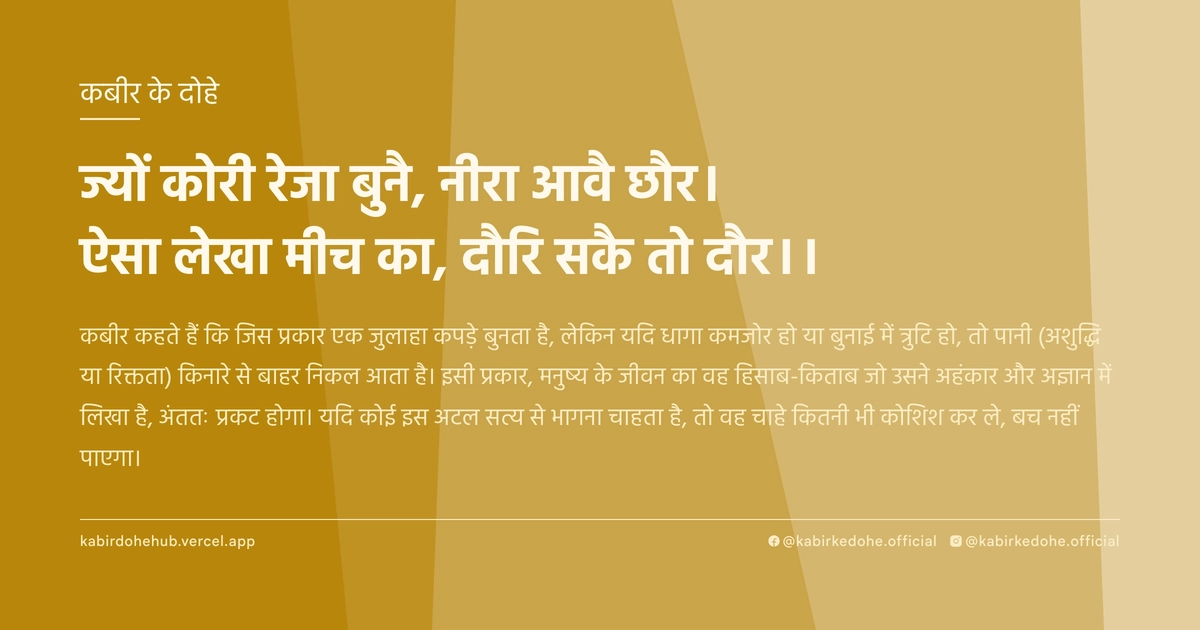
ज्यों कोरी रेजा बुनै, नीरा आवै छौर।
ऐसा लेखा मीच का, दौरि सकै तो दौर।।
Jyon kori reja bunai, neera aavai chhaur. Aisa lekha meech ka, dauri sakai to daur.
इस पृष्ठ पर इस कबीर दोहे का अर्थ (meaning), हिंदी व्याख्या और अंग्रेज़ी अनुवाद, दार्शनिक विश्लेषण और व्यावहारिक जीवन सीख दी गई है। यह दोहा मृतुक्यता (Mortality) विषय से जुड़ा है — Kabir doha meaning and explanation in Hindi and English.
अर्थ (Meaning):
कबीर कहते हैं कि जिस प्रकार एक जुलाहा कपड़े बुनता है, लेकिन यदि धागा कमजोर हो या बुनाई में त्रुटि हो, तो पानी (अशुद्धि या रिक्तता) किनारे से बाहर निकल आता है। इसी प्रकार, मनुष्य के जीवन का वह हिसाब-किताब जो उसने अहंकार और अज्ञान में लिखा है, अंततः प्रकट होगा। यदि कोई इस अटल सत्य से भागना चाहता है, तो वह चाहे कितनी भी कोशिश कर ले, बच नहीं पाएगा।
Kabir explains that just as a weaver works the loom, if the weave is flawed, the water (impurities or gaps) seeps through the edges. Similarly, the spiritual account of a human life, written in the ink of ego and ignorance, will eventually be revealed. No matter how fast one runs or how hard one tries to evade the consequences of their internal state, the ultimate truth of their existence remains inescapable.
व्याख्या (Interpretation):
इस दोहे का शाब्दिक अर्थ बुनाई की प्रक्रिया से जुड़ा है, जहाँ 'रेजा' बुनाई की तकनीक को दर्शाता है। रूपकात्मक रूप से, 'कपड़ा' मानव जीवन और उसके कर्मों का प्रतीक है। 'नीरा' या पानी यहाँ उस सत्य या दैवीय न्याय का प्रतीक है जो छिपे हुए दोषों को उजागर कर देता है। यह निर्गुण भक्ति के उस सिद्धांत को रेखांकित करता है जहाँ आत्मा (Atman) और परमात्मा (Brahman) के बीच का पर्दा केवल 'माया' है। जब माया का पर्दा हटता है, तो व्यक्ति का वास्तविक स्वरूप और उसके कर्मों का लेखा-जोखा सामने आता है। यह एक विरोधाभास है: हम दुनिया के लिए मुखौटे बुनते हैं, लेकिन ब्रह्मांडीय चेतना के सामने हम नग्न और पारदर्शी होते हैं।
Literally, the verse refers to the weaver's loom, where 'reja' signifies the act of weaving. Metaphorically, the 'cloth' represents the tapestry of human life and accumulated karma. The 'water' symbolizes the penetrating nature of Truth or Divine Justice that exposes hidden flaws. This aligns with Nirgun Bhakti, emphasizing that the veil between the Atman and Brahman is merely 'Maya' (illusion). When this veil is lifted, the actual spiritual account of the individual is revealed. It presents a profound paradox: while humans spend lifetimes weaving complex identities and social masks, they remain utterly transparent and exposed before the cosmic consciousness.
दार्शनिक विश्लेषण (Philosophical Analysis):
कबीर का यह दोहा उनके युग के सामाजिक और धार्मिक पाखंड पर एक तीखा प्रहार है। उन्होंने देखा कि लोग बाहरी कर्मकांडों (Ritualism) के माध्यम से अपनी आंतरिक अशुद्धियों को ढकने का प्रयास करते हैं, ठीक वैसे ही जैसे एक जुलाहा खराब बुनाई को छिपाने की कोशिश करता है। कबीर यहाँ अद्वैत वेदांत के उस सत्य को प्रस्तुत करते हैं जहाँ आत्मा का परमात्मा से मिलन केवल तभी संभव है जब 'अहंकार' का पूर्ण विनाश हो जाए।
सूफी मत के 'फना' (अहंकार का मिटना) के सिद्धांत की तरह, कबीर चेतावनी देते हैं कि बाहरी दिखावा आध्यात्मिक प्रगति का विकल्प नहीं हो सकता। जाति और धर्म के नाम पर जो विभाजन मनुष्य ने बनाया है, वह भी एक प्रकार की 'बुनाई' है जिसे सत्य का जल बहा ले जाएगा।
मनोवैज्ञानिक स्तर पर, यह दोहा 'संज्ञानात्मक विसंगति' (Cognitive Dissonance) की बात करता है। मनुष्य स्वयं को एक आदर्श छवि में देखता है, जबकि उसका अवचेतन मन उसकी त्रुटियों को जानता है। कबीर कहते हैं कि यह आंतरिक द्वंद्व अंततः प्रकट होगा।
वे इस बात पर जोर देते हैं कि मोक्ष किसी तीर्थ या मंत्र से नहीं, बल्कि आत्म-साक्षात्कार और ईमानदारी से आता है। जो व्यक्ति स्वयं को धोखा देता है, वह वास्तव में ब्रह्मांडीय न्याय से भागने का प्रयास कर रहा है।
अंततः, यह विश्लेषण हमें यह समझने पर मजबूर करता है कि जीवन एक निरंतर चलने वाली बुनाई है। यदि हम प्रेम और सत्य के धागों का उपयोग नहीं करते, तो हमारा जीवन-वस्त्र इतना कमजोर होगा कि वह सत्य की पहली लहर में ही बिखर जाएगा।
This Doha is a sharp critique of the social and religious hypocrisy of Kabir's era. He observed people attempting to conceal internal impurities through external rituals, much like a weaver trying to hide a flaw in the fabric. Kabir presents the truth of Advaita Vedanta here: the union of Atman and Brahman is only possible when the 'ego' is completely annihilated.
Similar to the Sufi concept of 'Fana' (the extinction of the self), Kabir warns that outward appearances cannot substitute for genuine spiritual evolution. The divisions of caste and creed created by humans are merely another form of 'weaving' that will be washed away by the waters of Truth.
On a psychological level, the verse addresses cognitive dissonance. Humans often project an idealized version of themselves to the world, while their subconscious harbors the truth of their flaws. Kabir asserts that this internal conflict will inevitably surface.
He emphasizes that liberation (Mukti) does not come from pilgrimages or rote chanting, but through self-realization and radical honesty. Anyone attempting to deceive themselves is essentially trying to outrun cosmic justice.
Ultimately, this analysis forces us to realize that life is a continuous process of weaving. If we do not use the threads of love and truth, the fabric of our existence will be too fragile to withstand the first wave of ultimate reality.
मूल संदेश (Core Message):
- बाहरी दिखावा आंतरिक रिक्तता को कभी नहीं भर सकता।
- अहंकार की बुनाई सत्य के जल में अवश्य बहेगी।
- ईमानदारी ही वह एकमात्र धागा है जो आत्मा को परमात्मा से जोड़ता है।
- स्वयं को धोखा देना ब्रह्मांड के सबसे बड़े भ्रम में पड़ना है।
- सच्ची मुक्ति मुखौटों को उतार फेंकने में निहित है।
- External facades can never fill internal voids.
- The weaving of ego will inevitably be washed away by the waters of Truth.
- Honesty is the only thread that binds the soul to the Divine.
- Deceiving oneself is the greatest illusion in the universe.
- True liberation lies in the courage to strip away all masks.
व्यावहारिक उदाहरण (Practical Example):
वाराणसी के एक पुराने मोहल्ले में माधव नाम का एक वृद्ध बुनकर रहता था। वह शहर का सबसे प्रसिद्ध बुनकर था, लेकिन उसका मन अहंकार से भरा था। वह अपनी साड़ियों की बारीकी के लिए जाना जाता था, पर वह गुप्त रूप से अपने सहायकों का शोषण करता था और उन्हें कम मजदूरी देता था। वह सोचता था कि उसकी धार्मिक पूजा और दान-पुण्य उसके इन पापों को ढक लेंगे।
एक दिन, एक युवा साधु उसके पास आया और उसकी साड़ियों की प्रशंसा की। माधव ने गर्व से कहा, 'मेरी कला अद्वितीय है, ईश्वर ने मुझे यह वरदान दिया है।' साधु ने मुस्कुराते हुए एक साधारण सफेद कपड़ा दिखाया जिसमें एक छोटा सा छेद था और कहा, 'माधव, जैसे इस छेद से रोशनी आर-पार दिख रही है, वैसे ही तुम्हारे अहंकार के छेद से तुम्हारी क्रूरता दिख रही है। तुम रेशम की चादरें तो बुन रहे हो, लेकिन तुम्हारी आत्मा का कपड़ा फटा हुआ है।'
माधव को पहले तो गुस्सा आया, लेकिन रात भर वह सो नहीं सका। उसे याद आया कि कैसे उसने अपने सहायकों के बच्चों की पढ़ाई के पैसे रोके थे। उसे महसूस हुआ कि वह जिस 'पुण्य' की चादर ओढ़कर घूम रहा था, वह वास्तव में एक ढोंग था।
अगली सुबह, माधव ने अपनी पूरी संपत्ति का एक बड़ा हिस्सा अपने सहायकों के कल्याण के लिए समर्पित कर दिया। उसने उनसे क्षमा मांगी और उन्हें अपने व्यवसाय में भागीदार बनाया।
उसने महसूस किया कि अब उसकी बुनाई में एक अलग ही चमक थी। वह अब केवल कपड़ा नहीं बुन रहा था, बल्कि रिश्तों की डोर जोड़ रहा था।
उसका अहंकार अब मिट चुका था और वह वास्तव में शांत महसूस कर रहा था।
उसने सीखा कि बाहरी चमक-धमक सत्य को छिपा नहीं सकती।
अंततः, माधव की साड़ियाँ अब केवल बाजार में नहीं, बल्कि लोगों के दिलों में प्रसिद्ध हुईं क्योंकि उनमें अब करुणा का धागा था।
यह 'कबीर ट्विस्ट' था जहाँ एक बाहरी कलाकार ने आंतरिक कलाकार को खोजा।
In an ancient alley of Varanasi lived an elderly weaver named Madhav. He was the most renowned weaver in the city, but his heart was consumed by ego. He was celebrated for the intricacy of his sarees, yet he secretly exploited his assistants, paying them meager wages. He believed that his religious rituals and public donations would veil these sins.
One day, a young monk visited him and praised his work. Madhav proudly replied, 'My art is peerless; God has bestowed this gift upon me.' The monk smiled, held up a simple white cloth with a tiny hole, and said, 'Madhav, just as light passes through this hole, your cruelty is visible through the holes in your ego. You weave silk sheets, but the fabric of your soul is torn.'
Initially, Madhav felt angered, but he could not sleep that night. He remembered how he had withheld money meant for his assistants' children's education. He realized that the 'cloak of virtue' he wore was merely a facade.
The next morning, Madhav dedicated a significant portion of his wealth to the welfare of his workers. He asked for their forgiveness and made them partners in his business.
He noticed that his weaving now possessed a different kind of radiance. He was no longer just weaving fabric; he was weaving bonds of human connection.
His ego had vanished, and for the first time, he felt a profound inner peace.
He learned that external brilliance cannot hide internal decay.
Eventually, Madhav's sarees became famous not just in the market, but in the hearts of people, for they now contained the thread of compassion.
This was the 'Kabir Twist'—where an external craftsman discovered the internal artist.
अभ्यास मार्गदर्शन (Practice Guidance):
- प्रतिदिन 20 मिनट मौन ध्यान करें, जहाँ आप अपने जीवन के उन 'छेद' या त्रुटियों को देखें जिन्हें आप दुनिया से छिपाते हैं।
- एक 'सत्य पत्रिका' (Truth Journal) लिखें: हर दिन एक ऐसी बात लिखें जिसे आपने अपनी छवि बचाने के लिए झूठ बोला या छिपाया, और फिर उसे स्वीकार करें।
- व्यवहार परिवर्तन: जब भी आप किसी की प्रशंसा करें या अपनी करें, स्वयं से पूछें—'क्या यह सत्य है या केवल एक बुनी हुई छवि?'
- निदान चेकलिस्ट: यदि आप दूसरों की आलोचना करते समय संतुष्टि महसूस करते हैं या अपनी गलतियों पर तुरंत बचाव (defensiveness) करते हैं, तो समझें कि आपका 'अहंकार का कपड़ा' अभी भी बहुत मोटा है।
- Practice 20 minutes of silent meditation daily, focusing on the 'holes' or flaws in your character that you attempt to hide from the world.
- Maintain a 'Truth Journal': Every day, record one instance where you lied or omitted the truth to protect your image, and then consciously accept the reality.
- Behavioral Shift: Whenever you praise someone or yourself, ask internally—'Is this the truth, or is it merely a woven image?'
- Diagnostic Checklist: If you feel a sense of satisfaction while criticizing others or react with immediate defensiveness when your mistakes are pointed out, recognize that your 'cloak of ego' is still too thick.
चिंतन प्रश्न (Reflection Questions):
- वह कौन सा 'छवि-वस्त्र' है जिसे आप समाज के सामने पहनते हैं, लेकिन अकेले में वह आपको बोझ लगता है?
- यदि आज आपका पूरा जीवन एक पारदर्शी कपड़े की तरह सबके सामने खुल जाए, तो आप किस बात से सबसे अधिक डरेंगे?
- आपकी डिजिटल पहचान (सोशल मीडिया) आपके वास्तविक स्वरूप से कितनी अलग है, और यह अंतर आपको कितना मानसिक तनाव देता है?
- क्या आप अपनी गलतियों को सुधारने से ज्यादा उन्हें 'सही' ठहराने में समय बिताते हैं?
- वह कौन सा सत्य है जिसे आप जानते हैं, लेकिन उसे स्वीकार करने का साहस नहीं जुटा पा रहे हैं?
- What is the 'image-cloak' you wear in society that feels like a burden when you are alone?
- If your entire life were suddenly revealed as a transparent cloth to everyone, what would you fear the most?
- How different is your digital identity from your actual self, and how much mental stress does this gap cause you?
- Do you spend more time justifying your mistakes than actually correcting them?
- What is the one truth you know deep down, but lack the courage to acknowledge?