
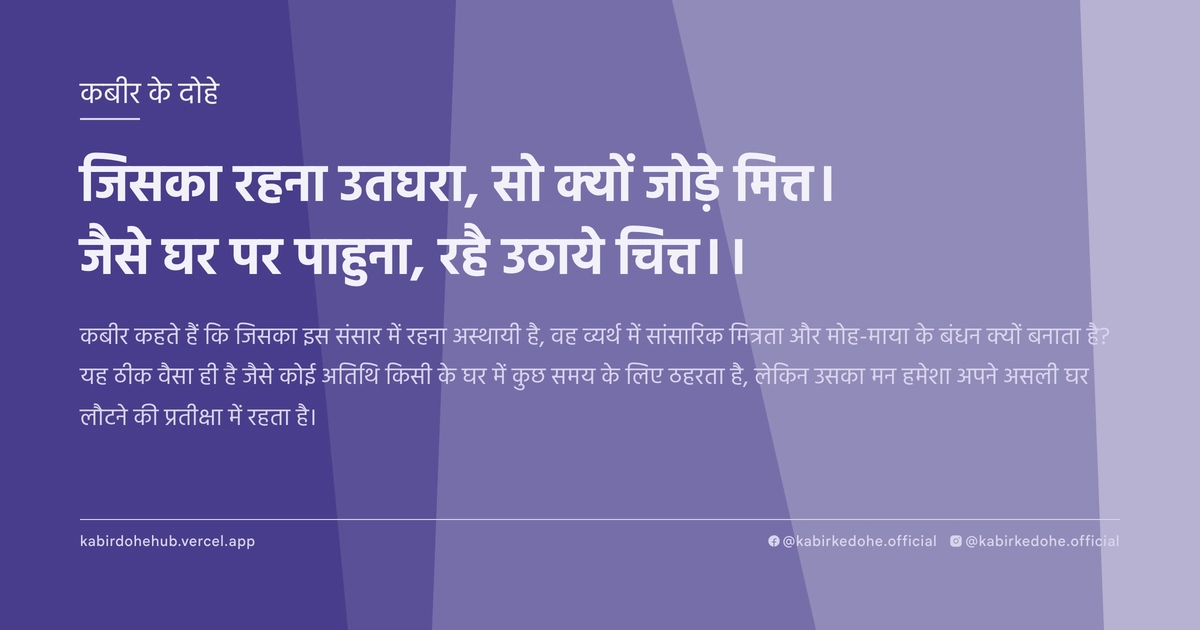
जिसका रहना उतघरा, सो क्यों जोड़े मित्त।
जैसे घर पर पाहुना, रहै उठाये चित्त।।
Jiska rahana utghara, so kyon jode mitt. Jaise ghar par pahuna, rahai uthaye chitt.
इस पृष्ठ पर इस कबीर दोहे का अर्थ (meaning), हिंदी व्याख्या और अंग्रेज़ी अनुवाद, दार्शनिक विश्लेषण और व्यावहारिक जीवन सीख दी गई है। यह दोहा वैराग्य (Detachment) विषय से जुड़ा है — Kabir doha meaning and explanation in Hindi and English.
अर्थ (Meaning):
कबीर कहते हैं कि जिसका इस संसार में रहना अस्थायी है, वह व्यर्थ में सांसारिक मित्रता और मोह-माया के बंधन क्यों बनाता है? यह ठीक वैसा ही है जैसे कोई अतिथि किसी के घर में कुछ समय के लिए ठहरता है, लेकिन उसका मन हमेशा अपने असली घर लौटने की प्रतीक्षा में रहता है।
Kabir questions why one who is merely a transient visitor in this material world strives to forge permanent earthly attachments. He likens human existence to a guest staying at an inn, whose heart remains restless and focused on the eventual return to their true, eternal home.
व्याख्या (Interpretation):
इस दोहे का शाब्दिक अर्थ है कि मनुष्य इस पृथ्वी पर एक यात्री है। आध्यात्मिक स्तर पर, 'उतघरा' शब्द उस अस्थिरता को दर्शाता है जो माया के प्रभाव में है। कबीर यहाँ निर्गुण भक्ति के माध्यम से यह समझा रहे हैं कि आत्मा (Atman) का वास्तविक निवास ब्रह्म (Brahman) में है, न कि इस नश्वर शरीर में। सांसारिक संबंध एक भ्रम या 'माया' हैं जो हमें हमारी वास्तविक पहचान से दूर ले जाते हैं। जब हम स्वयं को इस संसार का स्थायी निवासी मान लेते हैं, तो हम अहंकार और आसक्ति के जाल में फंस जाते हैं। यह विरोधाभास है कि हम उस स्थान को सजाने में समय बिताते हैं जहाँ हमें केवल कुछ समय के लिए रुकना है। अंततः, यह दोहा अद्वैत वेदांत के उस सत्य की ओर इशारा करता है जहाँ व्यक्ति को अपनी क्षणभंगुरता को पहचानकर शाश्वत सत्य की खोज करनी चाहिए।
Literally, the verse posits that human life is a fleeting visit. Metaphorically, 'utghara' signifies the inherent instability of the material plane. Through the lens of Nirgun Bhakti, Kabir argues that the soul (Atman) is a displaced spark of the Divine (Brahman), and this world is but a temporary transit point. Earthly attachments are manifestations of Maya—the cosmic illusion that veils our true nature. The central paradox lies in the human tendency to invest emotional permanence in a transient existence. By clinging to worldly friendships and identities, we ignore the spiritual urgency of our return. This aligns with Advaita Vedanta, suggesting that the realization of non-duality begins with the detachment from the 'guest' identity and the reclamation of the 'eternal' essence.
दार्शनिक विश्लेषण (Philosophical Analysis):
यह दोहा कबीर के उस क्रांतिकारी दृष्टिकोण को दर्शाता है जहाँ वे बाहरी कर्मकांडों और सामाजिक बंधनों के बजाय आंतरिक सत्य पर बल देते हैं। कबीर के समय में, लोग जाति, धर्म और सामाजिक प्रतिष्ठा के झूठे अहंकार में डूबे थे। कबीर ने इस 'सामाजिक मित्रता' या 'मित्त' को एक बाधा माना, क्योंकि यह अहंकार को पुष्ट करती है।
दार्शनिक रूप से, यह सूफी मत के 'फना' (अहंकार का विनाश) और वेदांत के 'विवेक' (नश्वर और शाश्वत के बीच अंतर) का संगम है। कबीर तर्क देते हैं कि यदि हम जानते हैं कि हम यहाँ अतिथि हैं, तो हम वस्तुओं और व्यक्तियों से चिपके रहने के बजाय उनके प्रति करुणा रखेंगे, लेकिन आसक्ति नहीं।
यहाँ 'मित्रता' का अर्थ केवल दोस्तों से नहीं, बल्कि उन सभी मानसिक संबंधों से है जो हमें यह विश्वास दिलाते हैं कि यह भौतिक संसार ही अंतिम सत्य है। यह एक मनोवैज्ञानिक रूपांतरण का आह्वान है: जब भय और मोह समाप्त होते हैं, तभी आत्मा मुक्त होती है।
कबीर का यह प्रहार उन लोगों पर है जो मोक्ष की बात तो करते हैं लेकिन अपनी इंद्रियों के सुखों को छोड़ने को तैयार नहीं होते। वे स्पष्ट करते हैं कि आध्यात्मिक यात्रा का पहला कदम अपनी 'अतिथि' स्थिति को स्वीकार करना है।
अंततः, यह विश्लेषण हमें सिखाता है कि जीवन की सार्थकता संचय में नहीं, बल्कि विसर्जन में है। जब हम यह समझ लेते हैं कि हम यहाँ केवल एक यात्री हैं, तो हमारा संघर्ष समाप्त हो जाता है और हम उस निराकार ईश्वर (Nirgun) के साथ एकाकार होने की दिशा में बढ़ते हैं।
This verse encapsulates Kabir's radical departure from ritualism and social stratification, emphasizing an internal, experiential truth over external validation. In Kabir's era, the rigid structures of caste and religious dogma created a false sense of permanent identity. Kabir challenges this by framing human existence as fundamentally transient.
Philosophically, this is a synthesis of the Sufi concept of 'Fana' (the annihilation of the ego) and the Vedantic principle of 'Viveka' (discrimination between the eternal and the ephemeral). Kabir argues that recognizing one's status as a 'guest' transforms the nature of relationship from attachment (Moha) to compassionate detachment.
The term 'Mitt' (friendship/attachment) refers not just to social circles, but to the psychological anchors that tether the soul to the illusion of the material world. By dismantling these anchors, the seeker moves toward the realization of the formless Divine (Nirgun).
Kabir addresses the psychological dissonance of the human condition: the desire for permanence in a world defined by change. He suggests that the ego is sustained by the lie of permanence; once the truth of transience is accepted, the ego collapses.
Ultimately, this teaching corrects the literalist misconception that detachment means abandoning society. Instead, it means engaging with the world without the delusion of ownership. The goal is to shift the center of gravity from the 'temporary house' of the body to the 'eternal home' of pure consciousness.
मूल संदेश (Core Message):
- सांसारिक मोह एक सुंदर लेकिन धोखा देने वाला पर्दा है।
- अस्थिरता को स्वीकार करना ही वास्तविक मानसिक शांति का मार्ग है।
- रिश्तों को प्रेम करें, लेकिन उनमें अपनी पहचान न खोएं।
- अहंकार का विसर्जन ही आत्मा की वास्तविक घर वापसी है।
- हम शरीर नहीं, बल्कि एक शाश्वत चेतना हैं जो यात्रा पर है।
- Worldly attachment is a beautiful but deceptive veil.
- Accepting transience is the only path to genuine mental peace.
- Love your relationships, but do not lose your identity within them.
- The dissolution of ego is the soul's true homecoming.
- We are not the body, but an eternal consciousness on a journey.
व्यावहारिक उदाहरण (Practical Example):
एक समय की बात है, वाराणसी के घाटों पर माधव नाम का एक वृद्ध बुनकर रहता था। माधव अपनी कला में निपुण था और उसने जीवन भर बेहतरीन रेशमी वस्त्र बनाए थे। उसने अपनी पूरी ऊर्जा अपने व्यापार को बढ़ाने, शहर के बड़े व्यापारियों से संबंध बनाने और अपनी संपत्ति को सुरक्षित करने में लगा दी। वह खुद को वाराणसी का एक प्रतिष्ठित नागरिक मानता था और उसकी पहचान उसके कपड़ों और उसके संपर्कों से थी।
एक दिन, माधव के घर में एक गंभीर बीमारी आई और उसकी सारी जमा पूँजी इलाज में खर्च हो गई। उसके वे 'मित्र' और व्यापारी, जिन्हें उसने सालों तक खुश रखा था, धीरे-धीरे उससे दूर होने लगे। माधव को महसूस हुआ कि जिन रिश्तों को उसने पत्थर की लकीर समझा था, वे रेत की तरह फिसल रहे थे।
निराशा में डूबा माधव एक शाम घाट पर बैठा था, तभी उसकी नज़र एक फकीर पर पड़ी जो केवल एक फटे हुए कंबल में लिपटा था, लेकिन उसके चेहरे पर एक असीम शांति थी। फकीर ने माधव की आँखों में देखा और बस इतना कहा, 'बेटा, तूने उस सराय को सजाने में पूरी उम्र गुज़ार दी, जहाँ तूने केवल एक रात रुकना था।'
यह शब्द माधव के लिए एक बिजली की तरह थे। उसे याद आया कि कैसे उसने अपनी आत्मा की शांति को बाहरी प्रशंसा और भौतिक संबंधों की वेदी पर कुर्बान कर दिया था। उसे समझ आया कि वह इस दुनिया में केवल एक 'पाहुना' (अतिथि) था, फिर भी वह ऐसा व्यवहार कर रहा था जैसे वह इस घर का मालिक हो।
उस दिन के बाद माधव का जीवन बदल गया। उसने बुनना नहीं छोड़ा, लेकिन अब वह वस्त्र अहंकार के लिए नहीं, बल्कि सेवा के लिए बनाने लगा। उसने उन व्यापारियों की परवाह करना छोड़ दिया जो केवल लाभ देखते थे।
उसने अपने घर के एक छोटे से हिस्से को उन अनाथ बच्चों के लिए खोल दिया जिन्हें कोई नहीं पूछता था। अब उसकी मित्रता किसी सामाजिक लाभ के लिए नहीं, बल्कि निस्वार्थ प्रेम के लिए थी।
उसने महसूस किया कि जब उसने 'अपना' होने का भ्रम छोड़ दिया, तो पूरा संसार उसका मित्र बन गया। उसकी आंतरिक बेचैनी समाप्त हो गई क्योंकि अब उसका चित्त अपने असली घर—परमात्मा—की ओर मुड़ गया था।
माधव अब भी उसी घाट पर रहता था, लेकिन अब वह एक 'मालिक' नहीं, बल्कि एक 'साक्षी' बन गया था। उसकी शांति अब उसकी संपत्ति पर नहीं, बल्कि उसकी इस समझ पर टिकी थी कि वह यहाँ केवल एक यात्री है।
अंततः, माधव की मृत्यु के समय उसके चेहरे पर वही मुस्कान थी जो उस फकीर की थी, क्योंकि उसने अतिथि की तरह विदा लेना सीख लिया था।
Once in the ancient city of Varanasi, there lived an elderly weaver named Madhav. Madhav was a master of his craft, creating the finest silk garments. He spent his entire life expanding his business, cultivating ties with the city's most powerful merchants, and accumulating wealth. He viewed himself as a pillar of society, and his identity was inextricably tied to his status and his network of influential friends.
One year, a severe illness struck Madhav's household, draining his savings and leaving him physically frail. Slowly, the 'friends' and merchants he had spent decades flattering began to vanish. Madhav realized with horror that the relationships he believed were carved in stone were actually written in sand.
Lost in despair, Madhav sat by the Ganges ghats one evening. He noticed a wandering ascetic wrapped in a tattered blanket, yet radiating an aura of profound peace. The ascetic looked into Madhav's eyes and said simply, 'Son, you spent your whole life decorating an inn where you were only meant to stay for a night.'
These words struck Madhav like a bolt of lightning. He recalled how he had sacrificed his inner peace on the altar of external praise and material bonds. He realized he had been treating himself as the owner of a house where he was merely a guest.
From that day forward, Madhav's life underwent a transformation. He did not stop weaving, but he stopped weaving for ego. He no longer sought the approval of the merchants who valued only profit.
He converted a portion of his home into a shelter for orphaned children, whom the society ignored. His friendships were no longer strategic alliances but expressions of selfless love.
He discovered that once he relinquished the illusion of 'ownership' and 'permanence,' the entire universe became his companion. His restlessness vanished as his consciousness shifted toward its true home—the Divine.
Madhav continued to live on the ghats, but no longer as a 'possessor,' but as a 'witness.' His peace was no longer dependent on his assets, but on the realization of his transient nature.
When his time finally came to leave the world, Madhav departed with the same serene smile as the ascetic, having finally learned how to leave as a graceful guest.
This 'Kabir Twist' shifted his focus from the accumulation of social capital to the cultivation of spiritual capital, proving that true liberation comes from accepting the temporary nature of the physical self.
अभ्यास मार्गदर्शन (Practice Guidance):
- प्रतिदिन 20 मिनट 'साक्षी भाव' का अभ्यास करें: अपने विचारों और भावनाओं को ऐसे देखें जैसे आप किसी और के जीवन का नाटक देख रहे हों।
- आत्म-पूछताछ जर्नल: हर रात लिखें कि आज आपने किन चीजों या व्यक्तियों के प्रति 'अत्यधिक आसक्ति' महसूस की और पूछें, 'यदि मैं यहाँ केवल एक अतिथि हूँ, तो यह मोह क्यों?'
- व्यवहारिक परिवर्तन: सप्ताह में एक बार किसी ऐसे व्यक्ति की निस्वार्थ मदद करें जिससे आपको कोई सामाजिक या व्यक्तिगत लाभ न मिले, ताकि 'उपयोगितावादी मित्रता' का भ्रम टूटे।
- निदान चेकलिस्ट: क्या आप किसी की आलोचना से विचलित होते हैं? क्या आप अपनी उपलब्धियों को अपनी स्थायी पहचान मानते हैं? यदि हाँ, तो आप अभी भी 'मालिक' बनने की कोशिश कर रहे हैं, 'अतिथि' की नहीं।
- Practice 'Witness Consciousness' (Sakshi Bhava) for 20 minutes daily: Observe your thoughts and emotions as if you are watching a play about someone else's life.
- Self-Inquiry Journaling: Every night, record instances where you felt 'excessive attachment' and ask, 'If I am merely a guest here, why does this attachment persist?'
- Behavioral Shift: Once a week, perform a selfless act for someone from whom you can gain no social or personal advantage, breaking the illusion of 'utilitarian friendship.'
- Diagnostic Checklist: Do you feel devastated by criticism? Do you equate your achievements with your permanent identity? If yes, you are still attempting to be the 'owner' rather than the 'guest.'
चिंतन प्रश्न (Reflection Questions):
- यदि आज आपकी सारी सामाजिक प्रतिष्ठा और संबंध छीन लिए जाएं, तो आपके भीतर क्या बचेगा?
- आप अपने जीवन के किन हिस्सों को 'स्थायी' मानकर बैठे हैं, जबकि वे वास्तव में क्षणभंगुर हैं?
- क्या आपकी मित्रताएँ वास्तव में प्रेम पर आधारित हैं, या वे केवल आपकी सामाजिक असुरक्षाओं को भरने का साधन हैं?
- आपकी 'डिजिटल पहचान' (सोशल मीडिया) किस हद तक आपके 'अतिथि' होने के सत्य को छुपा रही है?
- वह कौन सा डर है जो आपको इस संसार के प्रति विरक्त होने से रोकता है?
- If all your social status and relationships were stripped away today, what would remain of 'you'?
- Which parts of your life have you mistaken for 'permanent' when they are actually ephemeral?
- Are your friendships based on genuine love, or are they merely tools to fill your social insecurities?
- To what extent does your 'digital identity' mask the truth of your transient nature?
- What is the specific fear that prevents you from embracing detachment from this world?