
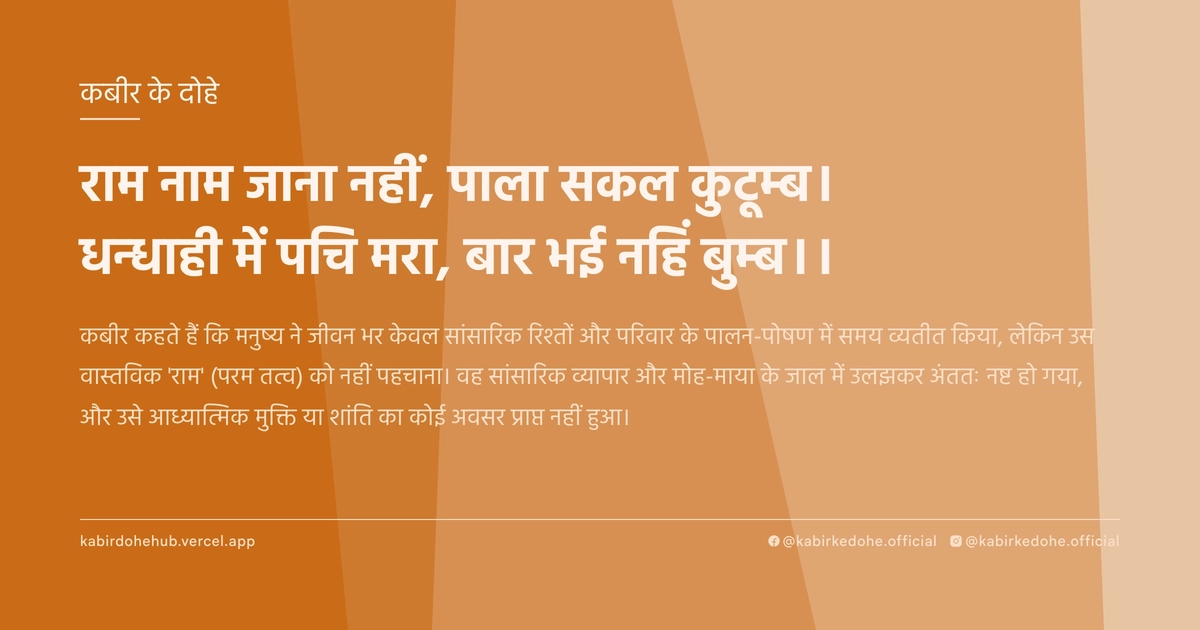
राम नाम जाना नहीं, पाला सकल कुटूम्ब।
धन्धाही में पचि मरा, बार भई नहिं बुम्ब।।
Ram naam jaana nahin, paala sakal kutumb. Dhandhahi mein pachi mara, baar bhai nahin bumb.
इस पृष्ठ पर इस कबीर दोहे का अर्थ (meaning), हिंदी व्याख्या और अंग्रेज़ी अनुवाद, दार्शनिक विश्लेषण और व्यावहारिक जीवन सीख दी गई है। यह दोहा भक्ति (Bhakti) विषय से जुड़ा है — Kabir doha meaning and explanation in Hindi and English.
अर्थ (Meaning):
कबीर कहते हैं कि मनुष्य ने जीवन भर केवल सांसारिक रिश्तों और परिवार के पालन-पोषण में समय व्यतीत किया, लेकिन उस वास्तविक 'राम' (परम तत्व) को नहीं पहचाना। वह सांसारिक व्यापार और मोह-माया के जाल में उलझकर अंततः नष्ट हो गया, और उसे आध्यात्मिक मुक्ति या शांति का कोई अवसर प्राप्त नहीं हुआ।
Kabir observes that a person spends their entire existence catering to the needs of their family and worldly attachments, completely ignoring the realization of the Divine Name (Ram). By becoming consumed by the relentless pursuit of material gain and social obligations, they perish in the struggle of existence without ever experiencing the awakening of spiritual liberation.
व्याख्या (Interpretation):
इस दोहे का शाब्दिक अर्थ सांसारिक जिम्मेदारियों और आध्यात्मिक उपेक्षा के बीच के संघर्ष को दर्शाता है। यहाँ 'राम' किसी व्यक्ति विशेष नहीं, बल्कि उस निर्गुण ब्रह्म का प्रतीक है जो कण-कण में व्याप्त है। 'कुटुम्ब' केवल परिवार नहीं, बल्कि उन सभी मोह-माया के बंधनों का प्रतिनिधित्व करता है जो आत्मा को सीमित करते हैं। कबीर यहाँ एक गहरे विरोधाभास को उजागर करते हैं: हम जिसे 'पालन-पोषण' कहते हैं, वह वास्तव में अहंकार का विस्तार है। जब व्यक्ति केवल बाहरी दुनिया को तृप्त करने में लगा रहता है, तो वह अपनी आंतरिक शून्यता को अनदेखा करता है। यह स्थिति अद्वैत वेदांत के 'माया' सिद्धांत को पुष्ट करती है, जहाँ संसार एक भ्रम है जो सत्य के मार्ग में बाधा बनता है। अंततः, बिना आत्म-साक्षात्कार के, जीवन केवल एक अंतहीन चक्र है जहाँ व्यक्ति 'पचि मरा' यानी मानसिक और आध्यात्मिक रूप से घुटकर मर जाता है।
The literal meaning highlights the tension between worldly responsibilities and spiritual neglect. Here, 'Ram' does not refer to a deity in a physical form, but to the Nirgun Brahman—the formless, omnipresent consciousness. 'Kutumb' (family) symbolizes all the attachments and social constructs that tether the soul to the material plane. Kabir exposes a central paradox: what we perceive as 'providing' or 'caring' is often an expansion of the ego. By focusing solely on external sustenance, the individual ignores the internal void. This aligns with the Advaita Vedanta concept of Maya, where the illusory world obscures the non-dual reality of Atman and Brahman. The phrase 'pachi mara' suggests a slow, agonizing spiritual death, where the soul is crushed by the weight of expectations and material pursuits, failing to achieve the 'bumb' or the spark of liberation.
दार्शनिक विश्लेषण (Philosophical Analysis):
कबीर का यह दोहा उनके युग के उस सामाजिक ढांचे पर प्रहार करता है जहाँ धर्म केवल कर्मकांड और सामाजिक मर्यादाओं तक सीमित था। वे यहाँ 'गृहस्थ' और 'संन्यासी' के बीच के द्वंद्व को समाप्त कर 'सहज मार्ग' की बात करते हैं। उनका दर्शन सूफी मत के 'फना' (अहंकार का विनाश) और वेदांत के 'अद्वैत' का संगम है। कबीर का तर्क है कि परिवार का पालन करना गलत नहीं है, लेकिन जब परिवार का मोह 'राम' (सत्य) से बड़ा हो जाता है, तो वह बंधन बन जाता है।
ऐतिहासिक रूप से, कबीर ने जाति और वर्ग के भेदों को नकारते हुए यह सिखाया कि ईश्वर किसी मंदिर या मस्जिद में नहीं, बल्कि स्वयं के भीतर है। वे ritualism (कर्मकांड) का विरोध करते हैं क्योंकि कर्मकांड अक्सर अहंकार को बढ़ाते हैं। जब कोई व्यक्ति कहता है कि वह अपने परिवार के लिए समर्पित है, तो वह अनजाने में अपनी पहचान को 'कर्ता' (doer) के रूप में स्थापित कर लेता है, जो कि आध्यात्मिक पतन का कारण है।
मनोवैज्ञानिक स्तर पर, यह दोहा 'संज्ञानात्मक विसंगति' (cognitive dissonance) को दर्शाता है। मनुष्य अपनी पूरी ऊर्जा बाहरी दुनिया को व्यवस्थित करने में लगा देता है, यह सोचकर कि शांति बाहरी व्यवस्था से आएगी। लेकिन कबीर स्पष्ट करते हैं कि शांति केवल आंतरिक रूपांतरण से संभव है।
यहाँ 'धंधा' केवल व्यापार नहीं, बल्कि वह मानसिक व्यस्तता है जो हमें वर्तमान क्षण से दूर रखती है। यह एक प्रकार की आध्यात्मिक निद्रा है। कबीर चाहते हैं कि साधक इस निद्रा से जागे और यह समझे कि आत्मा का संबंध किसी रक्त-संबंध से नहीं, बल्कि सार्वभौमिक चेतना से है।
अंततः, यह विश्लेषण हमें इस निष्कर्ष पर ले जाता है कि मुक्ति का मार्ग बाहरी त्याग में नहीं, बल्कि आंतरिक वैराग्य में है। जब हम परिवार को प्रेम करते हैं, लेकिन उसमें अपनी पहचान नहीं खोते, तब हम वास्तव में 'राम नाम' को जानते हैं। बिना इस बोध के, जीवन केवल एक बोझ है जिसे हम मृत्यु तक ढोते हैं।
This doha strikes at the heart of the social and religious structures of Kabir's era, where spirituality was often reduced to mere rituals and social conformity. He navigates the tension between the householder and the ascetic, proposing the 'Sahaj Marg' (the natural path). His philosophy is a synthesis of the Sufi concept of 'Fana' (annihilation of the ego) and the Advaita Vedanta principle of non-duality. Kabir argues that providing for one's family is not the error; the error lies in allowing familial attachment to supersede the realization of the Ultimate Truth.
Historically, Kabir rejected caste and creed, asserting that the Divine resides within the self rather than in external shrines. He opposed ritualism because rituals often reinforce the ego, creating a false sense of spiritual superiority. When a person identifies solely as a provider or a protector, they inadvertently solidify the 'doer' identity, which is the primary obstacle to enlightenment.
Psychologically, this verse addresses the cognitive dissonance of the human condition. We expend immense energy organizing the external world, believing that peace is a byproduct of external stability. Kabir clarifies that peace is an internal achievement, independent of external circumstances.
'Dhandha' (business/trade) in this context is not merely commercial activity but the mental preoccupation that distracts us from the present moment. It is a state of spiritual slumber. Kabir urges the seeker to awaken and realize that the soul's true kinship is not with biological relatives, but with the universal consciousness.
Ultimately, this analysis leads to the conclusion that liberation is not found in the physical abandonment of the world, but in internal detachment (Vairagya). When one loves their family without losing their identity in the process, they truly know the 'Name of Ram.' Without this realization, life becomes a heavy burden carried until the moment of death.
मूल संदेश (Core Message):
- बाहरी रिश्तों का मोह आध्यात्मिक अंधापन पैदा करता है।
- सच्ची समृद्धि आंतरिक शांति और आत्म-साक्षात्कार में है।
- कर्तव्य का पालन करें, लेकिन उसमें अपनी पहचान न खोएं।
- अहंकार आधारित प्रेम वास्तव में एक सूक्ष्म बंधन है।
- परमात्मा को बाहर खोजने के बजाय भीतर अनुभव करें।
- जीवन का उद्देश्य केवल अस्तित्व बचाना नहीं, बल्कि जागना है।
- Attachment to external relations creates spiritual blindness.
- True prosperity resides in inner peace and self-realization.
- Perform your duties, but do not lose your identity in them.
- Love based on ego is actually a subtle form of bondage.
- Experience the Divine within rather than searching for it outside.
- The purpose of life is not mere survival, but awakening.
व्यावहारिक उदाहरण (Practical Example):
वाराणसी के एक पुराने मोहल्ले में माधव नाम का एक बुनकर रहता था। माधव अपनी कला में निपुण था और दिन-रात केवल अपने परिवार की सुख-सुविधाओं के लिए कपड़े बुनता था। उसका पूरा जीवन इस बात पर केंद्रित था कि उसके बच्चे शहर के बड़े स्कूल में पढ़ें और उसका घर सबसे भव्य हो। वह अक्सर कहता, 'मेरा धर्म मेरा परिवार है।'
माधव ने अपने जीवन के चालीस साल केवल 'धंधे' और 'कुटुम्ब' की चिंता में बिता दिए। उसने कभी शांत बैठकर अपने भीतर झाँकने की कोशिश नहीं की। वह जितना अधिक कमाता, उसकी चिंताएं उतनी ही बढ़ती जातीं। उसके पास धन तो था, लेकिन मन में एक निरंतर बेचैनी रहती थी।
एक दिन, उसके मोहल्ले में एक फकीर आया जिसने माधव को देखा और मुस्कुराते हुए कहा, 'माधव, तूने रेशम के धागों से सुंदर वस्त्र तो बना लिए, लेकिन अपनी आत्मा के धागे तो उलझा दिए। तूने सबको पाला, पर खुद को खो दिया।'
यह बात माधव के दिल में चुभ गई। उसने महसूस किया कि वह वास्तव में एक मशीन बन गया था। वह अपने बच्चों से प्यार तो करता था, लेकिन वह प्यार वास्तव में उसके अपने अहंकार की संतुष्टि था कि 'मेरे बच्चे सफल हों'।
अगले कुछ महीनों तक, माधव ने अपने काम के बीच में केवल दस मिनट का मौन रखना शुरू किया। उसने यह सोचना शुरू किया कि वह कौन है—एक पिता, एक बुनकर, या उससे परे कुछ और?
धीरे-धीरे, उसका नजरिया बदलने लगा। उसने महसूस किया कि परिवार की सेवा करना पुण्य है, लेकिन परिवार को ही अपना एकमात्र सत्य मान लेना भ्रम है। उसने अपने काम को अब 'धंधा' नहीं, बल्कि 'सेवा' मानना शुरू किया।
उसने देखा कि जब वह अपनी पहचान को केवल 'पिता' या 'कमाऊ सदस्य' तक सीमित नहीं रखता, तो वह अपने परिवार को और अधिक निस्वार्थ भाव से प्रेम कर पाता है। उसका तनाव कम हो गया और उसके जीवन में एक असीम शांति का संचार हुआ।
माधव ने अब केवल बाहरी दुनिया को नहीं पाला, बल्कि अपने भीतर के उस 'राम' को भी जगाया जिसे वह वर्षों से अनदेखा कर रहा था। उसकी बुनाई अब केवल कपड़ा नहीं, बल्कि एक ध्यान बन गई थी।
अंततः, माधव ने यह जान लिया कि असली समृद्धि बैंक बैलेंस में नहीं, बल्कि उस आंतरिक मौन में है जहाँ व्यक्ति स्वयं को और परमात्मा को एक अनुभव करता है।
यह 'कबीर ट्विस्ट' था—जहाँ एक व्यक्ति ने अपनी जिम्मेदारियों को छोड़ा नहीं, बल्कि जिम्मेदारियों के प्रति अपने दृष्टिकोण को बदलकर मुक्ति का मार्ग खोज लिया।
In an old neighborhood of Varanasi lived a weaver named Madhav. Madhav was a master of his craft, spending his days and nights weaving exquisite fabrics solely to ensure the comfort and luxury of his family. His entire existence was centered on the goal of sending his children to the finest city schools and owning the most grand house in the lane. He often proclaimed, 'My family is my only religion.'
Madhav spent forty years of his life consumed by 'Dhandha' (business) and 'Kutumb' (family). He never once attempted to sit in silence and look within. The more he earned, the more his anxieties grew. He possessed wealth, but his mind was a storm of perpetual restlessness.
One day, a wandering dervish visited the lane, looked at Madhav, and smiled, saying, 'Madhav, you have woven beautiful garments with silk threads, but you have tangled the threads of your own soul. You nourished everyone, but you starved yourself.'
These words pierced Madhav's heart. He realized he had become a mere machine. He loved his children, but he recognized that this love was actually a projection of his own ego—a desire for the validation that comes from their success.
Over the following months, Madhav began to incorporate ten minutes of absolute silence into his workday. He started questioning: 'Who am I? Am I just a father, a weaver, or something beyond these labels?'
Slowly, his perspective shifted. He understood that serving one's family is a virtue, but treating the family as the ultimate truth is a delusion.
He began to view his work not as a 'business' to be conquered, but as a 'service' to be offered. He noticed that when he stopped limiting his identity to that of a 'provider,' he could love his family with a far more selfless and pure intensity.
His stress evaporated, and a profound sense of peace began to permeate his life. Madhav was no longer just nourishing his external world; he was awakening the 'Ram' within that he had ignored for decades.
His weaving ceased to be a chore and became a form of meditation. Every thread he pulled was a reminder of the connection between the individual and the universal.
Ultimately, Madhav discovered that true prosperity does not lie in a bank balance, but in that internal silence where the self and the Divine merge into one.
This was the 'Kabir Twist'—he did not abandon his responsibilities; instead, by transforming his relationship with those responsibilities, he found the path to liberation.
अभ्यास मार्गदर्शन (Practice Guidance):
- दैनिक चिंतन: प्रतिदिन 15 मिनट मौन बैठें और स्वयं से पूछें, 'क्या मेरी वर्तमान व्यस्तता मुझे मेरे वास्तविक स्वरूप से दूर ले जा रही है?'
- आत्म-पूछताछ जर्नल: एक डायरी लिखें जिसमें उन कार्यों की सूची हो जिन्हें आप 'कर्तव्य' मानकर करते हैं, और विश्लेषण करें कि उनमें अहंकार का कितना हिस्सा है।
- व्यवहारिक परिवर्तन: परिवार के सदस्यों की सेवा करते समय यह भाव रखें कि आप उनकी नहीं, बल्कि उनमें स्थित उस परमात्मा की सेवा कर रहे हैं।
- निदान चेकलिस्ट: यदि आप अत्यधिक तनाव, चिड़चिड़ापन या खालीपन महसूस कर रहे हैं, तो यह संकेत है कि आप 'धंधा' (माया) में अत्यधिक उलझ चुके हैं और 'राम' (आत्मा) को भूल गए हैं।
- Daily Contemplation: Spend 15 minutes in absolute silence daily, asking yourself, 'Is my current busyness distancing me from my true essence?'
- Self-Inquiry Journaling: Maintain a log of activities you perform as 'duties' and analyze how much of that action is driven by the ego's need for validation.
- Behavioral Shift: While serving your family, consciously shift your perception: see the Divine residing within them rather than just the human relative.
- Diagnostic Checklist: If you experience chronic stress, irritability, or a persistent sense of emptiness despite material success, it is a sign that you are consumed by 'Dhandha' (Maya) and have forgotten 'Ram' (the Soul).
चिंतन प्रश्न (Reflection Questions):
- यदि आज आपके सभी सामाजिक पद और पारिवारिक रिश्ते छीन लिए जाएं, तो आपके पास 'स्वयं' के रूप में क्या बचेगा?
- क्या आपका परिवार के प्रति प्रेम निस्वार्थ है, या यह आपकी अपनी छवि को बेहतर बनाने का एक साधन है?
- आप अपनी डिजिटल पहचान (सोशल मीडिया) को संवारने में जितना समय लगाते हैं, क्या उसका एक अंश अपनी आत्मा को जानने में लगाते हैं?
- वह कौन सा 'धंधा' या मानसिक बोझ है जिसे आप ढो रहे हैं और जिसे छोड़ने पर आप वास्तव में स्वतंत्र हो जाएंगे?
- क्या आप वास्तव में दूसरों की मदद कर रहे हैं, या मदद करने वाले की अपनी श्रेष्ठता का आनंद ले रहे हैं?
- If all your social titles and familial roles were stripped away today, what would remain of 'you'?
- Is your love for your family truly selfless, or is it a tool to enhance your own image and ego?
- Do you devote even a fraction of the time spent curating your digital persona to understanding your own soul?
- What is the specific 'Dhandha' or mental burden you are carrying that, if dropped, would make you truly free?
- Are you genuinely helping others, or are you enjoying the feeling of superiority that comes from being a helper?