
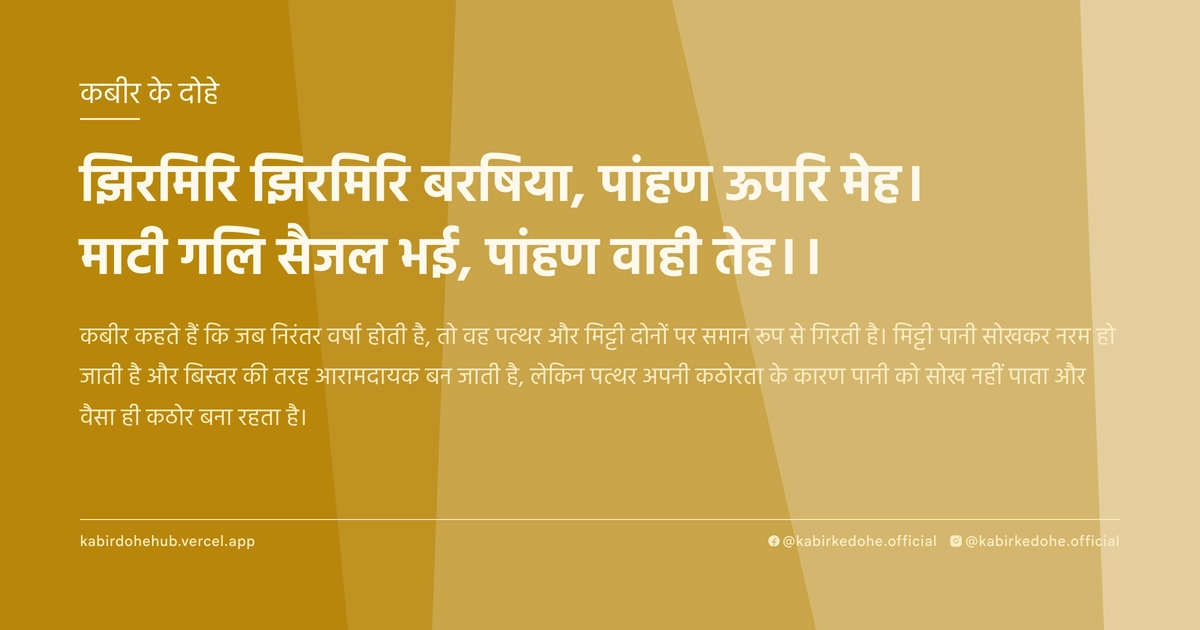
झिरमिरि झिरमिरि बरषिया, पांहण ऊपरि मेह।
माटी गलि सैजल भई, पांहण वाही तेह।।
Jirmiri jirmiri barshiya, paahan upari meh. Maati gali saijal bhayi, paahan vaahi teh.
इस पृष्ठ पर इस कबीर दोहे का अर्थ (meaning), हिंदी व्याख्या और अंग्रेज़ी अनुवाद, दार्शनिक विश्लेषण और व्यावहारिक जीवन सीख दी गई है। यह दोहा अनित्य (Impermanence) विषय से जुड़ा है — Kabir doha meaning and explanation in Hindi and English.
अर्थ (Meaning):
कबीर कहते हैं कि जब निरंतर वर्षा होती है, तो वह पत्थर और मिट्टी दोनों पर समान रूप से गिरती है। मिट्टी पानी सोखकर नरम हो जाती है और बिस्तर की तरह आरामदायक बन जाती है, लेकिन पत्थर अपनी कठोरता के कारण पानी को सोख नहीं पाता और वैसा ही कठोर बना रहता है।
Kabir observes that when a gentle, persistent rain falls, it descends upon both the stone and the soil alike. The soil, being receptive, absorbs the water and transforms into a soft, comforting bed, whereas the stone, remaining rigid and impervious, stays hard and unchanged despite the same rain.
व्याख्या (Interpretation):
यहाँ वर्षा 'गुरु के ज्ञान' या 'ईश्वरीय कृपा' का प्रतीक है जो सबके लिए समान रूप से उपलब्ध है। मिट्टी उस विनम्र साधक का प्रतीक है जो अहंकार शून्य है और ज्ञान को आत्मसात कर रूपांतरित हो जाता है। पत्थर उस अहंकारी व्यक्ति का प्रतीक है जो अपनी मान्यताओं और कठोरता में इतना जकड़ा हुआ है कि वह सत्य को स्वीकार नहीं कर पाता। यह दोहा निर्गुण भक्ति के उस सिद्धांत को दर्शाता है जहाँ केवल हृदय की कोमलता ही मोक्ष का मार्ग प्रशस्त करती है। माया यहाँ वह कठोरता है जो आत्मा को सत्य से अलग करती है। जब तक 'मैं' का पत्थर नहीं पिघलता, तब तक ब्रह्म का अनुभव असंभव है।
In this metaphor, the rain represents the 'Grace of the Divine' or the 'Wisdom of the Guru,' which falls indiscriminately upon all beings. The soil symbolizes the humble seeker—one who is devoid of ego and open to transformation, allowing the spiritual rain to soften their heart. Conversely, the stone represents the ego-driven individual, rigid in their convictions and impervious to truth. This aligns with Nirgun Bhakti, suggesting that spiritual evolution is not about the quantity of knowledge received, but the receptivity of the heart. Maya manifests here as the psychological rigidity that prevents the Atman from merging with Brahman. The central paradox is that the same truth that liberates the humble only reinforces the isolation of the proud.
दार्शनिक विश्लेषण (Philosophical Analysis):
कबीर का यह दोहा मध्यकालीन भारत के उस सामाजिक परिवेश में लिखा गया जहाँ धार्मिक कट्टरता और कर्मकांड चरम पर थे। कबीर ने यहाँ स्पष्ट किया है कि बाहरी अनुष्ठान (जैसे तीर्थयात्रा या माला जपना) तब तक व्यर्थ हैं जब तक आंतरिक स्वभाव में परिवर्तन न आए। यह विचार अद्वैत वेदांत के करीब है, जहाँ अज्ञान (Avidya) को ही वह पत्थर माना गया है जो जीव को परमात्मा से अलग करता है।
सूफीवाद के नजरिए से, यह 'फना' (अहंकार का विनाश) की प्रक्रिया है। जिस प्रकार मिट्टी अपना अस्तित्व मिटाकर पानी के साथ एक हो जाती है, वैसे ही साधक को अपने सीमित अहंकार को मिटाना पड़ता है। कबीर यहाँ यह तर्क दे रहे हैं कि ईश्वर की कृपा सबके लिए समान है, लेकिन उसका लाभ केवल वही उठा पाते हैं जिनमें 'समर्पण' का भाव होता है।
यहाँ पत्थर केवल मूर्खता का नहीं, बल्कि 'अति-आत्मविश्वास' और 'बौद्धिक अहंकार' का प्रतीक है। अक्सर विद्वान लोग अपनी पांडित्य के कारण सत्य को नहीं देख पाते, जबकि एक सरल हृदय वाला व्यक्ति सत्य को तुरंत पहचान लेता है। यह मनोवैज्ञानिक परिवर्तन की बात है—कठोरता से कोमलता की ओर संक्रमण।
कबीर ritualism (कर्मकांड) का विरोध करते हुए कहते हैं कि यदि आपका हृदय पत्थर जैसा है, तो गंगा स्नान या काबा की यात्रा आपके भीतर की शुष्कता को दूर नहीं कर सकती। वास्तविक शुद्धि आंतरिक नम्रता से आती है।
अंततः, यह दोहा हमें सिखाता है कि आध्यात्मिक प्रगति का पैमाना यह नहीं है कि आपने कितने ग्रंथ पढ़े हैं, बल्कि यह है कि आप कितने 'लचीले' और 'ग्रहणशील' हो गए हैं। जो झुकता है, वही बचता है और वही रूपांतरित होता है।
Kabir composed this verse during a period of intense religious dogmatism in medieval India. He argues that external rituals—pilgrimages, fasting, or repetitive chanting—are futile if the internal disposition remains unchanged. This mirrors the Advaita Vedanta concept where 'Avidya' (ignorance) is the stone-like barrier preventing the realization of the non-duality of Atman and Brahman.
From a Sufi perspective, this is the process of 'Fana' or the annihilation of the self. Just as the soil surrenders its form to merge with the water, the seeker must dissolve the ego to experience the Divine. Kabir posits that Divine Grace is universal and egalitarian, yet its efficacy depends entirely on the receptivity of the recipient.
Crucially, the 'stone' does not merely represent ignorance, but rather 'intellectual arrogance.' Often, the scholar is more blind than the illiterate because their pride in knowledge creates an impenetrable shell. This is a psychological analysis of resistance; the ego protects itself by remaining rigid, unaware that this very protection is its prison.
By rejecting ritualism, Kabir suggests that bathing in the Ganges or visiting the Kaaba cannot cure a desiccated soul. True purification is an internal softening, a shift from the 'hard' ego to the 'soft' heart. The rain of truth is constant, but the result varies by the nature of the ground.
Ultimately, the philosophical core is that spiritual evolution is measured not by the accumulation of information, but by the capacity for surrender. The one who can 'bend' or 'melt' is the only one who can be transformed by the Infinite.
मूल संदेश (Core Message):
- अहंकार सत्य के मार्ग में सबसे बड़ी बाधा है।
- नम्रता ही वह द्वार है जिससे ज्ञान भीतर प्रवेश करता है।
- कठोरता विनाश लाती है, जबकि लचीलापन जीवन देता है।
- ईश्वरीय कृपा सबके लिए है, पर ग्रहणशीलता व्यक्तिगत है।
- स्वयं को मिटाना ही वास्तव में स्वयं को पाना है।
- Ego is the primary obstacle on the path to Truth.
- Humility is the only portal through which wisdom enters.
- Rigidity leads to fragmentation; flexibility leads to life.
- Divine Grace is universal, but receptivity is an individual choice.
- The annihilation of the small 'i' is the discovery of the Great 'I'.
व्यावहारिक उदाहरण (Practical Example):
एक समय की बात है, बनारस के घाटों पर रहने वाली एक वृद्ध विधवा, जानकी, थी। वह जीवन भर बहुत कठोर रही थी, अपने सिद्धांतों और दूसरों की गलतियों के प्रति अत्यंत सख्त। वह मानती थी कि अनुशासन और क्रोध ही धर्म का सही मार्ग है। उसके घर आने वाले हर व्यक्ति को वह अपनी तीखी बातों से झिड़क देती थी।
उसी घाट पर एक युवा सन्यासी आया, जो केवल मौन और मुस्कुराहट से बात करता था। जानकी ने उसे 'अक्षम' और 'कमजोर' मानकर उसका उपहास किया। उसने सन्यासी से कहा, "तुम जैसे लोग दुनिया को नहीं जानते, केवल कोमलता से कुछ हासिल नहीं होता।"
सन्यासी ने कुछ नहीं कहा, बस उसे एक छोटा सा पौधा दिखाया जो पत्थर की दरार से निकल रहा था। उसने कहा, "माता, देखिए यह कोमल पौधा इस कठोर पत्थर को चीर कर बाहर आ गया, जबकि पत्थर अपनी कठोरता के कारण टूट गया।"
जानकी को पहले तो यह बात समझ नहीं आई, लेकिन कुछ दिनों बाद उसने देखा कि सन्यासी के प्रति उसकी नफरत धीरे-धीरे कम हो रही थी क्योंकि सन्यासी ने उसकी कड़वाहट का जवाब कभी कड़वाहट से नहीं दिया।
एक दिन जानकी बहुत बीमार पड़ गई। जिस समाज को उसने अपनी कठोरता से दूर किया था, वही लोग उसकी सेवा के लिए आगे आए। उसने महसूस किया कि उसकी 'कठोरता' उसे सुरक्षा नहीं, बल्कि अकेलापन दे रही थी।
उसने सन्यासी के शब्दों को याद किया और पहली बार अपनी आँखों में आँसू महसूस किए। वह अहसास कि वह गलत थी, उसके भीतर के 'पत्थर' को पिघलाने जैसा था।
उसने अपने पड़ोसियों से माफी मांगी और अपने क्रोध को करुणा में बदलना शुरू किया। उसने पाया कि जब वह नरम हुई, तो लोग उसके करीब आने लगे और उसे वह शांति मिली जो उसे कठोर नियमों में कभी नहीं मिली थी।
जानकी का जीवन अब एक 'सैजल' (बिस्तर) की तरह आरामदायक हो गया था, जहाँ प्रेम और शांति का वास था। उसने सीखा कि सत्य को स्वीकार करने के लिए अहंकार का मिटना अनिवार्य है।
उसका रूपांतरण यह साबित करता है कि जब हम अपनी मानसिक कठोरता छोड़ते हैं, तभी हम ईश्वरीय प्रेम की वर्षा को महसूस कर सकते हैं।
अब वह बनारस की गलियों में एक ऐसी महिला के रूप में जानी जाती थी जो सबको गले लगाती थी, ठीक उसी मिट्टी की तरह जो बारिश पाकर उपजाऊ हो जाती है।
In the ancient ghats of Varanasi lived an elderly widow named Janaki. For decades, she had been as rigid as a stone, clinging to a strict, unforgiving moral code. She believed that discipline and anger were the only ways to maintain righteousness. Anyone who entered her home was met with sharp critiques and a cold demeanor.
One day, a young monk arrived at the ghats. He spoke little and smiled often, radiating a profound stillness. Janaki viewed him as 'weak' and 'inept.' She mocked him, saying, "You do not understand the world; nothing is achieved through mere softness."
The monk did not argue. Instead, he pointed to a tiny, fragile sprout emerging from a crack in a massive stone slab. He whispered, "Look, Mother, this tender plant has split the hard stone to reach the light, while the stone, in its rigidity, has only been broken."
Janaki dismissed the observation initially, but over the following weeks, she noticed something strange. Despite her constant bitterness, the monk never reacted with anger. His unwavering kindness began to erode her defenses, like water dripping on a rock.
Suddenly, Janaki fell gravely ill. The very community she had pushed away with her hardness unexpectedly stepped forward to care for her. In her vulnerability, she realized that her 'strength' had actually been a wall of isolation.
She remembered the monk's words and, for the first time in years, felt tears streaming down her face. The admission of her own fallibility was the moment the 'stone' within her finally cracked.
She began to apologize to her neighbors and consciously replaced her judgment with curiosity and compassion. She discovered that as she softened, people drew closer, and she experienced a peace that her rigid rules had never provided.
Janaki's life transformed into a 'Sajal' (a soft bed) of tranquility and love. She understood that to receive the truth, one must first let go of the need to be 'right.'
Her transformation proved that when we relinquish psychological rigidity, we become fertile ground for divine love to take root.
She became known in the alleys of Varanasi as the woman who embraced everyone, mirroring the soil that becomes lush and life-giving after the rain.
अभ्यास मार्गदर्शन (Practice Guidance):
- प्रतिदिन 15 मिनट 'साक्षी भाव' का अभ्यास करें: अपने भीतर उठने वाले क्रोध या निर्णय (Judgment) को देखें और उसे बिना प्रतिक्रिया दिए केवल महसूस करें।
- आत्म-पूछताछ जर्नल: हर रात लिखें कि आज दिन भर में किस मोड़ पर आप 'पत्थर' (कठोर) बने रहे और यदि आप 'मिट्टी' (नम्र) होते तो परिणाम क्या होता।
- व्यवहारिक परिवर्तन: दिन में कम से कम एक बार किसी ऐसे व्यक्ति की बात को पूरी विनम्रता से सुनें जिससे आप असहमत हों, बिना उसे सही या गलत ठहराए।
- डायग्नोस्टिक चेकलिस्ट: क्या आप दूसरों की सलाह पर तुरंत रक्षात्मक (Defensive) हो जाते हैं? क्या आप अपनी गलतियों को स्वीकार करने में शर्म महसूस करते हैं? यदि हाँ, तो आपका 'पत्थर' अभी सक्रिय है।
- Practice 'Witness Consciousness' for 15 minutes daily: Observe the rising of anger or judgment within you and simply feel it without reacting.
- Self-Inquiry Journaling: Every night, record a moment where you acted as the 'stone' (rigid) and reflect on how the outcome would change if you had been the 'soil' (humble).
- Behavioral Shift: Once a day, listen with complete humility to someone you fundamentally disagree with, without attempting to correct them or label them as wrong.
- Diagnostic Checklist: Do you become instantly defensive when receiving feedback? Do you feel a sense of shame or ego-threat when admitting a mistake? If yes, your 'stone' is still active.
चिंतन प्रश्न (Reflection Questions):
- मेरे जीवन में वह कौन सा 'पत्थर' है जिसे मैं अपनी पहचान मानकर उससे चिपका हुआ हूँ?
- क्या मेरी नैतिकता वास्तव में करुणा से प्रेरित है, या यह केवल दूसरों को छोटा दिखाने का एक साधन है?
- जब मैं किसी की आलोचना करता हूँ, तो क्या मैं वास्तव में सत्य की खोज कर रहा हूँ या केवल अपनी श्रेष्ठता सिद्ध कर रहा हूँ?
- मेरे डिजिटल व्यक्तित्व (Social Media Ego) में मैं कितना 'कठोर' हूँ और वास्तविक जीवन में कितना 'नम्र'?
- क्या मैं वास्तव में बदलने के लिए तैयार हूँ, या मैं केवल बदलाव का ढोंग कर रहा हूँ?
- What is the specific 'stone' in my life that I have mistaken for my identity?
- Is my sense of morality driven by genuine compassion, or is it merely a tool to feel superior to others?
- When I criticize, am I seeking the truth, or am I simply reinforcing my own perceived righteousness?
- How does my digital persona (social media ego) differ in rigidity from my private, internal self?
- Am I truly open to transformation, or am I merely performing the act of being 'spiritual'?