
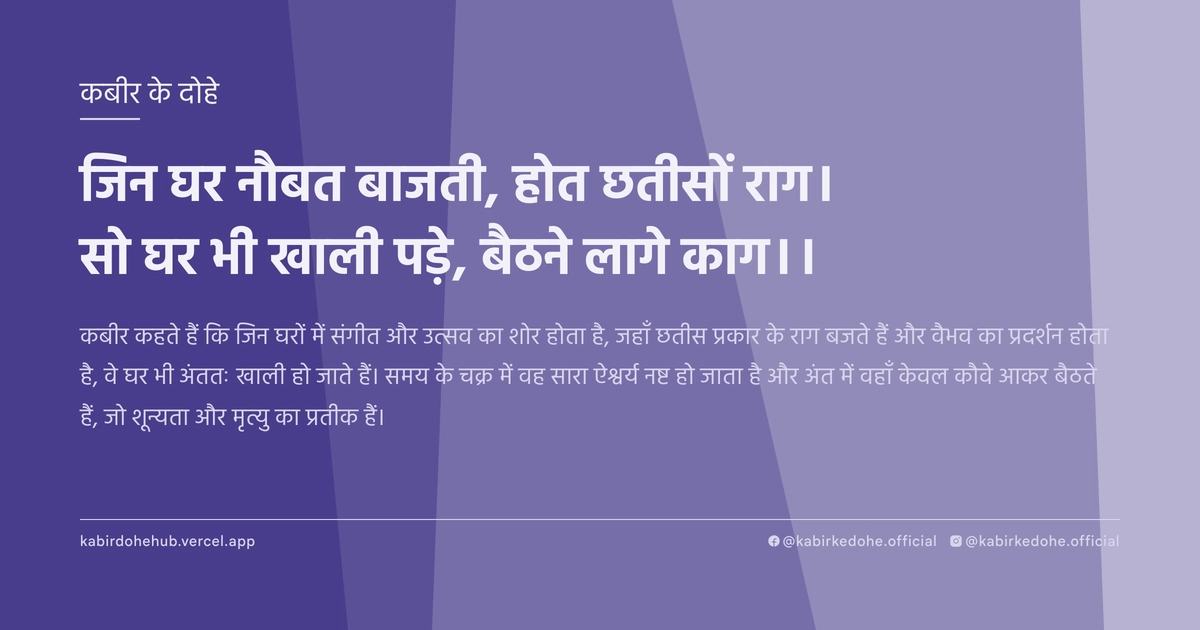
जिन घर नौबत बाजती, होत छतीसों राग।
सो घर भी खाली पड़े, बैठने लागे काग।।
Jin ghar naubat baajti, hot chhatison raag. So ghar bhi khaali pade, baithne laage kaag.
इस पृष्ठ पर इस कबीर दोहे का अर्थ (meaning), हिंदी व्याख्या और अंग्रेज़ी अनुवाद, दार्शनिक विश्लेषण और व्यावहारिक जीवन सीख दी गई है। यह दोहा मृतुक्यता (Mortality) विषय से जुड़ा है — Kabir doha meaning and explanation in Hindi and English.
अर्थ (Meaning):
कबीर कहते हैं कि जिन घरों में संगीत और उत्सव का शोर होता है, जहाँ छतीस प्रकार के राग बजते हैं और वैभव का प्रदर्शन होता है, वे घर भी अंततः खाली हो जाते हैं। समय के चक्र में वह सारा ऐश्वर्य नष्ट हो जाता है और अंत में वहाँ केवल कौवे आकर बैठते हैं, जो शून्यता और मृत्यु का प्रतीक हैं।
Kabir observes that houses echoing with the sound of royal drums and the complexity of thirty-six melodic ragas—symbols of peak worldly luxury and celebration—eventually fall into silence. In the inevitable cycle of time, all such grandeur vanishes, leaving the mansions empty and desolate, where only crows now perch, symbolizing the ultimate void and the certainty of death.
व्याख्या (Interpretation):
यह दोहा भौतिक सुखों की नश्वरता का एक शक्तिशाली रूपक है। 'नौबत' और 'छतीसों राग' सांसारिक उपलब्धियों, अहंकार और इंद्रिय सुखों के चरम को दर्शाते हैं। कबीर यहाँ यह समझा रहे हैं कि मनुष्य जिस सामाजिक प्रतिष्ठा और भौतिक संपत्ति को स्थायी मानता है, वह वास्तव में 'माया' का एक छलावा है। जब आत्मा शरीर रूपी घर को छोड़ती है या जब समय का प्रहार होता है, तो यह सारा वैभव अर्थहीन हो जाता है। 'काग' या कौवा यहाँ मृत्यु और विस्मृति का प्रतीक है, जो यह बताता है कि अंत में केवल शून्यता शेष रहती है। यह निर्गुण भक्ति का सार है, जहाँ बाहरी आडंबरों के बजाय आंतरिक सत्य की खोज पर बल दिया गया है। यह अद्वैत वेदांत के उस सत्य की ओर संकेत करता है कि केवल ब्रह्म ही शाश्वत है, बाकी सब क्षणभंगुर है।
This couplet serves as a potent metaphor for the transience of material pleasures. The 'naubat' (royal drums) and 'thirty-six ragas' represent the zenith of worldly achievements, ego-driven status, and sensory indulfections. Kabir illustrates that the social prestige and material wealth humans perceive as permanent are merely illusions of 'Maya'. When the soul departs the bodily house or when the wheel of time turns, all this grandeur becomes meaningless. The 'kaag' (crow) symbolizes death and oblivion, signifying that only emptiness remains in the end. This aligns with Nirgun Bhakti, emphasizing the pursuit of the formless internal truth over external rituals. It points toward the Advaita Vedanta truth that only the Brahman is eternal, while the phenomenal world is ephemeral.
दार्शनिक विश्लेषण (Philosophical Analysis):
कबीर का यह दोहा उस कालखंड की सामाजिक वास्तविकता को दर्शाता है जहाँ सत्ता और संपत्ति को ईश्वर की कृपा या श्रेष्ठता का प्रमाण माना जाता था। कबीर ने इस धारणा को चुनौती देते हुए यह स्पष्ट किया कि भौतिक समृद्धि आध्यात्मिक रिक्तता को नहीं भर सकती। वे यहाँ 'शून्यता' के दर्शन की बात कर रहे हैं, जो सूफीवाद के 'फना' (अहंकार का विनाश) के करीब है।
उनका प्रहार केवल अमीरों पर नहीं, बल्कि उस मानवीय प्रवृत्ति पर है जो बाहरी चमक-धमक में सत्य को खोजती है। वे ritualism (कर्मकांड) और बाहरी प्रदर्शन का विरोध करते हैं, क्योंकि ये चीजें मनुष्य को उसकी नश्वरता से दूर ले जाती हैं और अहंकार को पुष्ट करती हैं।
अद्वैत वेदांत के परिप्रेक्ष्य में, यह दोहा 'विवेक' जागृत करने का प्रयास है—यह अंतर करना कि क्या सत्य है और क्या मिथ्या। जब व्यक्ति यह समझ जाता है कि उसका 'अहंकार' और उसकी 'संपत्तियां' अस्थायी हैं, तब वह वास्तविक आत्म-साक्षात्कार की ओर बढ़ता है।
मनोवैज्ञानिक स्तर पर, कबीर हमें 'मृत्यु-स्मरण' (Memento Mori) की ओर ले जा रहे हैं। यह डराने के लिए नहीं, बल्कि वर्तमान क्षण में जागने के लिए है। जब हम यह स्वीकार करते हैं कि अंत में सब कुछ खाली हो जाएगा, तब हम संग्रह की वृत्ति को छोड़कर त्याग और प्रेम की ओर मुड़ते हैं।
अंततः, यह दोहा हमें यह सिखाता है कि वास्तविक 'संगीत' वह है जो आत्मा के भीतर बजता है, न कि वह जो बाहरी दुनिया के शोर में खो जाता है। बाहरी रागों का अंत निश्चित है, लेकिन आंतरिक मौन और परमात्मा के साथ एकात्मता ही एकमात्र स्थायी उपलब्धि है।
Kabir’s couplet reflects the social reality of his era, where power and wealth were often mistaken for divine grace or inherent superiority. By challenging this, Kabir clarifies that material abundance cannot fill spiritual void. He invokes a philosophy of 'emptiness' that closely mirrors the Sufi concept of 'Fana'—the annihilation of the ego into the Divine.
His critique is not merely directed at the wealthy, but at the universal human tendency to seek truth in external splendor. He opposes ritualism and ostentation because these distractions distance the individual from the reality of their own mortality and reinforce the walls of the ego.
From the perspective of Advaita Vedanta, this doha is an exercise in 'Viveka' (discernment)—the ability to distinguish between the Eternal (Sat) and the Ephemeral (Asat). Once a seeker realizes that their identity and possessions are transient, they move toward the realization of the Atman.
Psychologically, Kabir employs 'Memento Mori' (remembrance of death). This is not intended to evoke fear, but to trigger an awakening in the present moment. By accepting the inevitability of loss, the human psyche shifts from a drive of accumulation to a path of renunciation and universal love.
Ultimately, the poem teaches that the only 'music' worth cultivating is the internal melody of the soul, rather than the cacophony of worldly success. While external ragas are destined to fade, the internal silence and union with the formless Divine are the only enduring achievements.
मूल संदेश (Core Message):
- बाहरी वैभव एक भ्रम है जो अंततः शून्यता में विलीन हो जाता है।
- अहंकार का शोर आत्मा के संगीत को सुनने नहीं देता।
- मृत्यु ही एकमात्र सत्य है जो सभी भौतिक भेदों को मिटा देती है।
- सच्ची शांति संग्रह में नहीं, बल्कि विसर्जन और त्याग में है।
- आंतरिक मौन ही वह एकमात्र राग है जो शाश्वत रहता है।
- External grandeur is an illusion that eventually dissolves into void.
- The noise of ego prevents one from hearing the melody of the soul.
- Death is the only absolute truth that erases all material distinctions.
- True peace lies not in accumulation, but in dissolution and surrender.
- Internal silence is the only raga that remains eternal.
व्यावहारिक उदाहरण (Practical Example):
वाराणसी के एक पुराने मोहल्ले में रामदीन नाम का एक अत्यंत अभिमानी स्वर्णकार रहता था। उसके पास सोने की इतनी मात्रा थी कि पूरा शहर उसकी समृद्धि की चर्चा करता था। वह अपने घर में हर शाम संगीत के कार्यक्रम आयोजित करता, जहाँ देश के सर्वश्रेष्ठ संगीतकार छतीस राग गाते थे। रामदीन को लगता था कि उसका धन और उसका वैभव उसे मृत्यु और दुख से बचा लेंगे। वह गरीबों को तुच्छ समझता और अपनी संपत्ति को ही अपना धर्म मानता था।
एक समय ऐसा आया जब शहर में भीषण अकाल पड़ा और उसके व्यापारिक साझेदारों ने उसे धोखा दिया। धीरे-धीरे उसकी संपत्ति घटने लगी। उसके अहंकारी स्वभाव के कारण उसके अपने बेटे भी उससे अलग हो गए। वह जिस घर को अपनी जीत का किला मानता था, वह धीरे-धीरे शांत होने लगा। संगीतकारों ने आना बंद कर दिया क्योंकि अब वहाँ भुगतान करने वाला कोई नहीं था।
एक शाम, रामदीन अपने विशाल, धूल भरे हॉल में अकेला बैठा था। उसने देखा कि जहाँ कभी रागों की गूँज होती थी, वहाँ अब केवल एक कौवा खिड़की पर बैठा काँव-काँव कर रहा था। उस सन्नाटे में उसे कबीर का यह दोहा याद आया। उसे एहसास हुआ कि उसने पूरा जीवन 'बाहरी शोर' को सजाने में बिता दिया, लेकिन अपने भीतर के सन्नाटे को कभी नहीं समझा।
उसने महसूस किया कि जिस वैभव पर उसे गर्व था, वह केवल एक रेत का महल था। उसकी आँखों में आँसू थे, लेकिन यह दुख का नहीं, बल्कि बोध का था। उसने अपनी बची-कुची संपत्ति उन लोगों में बाँट दी जिन्हें उसने कभी अनदेखा किया था।
उसने संगीत के बाहरी शोर को छोड़कर ध्यान का मार्ग अपनाया। अब वह सोने के गहने नहीं, बल्कि संतोष के मोती पिरोने लगा।
उसका घर अब भी खाली था, लेकिन उसका हृदय पहली बार पूर्ण महसूस कर रहा था।
उसने सीखा कि असली समृद्धि वह नहीं जो दुनिया देखती है, बल्कि वह है जिसे आत्मा महसूस करती है।
रामदीन अब एक ऐसा व्यक्ति बन गया था जो मृत्यु से डरता नहीं था, क्योंकि उसने जीवन रहते ही अपने अहंकार की मृत्यु कर ली थी।
उसकी कहानी यह सिखाती है कि जब बाहरी राग शांत होते हैं, तभी आंतरिक सत्य की आवाज सुनाई देती है।
In an ancient neighborhood of Varanasi lived a goldsmith named Ramdin, consumed by immense pride. He possessed so much gold that the entire city spoke of his opulence. Every evening, he hosted lavish musical gatherings in his mansion, where the finest musicians performed thirty-six complex ragas. Ramdin believed his wealth and grandeur were shields that would protect him from death and sorrow. He viewed the poor with contempt, equating his net worth with his spiritual standing.
Time turned, and a severe famine struck the land, coupled with betrayal by his business partners. Slowly, his fortunes dwindled. Due to his arrogant nature, even his own sons distanced themselves from him. The house he considered an impregnable fortress of victory began to fall silent. The musicians stopped coming, for there was no longer any gold to pay them.
One evening, Ramdin sat alone in his vast, dust-covered hall. He noticed that where the echoes of ragas once vibrated, a single crow now perched on the window sill, cawing into the void. In that oppressive silence, Kabir’s words resonated within him. He realized he had spent his entire life decorating the 'external noise' while ignoring the silence within.
He understood that the grandeur he prided himself on was merely a castle of sand. Tears filled his eyes, not out of grief, but out of a sudden, piercing awakening. He distributed the remnants of his wealth among those he had spent a lifetime ignoring.
He abandoned the pursuit of external melodies and embraced the path of meditation. He stopped crafting ornaments of gold and began weaving beads of contentment.
His house remained empty of people and music, but for the first time, his heart felt full.
He learned that true prosperity is not what the world witnesses, but what the soul experiences.
Ramdin became a man who no longer feared death, for he had successfully killed his ego while still alive.
His story teaches that only when the external ragas fall silent can the voice of internal truth be heard.
अभ्यास मार्गदर्शन (Practice Guidance):
- प्रतिदिन 20 मिनट का मौन अभ्यास करें, जहाँ आप बाहरी शोर को केवल साक्षी भाव से देखें और उसे अपने भीतर प्रवेश न करने दें।
- एक 'नश्वरता जर्नल' (Impermanence Journal) बनाएँ। हर हफ्ते एक ऐसी चीज़ के बारे में लिखें जिसे आपने बहुत महत्वपूर्ण माना था, लेकिन अब वह आपके काम की नहीं रही।
- व्यवहार परिवर्तन: अपनी पहचान को अपनी उपलब्धियों, पद या संपत्ति से जोड़ना बंद करें। स्वयं को केवल एक 'चेतना' के रूप में देखने का प्रयास करें।
- निदान चेकलिस्ट: क्या आप अपनी सफलता के शोर में दूसरों की चुप्पी नहीं सुन पा रहे? क्या आपको अपनी वस्तुओं के खोने का डर सताता है? यदि हाँ, तो आप अभी भी माया के प्रभाव में हैं।
- Practice 20 minutes of daily silence, observing external noise as a witness without allowing it to penetrate your inner peace.
- Maintain an 'Impermanence Journal'. Each week, write about something you once considered indispensable but which has now lost its value or utility.
- Behavioral Shift: Stop anchoring your identity to your achievements, titles, or possessions. Attempt to perceive yourself solely as 'pure consciousness'.
- Diagnostic Checklist: Are you unable to hear the silence of others amidst the noise of your own success? Do you feel an acute fear of losing your possessions? If yes, you are still under the spell of Maya.
चिंतन प्रश्न (Reflection Questions):
- यदि आज आपकी सारी सामाजिक प्रतिष्ठा और संपत्ति छीन ली जाए, तो आपके व्यक्तित्व का क्या शेष बचेगा?
- आप अपने जीवन के 'शोर' (सफलता, प्रशंसा) का उपयोग किस सत्य को छिपाने के लिए कर रहे हैं?
- क्या आपका डिजिटल व्यक्तित्व (Social Media Ego) आपके वास्तविक आंतरिक शून्य को भरने का एक प्रयास है?
- आप किन ऐसी चीज़ों को पकड़े हुए हैं जिन्हें समय पहले ही आपसे छीन चुका है?
- क्या आप अकेलेपन और एकांत के बीच का अंतर समझते हैं, या आप एकांत से डरते हैं?
- If all your social prestige and wealth were stripped away today, what would remain of your personality?
- What truth are you attempting to hide behind the 'noise' (success, praise) of your life?
- Is your digital persona (social media ego) an attempt to fill an internal void?
- What are you still clinging to that time has already taken away from you?
- Do you understand the difference between loneliness and solitude, or do you fear the silence of solitude?