
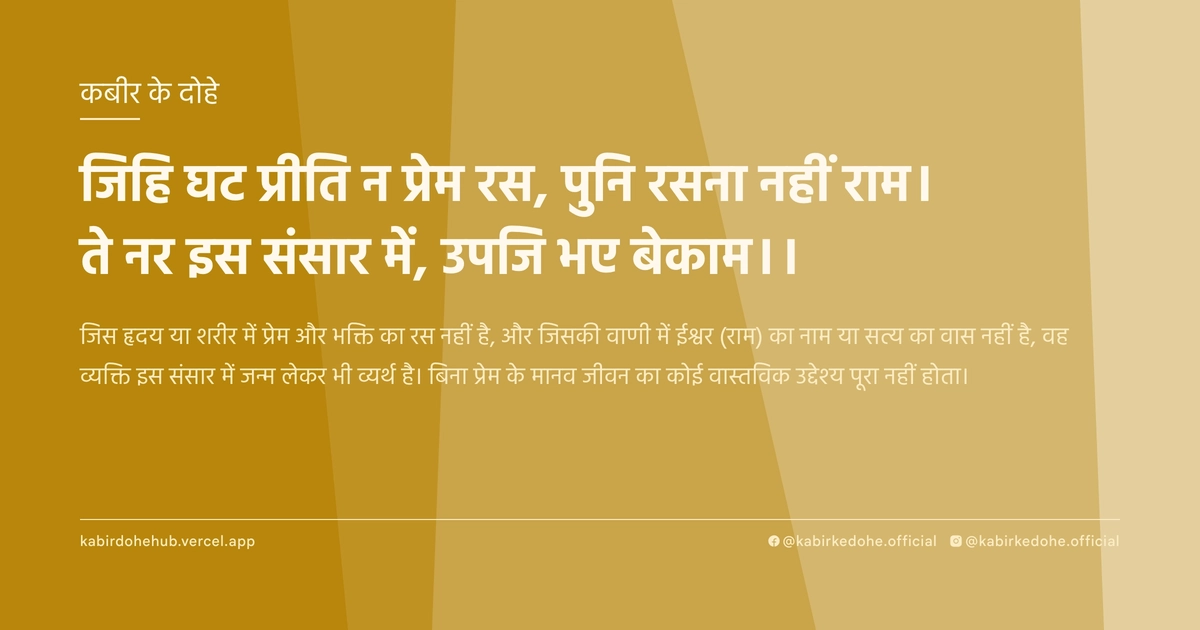
जिहि घट प्रीति न प्रेम रस, पुनि रसना नहीं राम।
ते नर इस संसार में, उपजि भए बेकाम।।
Jih ghat preeti na prem ras, puni rasna nahi Ram. Te nar is sansar mein, upaj bhaye bekaam.
इस पृष्ठ पर इस कबीर दोहे का अर्थ (meaning), हिंदी व्याख्या और अंग्रेज़ी अनुवाद, दार्शनिक विश्लेषण और व्यावहारिक जीवन सीख दी गई है। यह दोहा भक्ति (Bhakti) विषय से जुड़ा है — Kabir doha meaning and explanation in Hindi and English.
अर्थ (Meaning):
जिस हृदय या शरीर में प्रेम और भक्ति का रस नहीं है, और जिसकी वाणी में ईश्वर (राम) का नाम या सत्य का वास नहीं है, वह व्यक्ति इस संसार में जन्म लेकर भी व्यर्थ है। बिना प्रेम के मानव जीवन का कोई वास्तविक उद्देश्य पूरा नहीं होता।
He whose heart lacks the essence of love and divine affection, and whose tongue does not utter the name of the Eternal (Ram), is a wasted existence in this world. A life devoid of love is a life without purpose or spiritual fruition.
व्याख्या (Interpretation):
शाब्दिक अर्थ यह है कि प्रेम विहीन व्यक्ति मृत समान है। यहाँ 'राम' किसी व्यक्ति विशेष नहीं, बल्कि उस निर्गुण ब्रह्म का प्रतीक है जो कण-कण में व्याप्त है। 'प्रेम रस' वह आध्यात्मिक तरलता है जो अहंकार को गला देती है। जब तक व्यक्ति अपनी सीमित पहचान (माया) से ऊपर उठकर सर्वव्यापी प्रेम को महसूस नहीं करता, वह संसार के चक्र में फंसा रहता है। यह दोहा आत्मा और परमात्मा के बीच के उस सेतु की बात करता है जिसे केवल प्रेम के माध्यम से पार किया जा सकता है, क्योंकि ज्ञान बिना प्रेम के शुष्क है और कर्म बिना प्रेम के यांत्रिक है।
Literally, the verse posits that a person without love is functionally dead. 'Ram' here does not refer to a mythological figure but the Nirgun Brahman—the formless, omnipresent consciousness. 'Prem Ras' (the nectar of love) is the spiritual solvent that dissolves the ego. Until an individual transcends the illusion of the separate self (Maya) to experience universal love, they remain trapped in the cycle of Samsara. This Doha highlights the bridge between Atman and Brahman, asserting that while knowledge may be intellectual, only love provides the experiential realization of non-duality.
दार्शनिक विश्लेषण (Philosophical Analysis):
कबीर का यह दोहा उस युग की प्रतिक्रिया है जहाँ धर्म केवल कर्मकांडों, बाहरी दिखावे और कठोर जातिगत नियमों में सिमट गया था। कबीर ने 'प्रेम' को सर्वोच्च ज्ञान माना, जो कि सूफी मत के 'इश्क-ए-हकीकी' (ईश्वरीय प्रेम) और अद्वैत वेदांत के 'एकत्व' का संगम है। उनके लिए, मंदिर या मस्जिद जाना व्यर्थ है यदि हृदय में करुणा नहीं है।
दार्शनिक स्तर पर, यह 'अहं' के विसर्जन की बात करता है। जब व्यक्ति कहता है कि वह 'बेकाम' है, तो इसका अर्थ है कि उसने अपनी मूल प्रकृति (Swaroop) को खो दिया है। मनुष्य का जन्म केवल भौतिक सुखों के लिए नहीं, बल्कि उस चेतना में विलीन होने के लिए हुआ है जिससे वह अलग नहीं है।
यहाँ 'रसना' (जीभ) का उल्लेख केवल मंत्र जाप के लिए नहीं, बल्कि सत्य के प्रकटीकरण के लिए है। यदि वाणी में सत्य और प्रेम नहीं है, तो शब्द केवल शोर हैं। यह सूफी संतों की उस परंपरा से मिलता-जुलता है जहाँ हृदय को ईश्वर का निवास स्थान माना गया है।
कबीर ritualism (कर्मकांड) का खंडन करते हुए यह स्थापित करते हैं कि ईश्वर तक पहुँचने का मार्ग शास्त्र नहीं, बल्कि हृदय की पवित्रता है। यह एक मनोवैज्ञानिक रूपांतरण की मांग करता है जहाँ व्यक्ति 'मैं' से 'हम' और अंततः 'शून्य' की ओर बढ़ता है।
अंततः, यह दोहा इस सत्य को उद्घाटित करता है कि प्रेम ही एकमात्र ऐसी शक्ति है जो द्वैत (duality) को समाप्त कर सकती है। जब प्रेम रस घट में उतरता है, तब भक्त और भगवान का भेद मिट जाता है, जो कि भक्ति आंदोलन का मूल केंद्र था।
Kabir’s verse is a visceral reaction to an era where religion had devolved into empty ritualism, outward displays of piety, and rigid caste hierarchies. He elevates 'Love' as the supreme knowledge, synthesizing the Sufi concept of 'Ishq-e-Haqiqi' (Divine Love) with the Advaita Vedanta principle of non-duality. For Kabir, the pilgrimage to temples or mosques is futile if the heart remains a wasteland of indifference.
Philosophically, this is an exploration of the annihilation of the ego (Fana). When he describes such a person as 'bekaam' (useless), he refers to the failure to realize one's primordial nature. Human existence is not intended for the mere accumulation of material wealth, but for the reintegration of the individual soul into the universal consciousness.
The mention of 'Rasna' (tongue) transcends mere chanting; it signifies the alignment of speech with Truth. If the words spoken are not infused with love, they are merely acoustic noise. This mirrors the Sufi tradition where the heart is viewed as the only true sanctuary of the Divine.
By rejecting ritualism, Kabir establishes that the path to the Absolute is not through scriptures, but through the purity of the heart. This requires a profound psychological shift—a movement from the 'I' to the 'We,' and ultimately to the 'Void' or 'Sunya.'
Ultimately, the Doha reveals that love is the only force capable of dissolving duality. When the 'nectar of love' permeates the being, the distinction between the devotee and the Divine vanishes, marking the pinnacle of the Bhakti movement's spiritual objective.
मूल संदेश (Core Message):
- बिना प्रेम के ज्ञान केवल एक बोझ है।
- ईश्वर का वास्तविक नाम करुणा में निहित है।
- अहंकार का विसर्जन ही वास्तविक पूजा है।
- मानवीय संबंधों में दिव्यता खोजना ही धर्म है।
- प्रेम ही वह एकमात्र रस है जो आत्मा को तृप्त करता है।
- Knowledge without love is merely an intellectual burden.
- The true name of the Divine is found in compassion.
- The dissolution of ego is the only authentic worship.
- Finding divinity in human relationships is the essence of Dharma.
- Love is the only nectar that truly satiates the soul.
व्यावहारिक उदाहरण (Practical Example):
वाराणसी के एक पुराने घाट पर माधव नाम का एक वृद्ध नाविक रहता था। वह अपनी नाव चलाने में निपुण था, लेकिन उसका स्वभाव अत्यंत कठोर और क्रोधित था। वह खुद को बहुत धार्मिक मानता था क्योंकि वह रोज सुबह गंगा में स्नान करता और घंटों मंदिर में बैठता, लेकिन वह अपने साथी नाविकों और गरीब यात्रियों से घृणा करता था।
माधव का मानना था कि उसकी भक्ति उसके नियमों के पालन में है। वह दूसरों को नीचा दिखाता था और अपनी श्रेष्ठता का अहंकार पाले हुए था। उसके जीवन में अनुशासन था, लेकिन करुणा का एक कतरा भी नहीं था।
एक दिन, एक फकीर उसकी नाव में सवार हुआ। फकीर ने देखा कि माधव यात्रियों से रूखेपन से बात कर रहा है। फकीर ने मुस्कुराते हुए पूछा, 'माधव, तुम्हारी नाव तो बहुत सुंदर है, पर क्या इसमें प्रेम का पानी भरा है?'
माधव चिढ़ गया और बोला, 'यह नाव लकड़ी की है, पानी का काम तो गंगा का है। मैं धर्म का पालन करता हूँ, मुझे क्या जरूरत प्रेम की?'
फकीर ने शांति से उत्तर दिया, 'जिस नाव में प्रेम नहीं, वह केवल शरीर को एक किनारे से दूसरे किनारे ले जा सकती है, आत्मा को पार नहीं करा सकती। तुम राम का नाम तो लेते हो, पर तुम्हारी वाणी में वह रस नहीं है जो दूसरे के दुख को हर सके।'
यह बात माधव के हृदय पर चोट कर गई। उसने महसूस किया कि उसकी सारी पूजा-पाठ केवल एक मुखौटा थे। उसने देखा कि वह जिसे 'धर्म' कह रहा था, वह वास्तव में उसका अहंकार था जो उसे दूसरों से अलग कर रहा था।
अगले कुछ महीनों में माधव का व्यवहार बदलने लगा। उसने नाविकों के साथ अपनी कमाई साझा करना शुरू किया और यात्रियों की मदद बिना किसी स्वार्थ के करने लगा। उसने पाया कि जब वह प्रेम से बात करता है, तो उसे वह शांति मिलती है जो उसे घंटों मंदिर में बैठने से नहीं मिली थी।
अब उसकी 'रसना' (वाणी) में केवल शब्द नहीं, बल्कि संवेदना थी। वह समझ गया कि बिना प्रेम के उसकी सारी धार्मिकता 'बेकाम' थी। उसका जीवन अब केवल एक पेशा नहीं, बल्कि एक साधना बन गया था।
माधव ने जान लिया कि ईश्वर मंदिर की मूर्तियों में नहीं, बल्कि उस प्रेम में है जो एक मनुष्य दूसरे मनुष्य के लिए महसूस करता है। यही उसकी वास्तविक मुक्ति थी।
उसकी नाव अब केवल लोगों को घाट तक नहीं पहुँचाती थी, बल्कि उनके चेहरों पर मुस्कान छोड़ जाती थी।
On the ancient ghats of Varanasi lived an elderly boatman named Madhav. He was masterful in navigating the currents of the Ganges, but his temperament was harsh and abrasive. He considered himself deeply religious, spending hours in temples and performing rigorous rituals, yet he harbored disdain for his fellow boatmen and impoverished passengers.
Madhav believed that spirituality lay in the strict adherence to rules. He looked down upon others, nurturing a quiet but potent ego of spiritual superiority. His life was disciplined, yet it was entirely devoid of compassion.
One day, a wandering Sufi dervish boarded his boat. The dervish observed Madhav speaking curtly and unkindly to a struggling passenger. With a gentle smile, the dervish asked, 'Madhav, your boat is sturdy and beautiful, but does it carry the waters of love?'
Irritated, Madhav replied, 'This boat is made of wood; the water belongs to the Ganges. I follow the path of Dharma; why should I need love?'
The dervish replied calmly, 'A boat without love can carry the body from one shore to another, but it cannot ferry the soul across the ocean of existence. You chant the name of Ram, but your tongue lacks the nectar that heals another's pain.'
These words struck a chord deep within Madhav. He realized that his rituals were merely a mask, a way to feed his ego while pretending to be holy. He saw that his 'religion' had become a wall separating him from humanity.
Over the following months, Madhav’s demeanor shifted. He began sharing his earnings with struggling peers and helping passengers with genuine warmth. He discovered that the peace he sought in temple silence was actually found in the act of selfless kindness.
Now, his 'Rasna' (tongue) did not just utter words; it conveyed empathy. He understood that without love, his entire spiritual repertoire was 'bekaam'—useless.
Madhav realized that the Divine does not reside in stone idols, but in the love one human feels for another. This realization was his true liberation.
His boat no longer just transported people to the ghats; it left a trail of smiles and warmth in its wake, transforming his profession into a living prayer.
अभ्यास मार्गदर्शन (Practice Guidance):
- प्रतिदिन 15 मिनट मौन रहकर इस विचार पर मनन करें: 'क्या मेरा व्यवहार मेरे शब्दों से मेल खाता है?'
- एक 'करुणा डायरी' लिखें, जिसमें प्रतिदिन एक ऐसी घटना दर्ज करें जहाँ आपने बिना किसी लाभ के किसी की मदद की हो।
- वाणी का अभ्यास: बोलने से पहले रुकें और स्वयं से पूछें, 'क्या इस बात में प्रेम है या केवल अहंकार?'
- निदान चेकलिस्ट: यदि आप दूसरों की सफलता से ईर्ष्या महसूस करते हैं या केवल लाभ के लिए संबंध बनाते हैं, तो समझें कि 'प्रेम रस' की कमी है।
- Spend 15 minutes in daily silence contemplating: 'Does my behavior align with the words of love I speak?'
- Maintain a 'Compassion Journal,' recording one daily instance where you helped someone without expecting anything in return.
- Speech Mindfulness: Pause before speaking and ask, 'Is this utterance driven by love or by the need to be right/superior?'
- Diagnostic Checklist: If you feel envy at others' success or maintain relationships solely for utility, recognize the absence of 'Prem Ras' in your current state.
चिंतन प्रश्न (Reflection Questions):
- क्या मेरी धार्मिक पहचान मुझे दूसरों से जोड़ती है या मुझे श्रेष्ठ महसूस कराकर अलग करती है?
- यदि मेरे जीवन से मेरी उपलब्धियाँ और पद हटा दिए जाएँ, तो क्या मेरे भीतर कोई ऐसा प्रेम बचेगा जो दूसरों को आकर्षित करे?
- मैं अपनी वाणी का उपयोग सत्य बोलने के लिए करता हूँ या दूसरों को नियंत्रित करने के लिए?
- मेरे जीवन का वह कौन सा क्षेत्र है जहाँ मैं प्रेम का ढोंग करता हूँ लेकिन भीतर से रिक्त हूँ?
- क्या मैं उस व्यक्ति को प्रेम कर सकता हूँ जिसने मुझे सबसे अधिक चोट पहुँचाई है?
- Does my religious or spiritual identity connect me to others, or does it isolate me by fueling a sense of superiority?
- If all my achievements and titles were stripped away, would there be enough love left within me to attract others?
- Do I use my speech to convey Truth, or as a tool to manipulate and control those around me?
- In which area of my life am I performing the 'act' of love while remaining internally void?
- Am I capable of extending genuine love to the person who has caused me the deepest wound?