
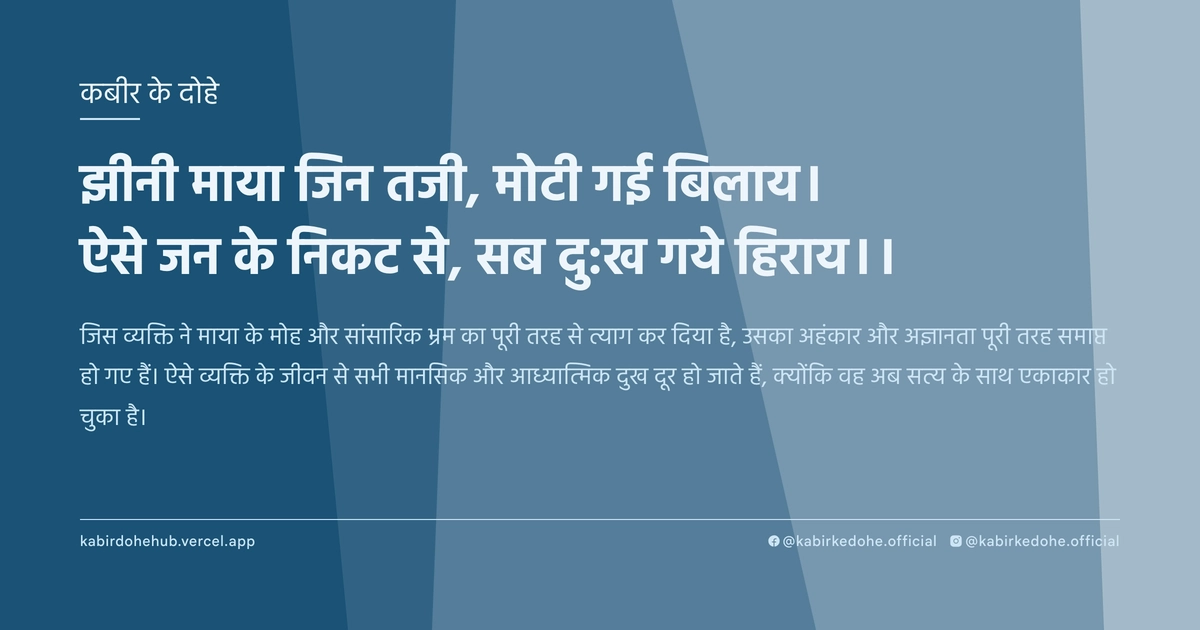
झीनी माया जिन तजी, मोटी गई बिलाय।
ऐसे जन के निकट से, सब दु:ख गये हिराय।।
Jheeni maya jin taji, moti gayi bilay. Aise jan ke nikat se, sab dukh gaye hiray.
इस पृष्ठ पर इस कबीर दोहे का अर्थ (meaning), हिंदी व्याख्या और अंग्रेज़ी अनुवाद, दार्शनिक विश्लेषण और व्यावहारिक जीवन सीख दी गई है। यह दोहा माया (Maya) विषय से जुड़ा है — Kabir doha meaning and explanation in Hindi and English.
अर्थ (Meaning):
जिस व्यक्ति ने माया के मोह और सांसारिक भ्रम का पूरी तरह से त्याग कर दिया है, उसका अहंकार और अज्ञानता पूरी तरह समाप्त हो गए हैं। ऐसे व्यक्ति के जीवन से सभी मानसिक और आध्यात्मिक दुख दूर हो जाते हैं, क्योंकि वह अब सत्य के साथ एकाकार हो चुका है।
The one who has completely renounced the illusions of Maya and the attachments of the material world has seen their ego dissolve entirely. For such a person, all forms of suffering vanish and flee, as they have aligned themselves with the ultimate, unchanging Truth.
व्याख्या (Interpretation):
शाब्दिक रूप से, यह दोहा माया के त्याग और दुखों के अंत के बीच सीधा संबंध स्थापित करता है। यहाँ 'मोटी' शब्द अहंकार के भारीपन और जड़ता को दर्शाता है। जब साधक यह समझ जाता है कि संसार की भौतिक वस्तुएं और सामाजिक पहचान केवल क्षणभंगुर हैं, तब वह 'माया' के जाल से मुक्त हो जाता है। यह मुक्ति निरगुण भक्ति का सार है, जहाँ ईश्वर को किसी रूप या मूर्ति में नहीं, बल्कि स्वयं के भीतर की शुद्ध चेतना में खोजा जाता है। अद्वैत वेदांत के अनुसार, जब 'मैं' और 'मेरा' का भ्रम मिटता है, तब केवल ब्रह्म शेष रहता है। यह विरोधाभास है कि जिसे हम पाने की कोशिश करते हैं (संसार), वही वास्तव में हमारे दुखों का कारण है, और जिसे हम खोने से डरते हैं (माया), उसका त्याग ही वास्तविक प्राप्ति है।
Literally, this couplet establishes a direct causal link between the renunciation of Maya and the cessation of suffering. The term 'moti' (thick/heavy) symbolizes the density of the ego and the inertia of ignorance. When a seeker realizes that material possessions and social identities are merely ephemeral shadows, they break free from the web of Maya. This liberation is the essence of Nirgun Bhakti, where the Divine is sought not in forms or idols, but within the pure consciousness of the self. According to Advaita Vedanta, when the illusion of 'I' and 'Mine' dissolves, only Brahman remains. It is a profound paradox: that which we strive to acquire (the world) is the very source of our misery, and that which we fear losing (Maya) is the only thing whose abandonment leads to true attainment.
दार्शनिक विश्लेषण (Philosophical Analysis):
कबीर का यह दोहा उस ऐतिहासिक कालखंड की उपज है जब धर्म कर्मकांडों, जातिगत श्रेष्ठता और बाहरी आडंबरों में उलझ गया था। कबीर ने स्पष्ट किया कि मोक्ष किसी तीर्थ यात्रा या कठिन व्रत से नहीं, बल्कि आंतरिक रूपांतरण से मिलता है। माया यहाँ केवल धन-संपत्ति नहीं है, बल्कि वह मानसिक पर्दा है जो आत्मा को परमात्मा से अलग दिखाता है।
दार्शनिक स्तर पर, यह सूफी मत के 'फना' (अहंकार का विनाश) और वेदांत के 'माया' सिद्धांत का संगम है। कबीर तर्क देते हैं कि जब तक मनुष्य स्वयं को शरीर या नाम से जोड़ता है, वह द्वैत में रहता है। यह द्वैत ही दुख की जड़ है। जब साधक 'मैं' को मिटा देता है, तो वह उस अनंत सागर में विलीन हो जाता है जहाँ न कोई लहर है और न कोई किनारा।
कबीर का विरोध केवल बाहरी दुनिया से नहीं, बल्कि उस आंतरिक आसक्ति से है जो हमें यह विश्वास दिलाती है कि हम अलग हैं। वे सिखाते हैं कि माया का त्याग का अर्थ संसार को छोड़ना नहीं, बल्कि संसार में रहते हुए उससे अप्रभावित रहना है। यह एक मनोवैज्ञानिक बदलाव है जहाँ व्यक्ति कर्ता भाव से हटकर साक्षी भाव में आ जाता है।
अक्सर लोग इस दोहे को भौतिक गरीबी के रूप में गलत समझते हैं। वास्तव में, कबीर 'अपरिग्रह' की बात कर रहे हैं—वस्तुओं का उपयोग करें, लेकिन उन्हें अपनी पहचान न बनने दें। जब पहचान मिटती है, तो भय मिटता है, और जहाँ भय नहीं होता, वहाँ दुख का कोई स्थान नहीं बचता।
अंततः, यह विश्लेषण हमें बताता है कि मुक्ति कोई बाहरी गंतव्य नहीं है, बल्कि एक आंतरिक स्थिति है। जब माया का पर्दा हटता है, तो जो शेष बचता है वह सत्य है, और वह सत्य ही आनंद है। यह अद्वैत की वह स्थिति है जहाँ भक्त और भगवान एक हो जाते हैं।
This couplet by Kabir is a product of an era where religion had become entangled in rituals, caste hierarchies, and external ostentation. Kabir asserts that liberation is not achieved through pilgrimages or rigorous fasting, but through a profound internal transformation. Here, Maya is not merely wealth or property, but the mental veil that creates a perceived separation between the Atman and the Paramatman.
On a philosophical level, this is a confluence of the Sufi concept of 'Fana' (the annihilation of the ego) and the Vedantic theory of Maya. Kabir argues that as long as a human identifies with the body or a social label, they remain trapped in duality. This duality is the root cause of all suffering. When the seeker erases the 'I', they merge into the infinite ocean where there are no waves and no shores.
Kabir's opposition is not directed at the physical world itself, but at the internal attachment that convinces us of our separation. He teaches that renouncing Maya does not mean fleeing from society, but remaining unaffected while living within it. This is a psychological shift from being the 'doer' to becoming the 'witness'.
Common literalist misconceptions often interpret this as a call for material poverty. In reality, Kabir is advocating for 'Aparigraha'—using objects without allowing them to define one's identity. When the identity dissolves, fear vanishes, and where there is no fear, suffering cannot reside.
Ultimately, this analysis reveals that liberation is not an external destination but an internal state. When the veil of Maya is lifted, what remains is Truth, and that Truth is bliss. This is the state of non-duality where the devotee and the Divine become one.
मूल संदेश (Core Message):
- माया बाहरी दुनिया नहीं, बल्कि आंतरिक मोह है।
- अहंकार का विसर्जन ही वास्तविक शांति का मार्ग है।
- पहचान का त्याग ही आत्मा की वास्तविक प्राप्ति है।
- दुख बाहरी परिस्थितियों से नहीं, बल्कि उनसे जुड़ाव से आता है।
- सत्य वह है जो समय और परिस्थिति से परे है।
- Maya is not the external world, but the internal attachment to it.
- The dissolution of the ego is the only path to authentic peace.
- Relinquishing identity is the true attainment of the Soul.
- Suffering arises not from circumstances, but from our attachment to them.
- Truth is that which remains beyond time and circumstance.
व्यावहारिक उदाहरण (Practical Example):
वाराणसी के घाटों पर रहने वाली एक वृद्ध विधवा, जानकी, का जीवन अत्यंत कठिन था। उसने अपना पूरा जीवन अपने परिवार की सेवा में लगा दिया था, लेकिन अंत में वह अकेली रह गई। वह अक्सर मंदिर जाकर अपनी व्यथा सुनाती और ईश्वर से शिकायत करती कि उसके साथ ऐसा अन्याय क्यों हुआ। वह अपनी पहचान एक 'दुखी विधवा' के रूप में इतनी गहराई से जोड़ चुकी थी कि उसका हर विचार उसी दुख के इर्द-गिर्द घूमता था।
एक दिन उसकी मुलाकात एक फकीर से हुई जिसने उसे कबीर का यह दोहा सुनाया। फकीर ने उससे पूछा, 'जानकी, तुम कौन हो?' उसने उत्तर दिया, 'मैं एक बेसहारा विधवा हूँ।' फकीर मुस्कुराया और बोला, 'यह विधवा होना तुम्हारी माया है, तुम्हारी पहचान का वह बोझ है जिसे तुमने ओढ़ रखा है। क्या तुम इस पहचान के बिना भी अस्तित्व में नहीं हो?'
जानकी को पहले यह बात समझ नहीं आई। लेकिन उसने धीरे-धीरे अभ्यास करना शुरू किया। जब भी उसे दुख महसूस होता, वह खुद से पूछती, 'क्या यह दुख जानकी का है, या उस पहचान का जिसे समाज ने उसे दिया है?' उसने महसूस किया कि वह अपनी 'बेसहारा' होने की छवि से इतनी प्यार करने लगी थी कि वह वास्तव में उसी दुख को पकड़ कर बैठी थी।
उसने अपनी पहचान को एक 'पीड़ित' से बदलकर एक 'साक्षी' बनाने का निर्णय लिया। उसने घाट पर आने वाले अन्य असहाय लोगों की मदद करना शुरू किया, बिना यह सोचे कि वह खुद कितनी गरीब है। उसने पाया कि जब उसने अपनी 'दुखिया' वाली पहचान (माया) को त्याग दिया, तो उसका आंतरिक बोझ हल्का हो गया।
वह अब भी अकेली थी, लेकिन वह अब 'अकेलापन' महसूस नहीं करती थी। उसने पाया कि उसकी पहचान अब किसी व्यक्ति या रिश्ते पर निर्भर नहीं थी, बल्कि वह उस विराट चेतना का हिस्सा बन गई थी जो सबके भीतर है।
उसका व्यवहार बदल गया। जहाँ वह पहले शिकायत करती थी, अब वह शांति से मुस्कुराती थी। लोग उससे पूछने लगे कि उसकी इस शांति का राज क्या है। उसने बस इतना कहा, 'मैंने उस बोझ को उतार दिया है जिसे मैं अपना नाम समझती थी।'
जानकी का जीवन अब एक उदाहरण बन गया कि कैसे बाहरी परिस्थितियों को बदले बिना, केवल आंतरिक पहचान (माया) को बदलकर दुखों से मुक्ति पाई जा सकती है।
यह 'कबीर ट्विस्ट' था—दुख को मिटाने के लिए परिस्थितियों को बदलना नहीं, बल्कि उस 'मैं' को मिटाना जिसने दुख को अपना लिया था।
Janaki, an elderly widow living on the ghats of Varanasi, led a life of immense hardship. She had spent her entire existence serving her family, only to end up alone. She frequently visited the temple, lamenting her fate and questioning the Divine about the injustice of her life. She had identified herself so deeply as a 'suffering widow' that every thought she had revolved around this grief.
One day, she met a wandering fakir who recited this doha to her. The fakir asked, 'Janaki, who are you?' She replied, 'I am a helpless widow.' The fakir smiled and said, 'This widowhood is your Maya; it is the heavy burden of identity you have draped over yourself. Do you not exist beyond this label?'
At first, Janaki did not understand. However, she began to practice this inquiry. Whenever she felt a surge of sorrow, she would ask herself, 'Is this grief belonging to me, or to the identity that society has assigned to me?' She realized that she had become so attached to her image as a victim that she was unconsciously clinging to her pain.
She decided to shift her identity from a 'victim' to a 'witness'. She began helping other destitute people on the ghats, without considering her own poverty. She discovered that as she let go of the identity of the 'suffering one' (Maya), her internal burden lightened significantly.
She was still alone, but she no longer felt 'loneliness'. She found that her identity was no longer dependent on a person or a relationship; instead, she became a part of the vast consciousness that resides in everyone.
Her behavior transformed. Where she once complained, she now smiled in serenity. People began asking her the secret of her peace. She simply replied, 'I have set down the burden that I once mistook for my name.'
Janaki's life became a testament to how one can find liberation from suffering not by changing external circumstances, but by dissolving the internal identity (Maya) that anchors the pain.
This was the 'Kabir Twist'—not to remove the sorrow by altering the world, but to remove the 'I' that had claimed the sorrow as its own.
अभ्यास मार्गदर्शन (Practice Guidance):
- दैनिक ध्यान: प्रतिदिन 20 मिनट मौन बैठें और अपने भीतर उठने वाले 'मैं' और 'मेरा' के विचारों को केवल देखें, उनमें शामिल न हों।
- आत्म-पूछताछ जर्नल: हर रात लिखें कि आज किस बात ने आपको विचलित किया और वह कौन सी 'पहचान' थी जिसे आप बचाने की कोशिश कर रहे थे।
- व्यवहार परिवर्तन: दिन में कम से कम एक बार ऐसा कार्य करें जिसमें आपका कोई व्यक्तिगत लाभ न हो और आप अपनी पहचान को पूरी तरह भूल जाएं।
- डायग्नोस्टिक चेकलिस्ट: क्या मैं अभी भी दूसरों की राय से प्रभावित हूँ? क्या मैं अपनी उपलब्धियों या दुखों को अपनी पहचान मानता हूँ? यदि हाँ, तो माया अभी भी प्रभावी है।
- Daily Meditation: Sit in silence for 20 minutes daily, observing the thoughts of 'I' and 'Mine' as they arise, without becoming entangled in them.
- Self-Inquiry Journaling: Every night, record what disturbed you today and identify which specific 'identity' or 'ego-image' you were trying to protect.
- Behavioral Shift: Perform at least one act of selfless service daily where you completely forget your social status or personal identity.
- Diagnostic Checklist: Am I still swayed by the opinions of others? Do I define myself by my achievements or my traumas? If yes, Maya is still dominant.
चिंतन प्रश्न (Reflection Questions):
- यदि आपसे आपकी नौकरी, आपका नाम और आपका रिश्ता छीन लिया जाए, तो आप वास्तव में कौन बचेंगे?
- आपकी कौन सी ऐसी 'छवि' है जिसे आप दुनिया के सामने बनाए रखने के लिए सबसे अधिक संघर्ष करते हैं?
- क्या आपका दुख वास्तव में आपकी परिस्थिति के कारण है, या उस कहानी के कारण जो आप खुद को सुनाते हैं?
- डिजिटल युग में, आपका सोशल मीडिया प्रोफाइल आपकी माया का कितना बड़ा हिस्सा है?
- क्या आप वास्तव में स्वतंत्र हैं, या आप अपनी पसंद और नापसंद के गुलाम हैं?
- If your job, your name, and your relationships were stripped away, who would you actually be?
- Which 'image' of yourself do you struggle the most to maintain in the eyes of the world?
- Is your suffering truly caused by your circumstances, or by the narrative you tell yourself about them?
- In the digital age, how much of your social media profile constitutes your Maya?
- Are you truly free, or are you a slave to your own preferences and aversions?