
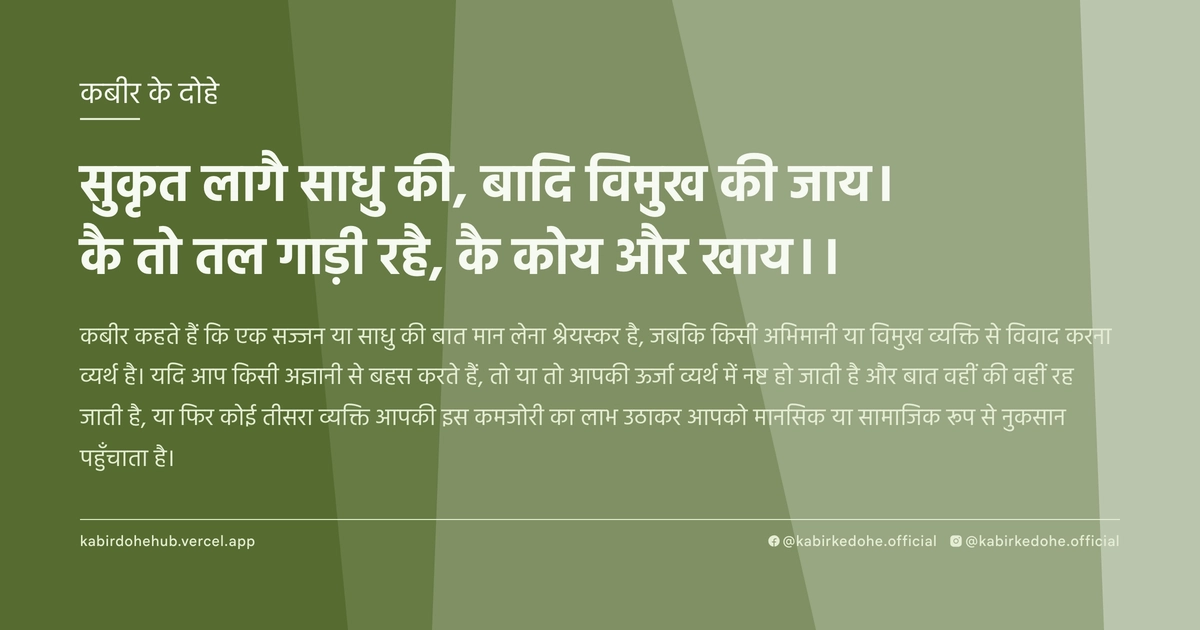
सुकृत लागै साधु की, बादि विमुख की जाय।
कै तो तल गाड़ी रहै, कै कोय और खाय।।
Sukrit laagai sadhu ki, baadi vimukh ki jaaye. Kai to tal gaadi rahai, kai koy aur khaaye.
इस पृष्ठ पर इस कबीर दोहे का अर्थ (meaning), हिंदी व्याख्या और अंग्रेज़ी अनुवाद, दार्शनिक विश्लेषण और व्यावहारिक जीवन सीख दी गई है। यह दोहा सत्संग (Satsang) विषय से जुड़ा है — Kabir doha meaning and explanation in Hindi and English.
अर्थ (Meaning):
कबीर कहते हैं कि एक सज्जन या साधु की बात मान लेना श्रेयस्कर है, जबकि किसी अभिमानी या विमुख व्यक्ति से विवाद करना व्यर्थ है। यदि आप किसी अज्ञानी से बहस करते हैं, तो या तो आपकी ऊर्जा व्यर्थ में नष्ट हो जाती है और बात वहीं की वहीं रह जाती है, या फिर कोई तीसरा व्यक्ति आपकी इस कमजोरी का लाभ उठाकर आपको मानसिक या सामाजिक रूप से नुकसान पहुँचाता है।
Kabir suggests that it is far more beneficial to accept the guidance of a realized soul (Saadhu) than to engage in futile arguments with those who are averse to truth or blinded by ego. He warns that debating with the ignorant leads to two outcomes: either the conversation remains stagnant and fruitless, or a third party exploits the conflict to cause further harm to the seeker.
व्याख्या (Interpretation):
इस दोहे का शाब्दिक अर्थ है कि साधु की बात का अनुसरण करें और विमुख व्यक्ति से विवाद न करें। आध्यात्मिक स्तर पर, 'साधु' वह है जिसने अपनी इंद्रियों और अहंकार पर विजय प्राप्त कर ली है, जबकि 'विमुख' वह है जो माया के प्रभाव में है। यहाँ 'तल गाड़ी रहना' का अर्थ है आध्यात्मिक ठहराव, जहाँ साधक अपनी ऊर्जा को तर्क-वितर्क में नष्ट कर देता है। यह निरगुण भक्ति का संकेत है कि सत्य तर्क से नहीं, बल्कि अनुभव और समर्पण से प्राप्त होता है। जब हम अहंकार से लड़ते हैं, तो हम वास्तव में अपने ही भीतर के भ्रम को पुष्ट कर रहे होते हैं। यह अद्वैत वेदांत के उस सिद्धांत को दर्शाता है जहाँ द्वैत (बहस) केवल अज्ञानता को बढ़ाता है, जबकि मौन और स्वीकृति आत्मा को ब्रह्म से जोड़ती है।
Literally, the verse advises following the wise and avoiding conflict with the stubborn. Metaphorically, the 'Saadhu' represents the awakened consciousness, while the 'Vimukh' symbolizes the ego-driven mind trapped in Maya. The phrase 'tal gaadi rahay' refers to spiritual stagnation; when a seeker engages in intellectual combat with the ignorant, they anchor themselves to the very illusion they seek to transcend. In the context of Nirgun Bhakti, truth is an experiential realization, not a logical conclusion. By arguing, the seeker reinforces the duality of 'I' and 'Other,' contradicting the Advaita Vedanta principle of non-duality. The paradox is that by trying to prove the truth to another, the seeker loses their own connection to the Truth, allowing the 'third party'—the ego—to consume their peace.
दार्शनिक विश्लेषण (Philosophical Analysis):
कबीर का यह दोहा उस सामाजिक और धार्मिक परिवेश में लिखा गया था जहाँ शास्त्रार्थ और बाहरी कर्मकांडों का बोलबाला था। कबीर ने हमेशा इस बात पर जोर दिया कि सत्य किसी किताब या बहस में नहीं, बल्कि हृदय की शुद्धता में है। उन्होंने जाति और धर्म के नाम पर होने वाले विवादों को निरर्थक माना। यहाँ उनका विरोध केवल बाहरी व्यक्तियों से नहीं, बल्कि उस 'बौद्धिक अहंकार' से है जो मनुष्य को लगता है कि वह तर्क के माध्यम से ईश्वर या सत्य को पा सकता है।
दार्शनिक रूप से, यह सूफी मत के 'फना' (अहंकार का विनाश) और अद्वैत के 'अहं ब्रह्मास्मि' के करीब है। जब हम किसी से बहस करते हैं, तो हम अपने 'अहं' को पुष्ट करते हैं। कबीर समझाते हैं कि सत्य का मार्ग समर्पण का है, न कि विजय का। यदि आप किसी विमुख व्यक्ति को सही साबित करने की कोशिश करते हैं, तो आप वास्तव में अपनी ऊर्जा को उस व्यक्ति के स्तर पर ले आते हैं।
यह मनोवैज्ञानिक रूपांतरण की बात करता है। तर्क मन का खेल है, जबकि प्रेम और मौन आत्मा की भाषा है। कबीर का संदेश है कि अपनी ऊर्जा को बाहरी विवादों के बजाय आंतरिक रूपांतरण में लगाया जाए। जो व्यक्ति स्वयं को जानने का प्रयास करता है, वह समझ जाता है कि दूसरे को बदलना असंभव है, केवल स्वयं को बदलना ही वास्तविक मुक्ति है।
यहाँ 'कोई और खाय' का गहरा अर्थ यह है कि जब दो लोग आपस में लड़ते हैं, तो समाज या बाहरी परिस्थितियाँ उनकी इस कमजोरी का लाभ उठाती हैं। यह आध्यात्मिक ऊर्जा के क्षय (leakage) की ओर इशारा करता है। जब चेतना विवाद में उलझी होती है, तो वह उच्च आयामों से कट जाती है।
अंततः, यह दोहा हमें यह सिखाता है कि मौन केवल शब्दों का अभाव नहीं है, बल्कि यह एक सक्रिय आध्यात्मिक चुनाव है। यह उस स्थिति की ओर ले जाता है जहाँ साधक यह जान लेता है कि सत्य को सिद्ध करने की आवश्यकता नहीं है, उसे केवल जिया जाना चाहिए।
This Doha emerges from an era dominated by rigid scholasticism and ritualistic debates. Kabir, a weaver by profession, challenged the notion that spiritual liberation could be achieved through intellectual superiority or scriptural mastery. He viewed the tradition of 'Shastrartha' (formal debate) as a trap for the ego, shifting the focus from the heart's purity to the mind's cleverness.
Philosophically, this aligns with the Sufi concept of 'Fana' (annihilation of the self) and the Advaita Vedanta realization of non-duality. Kabir posits that engaging in conflict with the 'Vimukh' (the averse/ignorant) is an act of reinforcing the 'I'—the very ego that prevents union with the Divine. To argue is to acknowledge the existence of a separate, opposing entity, thereby strengthening the illusion of duality.
From a psychological perspective, Kabir addresses the 'sunk cost fallacy' of spiritual energy. When a seeker attempts to correct another's ignorance through force or logic, they descend to the level of the ignorant. The transformation occurs not when the opponent is defeated, but when the seeker realizes that the need to defeat is the actual obstacle.
The warning that 'someone else may eat' refers to the spiritual leakage that occurs during conflict. In the state of anger or frustration, the subtle energy (Prana) is dissipated, leaving the practitioner vulnerable to external manipulations and internal distractions. The 'third party' is often the ego itself, which feeds on conflict to sustain its existence.
Ultimately, Kabir advocates for a 'Path of Least Resistance.' By choosing the company of the wise (Saadhu) and maintaining a strategic silence toward the ignorant, the seeker preserves their inner sanctuary. This is not an act of cowardice, but a sophisticated spiritual strategy to maintain equanimity (Samadhi) amidst the chaos of human ignorance.
मूल संदेश (Core Message):
- तर्क से सत्य नहीं, केवल भ्रम बढ़ता है।
- मौन रहना कमजोरी नहीं, बल्कि उच्चतम शक्ति है।
- अहंकारी से विवाद करना अपनी ऊर्जा का क्षय करना है।
- सत्य को सिद्ध करने की आवश्यकता नहीं, उसे जीना पर्याप्त है।
- आंतरिक शांति बाहरी जीत से कहीं अधिक मूल्यवान है।
- Logic expands illusion; only experience reveals Truth.
- Silence is not weakness, but the ultimate spiritual power.
- Debating with the ego-driven is a leakage of vital energy.
- Truth requires no proof; it only requires embodiment.
- Inner equanimity is far more precious than external victory.
व्यावहारिक उदाहरण (Practical Example):
वाराणसी के एक पुराने घाट पर माधव नाम का एक वृद्ध बुनकर रहता था। माधव अपनी सादगी और शांत स्वभाव के लिए जाना जाता था। उसी मोहल्ले में एक युवक था, जो स्वयं को बहुत बड़ा विद्वान मानता था और हर बात में दूसरों को नीचा दिखाने की कोशिश करता था। वह अक्सर माधव के पास आकर उसे यह समझाने की कोशिश करता कि उसकी बुनाई की तकनीक पुरानी है और उसे आधुनिक तरीके अपनाने चाहिए, जबकि वह वास्तव में केवल अपनी श्रेष्ठता सिद्ध करना चाहता था।
माधव चुपचाप उसकी बातें सुनता और मुस्कुरा देता। मोहल्ले के अन्य लोग माधव को उकसाते कि वह उस युवक को उसकी औकात दिखाए और उसे तर्क से हराए। लेकिन माधव जानता था कि यदि वह इस बहस में पड़ा, तो उसकी शांति भंग होगी और उसका ध्यान अपने काम और ईश्वर से हट जाएगा।
एक दिन वह युवक बहुत उग्र हो गया और माधव के काम की सार्वजनिक रूप से आलोचना करने लगा। माधव ने बस इतना कहा, 'बेटा, तुम्हारी बातें सही हो सकती हैं, मैं अपनी समझ के अनुसार काम कर रहा हूँ।' युवक को लगा कि माधव हार गया है, और वह अपनी जीत का जश्न मनाने लगा।
लेकिन कुछ समय बाद, उस युवक का अहंकार उसे इतना अंधा कर गया कि उसने अपने गुरुओं का अपमान करना शुरू कर दिया। परिणामस्वरूप, उसे समाज और उसके अपने गुरुओं ने बहिष्कृत कर दिया। वह मानसिक रूप से टूट गया और अवसाद में चला गया।
जब वह पूरी तरह टूट गया, तब वह माधव के पास आया। उसने देखा कि माधव अभी भी उसी शांति और संतोष के साथ अपना काम कर रहा था। युवक ने पूछा, 'आपने मुझे कभी टोका नहीं, कभी मेरी गलती नहीं बताई, फिर भी आप मुझसे कहीं अधिक सुखी कैसे हैं?'
माधव ने उत्तर दिया, 'मैंने तुम्हारी बातों से लड़कर अपनी ऊर्जा नष्ट नहीं की। मैंने तुम्हें तुम्हारे हाल पर छोड़ दिया क्योंकि सत्य को साबित करने की जरूरत नहीं होती, वह समय के साथ स्वयं प्रकट हो जाता है।'
युवक को समझ आया कि वह अब तक जिसे 'जीत' समझ रहा था, वह वास्तव में उसकी आध्यात्मिक हार थी। उसने माधव के चरणों में गिरकर क्षमा मांगी और मौन रहने का अभ्यास शुरू किया।
इस 'कबीर ट्विस्ट' ने युवक के जीवन को बदल दिया। उसने सीखा कि ज्ञान वह नहीं है जो दूसरों को नीचा दिखाए, बल्कि वह है जो स्वयं को विनम्र करे। उसने बहस छोड़कर सेवा का मार्ग अपनाया और अंततः आंतरिक शांति प्राप्त की।
In the ancient alleys of Varanasi, there lived an elderly weaver named Madhav. Madhav was revered for his profound simplicity and an unshakable inner calm. In the same neighborhood lived a young man, an aspiring scholar who believed his intellect was superior to all. He frequently approached Madhav, not to learn, but to critique his weaving techniques, attempting to prove that Madhav's ways were obsolete and primitive.
Madhav would listen in silence, responding only with a gentle smile. Other villagers often urged Madhav to fight back, to use his experience to humiliate the youth and prove him wrong. However, Madhav understood that entering such a conflict would only disturb his equilibrium and distract him from his devotion.
One afternoon, the youth became particularly aggressive, mocking Madhav's work in front of a crowd. Instead of defending himself, Madhav simply said, 'My son, your words may be true from your perspective; I simply work according to my understanding.' The youth perceived this as a total surrender and a victory of his intellect.
However, this perceived victory fueled the youth's arrogance. He began to belittle his own teachers and mentors, believing no one was his equal. Eventually, his hubris led to his social isolation; his mentors cast him out, and he found himself devoid of guidance and friendship.
Broken and depressed, the youth returned to Madhav. He found the old weaver still working with the same serenity and joy. The youth asked, 'You never argued with me, you never tried to correct me, yet you possess a peace that I could not find even in my intellectual victories. How?'
Madhav replied, 'I did not waste my life's energy fighting your illusions. I left you to your own journey because Truth does not need to be proven; it simply reveals itself when the noise of the ego subsides.'
This 'Kabir Twist' shattered the youth's delusions. He realized that his pursuit of 'winning' arguments was actually a process of losing himself. He surrendered his intellectual pride and began to practice the art of listening and silence.
He transformed from a critic into a seeker, understanding that true knowledge is not a weapon to defeat others, but a light to illuminate one's own darkness. He spent the rest of his days in service, finally tasting the peace that Madhav had always possessed.
अभ्यास मार्गदर्शन (Practice Guidance):
- प्रतिदिन 20 मिनट का 'मौन अभ्यास' करें, जहाँ आप किसी भी बाहरी उत्तेजना पर प्रतिक्रिया न दें।
- जब भी किसी विवाद की स्थिति उत्पन्न हो, स्वयं से पूछें: 'क्या इस बहस से मेरा अहंकार संतुष्ट होगा या मेरी आत्मा को शांति मिलेगी?'
- एक 'अहंकार जर्नल' बनाएँ जिसमें उन क्षणों को लिखें जब आपने सही होने की जिद की और उसके बाद आपको कैसा महसूस हुआ।
- डायग्नोस्टिक चेकलिस्ट: यदि आप किसी के साथ बहस करने के बाद मानसिक रूप से थका हुआ और अशांत महसूस करते हैं, तो समझें कि आप 'विमुख' की ऊर्जा में फंस गए हैं। यदि आप शांत रहते हैं, तो आप 'साधु' भाव में हैं।
- Practice 20 minutes of 'Conscious Silence' daily, observing external triggers without reacting to them.
- Whenever a conflict arises, ask yourself: 'Is this argument serving my ego's need for validation, or is it leading my soul toward peace?'
- Maintain an 'Ego Journal' to record instances where you insisted on being right and analyze the subsequent emotional state (exhaustion vs. peace).
- Diagnostic Checklist: If you feel mentally drained and agitated after a debate, you have fallen into the trap of the 'Vimukh.' If you remain centered and detached, you are embodying the 'Saadhu' consciousness.
चिंतन प्रश्न (Reflection Questions):
- मेरे जीवन में ऐसे कौन से लोग हैं जिनसे मैं बार-बार बहस करता हूँ, और वास्तव में मैं उनसे क्या सिद्ध करना चाहता हूँ?
- क्या मेरी 'सही होने की इच्छा' वास्तव में सत्य की खोज है, या यह केवल मेरे डिजिटल और सामाजिक अहंकार की भूख है?
- जब मैं किसी की बात नहीं मानता, तो क्या वह मेरी समझ के कारण है या मेरे भीतर के पूर्वाग्रहों के कारण?
- यदि मैं आज पूरी तरह से मौन हो जाऊँ, तो मेरे व्यक्तित्व का कौन सा हिस्सा सबसे ज्यादा असुरक्षित महसूस करेगा?
- क्या मैं दूसरों को बदलने की कोशिश करके वास्तव में अपनी अपनी आंतरिक रिक्तता को भरने का प्रयास कर रहा हूँ?
- Who are the people in my life I constantly argue with, and what am I actually trying to prove to them—or to myself?
- Is my 'need to be right' a genuine pursuit of truth, or is it merely the hunger of my digital and social ego?
- When I disagree with someone, is it based on a conscious realization or an unconscious bias?
- If I were to embrace absolute silence today, which part of my identity would feel the most threatened?
- Am I attempting to change others as a subconscious way of avoiding the difficult work of changing myself?