
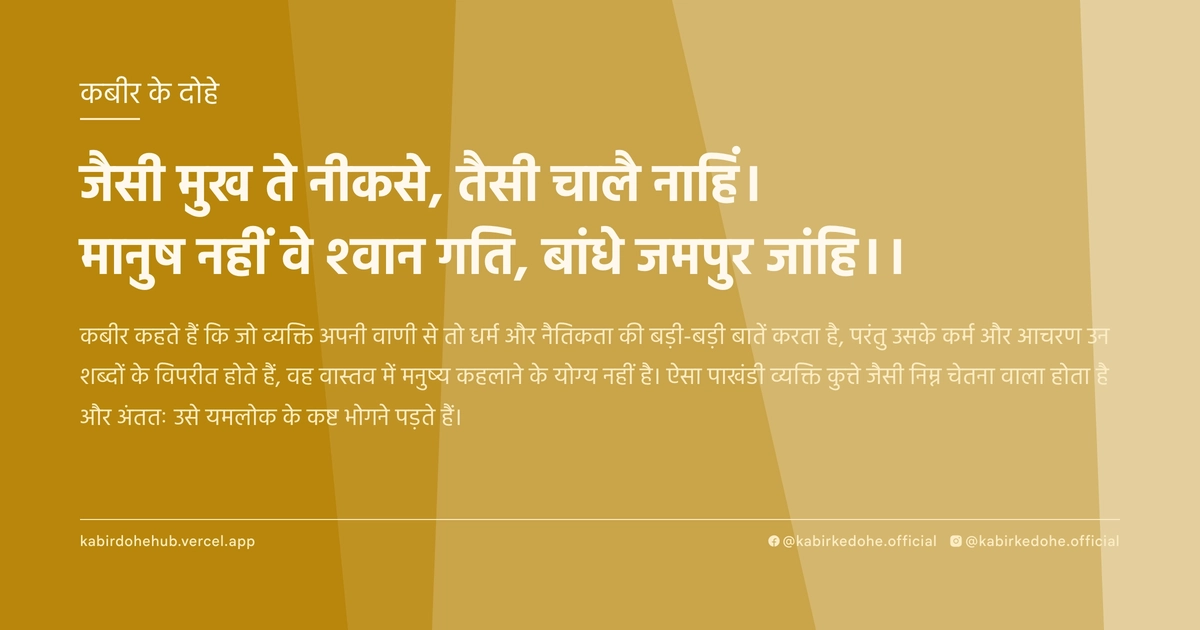
जैसी मुख ते नीकसे, तैसी चालै नाहिं।
मानुष नहीं वे श्वान गति, बांधे जमपुर जांहि।।
Jaisi mukh te neekase, taisi chaalai nahin. Manush nahi ve shwan gati, bandhe jampur jaahin.
इस पृष्ठ पर इस कबीर दोहे का अर्थ (meaning), हिंदी व्याख्या और अंग्रेज़ी अनुवाद, दार्शनिक विश्लेषण और व्यावहारिक जीवन सीख दी गई है। यह दोहा निष्ठा (Integrity) विषय से जुड़ा है — Kabir doha meaning and explanation in Hindi and English.
अर्थ (Meaning):
कबीर कहते हैं कि जो व्यक्ति अपनी वाणी से तो धर्म और नैतिकता की बड़ी-बड़ी बातें करता है, परंतु उसके कर्म और आचरण उन शब्दों के विपरीत होते हैं, वह वास्तव में मनुष्य कहलाने के योग्य नहीं है। ऐसा पाखंडी व्यक्ति कुत्ते जैसी निम्न चेतना वाला होता है और अंततः उसे यमलोक के कष्ट भोगने पड़ते हैं।
Kabir asserts that a person who speaks of righteousness and virtue but whose actions are contradictory to their words is not truly human. Such a hypocrite possesses the consciousness of a dog—driven by instinct and lack of integrity—and is ultimately bound for the sufferings of the underworld (Jampur).
व्याख्या (Interpretation):
यह दोहा कथनी और करनी के बीच के गहरे अंतराल को उजागर करता है। शाब्दिक अर्थ में, यह पाखंड की निंदा है, लेकिन आध्यात्मिक स्तर पर यह 'अहंकार' और 'माया' के प्रभाव का विश्लेषण है। जब मनुष्य की वाणी (शब्द) और उसका आचरण (कर्म) एक नहीं होते, तो वह द्वैत में जीता है। निर्गुण भक्ति के अनुसार, सत्य केवल वह है जो अनुभव में उतरे; केवल शब्दों का जाप करना या उपदेश देना शून्य है। 'श्वान गति' का अर्थ केवल पशु बनना नहीं, बल्कि अपनी प्रवृत्तियों का दास होना है। यह स्थिति आत्मा और परमात्मा के बीच के अद्वैत संबंध को बाधित करती है क्योंकि झूठ और पाखंड मन में एक पर्दा डाल देते हैं, जिससे आत्म-साक्षात्कार असंभव हो जाता है।
This couplet exposes the profound chasm between speech and action. Literally, it is a condemnation of hypocrisy, but spiritually, it analyzes the influence of 'Ahankara' (ego) and 'Maya' (illusion). When a person's words and deeds are misaligned, they exist in a state of duality. According to Nirgun Bhakti, truth is only that which is lived and experienced; the mere recitation of scriptures or preaching is void. 'Shwaan gati' (the state of a dog) does not merely imply animality, but rather being a slave to one's lower instincts. This state obstructs the non-dual relationship between the Atman and Brahman, as falsehood creates a veil over the mind, rendering self-realization impossible.
दार्शनिक विश्लेषण (Philosophical Analysis):
कबीर का यह प्रहार उस समय के धार्मिक पाखंड पर था जहाँ पंडित और मुल्ला केवल बाहरी कर्मकांडों और शब्दों के माध्यम से अपनी श्रेष्ठता सिद्ध करते थे। कबीर ने स्पष्ट किया कि ईश्वर किसी बाहरी दिखावे या शास्त्र के ज्ञान से नहीं, बल्कि आंतरिक सत्यनिष्ठा से प्राप्त होता है। यह दृष्टिकोण अद्वैत वेदांत के उस सिद्धांत से मेल खाता है जहाँ 'सत्य' को केवल बौद्धिक विमर्श नहीं, बल्कि अनुभवजन्य वास्तविकता माना गया है।
सूफी मत के 'नफ्स' (अहंकार) के सिद्धांत के अनुसार, जब तक मनुष्य अपने निचले स्वभाव को नियंत्रित नहीं करता, वह सत्य के मार्ग पर नहीं चल सकता। कबीर यहाँ चेतावनी दे रहे हैं कि शब्दों का आडंबर वास्तव में अहंकार का एक सूक्ष्म रूप है, जो व्यक्ति को यह भ्रम देता है कि वह आध्यात्मिक रूप से उन्नत है, जबकि वह वास्तव में अपनी वासनाओं का गुलाम है।
यहाँ 'जमपुर' (यमलोक) केवल एक भौगोलिक स्थान नहीं है, बल्कि एक मनोवैज्ञानिक अवस्था है। यह उस मानसिक पीड़ा और ग्लानि का प्रतीक है जो तब उत्पन्न होती है जब व्यक्ति अपनी अंतरात्मा के विरुद्ध कार्य करता है। यह कर्मफल के सिद्धांत की व्याख्या है, जहाँ कर्म शब्दों से अधिक शक्तिशाली होते हैं।
कबीर जाति और धर्म के भेदों को नकारते हुए यह संदेश देते हैं कि मानवता की कसौटी केवल 'सत्य' है। यदि आपका जीवन आपके शब्दों का प्रतिबिंब नहीं है, तो आप केवल एक सामाजिक मुखौटा पहनकर घूम रहे हैं। यह मनोवैज्ञानिक विखंडन व्यक्ति को मानसिक अशांति की ओर ले जाता है।
अंततः, यह दोहा साधक को 'साधना' से 'सहज' की ओर ले जाने का प्रयास है। सहजता वही है जहाँ विचार, शब्द और कर्म एक ही लय में हों। जब यह त्रय एक हो जाता है, तब अहंकार का विलोपन होता है और व्यक्ति वास्तव में 'मानुष' (मानव) बनता है, जो कि दिव्य चेतना का वाहक है।
Kabir's critique targets the religious hypocrisy of his era, where priests and clerics sought to establish superiority through external rituals and scriptural rhetoric. He clarifies that the Divine is not attained through outward show or theoretical knowledge, but through internal integrity. This aligns with Advaita Vedanta, where 'Satya' (Truth) is viewed not as an intellectual discourse, but as an experiential reality.
According to the Sufi concept of 'Nafs' (the lower self/ego), unless a person masters their lower instincts, they cannot walk the path of Truth. Kabir warns that the ornamentation of words is actually a subtle form of ego, creating the illusion of spiritual advancement while the individual remains a slave to their desires.
'Jampur' (the realm of Yama) is not merely a geographical destination but a psychological state. It symbolizes the mental anguish and guilt that arise when one acts against their own inner conscience. This is an interpretation of the law of Karma, where actions carry far more weight than words.
Rejecting caste and sectarian divides, Kabir posits that the only litmus test for humanity is 'Truth'. If your life is not a reflection of your words, you are merely wearing a social mask. This psychological fragmentation leads to profound inner turmoil and spiritual stagnation.
Ultimately, this couplet attempts to move the seeker from 'Sadhana' (disciplined practice) to 'Sahaj' (spontaneous natural state). Sahaj is where thought, word, and action move in a single rhythm. When this trinity aligns, the ego is annihilated, and the individual truly becomes 'Maanush' (human)—a vessel for divine consciousness.
मूल संदेश (Core Message):
- शब्द केवल मुखौटे हैं, कर्म ही वास्तविक पहचान हैं।
- पाखंड आत्मा की प्रगति में सबसे बड़ी बाधा है।
- सत्य वह नहीं जो बोला जाए, बल्कि वह है जो जिया जाए।
- अहंकार शब्दों के माध्यम से स्वयं को छिपाने का प्रयास करता है।
- आंतरिक एकता ही वास्तविक आध्यात्मिक उपलब्धि है।
- मानवता का अर्थ है कथनी और करनी का पूर्ण सामंजस्य।
- Words are mere masks; actions are the true identity.
- Hypocrisy is the greatest obstacle to spiritual evolution.
- Truth is not what is spoken, but what is lived.
- The ego attempts to hide itself through the ornamentation of words.
- Inner alignment is the only genuine spiritual achievement.
- Humanity means the complete harmony of speech and conduct.
व्यावहारिक उदाहरण (Practical Example):
वाराणसी के एक पुराने मोहल्ले में रामदीन नाम का एक वृद्ध बुनकर रहता था। वह पूरे शहर में अपनी धार्मिकता के लिए प्रसिद्ध था। वह हर सुबह गंगा स्नान करता, घंटों माला जपता और शाम को चौपाल पर बैठकर लोगों को संतोष, ईमानदारी और परोपकार के लंबे उपदेश देता था। लोग उसे 'संत' मानकर सम्मान देते थे।
लेकिन रामदीन का एक गुप्त चेहरा था। वह अपने घर में काम करने वाले एक युवा मजदूर, माधव, के साथ अत्यंत क्रूर था। वह माधव की मजदूरी काट लेता, उसे मामूली गलती पर गालियां देता और उसे अपमानित करता था। रामदीन का मानना था कि उपदेश देना उसका आध्यात्मिक कर्तव्य है, और घर के झगड़े केवल सांसारिक मामले हैं।
एक दिन, रामदीन ने चौपाल पर 'अहिंसा और करुणा' पर एक लंबा भाषण दिया। उसी समय, माधव वहां से गुजरा, जिसके हाथ में एक भारी गट्ठर था और वह थकान से चूर था। रामदीन ने सबके सामने माधव को जोर से डांटा क्योंकि उसने कपड़े तह करने में थोड़ी देरी की थी।
वहां बैठे एक मौन साधु ने रामदीन की आंखों में देखा और बस इतना कहा, 'रामदीन, तुम्हारी वाणी तो स्वर्ग की है, पर तुम्हारी चाल नर्क की। क्या तुम वास्तव में वह हो जो तुम कहते हो?'
यह वाक्य रामदीन के हृदय पर बिजली की तरह गिरा। उसे अचानक महसूस हुआ कि उसकी सारी मालाएं और उपदेश केवल एक ढोंग थे। उसने महसूस किया कि वह दुनिया को तो सुधारना चाहता था, लेकिन अपने भीतर के क्रोध और अहंकार को नहीं।
उस रात रामदीन सो नहीं सका। उसे अपनी 'श्वान गति' का आभास हुआ—वह अपनी वासनाओं और क्रोध का गुलाम था, जबकि वह खुद को ईश्वर का भक्त कहता था।
अगली सुबह, रामदीन ने माधव को बुलाया, उसकी बकाया मजदूरी दोगुनी करके दी और उसके पैर छूकर क्षमा मांगी। उसने चौपाल पर उपदेश देना छोड़ दिया और मौन रहकर सेवा करना शुरू किया।
अब रामदीन की वाणी कम थी, लेकिन उसका आचरण पवित्र था। उसने सीखा कि एक शब्द का पालन करना, हजार शब्दों के उपदेश देने से कहीं अधिक श्रेष्ठ है।
In an old neighborhood of Varanasi lived an elderly weaver named Ramdeen. He was renowned throughout the city for his piety. Every morning he bathed in the Ganges, spent hours chanting beads, and in the evenings sat at the community square giving long sermons on contentment, honesty, and philanthropy. People revered him as a 'saint'.
However, Ramdeen had a hidden side. He was extremely cruel to a young laborer in his house, Madhav. He would deduct Madhav's wages, abuse him for minor mistakes, and constantly humiliate him. Ramdeen believed that preaching was his spiritual duty, while domestic disputes were merely worldly matters.
One day, Ramdeen delivered a lengthy discourse on 'Non-violence and Compassion' at the square. At that moment, Madhav passed by, carrying a heavy bundle, exhausted from toil. In front of everyone, Ramdeen harshly scolded Madhav because he had been slightly slow in folding the fabrics.
A silent monk sitting there looked into Ramdeen's eyes and simply said, 'Ramdeen, your words belong to heaven, but your conduct belongs to hell. Are you truly who you claim to be?'
These words struck Ramdeen like a bolt of lightning. He suddenly realized that all his beads and sermons were a mere facade. He felt that while he wanted to reform the world, he had failed to conquer the anger and ego within himself.
Ramdeen could not sleep that night. He sensed his 'shwaan gati'—he was a slave to his impulses and rage, all while calling himself a devotee of God.
The next morning, Ramdeen called Madhav, paid him double his pending wages, and touched his feet in apology. He stopped giving sermons at the square and began practicing silent service.
Now, Ramdeen's speech was sparse, but his conduct was pure. He learned that living one word is far superior to preaching a thousand.
अभ्यास मार्गदर्शन (Practice Guidance):
- दैनिक आत्म-निरीक्षण: सोने से पहले एक डायरी लिखें जिसमें यह दर्ज करें कि आज आपके कौन से शब्द आपके कार्यों से मेल नहीं खाए।
- मौन व्रत का अभ्यास: सप्ताह में एक दिन कम से कम 4 घंटे मौन रहें ताकि आप शब्दों के मोह से ऊपर उठकर अपने आचरण पर ध्यान केंद्रित कर सकें।
- सत्यनिष्ठा चुनौती: अगले 30 दिनों तक कोई भी ऐसा वादा न करें जिसे आप पूरा न कर सकें, चाहे वह कितना भी छोटा क्यों न हो।
- निदान चेकलिस्ट: क्या मैं दूसरों को वह सलाह दे रहा हूँ जिसका पालन मैं स्वयं नहीं करता? क्या मेरी प्रशंसा मुझे अहंकारी बना रही है? क्या मैं अपनी गलतियों को शब्दों के पीछे छिपाता हूँ?
- Daily Self-Audit: Keep a journal before sleep recording instances where your words were not aligned with your actions today.
- Practice of Silence: Observe a vow of silence for at least 4 hours once a week to detach from the lure of words and focus on conduct.
- Integrity Challenge: For the next 30 days, make no promise that you cannot fulfill, regardless of how small it may be.
- Diagnostic Checklist: Am I giving advice to others that I do not follow myself? Is my public praise fueling my ego? Do I hide my failures behind sophisticated words?
चिंतन प्रश्न (Reflection Questions):
- यदि मेरे जीवन के सभी शब्द हटा दिए जाएं, तो क्या मेरा आचरण अभी भी मुझे 'अच्छा इंसान' साबित करेगा?
- मैं अपनी सार्वजनिक छवि को बनाए रखने के लिए अपने भीतर किन अंधेरों को छिपा रहा हूँ?
- क्या मेरी धार्मिक या आध्यात्मिक पहचान वास्तव में मेरे व्यवहार में झलकती है, या यह केवल एक सामाजिक लेबल है?
- जब मैं दूसरों की आलोचना करता हूँ, तो क्या मैं उन्हीं कमियों को अपने भीतर अनदेखा कर रहा होता हूँ?
- मेरे जीवन का वह कौन सा क्षेत्र है जहाँ मैं सबसे अधिक 'पाखंडी' महसूस करता हूँ और क्यों?
- क्या मैं सत्य बोलने के साहस से अधिक, 'सत्य जैसा दिखने' के सुख में डूबा हूँ?
- If all my words were removed from my life, would my conduct still prove me to be a 'good person'?
- What inner shadows am I hiding in order to maintain my public image?
- Does my religious or spiritual identity actually reflect in my behavior, or is it merely a social label?
- When I criticize others, am I ignoring those very same flaws within myself?
- In which area of my life do I feel most 'hypocritical', and why?
- Am I more immersed in the pleasure of 'appearing truthful' than in the courage of actually being true?