
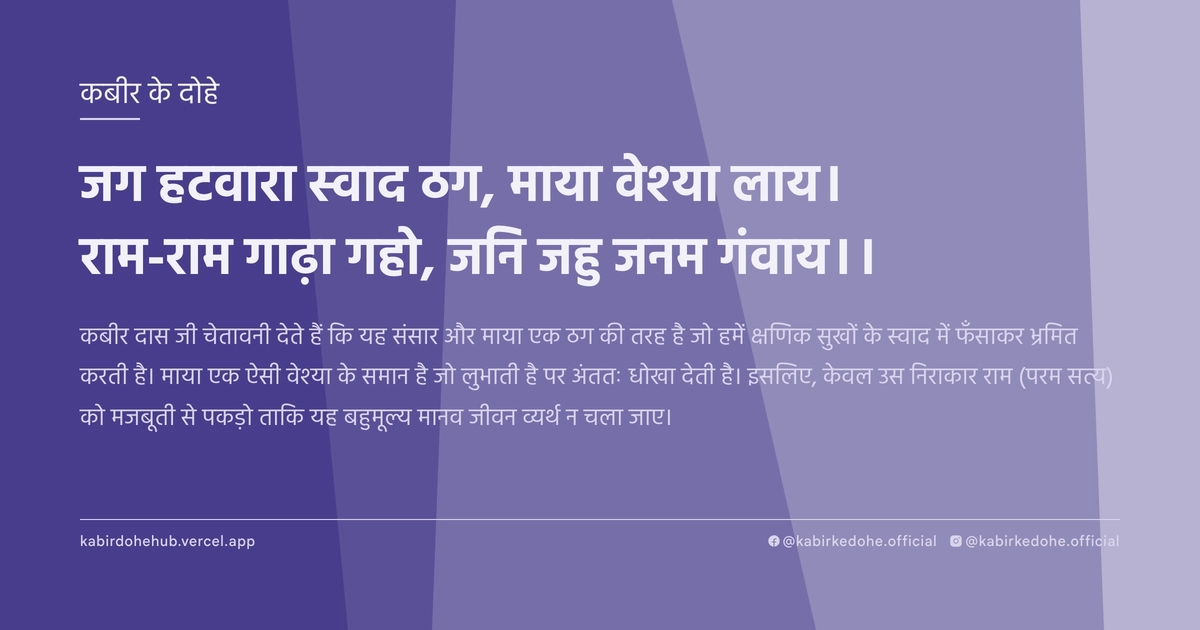
जग हटवारा स्वाद ठग, माया वेश्या लाय।
राम-राम गाढ़ा गहो, जनि जहु जनम गंवाय।।
Jag hatwara swad thag, maya veshya laaye. Ram-Ram gadha gaho, jani jahu janam ganvaye.
इस पृष्ठ पर इस कबीर दोहे का अर्थ (meaning), हिंदी व्याख्या और अंग्रेज़ी अनुवाद, दार्शनिक विश्लेषण और व्यावहारिक जीवन सीख दी गई है। यह दोहा माया (Maya) विषय से जुड़ा है — Kabir doha meaning and explanation in Hindi and English.
अर्थ (Meaning):
कबीर दास जी चेतावनी देते हैं कि यह संसार और माया एक ठग की तरह है जो हमें क्षणिक सुखों के स्वाद में फँसाकर भ्रमित करती है। माया एक ऐसी वेश्या के समान है जो लुभाती है पर अंततः धोखा देती है। इसलिए, केवल उस निराकार राम (परम सत्य) को मजबूती से पकड़ो ताकि यह बहुमूल्य मानव जीवन व्यर्थ न चला जाए।
Kabir warns that the world and Maya act as deceptive cheats, alluring us with the fleeting taste of sensory pleasures. Maya is compared to a courtesan who seduces but ultimately betrays. Therefore, one must hold firmly onto the eternal 'Ram' (the Formless Truth) to ensure that this precious human birth is not squandered in illusion.
व्याख्या (Interpretation):
इसका शाब्दिक अर्थ है कि माया हमें ठगती है, लेकिन गहरा अर्थ 'अहंकार' और 'आसक्ति' से जुड़ा है। यहाँ 'वेश्या' शब्द कामुकता का नहीं, बल्कि उस मोह का प्रतीक है जो सत्य को ढकता है। यह निर्गुण भक्ति का मार्ग है जहाँ राम कोई व्यक्ति नहीं, बल्कि वह चेतना है जो सर्वव्यापी है। माया वह पर्दा है जो आत्मा और ब्रह्म के अद्वैत संबंध को छिपाता है। जब मनुष्य बाहरी चमक-धमक में खो जाता है, तो वह अपनी वास्तविक प्रकृति को भूल जाता है। यह दोहा मनुष्य को बाहरी आडंबरों से हटाकर आंतरिक सत्य की ओर मुड़ने का आह्वान करता है।
Literally, it warns against the deception of Maya, but metaphorically, it addresses the grip of ego and attachment. The term 'courtesan' does not refer to sexuality, but to the seductive nature of illusion that veils the ultimate truth. This aligns with Nirgun Bhakti, where 'Ram' is not a deity in a temple, but the formless, omnipresent consciousness. Maya is the cosmic veil that obscures the non-duality of Atman and Brahman. When a human is consumed by external glitter, they forget their intrinsic divine nature. The couplet serves as a call to shift focus from transient appearances to the eternal essence.
दार्शनिक विश्लेषण (Philosophical Analysis):
कबीर का यह दोहा उनके समय के सामाजिक और धार्मिक पाखंड के विरुद्ध एक प्रहार है। उन्होंने देखा कि लोग कर्मकांडों और बाहरी दिखावे में उलझे हुए थे, जबकि वास्तविक आध्यात्मिक जागृति भीतर थी। यह विचार अद्वैत वेदांत के करीब है, जहाँ जगत को 'मिथ्या' माना गया है क्योंकि यह परिवर्तनशील है। कबीर माया को एक 'ठग' कहते हैं क्योंकि यह हमें यह विश्वास दिलाती है कि सुख वस्तुओं के संग्रह में है, जबकि सुख केवल आत्म-साक्षात्कार में है।
सूफी मत के 'फना' (अहंकार का विनाश) की तरह, कबीर भी चाहते हैं कि साधक अपनी झूठी पहचान को मिटा दे। उनके लिए 'राम-राम' का जाप केवल शब्दों का दोहराव नहीं, बल्कि उस परम तत्व के साथ एकाकार होने की प्रक्रिया है। वे जाति और धर्म की दीवारों को तोड़कर एक ऐसे सत्य की बात करते हैं जो सार्वभौमिक है।
यहाँ 'माया' का मनोवैज्ञानिक विश्लेषण यह है कि हमारी इंद्रियाँ हमें केवल वही दिखाती हैं जो वे देखना चाहती हैं। हम अपनी इच्छाओं को ही सत्य मान लेते हैं। कबीर इस मानसिक जाल को तोड़ने की सलाह देते हैं। वे कहते हैं कि यदि हम इस मोह-माया के जाल में फँसे रहे, तो हमारा जन्म केवल शारीरिक अस्तित्व बनकर रह जाएगा, आध्यात्मिक विकास नहीं होगा।
यह दोहा ritualism (कर्मकांड) की निरर्थकता को दर्शाता है। मंदिर, मस्जिद या तीर्थयात्रा तब तक व्यर्थ हैं जब तक मन के भीतर का लालच और अहंकार समाप्त नहीं होता। कबीर का 'राम' वह शून्य है जिसमें सब कुछ विलीन हो जाता है।
अंततः, यह संदेश है कि समय सीमित है। मानव जीवन एक दुर्लभ अवसर है। यदि हम इसे केवल सांसारिक सुखों की खोज में बिता देंगे, तो हम उस अनंत शांति को खो देंगे जो केवल आत्म-ज्ञान से प्राप्त होती है।
This couplet is a sharp critique of the social and religious hypocrisy of Kabir's era. He observed people entangled in rituals and external displays while true spiritual awakening remained internal. This perspective aligns with Advaita Vedanta, where the material world is termed 'Mithya' (illusory) because it is transient and ever-changing. Kabir describes Maya as a 'cheat' because it tricks the soul into believing that happiness lies in the accumulation of objects, whereas true bliss resides only in self-realization.
Similar to the Sufi concept of 'Fana' (the annihilation of the ego), Kabir urges the seeker to dissolve their false identity. For him, chanting 'Ram-Ram' is not a mere repetition of words but a process of merging with the Absolute Truth. He transcends the barriers of caste and creed to speak of a truth that is universal and formless.
Psychologically, Maya represents the filter of our senses; we perceive only what our desires project. We mistake our cravings for reality. Kabir advises breaking this mental trap. He argues that if we remain ensnared by this illusion, our human birth becomes a mere biological existence rather than a spiritual evolution.
The verse highlights the futility of ritualism. Temples, mosques, and pilgrimages are meaningless unless the greed and ego within the heart are extinguished. Kabir's 'Ram' is the primordial void (Shunya) into which all distinctions dissolve.
Ultimately, the message is about the finitude of time. Human life is a rare opportunity. If spent solely in the pursuit of worldly pleasures, one misses the eternal peace attainable only through the knowledge of the Self.
मूल संदेश (Core Message):
- सांसारिक सुख एक सुंदर भ्रम है जो आत्मा को सुला देता है।
- अहंकार वह पर्दा है जो हमें परमात्मा से अलग करता है।
- बाहरी कर्मकांड केवल मन को बहलाने के साधन हैं।
- सत्य की खोज बाहर नहीं, बल्कि स्वयं के भीतर है।
- जीवन की सार्थकता केवल आत्म-साक्षात्कार और प्रेम में है।
- Worldly pleasures are a beautiful illusion that puts the soul to sleep.
- Ego is the veil that separates the individual from the Divine.
- External rituals are merely distractions for the wandering mind.
- The search for truth is not outward, but within the self.
- The meaning of life lies solely in self-realization and love.
व्यावहारिक उदाहरण (Practical Example):
वाराणसी के घाटों पर रहने वाले एक वृद्ध विधवा, जानकी, की कहानी है। जानकी ने अपना पूरा जीवन धार्मिक अनुष्ठानों, कठिन उपवासों और दूसरों को यह दिखाने में बिता दिया कि वह कितनी 'पवित्र' है। वह हर दिन घंटों पूजा करती थी, लेकिन उसके मन में उन लोगों के प्रति घृणा थी जो उसके अनुसार 'अधर्मी' थे। उसका अहंकार उसकी भक्ति के पीछे छिपा था।
एक दिन, उसने एक फकीर को देखा जो बिना किसी माला या मंदिर के, बस शांति से बैठा था। जब जानकी ने उससे पूछा कि वह कैसे मोक्ष पाएगा, तो फकीर ने मुस्कुराकर कहा, 'माँ, तुम पत्थर को पूज रही हो, लेकिन अपने भीतर के पत्थर (अहंकार) को नहीं देख रही हो। यह बाहरी दिखावा ही वह माया है जो तुम्हें असली राम से दूर रख रही है।'
यह बात जानकी के दिल में चुभ गई। उसने महसूस किया कि उसकी सारी 'भक्ति' वास्तव में उसके अहंकार को पोषण दे रही थी। वह खुद को दूसरों से श्रेष्ठ मान रही थी। यही वह 'ठग' था जिसने उसे वर्षों तक भ्रम में रखा था।
धीरे-धीरे, जानकी ने दिखावे की पूजा छोड़ दी। उसने अपने भीतर की कड़वाहट को पहचानना शुरू किया। उसने महसूस किया कि असली राम किसी मूर्ति में नहीं, बल्कि उस करुणा में है जो वह दूसरों के प्रति महसूस करती है।
उसने घाट पर आने वाले गरीब बच्चों को पढ़ाना और उन्हें भोजन कराना शुरू किया। अब वह घंटों मंत्र नहीं पढ़ती थी, बल्कि हर कार्य को एक प्रार्थना की तरह करने लगी।
उसका जीवन अब बाहरी प्रशंसा का मोह नहीं रहा। उसने पाया कि जब उसने 'मैं पवित्र हूँ' का भ्रम छोड़ा, तब उसे वास्तविक शांति मिली।
उसकी आँखों में अब क्रोध नहीं, बल्कि एक गहरी स्थिरता थी। वह अब किसी को जज नहीं करती थी, क्योंकि उसने जान लिया था कि सबमें वही एक नूर है।
जानकी का यह परिवर्तन 'कबीर ट्विस्ट' था—जहाँ उसने बाहरी धर्म को छोड़कर आंतरिक धर्म को अपनाया। उसने अपनी पहचान एक 'धार्मिक महिला' से बदलकर एक 'प्रेमपूर्ण आत्मा' बना ली।
अंत में, वह जान गई कि जीवन का अर्थ अनुष्ठानों को पूरा करना नहीं, बल्कि अहंकार को मिटाकर प्रेम में विलीन होना है।
उसकी मृत्यु के समय, पूरा शहर उसे उसकी पवित्रता के लिए नहीं, बल्कि उसकी निस्वार्थ सेवा और प्रेम के लिए याद कर रहा था।
Consider the story of Janaki, an elderly widow living on the ghats of Varanasi. Janaki spent her entire life immersed in religious rituals, rigorous fasting, and projecting an image of extreme 'purity.' She spent hours in prayer daily, yet harbored deep resentment toward those she deemed 'unrighteous.' Her ego was cleverly hidden behind her devotion.
One day, she encountered a wandering fakir who sat in absolute stillness, without any prayer beads or temple. When Janaki asked how he expected to achieve salvation, the fakir smiled and said, 'Mother, you worship the stone, but you ignore the stone (ego) within your own heart. This external display is the very Maya that keeps you from the true Ram.'
These words pierced Janaki's heart. She realized that her entire 'devotion' was actually feeding her pride. She had been using her spirituality to feel superior to others. This was the 'cheat' that had kept her in illusion for decades.
Slowly, Janaki abandoned the performative aspects of her faith. She began to acknowledge the bitterness within her. She realized that the true Ram did not reside in an idol, but in the compassion she extended to others.
She started teaching and feeding the impoverished children who gathered on the ghats. She no longer spent hours chanting mantras; instead, she turned every act of service into a prayer.
Her life was no longer driven by the desire for external validation. She discovered that once she let go of the illusion of being 'the most pious,' she found genuine peace.
The anger in her eyes was replaced by a profound stillness. She stopped judging others, recognizing that the same divine light resided in everyone.
This was Janaki's 'Kabir Twist'—shifting from external religion to internal spirituality. She transformed her identity from a 'religious woman' to a 'loving soul.'
In the end, she understood that the purpose of life is not to complete rituals, but to dissolve the ego and merge into love.
When she passed away, the city remembered her not for her purity, but for her selfless service and unconditional love.
अभ्यास मार्गदर्शन (Practice Guidance):
- दैनिक आत्म-निरीक्षण: हर रात सोने से पहले विचार करें कि आज आपने कितनी बार अपनी 'छवि' (Image) को बचाने के लिए झूठ बोला या अहंकार दिखाया।
- मौन साधना: प्रतिदिन 20 मिनट पूर्ण मौन में बैठें। बाहरी शोर को नहीं, बल्कि मन के भीतर उठने वाले 'लालच' और 'तुलना' के विचारों को देखें।
- सेवा का अभ्यास: किसी ऐसे व्यक्ति की मदद करें जिससे आपको कोई लाभ न मिले और इस बात का गर्व भी न करें कि आपने मदद की है।
- डायग्नोस्टिक चेकलिस्ट: यदि आप अभी भी दूसरों की आलोचना कर रहे हैं या अपनी धार्मिकता पर गर्व महसूस कर रहे हैं, तो समझें कि आप अभी भी माया के 'ठग' के प्रभाव में हैं।
- Daily Self-Inquiry: Before sleep, reflect on how many times today you acted to protect your 'image' or displayed ego through subtle superiority.
- Silence Practice: Sit in complete silence for 20 minutes daily. Do not focus on external noise, but observe the internal currents of 'greed' and 'comparison.'
- Anonymous Service: Help someone from whom you gain nothing and ensure you feel no pride in the act of helping.
- Diagnostic Checklist: If you still find yourself judging others or feeling proud of your spiritual 'progress,' recognize that you are still under the influence of Maya's deception.
चिंतन प्रश्न (Reflection Questions):
- मेरी कौन सी ऐसी 'धार्मिक' या 'नैतिक' आदतें हैं जो वास्तव में मेरे अहंकार को संतुष्ट करती हैं?
- यदि मेरी सारी सामाजिक प्रतिष्ठा और पद छीन लिए जाएँ, तो मेरे पास क्या बचेगा?
- मैं दूसरों की मदद वास्तव में उनके लिए करता हूँ, या अपनी 'अच्छे इंसान' वाली छवि को पुष्ट करने के लिए?
- मेरे जीवन में 'माया' का वह कौन सा रूप है जो मुझे सबसे अधिक भ्रमित करता है—पैसा, प्रशंसा, या सत्ता?
- क्या मैं वास्तव में सत्य की खोज में हूँ, या मैं केवल सत्य के बारे में बात करना पसंद करता हूँ?
- Which of my 'religious' or 'moral' habits are actually serving to satisfy my ego?
- If all my social status and titles were stripped away, what would truly remain of me?
- Do I help others for their sake, or to reinforce my image as a 'good person'?
- Which form of Maya most deceives me—money, praise, or power?
- Am I truly seeking the truth, or do I simply enjoy talking about the truth?