
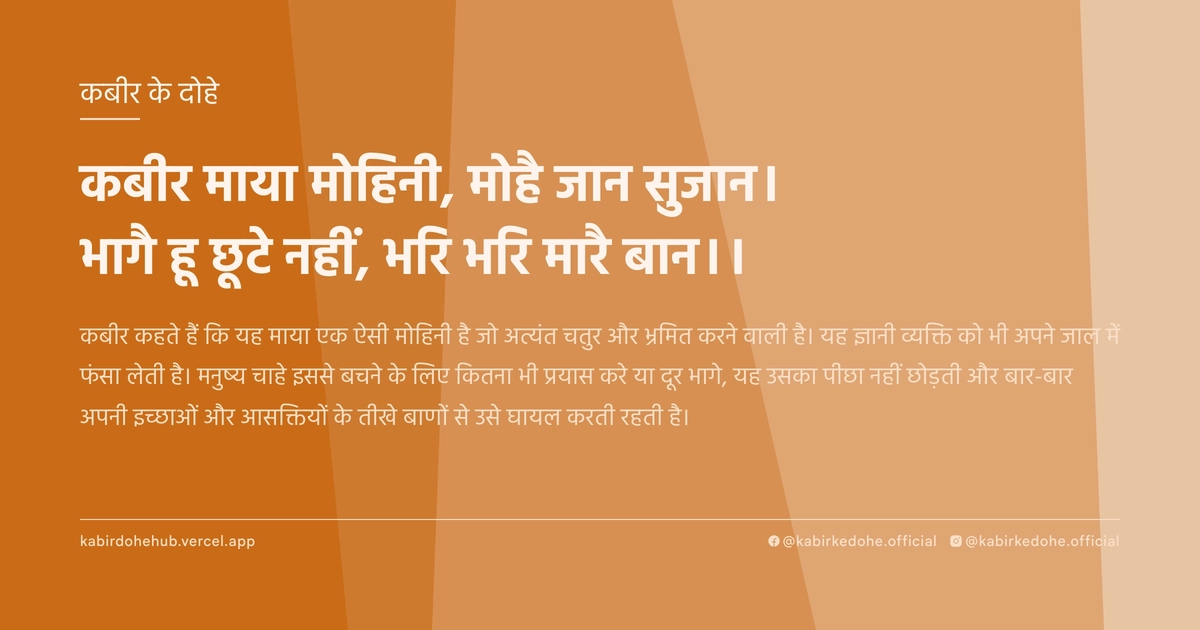
कबीर माया मोहिनी, मोहै जान सुजान।
भागै हू छूटे नहीं, भरि भरि मारै बान।।
Kabir maya mohini, mohai jaan sujan. Bhage hu chhute nahi, bhari bhari mare baan.
इस पृष्ठ पर इस कबीर दोहे का अर्थ (meaning), हिंदी व्याख्या और अंग्रेज़ी अनुवाद, दार्शनिक विश्लेषण और व्यावहारिक जीवन सीख दी गई है। यह दोहा माया (Maya) विषय से जुड़ा है — Kabir doha meaning and explanation in Hindi and English.
अर्थ (Meaning):
कबीर कहते हैं कि यह माया एक ऐसी मोहिनी है जो अत्यंत चतुर और भ्रमित करने वाली है। यह ज्ञानी व्यक्ति को भी अपने जाल में फंसा लेती है। मनुष्य चाहे इससे बचने के लिए कितना भी प्रयास करे या दूर भागे, यह उसका पीछा नहीं छोड़ती और बार-बार अपनी इच्छाओं और आसक्तियों के तीखे बाणों से उसे घायल करती रहती है।
Kabir asserts that Maya is a powerful enchantress, a cosmic illusion that deceils even the most discerning and wise souls. Despite one's desperate attempts to flee or escape its grip, Maya relentlessly pursues the seeker, striking them repeatedly with the piercing arrows of desire, attachment, and worldly distraction.
व्याख्या (Interpretation):
साब्दिक अर्थ में, माया एक जादूगरनी की तरह है जो सत्य को छिपा देती है। आध्यात्मिक स्तर पर, यह 'अविद्या' है जो आत्मा को उसके वास्तविक स्वरूप (ब्रह्म) से अलग दिखाती है। निर्गुण भक्ति के अनुसार, माया कोई बाहरी शक्ति नहीं बल्कि मन का वह भ्रम है जो नश्वर को शाश्वत मान लेता है। जब साधक 'मैं' और 'मेरा' के अहंकार में फंसता है, तो वह माया के बाणों का शिकार होता है। यह द्वैत का वह जाल है जहाँ आत्मा स्वयं को शरीर और नाम मान बैठती है। इस विरोधाभास को समझना आवश्यक है कि जिसे हम संसार कहते हैं, वह केवल एक मानसिक प्रक्षेपण है। अंततः, माया से भागना समाधान नहीं है, बल्कि उसे 'जानना' ही उससे मुक्त होने का एकमात्र मार्ग है।
Literally, Maya is depicted as an enchantress who veils the ultimate truth. Spiritually, it represents 'Avidya' or primordial ignorance that separates the Atman from its non-dual identity with Brahman. In the context of Nirgun Bhakti, Maya is not an external entity but a psychological distortion where the transient is mistaken for the eternal. When the seeker clings to the ego ('I' and 'Mine'), they are struck by the arrows of attachment. This is the central paradox: the soul believes it is a limited entity trapped in a physical form. The struggle to 'flee' from the world is futile because the illusion resides within the mind. Liberation comes not through avoidance, but through the realization that the enchantress is a mirror of one's own ignorance.
दार्शनिक विश्लेषण (Philosophical Analysis):
कबीर का यह दोहा उस युग की उपज है जहाँ कर्मकांड और बाहरी आडंबर चरम पर थे। कबीर ने ritualism का विरोध करते हुए यह स्पष्ट किया कि मोक्ष किसी मंदिर या मस्जिद में नहीं, बल्कि आंतरिक जागरूकता में है। यहाँ माया का वर्णन अद्वैत वेदांत के 'माया' सिद्धांत से मेल खाता है, जहाँ जगत को मिथ्या कहा गया है। कबीर का दृष्टिकोण सूफी मत के 'नफ्स' (अहंकार) के विलोपन के समान है, जहाँ साधक को अपनी वासनाओं को मारकर सत्य की प्राप्ति करनी होती है।
माया के 'बान' वास्तव में हमारी पांच इंद्रियों और उनसे जुड़ी कामनाएं हैं। जब हम किसी वस्तु या व्यक्ति से अत्यधिक मोह करते हैं, तो वह मोह ही दुख का कारण बनता है। कबीर चेतावनी देते हैं कि बौद्धिक ज्ञान (सुजान होना) पर्याप्त नहीं है; जब तक अनुभवजन्य ज्ञान (Anubhuti) नहीं होता, तब तक माया का प्रभाव बना रहता है।
यह विश्लेषण दर्शाता है कि कबीर जाति और धर्म के भेदों को निरर्थक मानते थे क्योंकि माया सभी को समान रूप से भ्रमित करती है। एक ब्राह्मण और एक जुलाहा, दोनों ही माया के जाल में समान रूप से फंसे हैं यदि वे अहंकार से ग्रस्त हैं।
मनोवैज्ञानिक स्तर पर, यह दोहा 'संज्ञानात्मक विसंगति' (Cognitive Dissonance) की बात करता है। हम जानते हैं कि मृत्यु निश्चित है, फिर भी हम संसार को स्थायी मानकर उससे चिपकते हैं। यही वह मानसिक संघर्ष है जिसे कबीर 'बाण' कह रहे हैं।
अंततः, कबीर का संदेश यह है कि माया से युद्ध करके उसे जीता नहीं जा सकता। जैसे अंधेरे को हटाने के लिए अंधेरे से लड़ना व्यर्थ है और केवल प्रकाश की आवश्यकता होती है, वैसे ही माया का अंत केवल आत्म-साक्षात्कार (Self-realization) के प्रकाश से संभव है।
This couplet emerges from an era dominated by rigid ritualism and caste hierarchies. Kabir vehemently rejected the notion that spiritual liberation could be achieved through external ceremonies, asserting instead that the battle is internal. His conceptualization of Maya aligns closely with Advaita Vedanta, where the perceived world is an illusion (Mithya) obscuring the singular reality of Brahman. Similarly, it echoes the Sufi concept of 'Nafs' (the lower self), which must be annihilated to achieve union with the Divine.
The 'arrows' mentioned by Kabir are the sensory cravings and psychological attachments that bind the soul. He warns that intellectual knowledge (being 'Sujaan') is insufficient; without experiential realization (Anubhuti), the mind remains susceptible to the enchantments of the ego.
Kabir’s philosophy dismantles social stratification. By identifying Maya as the universal deceiver, he implies that a priest and a weaver are equally trapped if they are governed by desire. The struggle is not against a social order, but against the internal mechanism of attachment.
Psychologically, this describes the tension between the conscious knowledge of impermanence and the subconscious drive for permanence. We logically understand that everything ends, yet we emotionally cling to the temporary. This dissonance is the source of the 'arrows' of suffering.
Ultimately, Kabir suggests that Maya cannot be defeated through avoidance or combat. Just as one does not fight darkness but simply introduces light, the illusion of Maya is dissolved not by fleeing the world, but by the awakening of the witness consciousness (Sakshi), which sees through the veil.
मूल संदेश (Core Message):
- माया बाहरी नहीं, आंतरिक मानसिक भ्रम है।
- बौद्धिक ज्ञान पर्याप्त नहीं, अनुभवजन्य बोध आवश्यक है।
- इच्छाओं का त्याग ही दुखों का एकमात्र अंत है।
- अहंकार का विलोपन ही वास्तविक मुक्ति का मार्ग है।
- सत्य को जानने के लिए मोह के पर्दे को हटाना होगा।
- आत्मा और ब्रह्म की एकता ही माया का विनाश करती है।
- Maya is not external; it is an internal mental distortion.
- Intellectual knowledge is insufficient; experiential realization is key.
- The cessation of craving is the only end to suffering.
- The annihilation of the ego is the sole path to liberation.
- The veil of attachment must be lifted to perceive the Truth.
- The realization of non-duality dissolves the illusion of Maya.
व्यावहारिक उदाहरण (Practical Example):
वाराणसी के घाटों पर रहने वाले एक वृद्ध विधवा, जानकी, का जीवन अत्यंत सरल था। उन्होंने अपना पूरा जीवन धर्म और परंपराओं के पालन में बिताया था। उनके लिए 'मोक्ष' का अर्थ था केवल पूजा-पाठ और कठोर व्रत। वे मानती थीं कि यदि वे हर नियम का पालन करेंगी, तो माया उन्हें छुएगी भी नहीं।
एक दिन, उन्होंने देखा कि उनका इकलौता पोता, जिसे वे बहुत प्यार करती थीं, शहर जाकर उनके संस्कारों को भूल गया और केवल धन कमाने में लग गया। जानकी को गहरा दुख हुआ। उन्हें लगा कि उनकी सारी तपस्या व्यर्थ गई क्योंकि उनका मोह अभी भी अपने पोते के प्रति था।
वे घंटों रोतीं और भगवान से शिकायत करतीं कि उन्होंने तो सब कुछ त्याग दिया, फिर भी यह दुख उन्हें क्यों मिल रहा है। वे स्वयं को 'सुजान' (ज्ञानी) मानती थीं क्योंकि वे शास्त्रों के अनुसार जी रही थीं, लेकिन उनका हृदय अभी भी आसक्ति के बाणों से घायल था।
तभी उनकी मुलाकात एक घुमक्कड़ फकीर से हुई, जिसने उन्हें कबीर का यह दोहा सुनाया। फकीर ने उनसे कहा, 'माँ, तुम मंदिर की दीवारों के पीछे भाग रही हो, लेकिन माया तुम्हारे भीतर के मोह में बैठी है। तुम पोते से नहीं, बल्कि अपनी उस उम्मीद से जुड़ी हो कि वह तुम्हारे अनुसार चले।'
जानकी को पहली बार अहसास हुआ कि उनकी पूजा केवल एक ढाल थी, जिसके पीछे उन्होंने अपने मोह को छिपा रखा था। उन्होंने महसूस किया कि वे जिस 'पवित्रता' का दावा कर रही थीं, वह वास्तव में एक सूक्ष्म अहंकार था।
उन्होंने धीरे-धीरे यह स्वीकार करना शुरू किया कि उनका पोता एक स्वतंत्र आत्मा है और उसका जीवन उसके अपने कर्मों का फल है। उन्होंने अपनी प्रार्थनाओं को 'मांगने' के बजाय 'समर्पण' में बदल दिया।
जैसे ही उन्होंने इस सूक्ष्म मोह को छोड़ा, उन्हें एक अद्भुत शांति का अनुभव हुआ। अब उन्हें पोते के पत्रों का इंतजार तो था, लेकिन उसकी अनुपस्थिति उन्हें तोड़ती नहीं थी।
जानकी ने सीखा कि माया से भागना (व्रत और नियमों में छिपना) समाधान नहीं है, बल्कि यह स्वीकार करना कि 'मैं' कुछ नहीं हूँ, असली मुक्ति है।
उनका जीवन अब केवल अनुष्ठानों का समूह नहीं था, बल्कि करुणा और तटस्थता का एक जीवंत उदाहरण बन गया। उन्होंने पाया कि जब मोह का बाण निकल जाता है, तो हृदय वास्तव में हल्का हो जाता है।
अंततः, जानकी ने अपनी शेष आयु अन्य असहाय वृद्धों की सेवा में लगा दी, जहाँ अब कोई 'मेरा' या 'तेरा' नहीं था, केवल एक निस्वार्थ प्रेम था।
In the ancient Ghats of Varanasi lived an elderly widow named Janaki. Her life was a testament to rigid adherence to tradition and religious piety. For her, 'Moksha' meant the meticulous performance of rituals and strict fasting. She believed that by following every scriptural rule, she could insulate herself from the influence of Maya.
One day, she realized that her only grandson, whom she adored, had moved to the city and abandoned her traditional values in pursuit of material wealth. Janaki was devastated. She felt her lifelong austerity was futile because her heart still bled for her grandson's perceived failures.
She spent hours weeping, questioning the Divine as to why she, a 'devout' woman, was still suffering. She considered herself 'Sujaan' (wise) because of her knowledge of the scriptures, yet she was being pierced by the arrows of attachment.
During this turmoil, she met a wandering fakir who recited Kabir's doha to her. The fakir remarked, 'Mother, you are fleeing into the walls of the temple, but Maya resides in your attachment. You are not attached to your grandson, but to the image of him that you want him to be.'
For the first time, Janaki realized that her rituals were merely a shield behind which she had hidden her deep-seated possessiveness. She understood that her 'piety' was actually a subtle form of ego, a belief that she was superior because of her discipline.
She began the slow process of accepting that her grandson was a free soul, and his path was his own. She transformed her prayers from 'requests for change' into 'acts of surrender.'
As she released this subtle grip, a profound peace descended upon her. She still loved her grandson, but his absence or choices no longer shattered her inner equilibrium.
Janaki learned that fleeing Maya through external rules is an illusion; the only true escape is the dissolution of the 'I' that claims ownership over others.
Her life ceased to be a collection of rituals and became a living example of equanimity and compassion. She discovered that once the arrow of attachment is removed, the heart becomes weightless.
In her final years, she dedicated herself to serving other abandoned elderly women, where there was no longer a 'mine' or 'thine,' only a boundless, selfless love.
अभ्यास मार्गदर्शन (Practice Guidance):
- साक्षी भाव का अभ्यास: प्रतिदिन 20 मिनट मौन बैठें और अपने विचारों को ऐसे देखें जैसे आप किसी फिल्म को देख रहे हों। यह पहचानें कि कौन सा विचार 'मोह' (attachment) से प्रेरित है।
- आत्म-पूछताछ (Self-Inquiry): जब भी क्रोध या दुख महसूस हो, स्वयं से पूछें—'यह दुख किसका है? क्या यह उस आत्मा का है जो अविनाशी है, या उस अहंकार का है जो कुछ खोने से डर रहा है?'
- अनासक्ति का प्रयोग: दिन में एक बार ऐसी वस्तु या स्थिति के प्रति तटस्थ रहने का प्रयास करें जिससे आप बहुत अधिक जुड़े हुए हैं। यह अनुभव करें कि आपकी खुशी उस बाहरी वस्तु पर निर्भर नहीं है।
- डायग्नोस्टिक चेकलिस्ट: क्या मैं दूसरों को बदलने की कोशिश कर रहा हूँ? क्या मेरी शांति मेरी परिस्थितियों पर निर्भर है? क्या मैं अपनी धार्मिक पहचान का उपयोग श्रेष्ठता महसूस करने के लिए करता हूँ? यदि हाँ, तो माया के बाण अभी भी सक्रिय हैं।
- Practice of Witness Consciousness: Sit in silence for 20 minutes daily, observing your thoughts as if watching a movie. Identify which thoughts are driven by 'Moh' (attachment).
- Self-Inquiry: Whenever anger or sorrow arises, ask yourself—'Who is experiencing this pain? Is it the eternal soul, or the ego that fears loss?'
- Experiment with Non-attachment: Once a day, consciously practice equanimity toward a person or object you are deeply attached to. Realize that your intrinsic joy does not depend on external variables.
- Diagnostic Checklist: Am I trying to control others? Is my peace contingent on external circumstances? Do I use my spiritual or religious identity to feel superior? If yes, the arrows of Maya are still active.
चिंतन प्रश्न (Reflection Questions):
- मेरी कौन सी ऐसी 'पवित्र' आदतें हैं जो वास्तव में मेरे अहंकार को पोषण दे रही हैं?
- मैं किन रिश्तों में प्यार के नाम पर केवल स्वामित्व (ownership) की भावना रखता हूँ?
- यदि आज मेरी सारी सामाजिक पहचान (पद, प्रतिष्ठा, धर्म) छीन ली जाए, तो मेरे भीतर क्या बचेगा?
- क्या मैं वास्तव में सत्य की खोज कर रहा हूँ, या केवल अपनी सुख-सुविधाओं के लिए आध्यात्मिकता का सहारा ले रहा हूँ?
- मेरे जीवन का वह कौन सा 'बाण' है जिसने मुझे सबसे अधिक घायल किया है, और वह बाण वास्तव में किसने चलाया—बाहरी दुनिया ने या मेरे अपने मोह ने?
- क्या मेरी डिजिटल पहचान (Social Media Ego) मेरी वास्तविक आत्मा को ढकने वाली एक आधुनिक माया है?
- Which of my 'pious' habits are actually feeding my hidden ego?
- In which relationships do I mistake a desire for ownership for genuine love?
- If all my social identities (status, prestige, religion) were stripped away today, what would remain within me?
- Am I truly seeking the Truth, or am I using spirituality as a tool for personal comfort and psychological security?
- Which 'arrow' in my life has caused the most pain, and who truly fired it—the external world or my own attachment?
- Is my digital persona (Social Media Ego) a modern manifestation of Maya, veiling my authentic self?