
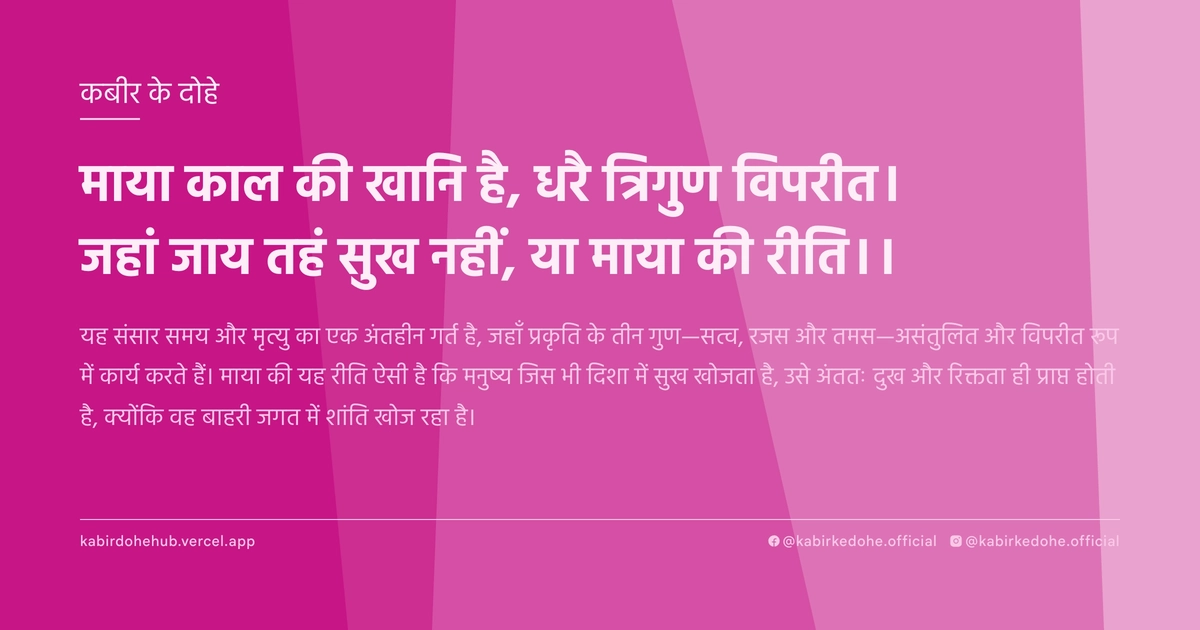
माया काल की खानि है, धरै त्रिगुण विपरीत।
जहां जाय तहं सुख नहीं, या माया की रीति।।
Maya kal ki khani hai, dharai trigun viprit. Jahan jaaye tahan sukh nahi, ya maya ki riti.
इस पृष्ठ पर इस कबीर दोहे का अर्थ (meaning), हिंदी व्याख्या और अंग्रेज़ी अनुवाद, दार्शनिक विश्लेषण और व्यावहारिक जीवन सीख दी गई है। यह दोहा माया (Maya) विषय से जुड़ा है — Kabir doha meaning and explanation in Hindi and English.
अर्थ (Meaning):
यह संसार समय और मृत्यु का एक अंतहीन गर्त है, जहाँ प्रकृति के तीन गुण—सत्व, रजस और तमस—असंतुलित और विपरीत रूप में कार्य करते हैं। माया की यह रीति ऐसी है कि मनुष्य जिस भी दिशा में सुख खोजता है, उसे अंततः दुख और रिक्तता ही प्राप्त होती है, क्योंकि वह बाहरी जगत में शांति खोज रहा है।
This world is an endless mine of time and mortality, where the three gunas—Sattva, Rajas, and Tamas—operate in a distorted and conflicting manner. Such is the way of Maya (illusion) that wherever a human seeks happiness in the external realm, they find only sorrow and emptiness, for they are chasing shadows in a transient world.
व्याख्या (Interpretation):
कबीर यहाँ 'काल' को केवल समय नहीं, बल्कि उस विनाशकारी शक्ति के रूप में देखते हैं जो जीव को जन्म-मृत्यु के चक्र में बांधे रखती है। 'त्रिगुण विपरीत' का अर्थ है कि जब तक हम प्रकृति के गुणों के अधीन हैं, हमारा विवेक बाधित रहता है और हम भ्रमित रहते हैं। यह दोहा निरगुण भक्ति के उस सिद्धांत को रेखांकित करता है जहाँ संसार को एक मायाजाल माना गया है। आत्मा जब स्वयं को शरीर या सामाजिक पहचान के साथ जोड़ती है, तो वह इस 'खान' में गिर जाती है। अद्वैत वेदांत के अनुसार, जब तक द्वैत (दो होने का भाव) बना रहता है, सुख असंभव है। वास्तविक सुख केवल उस निराकार ब्रह्म में है जो गुणों से परे (गुणातीत) है।
Kabir views 'Kaal' not merely as time, but as the destructive force that binds the soul to the cycle of birth and death. 'Trigun vipreet' implies that as long as we are governed by the three qualities of nature, our discernment remains clouded and distorted. This couplet underscores the principle of Nirgun Bhakti, where the world is perceived as a web of Maya. When the Atman identifies with the physical body or social persona, it falls into this 'mine' of temporal existence. According to Advaita Vedanta, as long as duality persists, true bliss is unattainable. Real peace exists only in the formless Brahman, which is Gunatita—transcending all qualities.
दार्शनिक विश्लेषण (Philosophical Analysis):
कबीर का यह दर्शन उनके समय के कर्मकांडीय धर्म और बाहरी आडंबरों के प्रति एक तीव्र प्रतिक्रिया था। उन्होंने देखा कि लोग मंदिर, मस्जिद और तीर्थयात्राओं में सुख खोज रहे हैं, जबकि दुख उनके अपने अहंकार और अज्ञान में निहित है। यह दोहा सूफीवाद के 'फना' (अहंकार का विनाश) और वेदांत के 'माया' सिद्धांत का एक सुंदर संगम है। कबीर तर्क देते हैं कि संसार की संरचना ही ऐसी है कि वह कभी तृप्ति नहीं दे सकता।
ऐतिहासिक रूप से, कबीर ने जाति व्यवस्था और धार्मिक श्रेष्ठता को चुनौती दी क्योंकि ये सभी 'माया' के ही सूक्ष्म रूप हैं। जब कोई व्यक्ति कहता है कि वह किसी विशेष जाति का है, तो वह वास्तव में त्रिगुणों के जाल में फंसकर अपनी वास्तविक पहचान (ब्रह्म) को भूल जाता है। यहाँ 'विपरीत' शब्द यह दर्शाता है कि प्रकृति के गुण हमें जोड़ने के बजाय अलग करते हैं।
मनोवैज्ञानिक स्तर पर, यह दोहा हमारी 'इच्छाओं के चक्र' का विश्लेषण करता है। हम एक सुख से दूसरे सुख की ओर भागते हैं, लेकिन हर उपलब्धि के बाद एक नया खालीपन पैदा हो जाता है। यह 'माया की रीति' है। कबीर हमें चेतावनी देते हैं कि बाहरी दुनिया में सुख की खोज करना एक ऐसी प्यास बुझाने जैसा है जिसमें हम खारा पानी पी रहे हों।
अद्वैत वेदांत के परिप्रेक्ष्य में, यह संसार 'मिथ्या' है। यह पूरी तरह गायब नहीं है, बल्कि यह वैसा नहीं है जैसा दिखाई देता है। जब साधक इस सत्य को जान लेता है कि वह शरीर नहीं बल्कि शुद्ध चेतना है, तब वह काल की इस खान से मुक्त हो जाता है। यह मुक्ति किसी स्वर्ग की प्राप्ति नहीं, बल्कि वर्तमान क्षण में स्वयं के वास्तविक स्वरूप को पहचानना है।
अंततः, कबीर का संदेश यह है कि मोक्ष का मार्ग बाहर नहीं, बल्कि भीतर है। जब हम गुणों के द्वंद्व से ऊपर उठकर साक्षी भाव (Witness Consciousness) में स्थित होते हैं, तब माया का प्रभाव समाप्त हो जाता है। यह एक क्रांतिकारी विचार था जिसने मध्यकालीन भारत में व्यक्ति को ईश्वर के लिए किसी मध्यस्थ (पुजारी या मौलवी) की आवश्यकता से मुक्त किया और सीधे अनुभव पर जोर दिया।
Kabir's philosophy was a sharp reaction to the ritualistic religion and external ostentations of his era. He observed people seeking happiness in temples, mosques, and pilgrimages, while the root of their suffering lay in their own ego and ignorance. This couplet is a sublime synthesis of the Sufi concept of 'Fana' (annihilation of the ego) and the Vedantic theory of 'Maya'. Kabir argues that the very structure of the world is such that it can never provide ultimate satisfaction.
Historically, Kabir challenged the caste system and religious superiority, viewing them as subtle manifestations of Maya. When an individual claims a specific caste identity, they are essentially trapped in the distorted play of the trigunas, forgetting their true identity as Brahman. The word 'vipreet' indicates that these natural qualities, instead of unifying us, serve to alienate and divide.
On a psychological level, this doha analyzes our 'cycle of desire'. We chase one pleasure after another, yet every achievement leaves a new void. This is the 'way of Maya'. Kabir warns that seeking happiness in the external world is akin to quenching thirst by drinking saltwater—it only increases the longing.
From the perspective of Advaita Vedanta, this world is 'Mithya' (illusory). It does not mean it doesn't exist, but that it is not as it appears. When the seeker realizes they are not the body but pure consciousness, they are liberated from this 'mine' of time. This liberation is not the attainment of a distant heaven, but the recognition of one's true nature in the present moment.
Ultimately, Kabir's message is that the path to salvation is internal, not external. When we rise above the conflict of the gunas and reside in the state of 'Sakshi' (Witness Consciousness), the influence of Maya ceases. This was a revolutionary idea that freed the individual from the need for intermediaries—priests or clerics—and emphasized direct experiential realization.
मूल संदेश (Core Message):
- बाहरी दुनिया सुख का स्रोत नहीं, बल्कि एक भ्रम है।
- समय और मृत्यु का भय केवल अज्ञानता से पैदा होता है।
- गुणों के द्वंद्व से ऊपर उठना ही वास्तविक मुक्ति है।
- संग्रह नहीं, बल्कि विसर्जन ही शांति का मार्ग है।
- आत्मा का स्वरूप निराकार है, इसे माया में न खोजें।
- The external world is not a source of joy, but an illusion.
- Fear of time and death is born solely from ignorance.
- Rising above the conflict of gunas is true liberation.
- Relinquishment, not accumulation, is the path to peace.
- The soul is formless; do not seek it within Maya.
व्यावहारिक उदाहरण (Practical Example):
वाराणसी के एक पुराने घाट पर माधव नाम का एक वृद्ध नाविक रहता था। माधव का पूरा जीवन नाव चलाने और यात्रियों को पार उतारने में बीता था। उसने अपनी पूरी उम्र इस विश्वास में बिताई कि यदि वह अधिक धन संचित करेगा, तो उसके अंतिम दिन सुखद होंगे। उसने अपनी ईमानदारी और कड़ी मेहनत से काफी संपत्ति जमा की, लेकिन जैसे-जैसे उसकी संपत्ति बढ़ी, उसकी चिंताएं भी बढ़ती गईं।
वह अब रात भर जागकर अपने धन की सुरक्षा की चिंता करता था। उसे डर था कि कोई उसकी जमापूंजी चुरा लेगा। उसके पास बेहतरीन कपड़े थे और बड़ा घर था, लेकिन उसके मन में शांति का एक कतरा भी नहीं था। वह अक्सर सोचता था कि उसने जीवन भर सुख की तलाश की, फिर भी वह आज सबसे अधिक दुखी क्यों है?
एक दिन उसकी नाव पर एक फकीर सवार हुआ, जिसकी आंखों में एक अजीब सी शांति थी। माधव ने अपनी संपत्ति का गर्व दिखाते हुए फकीर से पूछा, 'महाराज, मैंने जीवन भर मेहनत की, सब कुछ हासिल किया, फिर भी मेरा मन अशांत क्यों है?'
फकीर ने मुस्कुराते हुए माधव की ओर देखा और कहा, 'माधव, तूने जिस नाव को किनारे लगाने की कोशिश की है, वह रेत पर बनी है। तूने धन को सुख माना, लेकिन धन केवल एक साधन है, गंतव्य नहीं। तूने समय (काल) की उस खान में खुदाई की जहाँ केवल मिट्टी मिलती है, सोना नहीं।'
माधव को पहले तो यह बात समझ नहीं आई। लेकिन फकीर ने उसे एक प्रयोग बताया: 'अगले सात दिनों तक, अपनी संपत्ति का एक हिस्सा उन लोगों को दो जिन्हें इसकी वास्तव में जरूरत है, और देखो कि तुम्हारे भीतर क्या बदलता है।'
माधव ने हिचकिचाते हुए ऐसा करना शुरू किया। उसने एक गरीब विधवा की मदद की और एक अनाथ बच्चे की शिक्षा का जिम्मा लिया। जैसे-जैसे वह अपनी 'पकड़' ढीली करता गया, उसे महसूस हुआ कि उसका डर कम हो रहा है। उसने पाया कि सुख संचय करने में नहीं, बल्कि विसर्जन में था।
उसे समझ आया कि वह अब तक 'माया की रीति' का शिकार था—यह विश्वास कि बाहरी वस्तुएं आंतरिक शांति दे सकती हैं। उसने महसूस किया कि उसके त्रिगुण (लोभ, क्रोध, मोह) उसे विपरीत दिशा में ले जा रहे थे।
अंततः, माधव ने अपनी संपत्ति का एक बड़ा हिस्सा सामुदायिक सेवा में लगा दिया। वह अब भी नाव चलाता था, लेकिन अब वह केवल पैसे के लिए नहीं, बल्कि सेवा के भाव से चलाता था। उसकी बाहरी स्थिति नहीं बदली थी, लेकिन उसके भीतर का 'काल' समाप्त हो गया था और वह एक शाश्वत शांति का अनुभव करने लगा था।
On an ancient ghat in Varanasi lived an elderly boatman named Madhav. Madhav had spent his entire life rowing boats and ferrying passengers across the river. He lived by the conviction that if he accumulated enough wealth, his final years would be blissful. Through honesty and hard work, he amassed significant riches, but as his wealth grew, so did his anxieties.
He began spending his nights awake, worrying about the security of his savings. He feared someone would steal his hoard. He possessed the finest clothes and a large house, yet not a shred of peace resided in his heart. He often wondered why, despite a lifetime of chasing happiness, he felt more miserable than ever.
One day, a fakir with an extraordinary peace in his eyes boarded his boat. With a hint of pride in his possessions, Madhav asked, 'Maharaj, I worked hard all my life and achieved everything, yet why is my mind so restless?'
The fakir smiled and looked at Madhav, saying, 'Madhav, the boat you are trying to moor is made of sand. You mistook wealth for happiness, but wealth is merely a means, not the destination. You have been digging in the mine of time (Kaal), where only dust is found, not gold.'
Madhav did not understand at first. But the fakir suggested an experiment: 'For the next seven days, give a portion of your wealth to those who truly need it, and observe what changes within you.'
Madhav hesitantly began to do so. He helped a poor widow and took responsibility for the education of an orphaned child. As he loosened his 'grip' on his possessions, he noticed his fear diminishing. He discovered that happiness lay not in accumulation, but in relinquishment.
He realized he had been a victim of the 'way of Maya'—the belief that external objects could provide internal peace. He saw how his trigunas (greed, anger, attachment) were pulling him in the opposite direction of truth.
Ultimately, Madhav dedicated a large part of his wealth to community service. He continued to row his boat, but no longer for mere money, but with a spirit of service. His external circumstances hadn't changed, but the 'Kaal' within him had ceased, and he began to experience an eternal peace.
अभ्यास मार्गदर्शन (Practice Guidance):
- दैनिक साक्षी भाव: दिन में तीन बार 10 मिनट के लिए मौन बैठें और अपने विचारों को ऐसे देखें जैसे आप किसी अजनबी को देख रहे हों। यह आपको 'माया' के प्रभाव से अलग करेगा।
- अनासक्ति अभ्यास: हर दिन एक ऐसी वस्तु या विचार का त्याग करें जिससे आप अत्यधिक जुड़े हुए हैं। यह महसूस करें कि आपकी पहचान उस वस्तु से नहीं है।
- आत्म-पूछताछ जर्नल: प्रतिदिन लिखें—'आज मैंने किस बाहरी चीज़ में सुख खोजा और क्या वह सुख स्थायी था?'
- निदान चेकलिस्ट: यदि आप छोटी बातों पर क्रोधित हो रहे हैं, भविष्य की चिंता में डूबे हैं, या दूसरों से अपनी तुलना कर रहे हैं, तो समझ लें कि आप 'त्रिगुण विपरीत' की स्थिति में हैं।
- Daily Witnessing: Sit in silence for 10 minutes three times a day, observing your thoughts as if you are watching a stranger. This detaches you from the influence of 'Maya'.
- Practice of Non-Attachment: Every day, consciously let go of one object or thought you are overly attached to. Realize that your identity is not tied to that object.
- Self-Inquiry Journal: Write daily—'In what external thing did I seek happiness today, and was that happiness permanent?'
- Diagnostic Checklist: If you find yourself reacting with anger to trivialities, drowning in future anxieties, or comparing yourself to others, recognize that you are in the state of 'Trigun Vipreet'.
चिंतन प्रश्न (Reflection Questions):
- मेरी वह कौन सी 'डिजिटल पहचान' है जिसे मैं वास्तविक सुख मान बैठा हूँ?
- मैं किन सामाजिक मुखौटों के पीछे अपनी वास्तविक आत्मा को छिपा रहा हूँ?
- क्या मेरा 'परोपकार' वास्तव में निस्वार्थ है, या यह मेरे अहंकार को संतुष्ट करने का एक तरीका है?
- यदि आज मेरा सब कुछ छीन लिया जाए, तो मेरे भीतर क्या बचेगा?
- मैं किन ऐसी इच्छाओं के पीछे भाग रहा हूँ जिन्हें मैं जानता हूँ कि वे मुझे कभी संतुष्ट नहीं करेंगी?
- Which 'digital identity' of mine have I mistaken for real happiness?
- Behind which social masks am I hiding my true soul?
- Is my 'philanthropy' truly selfless, or is it a way to satisfy my ego?
- If everything were taken from me today, what would remain within me?
- Which desires am I chasing that I know will never truly satisfy me?