
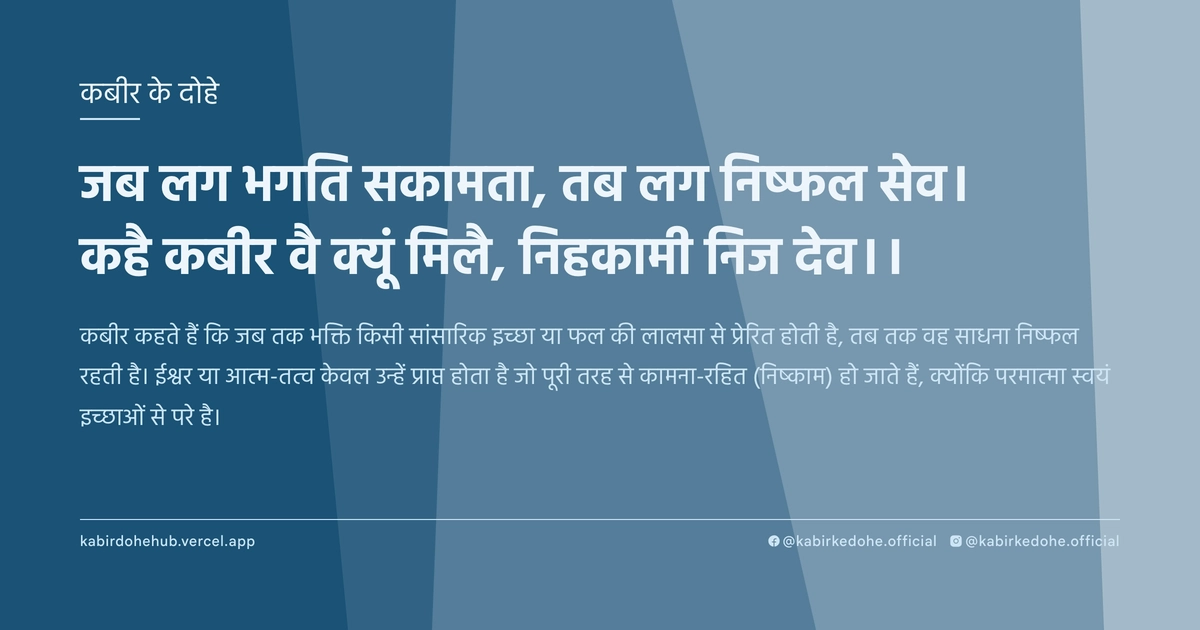
जब लग भगति सकामता, तब लग निष्फल सेव।
कहै कबीर वै क्यूं मिलै, निहकामी निज देव।।
Jab lag bhagati sakamata, tab lag nishphal sev. Kahai Kabir vai kyun milai, nihkaami nij dev.
इस पृष्ठ पर इस कबीर दोहे का अर्थ (meaning), हिंदी व्याख्या और अंग्रेज़ी अनुवाद, दार्शनिक विश्लेषण और व्यावहारिक जीवन सीख दी गई है। यह दोहा भक्ति (Bhakti) विषय से जुड़ा है — Kabir doha meaning and explanation in Hindi and English.
अर्थ (Meaning):
कबीर कहते हैं कि जब तक भक्ति किसी सांसारिक इच्छा या फल की लालसा से प्रेरित होती है, तब तक वह साधना निष्फल रहती है। ईश्वर या आत्म-तत्व केवल उन्हें प्राप्त होता है जो पूरी तरह से कामना-रहित (निष्काम) हो जाते हैं, क्योंकि परमात्मा स्वयं इच्छाओं से परे है।
Kabir asserts that as long as devotion is driven by desire or the expectation of a reward, the spiritual practice remains fruitless. The Divine or the True Self is only attainable to those who have become completely desireless, for the Ultimate Reality exists beyond the realm of wanting.
व्याख्या (Interpretation):
इस दोहे का शाब्दिक अर्थ है कि स्वार्थपूर्ण भक्ति व्यर्थ है। गहरा आध्यात्मिक विश्लेषण यह है कि 'सकाम' भक्ति वास्तव में ईश्वर की नहीं, बल्कि अपनी इच्छाओं की पूजा है। जब हम कुछ माँगते हैं, तो हम द्वैत (duality) को पुष्ट करते हैं—एक माँगने वाला और एक देने वाला। निर्गुण भक्ति का मार्ग इस द्वैत को मिटाने का है। माया हमें विश्वास दिलाती है कि बाहरी वस्तुएं सुख देंगी, जबकि वास्तविक आनंद 'निहकामी' होने में है। जब अहंकार और इच्छा का विलोपन होता है, तब आत्मा और ब्रह्म की एकता (अद्वैत) का अनुभव होता है। यह विरोधाभास है कि जिसे हम पाने की कोशिश करते हैं, वह तभी मिलता है जब हम पाने की इच्छा छोड़ देते हैं।
Literally, the verse states that selfish devotion is futile. Metaphorically, 'Sakam' (desire-driven) devotion is not the worship of God, but the worship of one's own cravings. By asking for something, we reinforce duality—the seeker and the provider. The path of Nirgun Bhakti aims to dissolve this separation. Maya deceives us into believing that external acquisitions bring peace, whereas true bliss lies in being 'Nihkami' (desireless). When the ego and its attachments vanish, the non-duality of Atman and Brahman is realized. It is the central paradox of spirituality: the Divine is attained only when the desire to attain it is relinquished.
दार्शनिक विश्लेषण (Philosophical Analysis):
कबीर का यह दृष्टिकोण उनके युग के कर्मकांडी और पाखंडी धार्मिक वातावरण के विरुद्ध एक सशक्त प्रहार था। उस समय लोग तीर्थयात्रा, व्रत और दान केवल स्वर्ग की प्राप्ति या पापों से मुक्ति के लिए करते थे। कबीर ने इसे 'व्यापार' कहा, 'भक्ति' नहीं। उनके अनुसार, जो भक्ति सौदेबाजी पर आधारित है, वह आत्मा को मुक्त करने के बजाय उसे और अधिक बंधन में डालती है।
यह विचार अद्वैत वेदांत के 'निष्काम कर्म' और सूफी मत के 'फना' (अहंकार का विनाश) के करीब है। सूफीवाद में 'इश्क-ए-हकीकी' (ईश्वरीय प्रेम) वह है जिसमें प्रेमी अपनी पहचान खो देता है और केवल प्रिय शेष रहता है। यदि प्रेमी पुरस्कार की इच्छा रखता है, तो वह प्रेम नहीं, बल्कि एक समझौता है। कबीर यहाँ मनोवैज्ञानिक रूपांतरण की बात कर रहे हैं जहाँ साधक अपनी पहचान को 'कर्ता' से बदलकर 'साक्षी' बना लेता है।
सांस्कृतिक रूप से, कबीर ने जाति और धर्म के बाहरी ढांचों को नकारते हुए आंतरिक शुद्धि पर जोर दिया। उन्होंने स्पष्ट किया कि मोक्ष किसी विशेष अनुष्ठान से नहीं, बल्कि मन की वासनाओं के अंत से मिलता है। यह विश्लेषण हमें सिखाता है कि आध्यात्मिक प्रगति का पैमाना यह नहीं है कि हमने कितनी प्रार्थनाएँ कीं, बल्कि यह है कि हमारे भीतर कितनी इच्छाएँ मरीं।
अक्सर लोग इस दोहे को गलत समझकर यह मानते हैं कि इच्छाएं रखना पाप है। वास्तव में, कबीर इच्छाओं के विरुद्ध युद्ध करने को नहीं, बल्कि उनके प्रति अनासक्त (detached) होने को कह रहे हैं। जब इच्छा का केंद्र 'मैं' से हटकर 'परमात्मा' या 'समष्टि' पर टिक जाता है, तो वह सकाम से निष्काम में बदल जाती है।
अंततः, यह दर्शन इस सत्य को स्थापित करता है कि परमात्मा कोई बाहरी सत्ता नहीं है जिसे मनाया जा सके, बल्कि वह हमारा अपना शुद्ध स्वरूप है। जब तक हम बाहरी फल की तलाश करते हैं, हम अपनी ही आंतरिक वास्तविकता से दूर भागते रहते हैं।
Kabir's perspective was a powerful strike against the ritualistic and hypocritical religious atmosphere of his era. People performed pilgrimages and charities merely for the sake of heaven or liberation from sin. Kabir termed this 'commerce,' not 'devotion.' He argued that devotion based on bargaining binds the soul further rather than liberating it.
This thought aligns closely with the 'Nishkama Karma' of Advaita Vedanta and the Sufi concept of 'Fana' (annihilation of the ego). In Sufism, 'Ishq-e-Haqiqi' (Divine Love) is that where the lover loses their identity, leaving only the Beloved. If the lover desires a reward, it is a transaction, not love. Kabir is discussing a psychological transformation where the seeker shifts from being the 'doer' to the 'witness.'
Culturally, Kabir rejected the external structures of caste and religion, emphasizing internal purification. He clarified that liberation comes not from specific rituals, but from the cessation of mental cravings. This analysis teaches us that the measure of spiritual progress is not how many prayers were recited, but how many desires were extinguished.
Common literalist misconceptions suggest that having desires is a sin. In reality, Kabir is not advocating for a war against desire, but for detachment. When the center of desire shifts from 'I' to the 'Universal' or 'Divine,' it transforms from Sakam to Nishkam.
Ultimately, this philosophy establishes that the Divine is not an external entity to be appeased, but our own pure essence. As long as we search for external rewards, we continue to flee from our own internal reality.
मूल संदेश (Core Message):
- इच्छा ही ईश्वर और आत्मा के बीच की सबसे बड़ी दीवार है।
- सच्ची प्रार्थना माँगना नहीं, बल्कि स्वयं को मिटाना है।
- जब 'मैं' समाप्त होता है, तब 'वह' प्रकट होता है।
- निष्कामता ही वह कुंजी है जो मोक्ष के द्वार खोलती है।
- परमात्मा कोई वस्तु नहीं जिसे पाया जाए, बल्कि एक अवस्था है जिसे जिया जाए।
- Desire is the greatest wall between the Divine and the Soul.
- True prayer is not asking, but the annihilation of the self.
- When the 'I' ends, the 'He/That' manifests.
- Desirelessness is the key that unlocks the doors of liberation.
- God is not an object to be acquired, but a state to be lived.
व्यावहारिक उदाहरण (Practical Example):
वाराणसी के एक पुराने घाट पर माधव नाम का एक वृद्ध नाविक रहता था। माधव का पूरा जीवन केवल अधिक पैसे कमाने और अपने परिवार के लिए संपत्ति जोड़ने की इच्छा में बीता। वह हर सुबह गंगा किनारे मंदिर में जाकर यह मन्नत माँगता कि उसकी नाव में अधिक सवारी आए और वह शहर का सबसे अमीर नाविक बन जाए। वह घंटों पूजा करता, लेकिन उसका मन हमेशा इस बात में रहता कि आज कितनी कमाई होगी।
एक दिन उसकी नाव एक भीषण तूफान में फंस गई। उसने अपनी पूरी शक्ति लगा दी, लेकिन लहरें उसे निगलने वाली थीं। उस क्षण, उसकी सारी संपत्ति, उसकी लालसा और उसके अहंकार का कोई मूल्य नहीं रहा। उसने महसूस किया कि जिस ईश्वर से वह केवल 'लाभ' माँग रहा था, वह वास्तव में उसके भीतर की शांति में था, न कि उसकी तिजोरी में।
उसने चिल्लाकर प्रार्थना नहीं की, बल्कि पहली बार पूरी तरह समर्पित होकर मौन हो गया। उसने अपनी जान बचाने की इच्छा भी छोड़ दी और बस उस अनंत प्रवाह में विलीन होने को तैयार हो गया। इसी 'निहकामी' अवस्था में उसे एक असीम शांति का अनुभव हुआ, जिसने उसे डर से मुक्त कर दिया।
चमत्कारिक रूप से, लहरें शांत हो गईं और वह किनारे लग गया। उस दिन के बाद माधव बदल गया। वह अब भी नाव चलाता था, लेकिन अब वह सवारी से पैसे लेने के बजाय, उनकी सेवा को अपनी भक्ति मानता था।
वह अब मंदिर में मन्नतें नहीं माँगता था, बल्कि केवल कृतज्ञता व्यक्त करता था। उसने देखा कि जब उसने 'पाने' की इच्छा छोड़ी, तो उसे वह संतोष मिला जो करोड़ों रुपयों से नहीं मिला था।
गाँव के लोग हैरान थे कि माधव अब पहले से अधिक खुश और शांत था, जबकि उसकी आर्थिक स्थिति वैसी ही थी। वह अब केवल एक नाविक नहीं, बल्कि एक जीवित संत बन चुका था।
उसका जीवन अब एक 'सौदे' से 'समर्पण' में बदल गया था। उसने समझ लिया था कि ईश्वर को पाने का रास्ता माँगने से नहीं, बल्कि खाली होने से शुरू होता है।
माधव की कहानी यह सिखाती है कि जब तक हम ईश्वर को एक 'डिलीवरी सर्विस' की तरह देखते हैं, हम उनसे दूर रहते हैं। जिस दिन हम केवल उनके होने का आनंद लेते हैं, हम वास्तव में उन्हें पा लेते हैं।
On an old ghat in Varanasi lived an elderly boatman named Madhav. Madhav's entire life was spent in the desire to earn more money and accumulate wealth for his family. Every morning, he would visit the temple by the Ganges and pray for more passengers and to become the richest boatman in the city. He spent hours in prayer, but his mind was always calculating today's earnings.
One day, his boat was caught in a violent storm. He exerted all his strength, but the waves were about to swallow him. In that moment, all his wealth, his cravings, and his ego became worthless. He realized that the God from whom he only asked for 'profit' was actually in the peace within him, not in his coffers.
He did not scream in prayer; for the first time, he became completely surrendered and silent. He let go even of the desire to save his own life and prepared to merge into the infinite flow. In this state of 'Nihkami' (desirelessness), he experienced an immense peace that freed him from fear.
Miraculously, the waves calmed, and he reached the shore. After that day, Madhav changed. He still rowed the boat, but now he viewed serving the passengers as his devotion rather than a means to earn money.
He no longer asked for favors at the temple but expressed only gratitude. He discovered that when he stopped wanting to 'get,' he found a contentment that millions of rupees could not buy.
Villagers were surprised that Madhav was now happier and calmer, even though his financial status remained the same. He was no longer just a boatman, but a living saint.
His life had shifted from a 'transaction' to 'surrender.' He understood that the path to God begins not with asking, but with becoming empty.
Madhav's story teaches us that as long as we view God as a 'delivery service,' we remain distant. The day we enjoy the mere presence of the Divine, we truly find Them.
अभ्यास मार्गदर्शन (Practice Guidance):
- दैनिक अभ्यास: प्रतिदिन 20 मिनट मौन बैठें। जब भी कोई इच्छा (चाहे वह छोटी हो या बड़ी) मन में आए, उसे दबाएँ नहीं, बल्कि केवल एक साक्षी की तरह देखें और कहें, 'यह मेरी इच्छा है, मेरा स्वरूप नहीं'।
- आत्म-पूछताछ जर्नल: हर रात लिखें कि आज आपने कितनी बार ईश्वर या ब्रह्मांड से कुछ 'माँगा' और कितनी बार केवल 'धन्यवाद' दिया। विश्लेषण करें कि माँगने के पीछे का डर क्या था।
- व्यवहारिक परिवर्तन: सप्ताह में एक बार ऐसा कार्य करें जिसके बदले में आप किसी भी प्रकार के लाभ, प्रशंसा या प्रतिफल की अपेक्षा न करें। इसे पूरी तरह गुप्त रखें।
- डायग्नोस्टिक चेकलिस्ट: क्या मैं प्रार्थना के बाद परिणाम की चिंता करता हूँ? क्या मेरी शांति मेरी इच्छाओं की पूर्ति पर निर्भर है? यदि हाँ, तो मैं अभी भी 'सकाम' भक्ति में हूँ।
- Daily Practice: Sit in silence for 20 minutes daily. Whenever a desire arises (small or large), do not suppress it; instead, observe it as a witness and say, 'This is my desire, not my essence.'
- Self-Inquiry Journal: Every night, record how many times you 'asked' for something from the Divine/Universe and how many times you simply gave 'thanks.' Analyze the fear behind the asking.
- Behavioral Change: Once a week, perform an act of service where you expect absolutely no reward, praise, or return. Keep this act entirely secret.
- Diagnostic Checklist: Do I worry about the outcome after praying? Is my peace dependent on the fulfillment of my desires? If yes, I am still in 'Sakam' (desire-driven) devotion.
चिंतन प्रश्न (Reflection Questions):
- यदि आपकी सभी भौतिक इच्छाएं आज पूरी हो जाएं, तो क्या आप वास्तव में शांत होंगे, या नई इच्छाएं जन्म लेंगी?
- आपकी प्रार्थनाएं वास्तव में ईश्वर के प्रति प्रेम हैं, या केवल अपनी जरूरतों की एक सूची?
- आपका 'डिजिटल ईगो' (सोशल मीडिया पर छवि) किस तरह की सकाम भक्ति का आधुनिक रूप है?
- क्या आप बिना किसी शर्त के किसी से प्रेम कर सकते हैं, या आपका प्रेम हमेशा कुछ पाने की उम्मीद रखता है?
- वह कौन सा डर है जो आपको पूरी तरह से 'निहकामी' होने से रोकता है?
- If all your material desires were fulfilled today, would you truly be at peace, or would new desires emerge?
- Are your prayers truly love for the Divine, or just a shopping list of your needs?
- How is your 'digital ego' (social media image) a modern form of desire-driven devotion?
- Can you love someone unconditionally, or does your love always expect something in return?
- What is the underlying fear that prevents you from becoming completely 'Nihkami' (desireless)?