
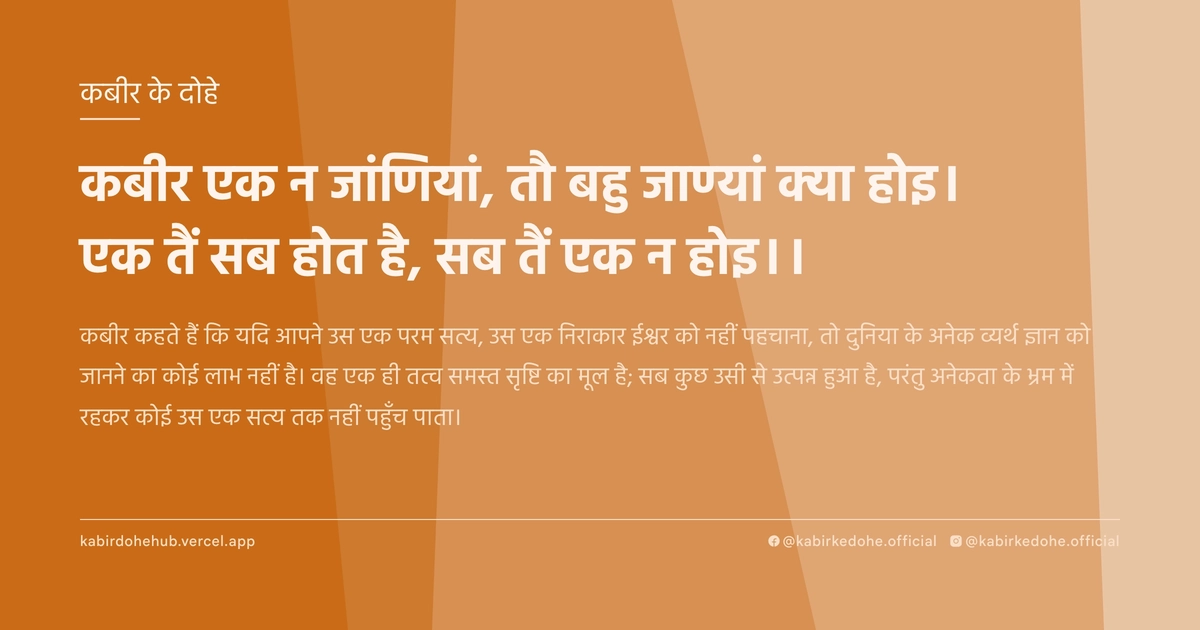
कबीर एक न जांणियां, तौ बहु जाण्यां क्या होइ।
एक तैं सब होत है, सब तैं एक न होइ।।
Kabir ek na jaaniya, tau bahu jaaniya kya hoye. Ek tain sab hot hai, sab tain ek na hoye.
इस पृष्ठ पर इस कबीर दोहे का अर्थ (meaning), हिंदी व्याख्या और अंग्रेज़ी अनुवाद, दार्शनिक विश्लेषण और व्यावहारिक जीवन सीख दी गई है। यह दोहा निर्गुण ब्रह्म (Nirguna Brahman) विषय से जुड़ा है — Kabir doha meaning and explanation in Hindi and English.
अर्थ (Meaning):
कबीर कहते हैं कि यदि आपने उस एक परम सत्य, उस एक निराकार ईश्वर को नहीं पहचाना, तो दुनिया के अनेक व्यर्थ ज्ञान को जानने का कोई लाभ नहीं है। वह एक ही तत्व समस्त सृष्टि का मूल है; सब कुछ उसी से उत्पन्न हुआ है, परंतु अनेकता के भ्रम में रहकर कोई उस एक सत्य तक नहीं पहुँच पाता।
Kabir asserts that if one fails to recognize the One Absolute Truth—the singular, formless Divine—then the acquisition of vast amounts of worldly or fragmented knowledge is futile. Everything in existence emanates from that One Source; while the One manifests as the many, the many cannot lead back to the One unless the illusion of separation is dissolved.
व्याख्या (Interpretation):
इस दोहे का शाब्दिक अर्थ है कि एक को न जानकर बहुत कुछ जानने का क्या लाभ। यहाँ "एक" का अर्थ केवल संख्या नहीं, बल्कि अद्वैत सत्ता है। कबीर माया के उस जाल की बात कर रहे हैं जहाँ मनुष्य विभिन्न धर्मों, ग्रंथों और अनुष्ठानों में उलझकर रह जाता है, जबकि सत्य अत्यंत सरल और एकात्मक है। यह निर्गुण भक्ति का सार है, जहाँ ईश्वर किसी मूर्ति या नाम में नहीं, बल्कि चेतना के मूल बिंदु में स्थित है। जब तक साधक 'अनेकता' (द्वैत) के मोह में रहता है, वह उस 'एक' (ब्रह्म) का अनुभव नहीं कर सकता। यह विरोधाभास है कि हम पूरी दुनिया को खोजते हैं, जबकि खोजने वाला स्वयं वही है जिसे वह खोज रहा है। अंततः, यह आत्मा और परमात्मा की अभिन्नता का उद्घोष है।
Literally, the verse questions the utility of diverse knowledge if the singular Truth remains unknown. Here, "One" does not denote a numerical value but the Non-dual Reality (Advaita). Kabir addresses the veil of Maya, where humanity becomes entangled in disparate religions, scriptures, and rituals, missing the singular, formless essence. This is the core of Nirgun Bhakti: the Divine is not found in idols or labels but in the primordial point of consciousness. As long as the seeker clings to the illusion of multiplicity (duality), the experience of the One (Brahman) remains elusive. It presents the central paradox of the human condition: we search the entire universe for a Truth that is the very essence of the searcher. Ultimately, it is a proclamation of the identity between Atman and Brahman.
दार्शनिक विश्लेषण (Philosophical Analysis):
कबीर का यह दोहा उनके युग के धार्मिक पाखंड और बौद्धिक अहंकार पर एक तीखा प्रहार है। 15वीं शताब्दी में, जब समाज जाति, पंथ और जटिल कर्मकांडों में विभाजित था, कबीर ने 'एक' की अवधारणा पेश की जो हिंदू अद्वैत वेदांत और सूफी 'वहदत-अल-वजूद' (अस्तित्व की एकता) का संगम है। वे तर्क देते हैं कि बाहरी ज्ञान (बहु) केवल अहंकार को बढ़ाता है, जबकि आंतरिक ज्ञान (एक) अहंकार को मिटाता है।
दार्शनिक स्तर पर, यह 'एक' वह शून्य या पूर्ण है जिससे संपूर्ण ब्रह्मांड का प्रस्फुटन हुआ है। कबीर का विरोध उन विद्वानों से है जो वेदों और कुरान के शब्दों में उलझे हैं लेकिन अपने भीतर के प्रकाश को नहीं देख पाते। उनके लिए, ज्ञान का संचय करना एक मानसिक बोझ है यदि वह मुक्ति की ओर नहीं ले जाता।
सूफीवाद के प्रभाव में, कबीर इस 'एक' को उस प्रेमी के रूप में देखते हैं जो हर कण में व्याप्त है। यह विचार कि "सब तैं एक न होइ" यह दर्शाता है कि बाहरी दुनिया की विविधता हमें सत्य से दूर ले जाती है। हम वस्तुओं, संबंधों और उपाधियों को सत्य मान लेते हैं, जबकि वे केवल प्रतिबिंब हैं।
मनोवैज्ञानिक रूप से, यह दोहा 'संज्ञानात्मक विखंडन' से 'एकीकरण' की यात्रा है। जब मनुष्य यह समझ जाता है कि वह और उसका आराध्य अलग नहीं हैं, तो भय और द्वेष समाप्त हो जाते हैं। यह अहंकार का विसर्जन (Fana) है, जहाँ 'मैं' मिटकर 'वह' हो जाता है।
अंततः, कबीर यह स्पष्ट करते हैं कि सत्य किसी विशेष धर्म की बपौती नहीं है। यह एक सार्वभौमिक अनुभव है। जो व्यक्ति अपनी इंद्रियों के शोर को शांत कर उस मौन 'एक' को सुन लेता है, वही वास्तव में ज्ञानी है। बाकी सब केवल शब्दों का खेल है।
This couplet is a sharp critique of the religious hypocrisy and intellectual arrogance of Kabir's era. In the 15th century, amidst a society fractured by caste, sect, and complex rituals, Kabir introduced the concept of the 'One'—a synthesis of Hindu Advaita Vedanta and the Sufi doctrine of 'Wahdat-al-Wujud' (Unity of Existence). He argues that external knowledge (the many) only inflates the ego, whereas internal realization (the One) annihilates it.
Philosophically, this 'One' is the Void or the Absolute from which the entire cosmos emanates. Kabir opposes scholars who are lost in the literalism of the Vedas or the Quran but fail to perceive the inner light. To him, the accumulation of fragmented knowledge is a mental burden if it does not lead to liberation (Mukti).
Influenced by Sufism, Kabir views this 'One' as the Beloved pervading every atom. The phrase "sab tain ek na hoi" suggests that the diversity of the external world often distracts us from the Truth. We mistake objects, relationships, and titles for reality, whereas they are merely reflections of the singular source.
Psychologically, this verse describes a journey from 'cognitive fragmentation' to 'integration.' When a human realizes that they and the Divine are not separate, fear and hatred dissolve. This is the process of 'Fana' (annihilation of the self), where the 'I' vanishes to reveal the 'He'.
Ultimately, Kabir clarifies that Truth is not the monopoly of any specific religion. It is a universal experience. The one who silences the noise of the senses to hear the silent 'One' is the only true knower. Everything else is merely a play of words.
मूल संदेश (Core Message):
- बाहरी ज्ञान का संचय आध्यात्मिक प्रगति की गारंटी नहीं है।
- अनेकता का भ्रम ही आत्मा को परमात्मा से अलग करता है।
- सत्य किसी ग्रंथ में नहीं, बल्कि स्वयं के अनुभव में निहित है।
- अहंकार का विसर्जन ही 'एक' तक पहुँचने का एकमात्र मार्ग है।
- ब्रह्मांड की विविधता एक ही मूल चेतना का विस्तार है।
- The accumulation of external knowledge does not guarantee spiritual progress.
- The illusion of multiplicity is what separates the soul from the Divine.
- Truth resides not in scriptures, but in the direct experience of the self.
- The dissolution of the ego is the only path to reaching the 'One'.
- The diversity of the universe is but an expansion of a single consciousness.
व्यावहारिक उदाहरण (Practical Example):
वाराणसी के एक पुराने मोहल्ले में माधव नाम का एक अत्यंत विद्वान पंडित रहता था। उसने चारों वेदों, उपनिषदों और दर्जनों पुराणों का गहन अध्ययन किया था। शहर भर में उसकी ख्याति थी और लोग अपनी आध्यात्मिक शंकाओं के लिए उसके पास आते थे। माधव को अपने ज्ञान पर बहुत गर्व था और वह अक्सर उन लोगों का उपहास करता था जो साक्षर नहीं थे।
उसी शहर में एक साधारण बुनकर रहता था, जो दिन भर करघे पर काम करता और शाम को कबीर के दोहे गुनगुनाता। वह पढ़ा-लिखा नहीं था, लेकिन उसके चेहरे पर एक असीम शांति थी। माधव अक्सर उसे देखता और सोचता कि यह अनपढ़ व्यक्ति इतना शांत कैसे रह सकता है जबकि मैं, जिसने सारे शास्त्र पढ़े हैं, अभी भी क्रोध और चिंता से घिरा रहता हूँ।
एक दिन माधव ने उस बुनकर को चुनौती दी, "तुम जिसे सत्य कहते हो, क्या तुम उसके बारे में कोई शास्त्र प्रमाण दे सकते हो?" बुनकर ने मुस्कुराते हुए कहा, "पंडित जी, मैं प्रमाण नहीं, अनुभव जानता हूँ। आप सागर के बारे में हज़ारों किताबें पढ़ चुके हैं, लेकिन क्या आपने कभी एक बार भी उसमें डुबकी लगाई है?"
माधव को यह बात चुभी, लेकिन उसने गौर किया कि बुनकर की आँखों में एक ऐसी गहराई थी जो उसने किसी ग्रंथ में नहीं पढ़ी थी। उसने पूछा, "डुबकी कैसे लगाऊं?"
बुनकर ने जवाब दिया, "अपने ज्ञान की पोटली को किनारे रख दें। जब तक आप 'मैं विद्वान हूँ' के बोझ तले दबे रहेंगे, तब तक आप उस 'एक' को नहीं देख पाएंगे जो आपके और मेरे भीतर समान रूप से धड़क रहा है।"
माधव ने पहली बार महसूस किया कि उसका ज्ञान वास्तव में एक दीवार बन गया था जिसने उसे सत्य से अलग कर दिया था। उसने महसूस किया कि वह 'बहुत' (शास्त्रों, चर्चाओं, प्रशंसाओं) को तो जान गया था, लेकिन उस 'एक' (स्वयं की आत्मा और परमात्मा के मिलन) को पूरी तरह भूल गया था।
अगले कुछ महीनों तक, माधव ने शास्त्रों को पढ़ना बंद कर दिया और मौन का अभ्यास किया। उसने अपनी विद्वत्ता के अहंकार को त्याग कर साधारण लोगों की सेवा करना शुरू किया। उसने पाया कि जब वह दूसरों में उसी 'एक' परमात्मा को देखने लगा, तो उसका आंतरिक संघर्ष समाप्त हो गया।
अब माधव केवल एक पंडित नहीं था, वह एक जागृत मनुष्य बन गया था। उसने सीखा कि हज़ारों शब्दों का ज्ञान उस एक क्षण के अनुभव के सामने तुच्छ है, जहाँ आत्मा का परमात्मा से मिलन होता है।
In an ancient neighborhood of Varanasi lived a highly learned priest named Madhav. He had mastered the four Vedas, the Upanishads, and dozens of Puranas. He was renowned throughout the city, and people flocked to him for spiritual guidance. Madhav took immense pride in his erudition and often mocked those who were illiterate.
In the same city lived a simple weaver who spent his days at the loom and his evenings humming the couplets of Kabir. He was unlettered, yet his face radiated a profound, immeasurable peace. Madhav often observed him, wondering how this uneducated man could be so serene while he, who had read all the scriptures, remained plagued by anger and anxiety.
One day, Madhav challenged the weaver, "You speak of Truth; can you provide any scriptural evidence for your claims?" The weaver smiled and replied, "Pandit ji, I do not know evidence; I know experience. You have read thousands of books about the ocean, but have you ever once dived into it?"
Madhav felt stung by the remark, but he noticed a depth in the weaver's eyes that he had never encountered in any text. He asked, "How do I dive?"
The weaver answered, "Set aside the bundle of your knowledge. As long as you are burdened by the thought 'I am a scholar,' you will never perceive the 'One' that beats equally within you and me."
For the first time, Madhav realized that his knowledge had actually become a wall separating him from the Truth. He understood that he had mastered the 'Many' (scriptures, debates, accolades) but had completely forgotten the 'One' (the union of the soul with the Divine).
Over the next few months, Madhav stopped reading scriptures and practiced silence. He abandoned the ego of scholarship and began serving ordinary people. He discovered that when he started seeing that same 'One' Divine in others, his internal conflict vanished.
Madhav was no longer just a priest; he had become an awakened human being. He learned that the knowledge of a thousand words is trivial compared to that one moment of experience where the soul merges with the Absolute.
अभ्यास मार्गदर्शन (Practice Guidance):
- प्रतिदिन 20 मिनट का 'मौन अभ्यास' करें, जहाँ आप किसी भी विचार या शब्द को पकड़ने के बजाय केवल अपनी श्वास के साक्षी बनें।
- एक डायरी लिखें जिसमें आप उन 'अनेक' पहचानों (जैसे- पद, रिश्ता, धर्म) की सूची बनाएं जिन्हें आप सत्य मानते हैं, और फिर विचार करें कि यदि ये सब हटा दिए जाएं, तो वास्तव में आप कौन हैं।
- व्यवहार परिवर्तन: दिन में कम से कम एक बार किसी ऐसे व्यक्ति की मदद करें जिससे आपका वैचारिक मतभेद हो, यह याद रखते हुए कि आप दोनों में एक ही चेतना प्रवाहित है।
- निदान चेकलिस्ट: क्या आप अभी भी सही और गलत के तर्कों में उलझे हैं? क्या आप दूसरों को अपनी मान्यताओं से आंकते हैं? यदि हाँ, तो आप 'बहु' (अनेकता) में फंसे हैं। यदि आप विपरीत परिस्थितियों में भी एक आंतरिक स्थिरता महसूस करते हैं, तो आप 'एक' की ओर बढ़ रहे हैं।
- Practice 20 minutes of 'Silent Observation' daily, where instead of clinging to thoughts or words, you simply remain a witness to your breath.
- Maintain a journal listing the 'Many' identities (such as status, relationships, religion) you believe define you, then contemplate: if all these were stripped away, who would you actually be?
- Behavioral Shift: At least once a day, help someone with whom you have a deep ideological conflict, remembering that the same consciousness flows through both of you.
- Diagnostic Checklist: Are you still entangled in arguments of right and wrong? Do you judge others based on your beliefs? If yes, you are trapped in the 'Many'. If you feel an inner stillness even amidst chaos, you are moving toward the 'One'.
चिंतन प्रश्न (Reflection Questions):
- मेरे जीवन की कौन सी 'डिग्री' या 'उपाधि' मुझे दूसरों से श्रेष्ठ महसूस कराती है, और क्या यह मुझे सत्य से दूर ले जा रही है?
- क्या मैं ईश्वर को एक बाहरी सत्ता के रूप में खोज रहा हूँ, या मैं उसे अपने भीतर की शून्यता में देखने का साहस रखता हूँ?
- मेरी डिजिटल पहचान (सोशल मीडिया) मेरे वास्तविक अस्तित्व का कितना हिस्सा है, और क्या मैं इस आभासी 'अनेकता' में खो गया हूँ?
- यदि आज मेरी सारी बौद्धिक उपलब्धियाँ छीन ली जाएं, तो क्या मेरे पास शांति का कोई आधार बचेगा?
- मैं किन पूर्वाग्रहों के कारण दूसरों को 'अलग' देखता हूँ, जबकि कबीर कहते हैं कि सब 'एक' हैं?
- Which 'degree' or 'title' in my life makes me feel superior to others, and is it distancing me from the Truth?
- Am I searching for the Divine as an external entity, or do I have the courage to see it in the void within me?
- How much of my digital identity (social media) constitutes my actual existence, and have I lost myself in this virtual 'multiplicity'?
- If all my intellectual achievements were stripped away today, would I have any foundation for peace left?
- What biases cause me to see others as 'separate,' while Kabir insists that all are 'One'?