
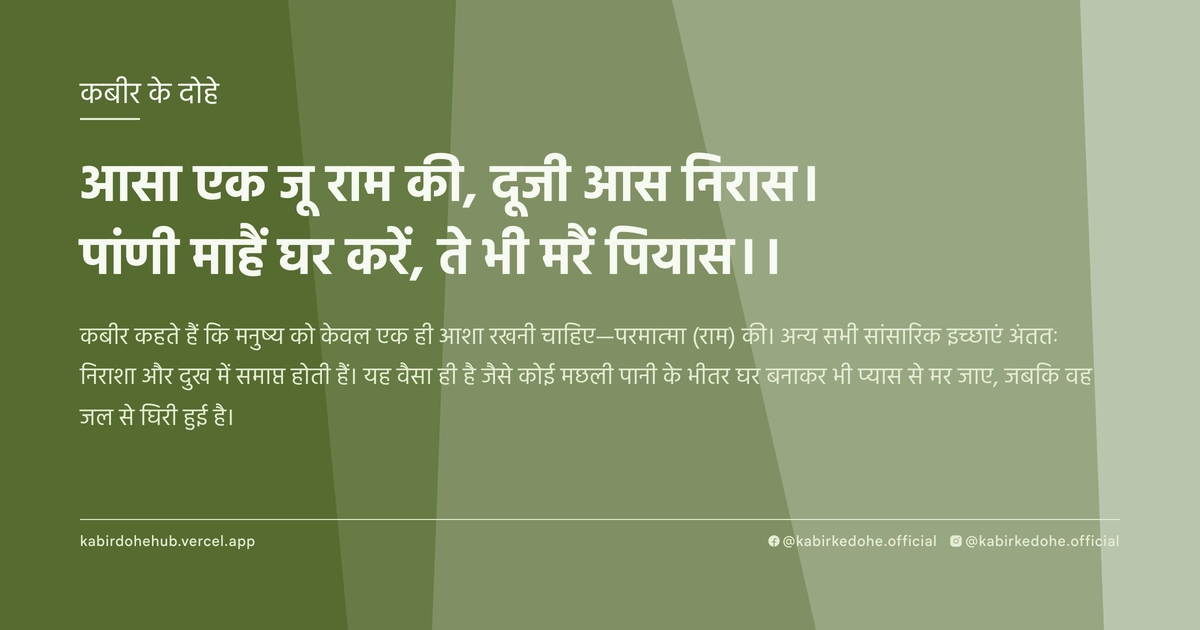
आसा एक जू राम की, दूजी आस निरास।
पांणी माहैं घर करें, ते भी मरैं पियास।।
Aasa ek ju Ram ki, dooji aas niraas. Paani mahain ghar karein, te bhi marain piyaas.
इस पृष्ठ पर इस कबीर दोहे का अर्थ (meaning), हिंदी व्याख्या और अंग्रेज़ी अनुवाद, दार्शनिक विश्लेषण और व्यावहारिक जीवन सीख दी गई है। यह दोहा प्रपत्ति (Surrender) विषय से जुड़ा है — Kabir doha meaning and explanation in Hindi and English.
अर्थ (Meaning):
कबीर कहते हैं कि मनुष्य को केवल एक ही आशा रखनी चाहिए—परमात्मा (राम) की। अन्य सभी सांसारिक इच्छाएं अंततः निराशा और दुख में समाप्त होती हैं। यह वैसा ही है जैसे कोई मछली पानी के भीतर घर बनाकर भी प्यास से मर जाए, जबकि वह जल से घिरी हुई है।
Kabir asserts that one should harbor only a single hope: the longing for the Divine (Ram). All other worldly desires inevitably lead to disappointment and void. He likens this state to a fish that builds its home within the water, yet perishes from thirst, despite being completely surrounded by the very element it needs.
व्याख्या (Interpretation):
यहाँ 'राम' शब्द किसी व्यक्ति विशेष के लिए नहीं, बल्कि उस निर्गुण ब्रह्म के लिए है जो सर्वव्यापी है। कबीर एक गहरे विरोधाभास को उजागर करते हैं: हम उस ईश्वर की खोज में भटकते हैं जो हमारे भीतर ही स्थित है। 'पानी में घर' माया के उस भ्रम का प्रतीक है जहाँ मनुष्य भौतिक सुखों के बीच रहकर भी आध्यात्मिक रूप से रिक्त महसूस करता है। यह अद्वैत वेदांत के उस सत्य को दर्शाता है कि जीव और ब्रह्म अलग नहीं हैं, फिर भी अज्ञान (माया) के कारण जीव स्वयं को अलग मानकर तड़पता रहता है। प्यास का मरना उस आत्मा की तड़प है जो सत्य के करीब होकर भी उसे पहचान नहीं पाती।
In this verse, 'Ram' does not refer to a mythological figure but to the Nirgun Brahman—the formless, omnipresent Absolute. Kabir highlights a profound paradox: humanity wanders in search of a Divine presence that is already intrinsic to their own being. The 'home in the water' symbolizes the illusion of Maya, where a person exists amidst material abundance yet remains spiritually hollow. This aligns with Advaita Vedanta, suggesting that while the Atman and Brahman are non-dual, the veil of ignorance (Avidya) creates a perceived separation. The 'death by thirst' represents the existential agony of a soul that is immersed in the Divine essence but remains unconscious of its own nature.
दार्शनिक विश्लेषण (Philosophical Analysis):
कबीर का यह दोहा मध्यकालीन भारत के उस दौर का है जब धर्म कर्मकांडों और बाहरी आडंबरों में जकड़ा हुआ था। कबीर ने स्पष्ट किया कि मोक्ष किसी तीर्थ या मंदिर में नहीं, बल्कि आंतरिक जागरूकता में है। वे यहाँ 'सांसारिक आशाओं' का खंडन करते हैं क्योंकि वे क्षणभंगुर हैं। सूफी मत के 'फना' (अहंकार का विनाश) और वेदांत के 'अहं ब्रह्मास्मि' का संगम यहाँ दिखता है।
वे बताते हैं कि मनुष्य की समस्या संसाधनों की कमी नहीं, बल्कि दृष्टि की कमी है। हम बाहरी दुनिया में सुख खोजते हैं, जो कि एक अंतहीन चक्र है। यह मनोवैज्ञानिक रूप से उस स्थिति को दर्शाता है जहाँ व्यक्ति अपनी पहचान को बाहरी उपलब्धियों से जोड़ लेता है, जिससे आंतरिक रिक्तता बढ़ती जाती है।
कबीर का प्रहार उन लोगों पर है जो धर्म को केवल एक सामाजिक सुरक्षा या लाभ प्राप्ति का साधन मानते हैं। उनके लिए 'राम' का अर्थ है वह परम सत्य जो जाति, धर्म और वर्ग से परे है। वे ritualism को नकारते हुए सहज समाधि पर जोर देते हैं।
यहाँ 'निरास' शब्द केवल दुख नहीं, बल्कि एक चेतावनी है। यह संकेत देता है कि जब तक केंद्र बिंदु 'मैं' (अहंकार) रहेगा, तब तक हर इच्छा अंततः शून्य में मिलेगी। केवल जब केंद्र 'राम' (परमात्मा) होगा, तब शांति संभव है।
अंततः, यह विश्लेषण हमें सिखाता है कि हम सत्य के सागर में डूबे हुए हैं, फिर भी हम प्यासे हैं क्योंकि हमने सत्य को बाहर खोजना शुरू कर दिया है। यह अज्ञानता ही सबसे बड़ा बंधन है।
This couplet emerges from a medieval Indian era where spirituality was often reduced to rigid rituals and external displays of piety. Kabir dismantles this by asserting that liberation is not found in pilgrimages or temples, but in internal awakening. He rejects 'worldly hopes' because they are inherently ephemeral and transient, leading only to a cycle of craving and disappointment.
There is a striking convergence here between the Sufi concept of 'Fana' (the annihilation of the ego) and the Vedantic realization of 'Aham Brahmasmi' (I am Brahman). Kabir suggests that the human crisis is not a lack of resources, but a lack of perception. We seek fulfillment in the external world, which is a psychological treadmill that increases internal void as we attach our identity to fleeting achievements.
Kabir specifically targets those who treat religion as a social tool or a means for material gain. For him, 'Ram' is the Formless Absolute, transcending caste, creed, and dogma. He rejects ritualism in favor of 'Sahaj Samadhi'—a natural, effortless state of spiritual equilibrium.
The term 'Niraas' (hopelessness/disappointment) serves as a spiritual warning. It indicates that as long as the center of one's existence is the 'I' (the ego), every desire will eventually collapse into emptiness. Only when the center shifts to the Divine can true peace be attained.
Ultimately, the analysis reveals that we are like fish in an ocean of consciousness, yet we die of thirst because we have been conditioned to look for water outside the ocean. This fundamental ignorance is the primary shackle of the human condition.
मूल संदेश (Core Message):
- बाहरी इच्छाएं केवल मृगतृष्णा हैं, जो कभी तृप्त नहीं होतीं।
- परमात्मा कहीं दूर नहीं, बल्कि हमारे अस्तित्व का आधार है।
- अहंकार का त्याग ही वास्तविक तृप्ति का एकमात्र मार्ग है।
- सांसारिक आशाओं का मोह ही मानसिक पीड़ा का मूल कारण है।
- जब खोज भीतर की ओर मुड़ती है, तब प्यास स्वतः समाप्त हो जाती है।
- External desires are mere mirages that can never be satisfied.
- The Divine is not distant but the very foundation of our existence.
- The dissolution of the ego is the only path to true fulfillment.
- Attachment to worldly hopes is the root cause of mental suffering.
- When the search turns inward, the thirst vanishes spontaneously.
व्यावहारिक उदाहरण (Practical Example):
एक समय की बात है, वाराणसी के घाटों पर रहने वाला एक वृद्ध बुनकर था, जिसका नाम माधव था। माधव अपनी पूरी जिंदगी बेहतरीन रेशमी वस्त्र बुनने में लगा रहा। उसने सोचा कि यदि वह शहर का सबसे अमीर बुनकर बन जाएगा, तो उसे मानसिक शांति और ईश्वर की प्राप्ति होगी। उसने दिन-रात मेहनत की, धन संचित किया और बड़ा घर बनाया।
लेकिन जैसे-जैसे उसकी संपत्ति बढ़ी, उसकी चिंताएं भी बढ़ती गईं। वह अब चोरी के डर से सो नहीं पाता था और अपने बेटों के बीच संपत्ति के विवादों से परेशान रहता था। वह जितना अधिक धन कमाता, उसकी 'प्यास' उतनी ही बढ़ती जाती। वह भौतिक सुखों के उस सागर में था, फिर भी भीतर से सूखा महसूस करता था।
एक दिन वह एक फकीर के पास गया और अपनी व्यथा सुनाई। फकीर ने उसे एक छोटा सा दर्पण दिखाया और कहा, "माधव, तुम जिस शांति को बाहर ढूंढ रहे हो, वह तुम्हारे भीतर ही है। तुम उस मछली की तरह हो जो समुद्र में रहकर भी पानी मांग रही है।"
माधव को अचानक कबीर का यह बोध हुआ। उसने महसूस किया कि उसकी सारी 'आशाएं' केवल बाहरी दुनिया की थीं, जबकि उसकी आत्मा की पुकार अनसुनी रह गई थी। उसने अपनी संपत्ति का एक बड़ा हिस्सा गरीबों में बांटना शुरू किया और केवल अपने काम को ईश्वर की सेवा मानकर करने लगा।
उसने पाया कि जब उसने 'पाने' की इच्छा छोड़ दी, तो उसे वह शांति मिल गई जिसकी तलाश में उसने पूरी उम्र गुजार दी थी। अब वह रेशम नहीं बुनता था, बल्कि प्रेम और संतोष के धागे बुनने लगा था।
उसका जीवन अब किसी प्रदर्शन के लिए नहीं, बल्कि आंतरिक आनंद के लिए था। वह अब भी बुनकर था, लेकिन अब वह अपनी प्यास बुझाने के लिए बाहर नहीं भागता था।
उसने सीखा कि असली संपत्ति वह नहीं जो तिजोरी में हो, बल्कि वह है जो हृदय में हो। माधव अब वास्तव में 'राम' की आशा में था, और उसकी सारी सांसारिक निराशाएं समाप्त हो गईं।
उसकी कहानी यह सिखाती है कि भौतिक समृद्धि कभी भी आध्यात्मिक रिक्तता को नहीं भर सकती।
Once, in the ghats of Varanasi, lived an elderly weaver named Madhav. Madhav spent his entire life crafting the finest silk garments. He believed that if he became the wealthiest weaver in the city, he would finally attain mental peace and a connection with the Divine.
He worked tirelessly, accumulated vast wealth, and built a grand house. However, as his riches grew, so did his anxieties. He could no longer sleep for fear of theft and was plagued by disputes between his sons over the inheritance. The more he acquired, the more his 'thirst' grew. He lived in an ocean of material luxury, yet felt internally parched.
One day, he approached a wandering mystic and shared his misery. The mystic held up a small mirror and said, "Madhav, the peace you seek externally is already within you. You are like the fish that lives in the ocean yet begs for water."
Suddenly, the essence of Kabir's wisdom struck Madhav. He realized that all his 'hopes' had been anchored in the external world, while the cry of his own soul had gone unheard. He began distributing a large portion of his wealth to the poor and started treating his craft as a selfless service to the Divine.
He discovered that the moment he ceased the desire to 'acquire,' he found the very peace he had spent a lifetime chasing. He was no longer just weaving silk; he was weaving threads of love and contentment.
His life was no longer a performance for society but a journey toward inner bliss. He remained a weaver, but he no longer ran outside to quench his thirst.
He learned that true wealth is not what is stored in a vault, but what resides in the heart. Madhav now placed his hope solely in the Divine, and all his worldly disappointments vanished.
His story illustrates that material abundance can never fill a spiritual void.
अभ्यास मार्गदर्शन (Practice Guidance):
- प्रतिदिन 20 मिनट मौन बैठें और यह विचार करें कि आप उस परमात्मा के भीतर हैं, जैसे मछली पानी में होती है।
- एक डायरी लिखें जिसमें उन तीन सांसारिक इच्छाओं को दर्ज करें जो आपको सबसे अधिक तनाव देती हैं, और फिर विश्लेषण करें कि क्या वे वास्तव में आपकी आत्मा की जरूरत हैं या केवल सामाजिक दबाव।
- व्यवहार परिवर्तन: दिन में कम से कम एक बार किसी की मदद बिना किसी उम्मीद या फल की इच्छा के करें, ताकि 'आशा' का बंधन टूटे।
- निदान चेकलिस्ट: क्या मैं अपनी खुशी को किसी बाहरी वस्तु या व्यक्ति की उपलब्धि से जोड़ रहा हूँ? क्या मैं पर्याप्त संसाधनों के बावजूद अधूरा महसूस करता हूँ? यदि हाँ, तो आप 'पानी में प्यासे' होने की स्थिति में हैं।
- Sit in silence for 20 minutes daily, contemplating that you exist within the Divine, just as a fish exists within water.
- Maintain a journal listing three worldly desires that cause you the most stress, then analyze whether they are genuine needs of the soul or merely social pressures.
- Behavioral Shift: Perform at least one act of kindness daily without any expectation of reward, breaking the chain of 'hope' and attachment.
- Diagnostic Checklist: Am I linking my happiness to an external object or person's achievement? Do I feel incomplete despite having sufficient resources? If yes, you are in the state of 'thirsting within the water'.
चिंतन प्रश्न (Reflection Questions):
- मेरे जीवन में ऐसी कौन सी 'आशा' है जिसे मैं अपनी पहचान मान बैठा हूँ, और यदि वह छिन जाए तो मेरा अस्तित्व क्या बचेगा?
- मैं दुनिया के सामने एक सफल व्यक्ति दिखने की कोशिश करता हूँ, लेकिन मेरे भीतर का वह कौन सा कोना है जो अभी भी प्यासा और अकेला है?
- क्या मेरी आध्यात्मिक खोज वास्तव में सत्य की प्यास है, या यह केवल मेरे अहंकार को एक 'पवित्र' पहचान देने का तरीका है?
- मैं किन सामाजिक मुखौटों के पीछे अपनी वास्तविक शून्यता को छिपा रहा हूँ?
- यदि मैं आज अपनी सभी भौतिक उपलब्धियों को भूल जाऊँ, तो क्या मैं स्वयं के साथ शांति से रह पाऊँगा?
- Which 'hope' in my life have I mistaken for my identity, and what would remain of me if it were taken away?
- I strive to appear successful to the world, but which corner of my inner being remains thirsty and lonely?
- Is my spiritual quest a genuine thirst for Truth, or is it merely a way for my ego to acquire a 'holy' identity?
- Behind which social masks am I hiding my actual internal void?
- If I were to forget all my material achievements today, would I be able to exist in peace with myself?