
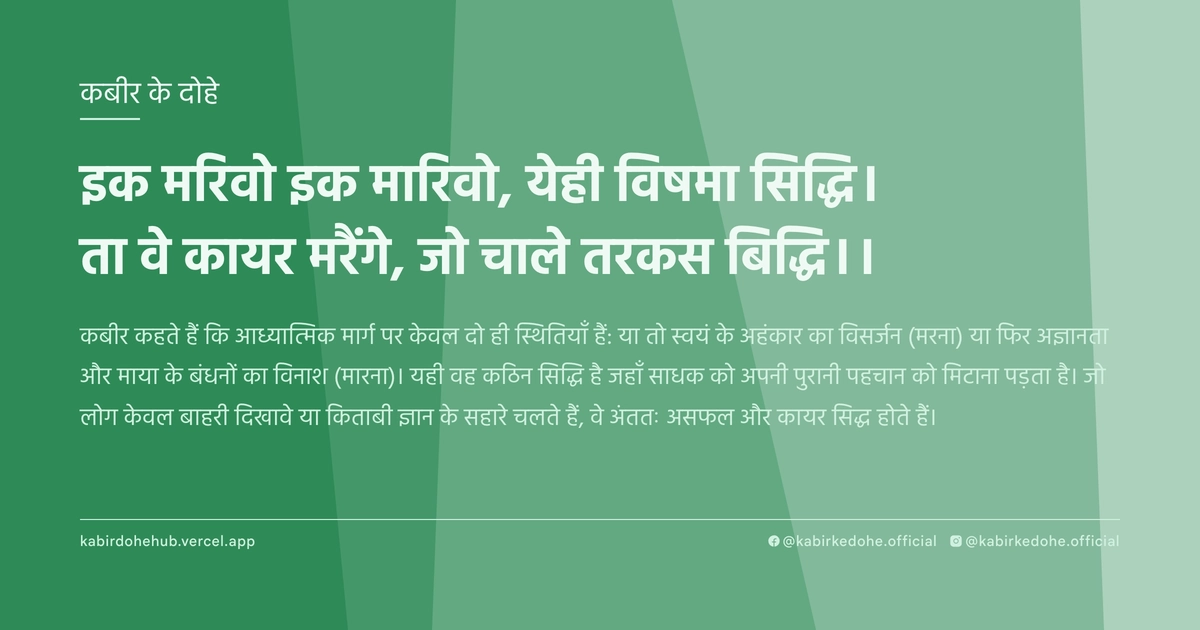
इक मरिवो इक मारिवो, येही विषमा सिद्धि।
ता वे कायर मरैंगे, जो चाले तरकस बिद्धि।।
Ik marivo ik maarivo, yehi vishma siddhi. Ta ve kaayar marainge, jo chaale tarkas biddhi.
इस पृष्ठ पर इस कबीर दोहे का अर्थ (meaning), हिंदी व्याख्या और अंग्रेज़ी अनुवाद, दार्शनिक विश्लेषण और व्यावहारिक जीवन सीख दी गई है। यह दोहा निष्ठा (Integrity) विषय से जुड़ा है — Kabir doha meaning and explanation in Hindi and English.
अर्थ (Meaning):
कबीर कहते हैं कि आध्यात्मिक मार्ग पर केवल दो ही स्थितियाँ हैं: या तो स्वयं के अहंकार का विसर्जन (मरना) या फिर अज्ञानता और माया के बंधनों का विनाश (मारना)। यही वह कठिन सिद्धि है जहाँ साधक को अपनी पुरानी पहचान को मिटाना पड़ता है। जो लोग केवल बाहरी दिखावे या किताबी ज्ञान के सहारे चलते हैं, वे अंततः असफल और कायर सिद्ध होते हैं।
Kabir asserts that on the spiritual path, there are only two definitive states: either the voluntary dissolution of the ego (dying to the self) or the active destruction of ignorance and worldly attachments (killing the illusion). This is the paradoxical achievement of liberation. Those who rely solely on theoretical knowledge or the safety of ritualistic shields are cowards who will never attain the ultimate truth.
व्याख्या (Interpretation):
इस दोहे का शाब्दिक अर्थ मृत्यु और विनाश से जुड़ा प्रतीत होता है, किंतु यह पूर्णतः रूपकात्मक है। 'मरिवो' का अर्थ है 'अहं' का विलोपन, जहाँ व्यक्ति अपनी पृथक पहचान को ब्रह्म में विलीन कर देता है, जो कि अद्वैत वेदांत का मूल है। 'मारिवो' का अर्थ है उन मानसिक संस्कारों और वासनाओं का संहार करना जो आत्मा को माया के पर्दे में ढके रखते हैं। यह निर्गुण भक्ति की वह अवस्था है जहाँ साधक को यह समझना होता है कि जब तक 'मैं' जीवित है, तब तक 'परमात्मा' का अनुभव असंभव है। यहाँ 'तरकस बिद्धि' का अर्थ है वह बौद्धिक अहंकार या शास्त्र-ज्ञान जो केवल सुरक्षा कवच का काम करता है लेकिन वास्तविक अनुभव नहीं देता। यह विरोधाभास दर्शाता है कि मोक्ष कोई बाहरी प्राप्ति नहीं, बल्कि आंतरिक शून्यता की प्रक्रिया है।
While the literal words suggest death and killing, the meaning is deeply metaphorical and rooted in the alchemy of the soul. 'Marivo' (dying) refers to the dissolution of the ego-self, the 'I-consciousness' that separates the individual from the Universal Brahman, aligning with Advaita Vedanta's non-duality. 'Marivo' (killing) signifies the aggressive eradication of Vasanas (latent desires) and Maya (illusion) that veil the Atman. In the context of Nirgun Bhakti, this is the realization that the 'I' must perish for the Divine to emerge. The 'tarkas biddhi' (quiver-wisdom) symbolizes the intellectual vanity of those who hoard scriptures and rituals as a defensive shield, avoiding the actual vulnerability of spiritual surrender. The central paradox is that one must 'die' while living to truly experience eternal life.
दार्शनिक विश्लेषण (Philosophical Analysis):
कबीर का यह दृष्टिकोण उनके समय के धार्मिक पाखंड और कर्मकांडीय कठोरता के विरुद्ध एक सशक्त प्रहार है। उन्होंने देखा कि लोग तीर्थों, मालाओं और शास्त्रों के संचय को ही मोक्ष का मार्ग मान बैठे थे, जबकि वास्तविक परिवर्तन आंतरिक था। यह दर्शन सूफी मत के 'फना' (Fana) के सिद्धांत से मेल खाता है, जहाँ साधक ईश्वर में विलीन होने के लिए अपने अस्तित्व को मिटा देता है।
अद्वैत वेदांत के परिप्रेक्ष्य में, यह दोहा 'माया' के विनाश की बात करता है। जब तक व्यक्ति स्वयं को शरीर और मन मानता है, वह जन्म-मृत्यु के चक्र में फँसा रहता है। कबीर यहाँ चेतावनी देते हैं कि केवल बौद्धिक चर्चा (तरकस बिद्धि) से सत्य नहीं मिलता; उसके लिए साहसपूर्वक अपने अहंकार की बलि देनी पड़ती है।
सामाजिक स्तर पर, कबीर जाति और धर्म के भेदों को इसी 'अहंकार' का विस्तार मानते थे। उनके लिए, जो व्यक्ति अपनी जातिगत श्रेष्ठता के अहंकार को नहीं मारता, वह आध्यात्मिक रूप से मृत है। यह मार्ग कठिन है क्योंकि यह व्यक्ति को उसकी सबसे प्रिय वस्तु—उसकी पहचान—को त्यागने के लिए कहता है।
मनोवैज्ञानिक रूप से, यह 'मृत्यु' वास्तव में एक मानसिक पुनर्जन्म है। जब पुराने विश्वास और कंडीशनिंग टूटते हैं, तभी एक नई चेतना का उदय होता है। कबीर यहाँ स्पष्ट करते हैं कि आध्यात्मिक यात्रा कोई आरामदायक सैर नहीं, बल्कि एक युद्ध है जो स्वयं के भीतर लड़ा जाता है।
अंततः, यह दोहा हमें सिखाता है कि ज्ञान तब तक व्यर्थ है जब तक वह व्यवहार में न उतरे। केवल शास्त्रों को पढ़ना 'तरकस' में तीर रखने जैसा है; असली वीरता उन तीरों को अपने ही अहंकार के हृदय में चलाने में है।
Kabir's perspective is a fierce critique of the religious hypocrisy and ritualistic rigidity of his era. He observed that people mistook the accumulation of pilgrimages, beads, and scriptural citations for the path to liberation, ignoring the necessity of internal transmutation. This philosophy mirrors the Sufi concept of 'Fana' (annihilation), where the seeker dissolves their individual identity to merge with the Divine Presence.
From the lens of Advaita Vedanta, this Doha addresses the destruction of 'Maya'. As long as an individual identifies with the body and mind, they remain trapped in the cycle of Samsara. Kabir warns that intellectual discourse (tarkas biddhi) is a mere distraction; truth requires the courageous sacrifice of the ego. He challenges the safety of the 'scholar' who knows the map but refuses to walk the terrain.
Socially, Kabir viewed caste and sectarian divisions as extensions of this very ego. To him, anyone clinging to the superiority of their birth or creed is spiritually stagnant. The path is arduous because it demands the surrender of the most cherished possession: the perceived self-identity.
Psychologically, this 'death' is actually a mental rebirth. When old conditioning and societal imprints are shattered, a higher consciousness emerges. Kabir frames the spiritual journey not as a peaceful stroll, but as a rigorous internal war against the shadows of the mind.
Ultimately, the Doha teaches that knowledge is futile unless it is embodied. Reading scriptures without practice is like keeping arrows in a quiver; true bravery lies in directing those arrows toward the heart of one's own arrogance.
मूल संदेश (Core Message):
- बौद्धिक ज्ञान केवल एक ढाल है, वास्तविक परिवर्तन साहस मांगता है।
- अहंकार की मृत्यु ही आध्यात्मिक जीवन का वास्तविक जन्म है।
- दिखावे की भक्ति और शास्त्र-ज्ञान अंततः साधक को कायर बनाते हैं।
- सत्य तक पहुँचने के लिए अपनी झूठी पहचान का त्याग अनिवार्य है।
- निर्गुण ब्रह्म का अनुभव केवल शून्य होने पर ही संभव है।
- Intellectual knowledge is but a shield; true transformation requires raw courage.
- The death of the ego is the actual birth of the spiritual life.
- Performative devotion and scriptural hoarding ultimately render the seeker a coward.
- To reach the Truth, the sacrifice of the false identity is mandatory.
- The experience of the Formless Divine is possible only when one becomes zero.
व्यावहारिक उदाहरण (Practical Example):
एक समय की बात है, बनारस के घाटों पर रहने वाला एक वृद्ध बुनकर था, जिसका नाम माधव था। माधव अपनी कला में निपुण था और शहर भर में उसकी साड़ियों की माँग थी। लेकिन इस निपुणता ने उसके भीतर एक गहरा अहंकार भर दिया था। वह मानता था कि उसकी कला उसे अन्य बुनकरों से श्रेष्ठ बनाती है और वह स्वयं को एक 'सिद्ध' कलाकार समझने लगा था।
माधव अक्सर अन्य कारीगरों को नीचा दिखाता और अपनी श्रेष्ठता का बखान करता। वह धर्म और शास्त्रों की बातें भी करता था, लेकिन उसका व्यवहार अहंकारी था। वह मानता था कि उसकी धार्मिकता उसके ज्ञान से सिद्ध होती है, जो उसके लिए एक 'तरकस' की तरह था—दिखावे के लिए पर्याप्त लेकिन हृदय को बदलने के लिए नाकाफी।
एक दिन, एक फकीर उसके पास आया और उसकी सबसे सुंदर साड़ी को देख कर मुस्कुराया। फकीर ने कहा, "माधव, यह साड़ी तो सुंदर है, लेकिन इसे बनाने वाला अभी भी मैला है।" माधव क्रोधित हो गया और उसने फकीर को अपनी विद्वत्ता और कला का प्रमाण देना शुरू कर दिया।
फकीर ने शांति से जवाब दिया, "तुमने धागों को तो सुलझा लिया, लेकिन अपने भीतर के अहंकार के उलझे हुए धागों को नहीं सुलझाया। तुम केवल शब्दों के तरकस में तीर जमा कर रहे हो, लेकिन क्या तुमने कभी अपने 'मैं' को मारा है?"
यह बात माधव के हृदय पर गहरी चोट कर गई। उसे महसूस हुआ कि उसकी सारी उपलब्धियाँ केवल उसके अहंकार को पोषण दे रही थीं। वह जिसे अपनी 'सिद्धि' समझ रहा था, वह वास्तव में उसकी सबसे बड़ी बाधा थी।
अगले कुछ महीनों तक माधव ने मौन धारण कर लिया। उसने अपनी कला को अब अपनी श्रेष्ठता के लिए नहीं, बल्कि सेवा के लिए उपयोग करना शुरू किया। उसने उन युवा बुनकरों को मुफ्त में सिखाना शुरू किया जिन्हें वह पहले तुच्छ समझता था।
उसने महसूस किया कि जब उसने अपनी 'श्रेष्ठ बुनकर' वाली पहचान को मारा (मरिवो), तब उसके भीतर एक असीम शांति का जन्म हुआ। उसकी कला अब केवल कपड़ा बुनना नहीं, बल्कि आत्मा को परमात्मा से जोड़ने का एक माध्यम बन गई।
माधव अब वह व्यक्ति नहीं था जो अपनी श्रेष्ठता का ढिंढोरा पीटता था। उसने जान लिया था कि असली सिद्धि शास्त्रों के ज्ञान में नहीं, बल्कि अहंकार के विसर्जन में है।
उसका जीवन अब एक खुली किताब था, जहाँ न कोई दिखावा था और न कोई अहंकार। उसने वास्तव में उस 'विषमा सिद्धि' को प्राप्त कर लिया था, जहाँ व्यक्ति स्वयं को खोकर सबको पा लेता है।
बनारस के लोग अब उसे उसकी साड़ियों के लिए नहीं, बल्कि उसकी विनम्रता और करुणा के लिए जानने लगे थे।
Once, in the riverside alleys of Varanasi, lived an elderly weaver named Madhav. Madhav was a master of his craft, and his sarees were coveted across the city. However, this mastery had bred a deep-seated arrogance within him. He believed his skill made him superior to all other weavers and viewed himself as a 'perfected' artist.
Madhav often belittled other artisans and boasted of his superiority. He spoke eloquently of religion and scriptures, but his behavior remained haughty. He believed his spirituality was proven by his knowledge, which served as a 'quiver'—impressive for show, but useless for transforming the heart.
One day, a wandering fakir arrived and smiled upon seeing Madhav's most exquisite saree. The fakir remarked, "Madhav, the fabric is beautiful, but the weaver is still stained." Madhav became enraged and began listing his achievements and scriptural knowledge to prove his worth.
The fakir replied calmly, "You have untangled the threads of the loom, but you have not untangled the knots of ego within. You are merely collecting arrows in a quiver of words, but have you ever dared to kill your 'I'?"
These words struck Madhav like a bolt of lightning. He realized that all his achievements were merely feeding his ego. What he had mistaken for 'spiritual attainment' was actually his greatest obstacle.
For the next few months, Madhav embraced silence. He stopped using his art as a tool for status and began using it for service. He started teaching young weavers for free—the very people he had previously looked down upon.
He discovered that when he 'died' to his identity as the 'Superior Weaver' (Marivo), an infinite peace was born within him. His art was no longer about weaving cloth, but about weaving the soul back to the Divine.
Madhav was no longer the man who trumpeted his own glory. He understood that true siddhi does not lie in the accumulation of knowledge, but in the annihilation of the ego.
His life became an open book, devoid of pretense and pride. He had finally achieved that 'difficult attainment' where one finds everything by losing oneself.
The people of Varanasi began to know him not for the intricacy of his sarees, but for the depth of his humility and compassion.
अभ्यास मार्गदर्शन (Practice Guidance):
- दैनिक आत्म-निरीक्षण: प्रतिदिन 15 मिनट मौन बैठें और विचार करें कि आज दिन भर में कितनी बार 'मैं' (अहंकार) ने मेरी प्रतिक्रियाओं को नियंत्रित किया।
- अहंकार विसर्जन अभ्यास: किसी ऐसे कार्य को गुप्त रूप से करें जिससे दूसरों की मदद हो, लेकिन यह सुनिश्चित करें कि किसी को भी पता न चले कि वह आपने किया है।
- जर्नलिंग प्रॉम्प्ट: "यदि मेरी वर्तमान पहचान, पद और प्रतिष्ठा छीन ली जाए, तो मेरे भीतर क्या बचेगा?" इस पर गहराई से लिखें।
- डायग्नोस्टिक चेकलिस्ट: क्या मैं अपनी राय दूसरों पर थोपता हूँ? क्या मैं अपनी उपलब्धियों के माध्यम से सम्मान चाहता हूँ? क्या मैं आलोचना सुनकर विचलित होता हूँ? यदि हाँ, तो 'तरकस बिद्धि' अभी भी प्रभावी है।
- Daily Self-Observation: Spend 15 minutes in silence daily, observing how many times the 'I' (ego) dictated your reactions throughout the day.
- Ego-Dissolution Practice: Perform an act of service in complete secrecy, ensuring that no one knows you were the benefactor, to break the need for recognition.
- Journaling Prompt: "If my current identity, title, and reputation were stripped away, what would remain of me?" Explore this void in writing.
- Diagnostic Checklist: Do I impose my opinions on others? Do I seek validation through my achievements? Do I feel disturbed by criticism? If yes, the 'quiver-wisdom' is still dominating your consciousness.
चिंतन प्रश्न (Reflection Questions):
- मेरा वह कौन सा 'बौद्धिक तरकस' है जिसका उपयोग मैं अपनी आंतरिक रिक्तता को छिपाने के लिए करता हूँ?
- क्या मैं वास्तव में सत्य की खोज में हूँ, या मैं केवल एक 'ज्ञानी' कहलाने की इच्छा रखता हूँ?
- मेरे जीवन का वह कौन सा हिस्सा है जहाँ मैं अभी भी अपनी श्रेष्ठता सिद्ध करने की कोशिश कर रहा हूँ?
- यदि मुझे अपनी पूरी सामाजिक पहचान छोड़नी पड़े, तो क्या मैं स्वयं को स्वीकार कर पाऊँगा?
- क्या मेरी आध्यात्मिक साधना मुझे विनम्र बना रही है, या यह मेरे अहंकार को एक नया 'धार्मिक' रूप दे रही है?
- What is the 'intellectual quiver' I use to mask my internal emptiness?
- Am I truly seeking the Truth, or am I merely desiring the label of being 'knowledgeable'?
- In which area of my life am I still desperately trying to prove my superiority?
- If I were forced to abandon my entire social identity, would I be able to accept who I am?
- Is my spiritual practice making me humble, or is it simply giving my ego a new 'religious' mask?