
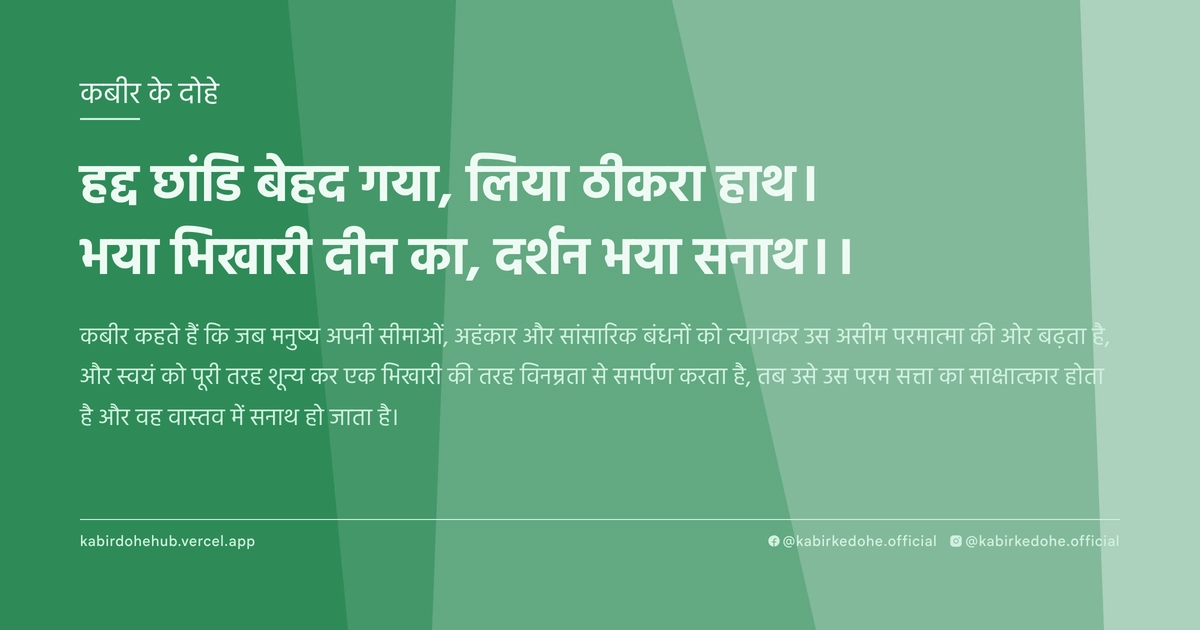
हद्द छांडि बेहद गया, लिया ठीकरा हाथ।
भया भिखारी दीन का, दर्शन भया सनाथ।।
Hadd chhandi behad gaya, liya theekra haath. Bhaya bhikhari deen ka, darshan bhaya sanath.
इस पृष्ठ पर इस कबीर दोहे का अर्थ (meaning), हिंदी व्याख्या और अंग्रेज़ी अनुवाद, दार्शनिक विश्लेषण और व्यावहारिक जीवन सीख दी गई है। यह दोहा प्रपत्ति (Surrender) विषय से जुड़ा है — Kabir doha meaning and explanation in Hindi and English.
अर्थ (Meaning):
कबीर कहते हैं कि जब मनुष्य अपनी सीमाओं, अहंकार और सांसारिक बंधनों को त्यागकर उस असीम परमात्मा की ओर बढ़ता है, और स्वयं को पूरी तरह शून्य कर एक भिखारी की तरह विनम्रता से समर्पण करता है, तब उसे उस परम सत्ता का साक्षात्कार होता है और वह वास्तव में सनाथ हो जाता है।
Kabir proclaims that when a seeker transcends the boundaries of the ego and the finite limits of the material world, embracing the posture of a spiritual beggar with a bowl of surrender, they finally encounter the Infinite. In the moment of absolute poverty of spirit, the soul discovers it is no longer orphaned but sheltered by the Eternal.
व्याख्या (Interpretation):
इस दोहे में 'हद्द' का अर्थ है अहंकार की सीमाएं और 'बेहद' का अर्थ है वह अनंत शून्य जहाँ ईश्वर वास करता है। 'ठीकरा' हाथ में लेना केवल भौतिक भिक्षा नहीं, बल्कि पूर्ण आत्म-समर्पण और अहंकार के विसर्जन का प्रतीक है। जब साधक यह स्वीकार कर लेता है कि वह आध्यात्मिक रूप से पूर्णतः रिक्त है, तभी वह उस असीम कृपा के लिए पात्र बनता है। यह निर्गुण भक्ति का सार है जहाँ भक्त अपनी पहचान मिटाकर ब्रह्म में लीन हो जाता है। यहाँ 'दीन' होना वास्तव में सबसे बड़ी शक्ति है क्योंकि यह माया के भ्रम को तोड़ता है। अंततः, जो स्वयं को खो देता है, वही उस 'सनाथ' (परमात्मा) को पाता है जो सबका वास्तविक सहारा है।
The term 'Hadd' signifies the restrictive boundaries of the ego and social identity, while 'Behad' represents the boundless void of the Absolute. Holding the 'Thikra' (broken clay bowl) is not a call for literal alms, but a profound metaphor for spiritual bankruptcy and total surrender. In the framework of Nirgun Bhakti, the seeker must first become 'nothing' to become 'everything.' This paradox suggests that as long as the 'I' exists, the Divine cannot enter; only when the vessel of the self is shattered does the light of Brahman illuminate the soul. The transition from being a 'beggar' to being 'Sanath' (protected/supported) illustrates the non-duality of Atman and Brahman, where the illusion of separation vanishes into a singular, eternal union.
दार्शनिक विश्लेषण (Philosophical Analysis):
कबीर का यह दर्शन उनके युग के कर्मकांडीय आडंबरों पर एक कड़ा प्रहार है। उस समय धर्म बाहरी प्रतीकों, ऊंच-नीच और कठोर नियमों में जकड़ा हुआ था। कबीर 'हद्द' को छोड़ने की बात कर रहे हैं, जिसका अर्थ है जाति, धर्म और सामाजिक प्रतिष्ठा की उन दीवारों को गिराना जो मनुष्य को उसकी वास्तविक प्रकृति से अलग करती हैं। यह विचार अद्वैत वेदांत के करीब है, जहाँ जीव और ब्रह्म की एकता पर जोर दिया गया है, लेकिन कबीर इसे एक सूफी रंग देते हैं जहाँ 'फना' (अहंकार का विनाश) ही 'बका' (ईश्वर में जीवित रहना) का एकमात्र मार्ग है।
यहाँ 'भिखारी' बनने का मनोवैज्ञानिक अर्थ है—अपनी बौद्धिक श्रेष्ठता और अहंकार का त्याग। जब तक मनुष्य यह सोचता है कि वह 'जानता' है, वह सीखने के लिए तैयार नहीं होता। यह मानसिक शून्यता ही वह स्थान है जहाँ परमात्मा का वास होता है। कबीर तर्क देते हैं कि ईश्वर किसी मंदिर या मस्जिद में नहीं, बल्कि उस हृदय में मिलता है जिसने अपनी सारी कृत्रिम पहचानें त्याग दी हैं।
यह दोहा यह भी स्पष्ट करता है कि आध्यात्मिक यात्रा 'प्राप्ति' की नहीं, बल्कि 'त्याग' की यात्रा है। हम अक्सर ईश्वर को कुछ मांगने के लिए ढूंढते हैं, जबकि कबीर कहते हैं कि ईश्वर को पाने के लिए पहले सब कुछ छोड़ना पड़ता है। यह 'शून्य' की अवस्था ही वास्तविक पूर्णता है।
सांस्कृतिक रूप से, यह संदेश समाज के सबसे निचले तबके को यह शक्ति देता है कि उनकी दीनता ही उनकी सबसे बड़ी आध्यात्मिक संपत्ति है। यदि एक व्यक्ति स्वयं को तुच्छ मानकर समर्पित हो जाए, तो वह उस सम्राट (ईश्वर) का सानिध्य पा सकता है जिसके सामने बड़े-बड़े विद्वान अपने ज्ञान के बोझ तले दबे रहते हैं।
अंततः, यह दर्शन हमें सिखाता है कि मुक्ति किसी बाहरी अनुष्ठान से नहीं, बल्कि आंतरिक रूपांतरण से आती है। जब 'मैं' मरता है, तब 'वह' प्रकट होता है। यही वह बिंदु है जहाँ भक्त और भगवान के बीच का अंतर समाप्त हो जाता है और केवल एक अनंत चेतना शेष रह जाती है।
Kabir's philosophy in this verse serves as a radical critique of the ritualistic rigidity prevalent during his era. He challenges the 'Hadd'—the artificial boundaries of caste, creed, and religious dogma that fragmented human consciousness. By urging the seeker to move toward the 'Behad' (the Boundless), Kabir aligns himself with the core of Advaita Vedanta, asserting that the perceived separation between the individual soul and the Universal Consciousness is a mere illusion (Maya). However, he infuses this with the Sufi concept of 'Fana'—the annihilation of the self—suggesting that the ego must be completely extinguished before the Divine Presence can be realized.
Psychologically, the act of becoming a 'bhikhari' (beggar) represents the state of spiritual openness. The intellectual ego often acts as a barrier; the belief that one 'possesses' knowledge prevents the actual experience of Truth. By adopting the posture of a beggar, the seeker acknowledges their fundamental ignorance and emptiness, which paradoxically becomes the only vessel capable of holding the Infinite. Kabir suggests that the Divine does not reside in the grandeur of temples or the austerity of mosques, but in the humility of a heart that has ceased to claim ownership over its identity.
This teaching emphasizes that the spiritual path is not one of acquisition, but of subtraction. Most seekers approach the Divine with a list of desires, yet Kabir posits that the only way to 'gain' the Absolute is to 'lose' the finite self. This is the central paradox of mysticism: the more one clings to their identity, the further they drift from the Truth; the more they surrender, the closer they come to the Source.
Historically, this message was profoundly empowering for the marginalized. By elevating 'deen-ta' (humility/poverty) to a spiritual prerequisite, Kabir inverted the social hierarchy of his time. He argued that the social outcast, stripped of worldly pride, is closer to liberation than the high-born scholar burdened by the weight of their own perceived superiority.
Ultimately, the verse points toward a transformation of consciousness. It moves the seeker from the realm of 'doing' (rituals, prayers, efforts) to the realm of 'being' (surrender, silence, presence). When the 'I' is finally dissolved, the duality of seeker and sought vanishes, leaving only the singular, luminous reality of the Sanath—the Eternal Protector.
मूल संदेश (Core Message):
- अहंकार की सीमाएं ही ईश्वर और आत्मा के बीच की सबसे बड़ी दीवार हैं।
- पूर्ण समर्पण ही वह एकमात्र कुंजी है जो अनंत के द्वार खोलती है।
- जब हम स्वयं को शून्य करते हैं, तभी हम पूर्णता को प्राप्त कर सकते हैं।
- आध्यात्मिक दरिद्रता (विनम्रता) ही वास्तविक दैवीय समृद्धि का आधार है।
- सनाथ होने का अर्थ है—स्वयं को खोकर उस परम सत्ता में विलीन हो जाना।
- The boundaries of the ego are the primary walls separating the soul from the Divine.
- Total surrender is the only key that unlocks the gates of the Infinite.
- Only by becoming a void can one be filled with the Absolute.
- Spiritual poverty (humility) is the foundation of true divine abundance.
- To be 'Sanath' is to lose the small self and merge into the Eternal Presence.
व्यावहारिक उदाहरण (Practical Example):
वाराणसी के एक घाट पर माधव नाम का एक वृद्ध बुनकर रहता था। माधव अपने काम में निपुण था और शहर भर में उसकी ख्याति थी। उसे अपने कौशल पर बहुत गर्व था और वह मानता था कि उसकी मेहनत और बुद्धि ही उसकी सफलता का आधार है। वह अक्सर अन्य बुनकरों को नीचा दिखाता और खुद को श्रेष्ठ समझता था।
एक समय ऐसा आया जब शहर में भीषण अकाल पड़ा और व्यापार पूरी तरह ठप हो गया। माधव की सारी जमापूंजी खत्म हो गई और उसके पास खाने के लिए एक दाना भी नहीं बचा। उसकी सामाजिक प्रतिष्ठा, उसका अहंकार और उसका गर्व धीरे-धीरे बिखरने लगा।
एक दिन भूख से व्याकुल माधव एक मंदिर की सीढ़ियों पर बैठा था। उसने देखा कि एक फकीर वहां बैठा है, जिसके पास केवल एक मिट्टी का कटोरा (ठीकरा) है, फिर भी उसके चेहरे पर एक असीम शांति और संतोष है। माधव ने उससे पूछा, "तुम्हारे पास कुछ नहीं है, फिर भी तुम इतने खुश कैसे हो?"
फकीर ने मुस्कुराकर कहा, "क्योंकि मैंने वह सब छोड़ दिया है जिसे मैं 'मेरा' कहता था। जब तक मैं खुद को मालिक समझता था, मैं डर में था। अब मैं एक भिखारी हूँ, और भिखारी को डर नहीं होता क्योंकि वह जानता है कि उसका पालनहार कोई और है।"
माधव को पहली बार अपनी 'हद्द' का एहसास हुआ। उसे समझ आया कि उसका गर्व ही उसकी सबसे बड़ी जेल थी। उसने महसूस किया कि उसकी सारी उपलब्धियां वास्तव में उसके अहंकार की दीवारें थीं जिन्होंने उसे उस परम शांति से दूर रखा था।
उस रात, माधव ने मानसिक रूप से अपना सब कुछ—अपनी प्रतिष्ठा, अपनी श्रेष्ठता और अपनी पहचान—उस अनंत परमात्मा के चरणों में समर्पित कर दी। उसने मन ही मन कहा, "मैं अब कुछ नहीं हूँ, मैं केवल तेरा हूँ।"
जैसे ही उसने यह समर्पण किया, उसके भीतर एक अद्भुत हल्कापन महसूस हुआ। वह अब इस बात से परेशान नहीं था कि कल क्या होगा। उसकी बेचैनी समाप्त हो गई और एक गहरी आंतरिक शांति ने उसकी जगह ले ली।
अगले कुछ दिनों में, माधव ने फिर से काम शुरू किया, लेकिन अब उसका नजरिया बदल चुका था। वह अब श्रेष्ठता के लिए नहीं, बल्कि सेवा के लिए बुनता था। वह अब अन्य बुनकरों की मदद करता और उनके साथ विनम्रता से पेश आता।
उसने पाया कि जब उसने खुद को 'भिखारी' मान लिया, तो उसे वह 'सनाथ' मिल गया जो हमेशा उसके भीतर था। उसकी गरीबी ने उसे वह आध्यात्मिक अमीरी दी जो उसकी समृद्धि कभी नहीं दे पाई थी।
माधव अब केवल एक बुनकर नहीं था, वह एक मुक्त आत्मा बन चुका था जिसने सीमाओं को लांघकर अनंत का अनुभव किया था।
On the ghats of Varanasi lived an elderly weaver named Madhav. Madhav was a master of his craft, renowned throughout the city for the intricacy of his looms. However, this mastery had birthed a towering ego. He believed his skill and intellect were the sole architects of his success, and he frequently looked down upon fellow weavers, viewing himself as spiritually and professionally superior.
Time turned, and a severe famine struck the region, bringing trade to a grinding halt. Madhav's savings evaporated, and soon, he found himself without a single grain of rice. The social prestige he had clung to, the pride in his lineage, and the arrogance of his skill began to crumble under the weight of starvation.
One afternoon, exhausted and broken, Madhav sat on the steps of a temple. He noticed a wandering dervish sitting nearby. The dervish possessed nothing but a cracked clay bowl (thikra), yet his face radiated a profound, unshakable peace and an aura of absolute contentment.
Driven by curiosity and desperation, Madhav asked, "You have nothing to your name, yet you look more satisfied than I ever was in my prime. How is this possible?"
The dervish smiled gently and replied, "Because I have surrendered everything I once called 'mine.' As long as I believed I was the master of my fate, I lived in fear of losing it. Now, I am a beggar, and a beggar has no fear, for he knows that his sustenance comes from the Eternal Provider."
In that moment, Madhav felt the walls of his 'Hadd'—his self-imposed boundaries of identity—collapse. He realized that his pride had been a gilded cage, isolating him from the true essence of existence. He saw that his perceived superiority was actually a barrier to the peace he so desperately craved.
That night, in the silence of his empty hut, Madhav performed a mental act of total surrender. He consciously let go of his reputation, his ego, and his identity as a 'master weaver.' He whispered into the void, "I am nothing. I possess nothing. I am merely a vessel for Thy will."
As he surrendered, a sudden, overwhelming lightness washed over him. The anxiety about the future, the shame of his poverty, and the weight of his past vanished. He felt a deep, resonant silence fill the space where his ego had once screamed.
In the following months, Madhav returned to his loom, but he was a changed man. He no longer wove to prove his superiority; he wove as an act of devotion and service. He treated every other weaver as an equal, sharing his knowledge without a shred of condescension.
He discovered that by becoming a 'beggar' in spirit, he had finally found the 'Sanath'—the Eternal Protector—who had been residing within him all along. His material poverty had become the gateway to a spiritual opulence that his previous wealth could never have purchased.
Madhav was no longer just a weaver of cloth; he had become a weaver of peace, having crossed the boundary of the finite to touch the Infinite.
अभ्यास मार्गदर्शन (Practice Guidance):
- प्रतिदिन 20 मिनट मौन ध्यान करें, जहाँ आप अपनी सभी सामाजिक पहचानों (नाम, पद, रिश्ता) को मानसिक रूप से त्याग दें और केवल एक 'शून्य' के रूप में स्वयं को अनुभव करें।
- एक 'समर्पण जर्नल' बनाएँ। हर रात उन तीन चीजों को लिखें जिन्हें आप आज पकड़ कर बैठे थे (जैसे क्रोध, सही होने की जिद, या प्रशंसा की इच्छा) और उन्हें सचेत रूप से परमात्मा को सौंप दें।
- व्यवहार परिवर्तन: दिन में कम से कम एक बार ऐसी स्थिति में खुद को रखें जहाँ आप किसी से मदद मांगें या किसी की विनम्रता को स्वीकार करें, ताकि आपका अहंकार कम हो सके।
- डायग्नोस्टिक चेकलिस्ट: क्या आप अभी भी अपनी उपलब्धियों का श्रेय खुद लेते हैं? क्या आप दूसरों की आलोचना करते समय श्रेष्ठता महसूस करते हैं? यदि हाँ, तो आप अभी भी 'हद्द' (सीमाओं) में हैं।
- Practice 20 minutes of silent meditation daily, mentally stripping away all social identities (name, title, role) and experiencing yourself simply as a 'void' or a witness.
- Maintain a 'Surrender Journal.' Every night, list three things you clung to during the day (e.g., a need to be right, a desire for praise, or a grudge) and consciously offer them up to the Infinite.
- Behavioral Shift: Once a day, intentionally place yourself in a position of humility—ask for help or acknowledge someone else's superiority in a specific area—to actively erode the ego.
- Diagnostic Checklist: Do you still claim sole credit for your successes? Do you feel a sense of superiority while criticizing others? If yes, you are still operating within the 'Hadd' (boundaries) of the ego.
चिंतन प्रश्न (Reflection Questions):
- मेरी वह कौन सी 'पहचान' है जिसे खोने के विचार मात्र से मुझे सबसे अधिक डर लगता है?
- क्या मेरी विनम्रता वास्तविक है, या यह केवल दूसरों से प्रशंसा पाने का एक सामाजिक मुखौटा है?
- मैं किन मानसिक सीमाओं (Hadd) में कैद हूँ जो मुझे दूसरों के प्रति करुणा रखने से रोकती हैं?
- यदि आज मेरा सारा सामाजिक सम्मान छीन लिया जाए, तो मेरे भीतर क्या बचेगा?
- क्या मैं वास्तव में समर्पित हूँ, या मैं केवल अपनी इच्छाओं की पूर्ति के लिए ईश्वर से 'भीख' मांग रहा हूँ?
- Which part of my identity would I be most terrified to lose if it were stripped away today?
- Is my humility genuine, or is it merely a social mask designed to elicit admiration from others?
- What are the mental boundaries (Hadd) that prevent me from experiencing unconditional compassion for all beings?
- If all my social status and accolades were removed, what core essence of 'me' would remain?
- Am I truly surrendering to the Divine, or am I simply 'begging' for the fulfillment of my own desires?