
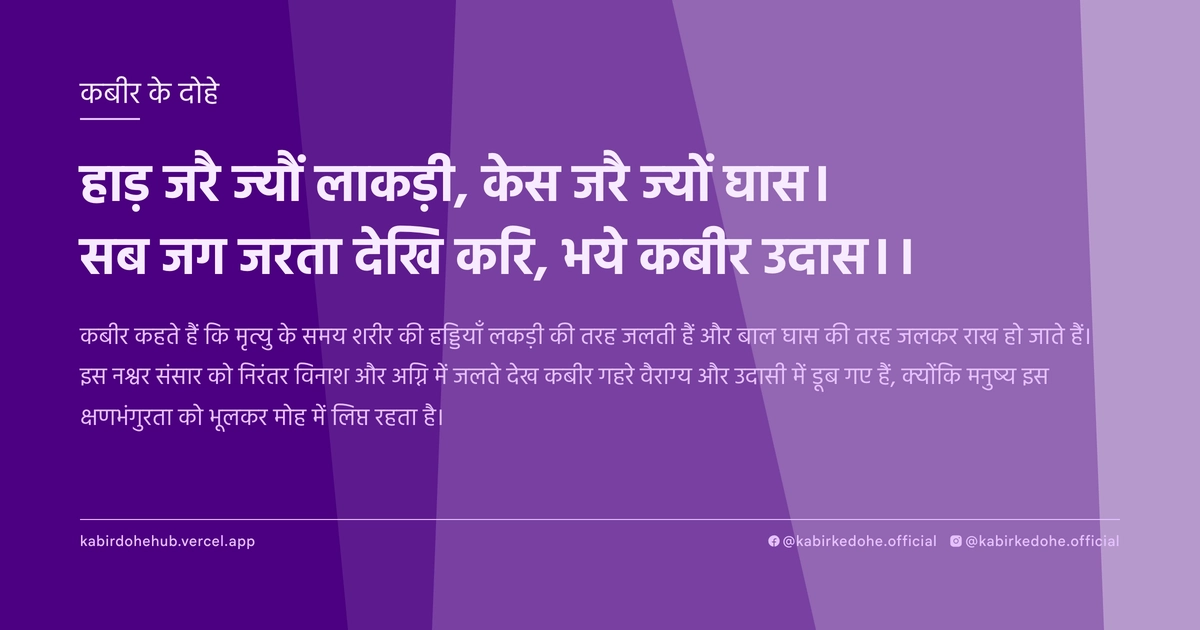
हाड़ जरै ज्यौं लाकड़ी, केस जरै ज्यों घास।
सब जग जरता देखि करि, भये कबीर उदास।।
Haad jarai jyon laakdi, kes jarai jyon ghaas. Sab jag jarta dekh kari, bhaye Kabir udaas.
इस पृष्ठ पर इस कबीर दोहे का अर्थ (meaning), हिंदी व्याख्या और अंग्रेज़ी अनुवाद, दार्शनिक विश्लेषण और व्यावहारिक जीवन सीख दी गई है। यह दोहा मृतुक्यता (Mortality) विषय से जुड़ा है — Kabir doha meaning and explanation in Hindi and English.
अर्थ (Meaning):
कबीर कहते हैं कि मृत्यु के समय शरीर की हड्डियाँ लकड़ी की तरह जलती हैं और बाल घास की तरह जलकर राख हो जाते हैं। इस नश्वर संसार को निरंतर विनाश और अग्नि में जलते देख कबीर गहरे वैराग्य और उदासी में डूब गए हैं, क्योंकि मनुष्य इस क्षणभंगुरता को भूलकर मोह में लिप्त रहता है।
Kabir observes that in the funeral pyre, bones burn like dry wood and hair vanishes like scorched grass. Witnessing the entire world consumed by this inevitable fire of mortality, Kabir is overcome with a profound spiritual melancholy, mourning how humanity clings to a transient existence while ignoring its own certain dissolution.
व्याख्या (Interpretation):
यह दोहा शरीर की भौतिक नश्वरता से शुरू होकर आत्मा की शाश्वत खोज की ओर ले जाता है। 'लकड़ी' और 'घास' का रूपक यह दर्शाता है कि जिसे हम 'मैं' या 'मेरा' कहते हैं, वह अंततः केवल ईंधन है। यहाँ 'उदासी' साधारण शोक नहीं, बल्कि 'करुणा' है—एक ऐसी गहन अनुभूति जहाँ साधक देखता है कि जीव माया के भ्रम में फँसा है। यह निर्गुण भक्ति का सार है, जहाँ ईश्वर किसी मूर्ति में नहीं बल्कि उस सत्य में है जो विनाश के बाद भी शेष रहता है। अद्वैत वेदांत के अनुसार, यह शरीर केवल एक आवरण है; जब यह जलता है, तब केवल शुद्ध चेतना या ब्रह्म शेष रहता है। विरोधाभास यह है कि इस विनाश का बोध ही वास्तविक जीवन की शुरुआत है।
This couplet begins with the visceral reality of physical decay to lead the seeker toward the eternal nature of the soul. The metaphors of 'wood' and 'grass' strip away the vanity of the human form, revealing that the ego is merely fuel for the fire of time. Kabir's 'sadness' is not worldly grief but 'Karuna'—a divine compassion for those blinded by Maya (illusion). In the context of Nirgun Bhakti, the formless Divine is realized only when the attachment to the 'form' is incinerated. Drawing from Advaita Vedanta, the burning of the body symbolizes the dissolution of the false identity (Ahankara) to reveal the non-dual reality of Atman-Brahman. The central paradox is that recognizing one's own inevitable destruction is the only catalyst for true spiritual awakening.
दार्शनिक विश्लेषण (Philosophical Analysis):
कबीर का यह दोहा उस युग की उपज है जहाँ कर्मकांड और बाहरी आडंबर चरम पर थे। उन्होंने मंदिर-मस्जिद के विवादों से ऊपर उठकर 'मृत्यु' को सबसे बड़े सत्य के रूप में प्रस्तुत किया है। यह विश्लेषण दर्शाता है कि कैसे कबीर ने जाति और धर्म के भेदों को नकार दिया, क्योंकि चिता की अग्नि में राजा और रंक, ब्राह्मण और अछूत, सब एक समान राख बन जाते हैं।
दार्शनिक स्तर पर, यह सूफीवाद के 'फना' (अहंकार का विनाश) के विचार से मेल खाता है। जिस प्रकार शरीर जलता है, उसी प्रकार साधक को अपने अहंकार को ज्ञान की अग्नि में जलाना चाहिए। यदि हम शरीर के विनाश को स्वीकार नहीं करते, तो हम कभी उस अविनाशी तत्व को नहीं खोज पाएंगे।
अद्वैत वेदांत के परिप्रेक्ष्य में, यह 'माया' के पर्दे को हटाने की प्रक्रिया है। संसार एक स्वप्न की तरह है, और मृत्यु उस स्वप्न का अंत है। कबीर यहाँ चेतावनी दे रहे हैं कि जो व्यक्ति केवल भौतिक सुखों में निवेश करता है, वह अंततः रिक्त हाथ रह जाता है।
मनोवैज्ञानिक रूप से, यह 'Memento Mori' (मृत्यु को याद रखो) का अभ्यास है। जब मनुष्य अपनी नश्वरता को गहराई से महसूस करता है, तो उसका क्रोध, लोभ और ईर्ष्या स्वतः समाप्त होने लगते हैं। यह उदासी वास्तव में एक शुद्धि प्रक्रिया है, जो व्यक्ति को सांसारिक मोह से मुक्त कर आंतरिक शांति की ओर ले जाती है।
अंततः, कबीर यह समझाते हैं कि वास्तविक दुख मृत्यु नहीं है, बल्कि यह अज्ञानता है कि हम स्वयं को इस नश्वर शरीर के साथ जोड़ लेते हैं। ज्ञान की अग्नि जब शरीर की अग्नि से पहले जलती है, तब मृत्यु केवल एक वस्त्र बदलने जैसा सरल अनुभव बन जाती है।
Kabir’s verse emerges from an era dominated by rigid ritualism and sectarian strife. By centering the discourse on death, he bypasses all religious hierarchies, asserting that the funeral pyre is the ultimate equalizer where caste, creed, and class are reduced to identical ash. This is a radical rejection of the social constructs of his time.
Philosophically, this aligns with the Sufi concept of 'Fana'—the annihilation of the self. Just as the physical body is consumed by fire, the spiritual seeker must allow their ego to be incinerated by the fire of divine knowledge. Without this internal combustion, the transition to the Eternal remains obstructed by the debris of identity.
From the lens of Advaita Vedanta, the burning of the body represents the peeling away of the 'Koshas' (sheaths) of ignorance. The world is perceived as a transient projection (Maya), and death is the moment of awakening from this collective dream. Kabir warns that investing solely in the material is a strategic failure of the soul.
Psychologically, this is an exercise in 'Memento Mori'. By consciously confronting mortality, the practitioner neutralizes the drivers of greed, anger, and vanity. The 'sadness' Kabir describes is a transformative melancholy—a purgative state that clears the heart of attachments to make room for the formless Divine.
Ultimately, Kabir posits that the true tragedy is not death itself, but the delusion of permanence. When the fire of wisdom consumes the ego before the fire of the pyre consumes the flesh, death ceases to be a terror and becomes a liberation, a simple shedding of a worn-out garment.
मूल संदेश (Core Message):
- शरीर नश्वर है, इसे पकड़ना व्यर्थ है।
- मृत्यु का बोध ही वास्तविक जीवन का द्वार है।
- अहंकार की अग्नि को ज्ञान की अग्नि से जलाएं।
- मोह का त्याग ही शाश्वत शांति का मार्ग है।
- हम शरीर नहीं, बल्कि अविनाशी चेतना हैं।
- The body is transient; clinging to it is futile.
- Awareness of death is the gateway to true living.
- Incinerate the ego's fire with the fire of wisdom.
- Renouncing attachment is the only path to eternal peace.
- We are not the flesh, but the indestructible consciousness.
व्यावहारिक उदाहरण (Practical Example):
वाराणसी के घाटों पर रहने वाली एक वृद्ध विधवा, जानकी, का जीवन केवल दूसरों की सेवा और अपनी छोटी सी कुटिया की देखभाल में बीतता था। वह हर दिन श्मशान की अग्नि को जलते देखती थी, फिर भी उसके मन में एक गहरा डर था—अपने अकेलेपन का और अपनी पहचान के खो जाने का।
वह मानती थी कि उसकी पहचान उसकी मृत पति की यादों और उसके द्वारा दिए गए कुछ पुराने गहनों से जुड़ी है। वह उन गहनों को अपनी आत्मा का हिस्सा मानती थी और उन्हें कभी नहीं उतारती थी।
एक दिन, घाट पर एक युवा साधु ने कबीर का यह दोहा सुनाया। जानकी ने पूछा, 'अगर सब कुछ जल जाना है, तो फिर इस जीवन का अर्थ क्या है?' साधु ने मुस्कुराकर कहा, 'अर्थ उस चीज़ में नहीं है जो जलती है, बल्कि उस चीज़ में है जो कभी नहीं जलती।'
जानकी ने गहराई से विचार किया। उसने महसूस किया कि वह अपनी पहचान उन चीज़ों से जोड़ रही थी जो वास्तव में 'घास और लकड़ी' की तरह नश्वर थीं। उसकी उदासी अब डर से बदलकर एक शांत स्वीकृति में बदल गई।
उसने अपने गहने एक अनाथालय को दान कर दिए। उसे लगा जैसे उसके कंधों से एक भारी बोझ उतर गया हो। अब वह जब श्मशान की अग्नि देखती, तो उसे डर नहीं लगता था, बल्कि एक मुक्ति का अहसास होता था।
उसने अपना समय केवल पूजा-पाठ में नहीं, बल्कि उन लोगों की मदद करने में लगाया जो जीवन के अंतिम क्षणों में अकेले थे। वह उन्हें याद दिलाती कि शरीर तो जल जाएगा, पर प्रेम की गूँज शेष रहेगी।
उसका व्यवहार बदल गया; वह अब छोटी-छोटी बातों पर क्रोध नहीं करती थी। उसे समझ आ गया था कि जिस 'मैं' के लिए वह लड़ रही थी, वह तो केवल राख होने की प्रतीक्षा में है।
जब जानकी का अंत समय आया, तो उसके चेहरे पर कोई भय नहीं था। उसने अपनी आँखें बंद कीं और मुस्कुराते हुए कहा, 'अंततः, मैं उस अग्नि में मिल रही हूँ जो मुझे शुद्ध करेगी।'
उसका जीवन एक उदाहरण बन गया कि कैसे मृत्यु का बोध मनुष्य को अधिक दयालु और निस्वार्थ बना सकता है। उसने नश्वरता को अपनी कमजोरी नहीं, बल्कि अपनी सबसे बड़ी शक्ति बना लिया।
वाराणसी के लोग अब उसे 'शांति की मूरत' कहते थे, क्योंकि उसने जीवन को जलने से पहले ही जीना सीख लिया था।
Janaki, an elderly widow living on the ghats of Varanasi, spent her days in quiet service and tending to her small hut. Every day, she witnessed the funeral pyres, yet she harbored a deep-seated fear—the fear of loneliness and the total erasure of her identity.
She believed her essence was tied to the memories of her late husband and a few ancestral gold ornaments she wore. These trinkets were not just jewelry to her; they were the anchors of her existence.
One afternoon, a young monk reciting Kabir’s poetry caught her attention. Upon hearing this specific doha, Janaki asked, 'If everything is destined to burn like grass, what is the purpose of this struggle?' The monk replied, 'The purpose is not in that which burns, but in that which remains untouched by fire.'
Janaki reflected on this for weeks. She realized she had spent decades polishing a 'self' made of wood and grass—temporary attachments and social roles that were destined for the pyre.
In a moment of sudden clarity, she donated her gold ornaments to an orphanage. As the jewelry left her skin, she felt a physical lightness, as if a heavy shroud had been lifted from her spirit.
Her perspective on the cremation fires shifted. Instead of seeing death as a void, she saw it as a liberation. The sight of the flames no longer triggered anxiety, but a profound sense of peace.
She began spending her time comforting the dying and their grieving families, reminding them that while the vessel is fragile, the essence is eternal. Her empathy became her new identity.
She stopped engaging in petty disputes with other residents of the ghats. She realized that the 'ego' she was defending was merely a flicker of smoke in a vast wind.
When her own time came, Janaki faced the end without a single tremor of fear. She closed her eyes with a smile, whispering, 'Finally, I merge with the fire that purifies.'
Her transformation became a legend among the locals—a testament to how the conscious acceptance of mortality can strip away fear and replace it with unconditional love.
Janaki had learned the ultimate secret: by accepting the burning of the temporary, she had discovered the permanence of the soul.
अभ्यास मार्गदर्शन (Practice Guidance):
- प्रतिदिन 10 मिनट 'शव साधना' करें: शांत लेटकर कल्पना करें कि आपका शरीर पंचतत्वों में विलीन हो रहा है और केवल एक शुद्ध प्रकाश शेष है।
- आत्म-पूछताछ जर्नल: लिखें कि आपकी कौन सी उपलब्धियाँ या वस्तुएँ ऐसी हैं जिन्हें आप 'स्थायी' मानते हैं, और फिर विश्लेषण करें कि वे मृत्यु के बाद कैसे अर्थहीन हो जाएँगी।
- व्यवहारिक परिवर्तन: जब भी क्रोध या ईर्ष्या आए, स्वयं से पूछें—'क्या यह भावना उस दिन मायने रखेगी जब मैं राख बन जाऊँगा?'
- निदान चेकलिस्ट: यदि आप अभी भी अपनी सामाजिक स्थिति या भौतिक संपत्ति के खोने पर अत्यधिक तनाव महसूस करते हैं, तो इसका अर्थ है कि आप अभी भी 'लकड़ी और घास' से चिपके हुए हैं।
- Daily 'Shava Sadhana' (Corpse Meditation): Lie still for 10 minutes, visualizing the physical body dissolving into the five elements, leaving only a spark of pure, formless consciousness.
- Self-Inquiry Journaling: List the achievements or possessions you consider 'permanent,' then critically analyze how they will be rendered meaningless at the moment of dissolution.
- Behavioral Shift: Whenever anger or jealousy arises, pause and ask—'Will this emotion hold any value when I am reduced to ash?'
- Diagnostic Checklist: If you still experience acute distress over the loss of social status or material wealth, it is a sign that you are still clinging to the 'wood and grass' of the ego.
चिंतन प्रश्न (Reflection Questions):
- यदि आज आपकी मृत्यु हो जाए, तो आपकी कौन सी 'पहचान' वास्तव में आपके साथ जाएगी?
- आप अपने डिजिटल और सामाजिक व्यक्तित्व को संवारने में कितना समय व्यर्थ करते हैं, जबकि वह केवल 'घास' की तरह है?
- क्या आपकी करुणा दूसरों के प्रति है, या केवल अपनी नश्वरता के डर से उपजी है?
- वह कौन सा हिस्सा है आपके भीतर जो कभी नहीं जलता, चाहे परिस्थितियाँ कैसी भी हों?
- क्या आप वास्तव में मृत्यु से डरते हैं, या उस सत्य से जिसे आप स्वीकार नहीं करना चाहते?
- If you were to perish today, which part of your 'identity' would actually survive the fire?
- How much energy do you waste sculpting a digital or social persona that is as transient as grass?
- Is your compassion for others genuine, or is it merely a byproduct of your own fear of mortality?
- What is that singular part of your being that remains unburnt, regardless of life's circumstances?
- Do you truly fear death, or do you fear the truth that you have spent your life chasing illusions?