
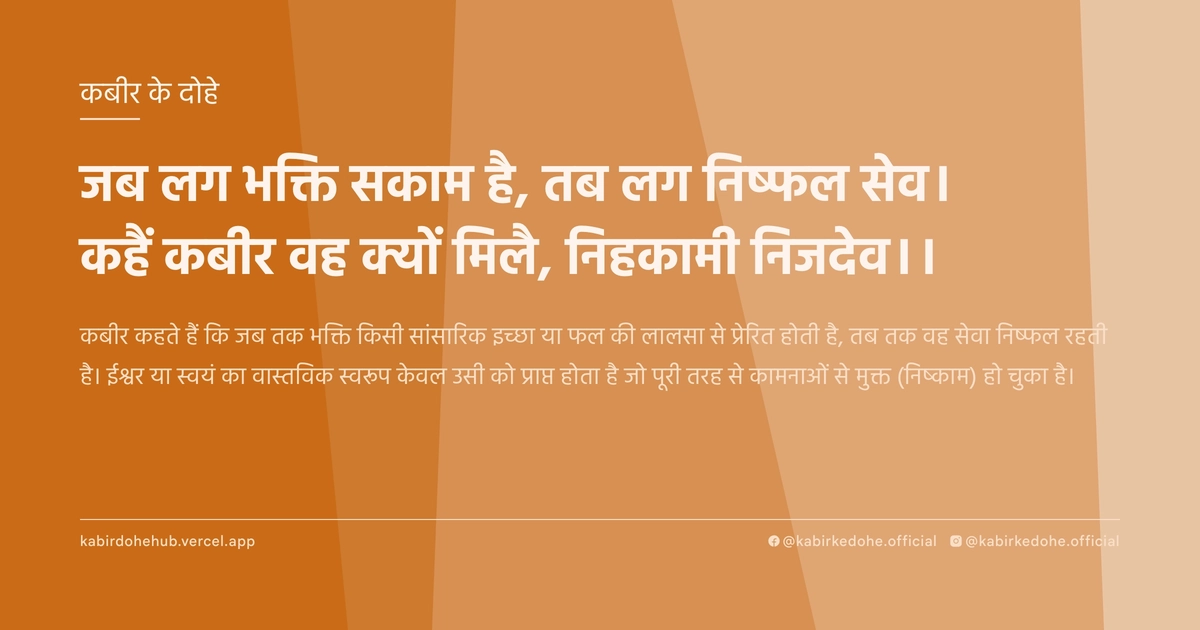
जब लग भक्ति सकाम है, तब लग निष्फल सेव।
कहैं कबीर वह क्यों मिलै, निहकामी निजदेव।।
Jab lag bhakti sakam hai, tab lag nishphal sev. Kahen Kabir vah kyun milai, nihkami nijdev.
इस पृष्ठ पर इस कबीर दोहे का अर्थ (meaning), हिंदी व्याख्या और अंग्रेज़ी अनुवाद, दार्शनिक विश्लेषण और व्यावहारिक जीवन सीख दी गई है। यह दोहा निष्ठा (Integrity) विषय से जुड़ा है — Kabir doha meaning and explanation in Hindi and English.
अर्थ (Meaning):
कबीर कहते हैं कि जब तक भक्ति किसी सांसारिक इच्छा या फल की लालसा से प्रेरित होती है, तब तक वह सेवा निष्फल रहती है। ईश्वर या स्वयं का वास्तविक स्वरूप केवल उसी को प्राप्त होता है जो पूरी तरह से कामनाओं से मुक्त (निष्काम) हो चुका है।
Kabir asserts that as long as devotion is driven by worldly desires or the hope of a reward, such service remains fruitless. The Divine, or the true Self, is only attainable by one who has become entirely desireless and selfless.
व्याख्या (Interpretation):
इस दोहे का शाब्दिक अर्थ है कि स्वार्थपूर्ण भक्ति व्यर्थ है। रूपकात्मक स्तर पर, 'सकाम' वह मानसिक अवस्था है जहाँ भक्त ईश्वर को एक साधन मानता है, साध्य नहीं। यह निरगुण भक्ति का मूल सिद्धांत है जहाँ आत्मा और परमात्मा के बीच का पर्दा 'अहंकार' और 'इच्छा' है। जब तक हम कुछ पाने की इच्छा रखते हैं, हम द्वैत (duality) में जीते हैं। अद्वैत वेदांत के अनुसार, इच्छा ही माया का मूल है जो हमें ब्रह्म से अलग करती है। जब 'मैं' और 'मेरा' समाप्त होता है, तभी 'वह' (परमात्मा) प्रकट होता है। यह विरोधाभास है कि जिसे हम पाने की कोशिश करते हैं, वह तभी मिलता है जब हम पाने की इच्छा छोड़ देते हैं।
Literally, the verse states that selfish devotion is futile. Metaphorically, 'Sakaam' represents a mental state where the devotee views the Divine as a means to an end, rather than the end itself. This is a core tenet of Nirgun Bhakti, where the veil between the Atman and Brahman is composed of ego and desire. As long as we harbor desires, we exist in duality. According to Advaita Vedanta, desire is the root of Maya, the illusion that separates us from the Absolute. Only when the 'I' and 'mine' dissolve does the Divine manifest. It is the central paradox of spirituality: the Divine is attained only when the desire for attainment is relinquished.
दार्शनिक विश्लेषण (Philosophical Analysis):
कबीर का यह विचार उनके युग के कर्मकांडीय और प्रदर्शनकारी धर्म के विरुद्ध एक सशक्त प्रहार था। उस समय लोग मंदिर-मस्जिदों में केवल इसलिए जाते थे ताकि उन्हें स्वर्ग मिले या पाप धुल जाएं। कबीर ने इसे 'सौदा' कहा, भक्ति नहीं। उन्होंने स्पष्ट किया कि ईश्वर कोई बाहरी सत्ता नहीं है जो रिश्वत या अनुष्ठान से प्रसन्न हो, बल्कि वह अंतरात्मा का शुद्ध स्वरूप है।
यह दर्शन सूफीवाद के 'फना' (अहंकार का विलीनीकरण) के करीब है, जहाँ प्रेमी अपनी हस्ती को मिटाकर ही प्रिय से मिलता है। यदि प्रेमी में अपनी पहचान या इच्छा शेष है, तो वह मिलन अधूरा है। कबीर यहाँ 'निहकामी' होने पर जोर देते हैं, जिसका अर्थ आलस्य नहीं, बल्कि मानसिक आसक्ति का पूर्ण अभाव है।
अद्वैत वेदांत के परिप्रेक्ष्य में, इच्छाएं 'अविद्या' का परिणाम हैं। जब तक साधक यह सोचता है कि 'मैं' ईश्वर को 'प्राप्त' करूँगा, तब तक वह यह मान रहा है कि वह और ईश्वर अलग-अलग हैं। यह पृथकता ही दुख का कारण है। निष्काम सेवा वास्तव में इस भ्रम को तोड़ने की प्रक्रिया है।
मनोवैज्ञानिक स्तर पर, सकाम भक्ति एक प्रकार का 'लेन-देन' है जो अहंकार को और पुष्ट करता है। 'मैंने इतनी पूजा की, इसलिए मुझे यह मिलना चाहिए'—यह विचार अहंकार को बढ़ाता है। इसके विपरीत, निष्काम भक्ति अहंकार को गला देती है, जिससे चित्त शांत और निर्मल होता है।
अंततः, कबीर यह समझाते हैं कि परमात्मा 'निहकामी' है, इसलिए वह केवल निहकामी को ही मिल सकता है। यह एक आध्यात्मिक प्रतिध्वनि है: समान ही समान को आकर्षित करता है। जब मनुष्य अपनी इच्छाओं की राख पर खड़ा होता है, तब वह उस अनंत शून्य में प्रवेश करता है जहाँ केवल शुद्ध चेतना शेष रहती है।
Kabir’s insight is a powerful critique of the ritualistic and performative religion of his era. During his time, people frequented temples and mosques primarily to secure a place in heaven or to cleanse sins. Kabir termed this a 'transaction,' not devotion. He clarified that the Divine is not an external entity to be bribed or appeased through rituals, but the purest essence of the inner self.
This philosophy aligns closely with the Sufi concept of 'Fana' (annihilation of the ego), where the lover meets the Beloved only after erasing their own existence. If any trace of identity or desire remains, the union is incomplete. Kabir emphasizes being 'Nihkaami,' which does not imply lethargy, but the total absence of mental attachment.
From the perspective of Advaita Vedanta, desires are a result of 'Avidya' (ignorance). As long as the seeker believes 'I' will 'attain' God, they are reinforcing the illusion of separation between the self and the Absolute. This perceived duality is the root of all suffering. Selfless service is the process of shattering this illusion.
Psychologically, desire-driven devotion is a form of transactional bargaining that strengthens the ego. The thought 'I have prayed this much, therefore I deserve this' only inflates the sense of self. In contrast, selfless devotion dissolves the ego, leading to a state of mental stillness and purity.
Ultimately, Kabir explains that the Divine is 'desireless' (Nihkaami); therefore, the Divine can only be realized by one who is also desireless. It is a spiritual resonance: like attracts like. When a human stands upon the ashes of their desires, they enter that infinite void where only pure consciousness remains.
मूल संदेश (Core Message):
- इच्छा ही ईश्वर और आत्मा के बीच की सबसे बड़ी दीवार है।
- सच्ची भक्ति वह है जहाँ केवल देने का भाव हो, पाने का नहीं।
- जब तक 'मैं' जीवित है, तब तक 'वह' अदृश्य रहेगा।
- मोक्ष कोई पुरस्कार नहीं, बल्कि इच्छाओं के विसर्जन की अवस्था है।
- निष्काम कर्म ही वह कुंजी है जो अनंत द्वार खोलती है।
- Desire is the greatest wall between the Divine and the Soul.
- True devotion is where there is only the will to give, not to receive.
- As long as the 'I' survives, the 'Divine' remains invisible.
- Liberation is not a reward, but the state of dissolved desires.
- Selfless action is the only key that unlocks the infinite door.
व्यावहारिक उदाहरण (Practical Example):
वाराणसी के घाटों पर रहने वाली एक वृद्ध विधवा, जानकी, का जीवन केवल एक ही इच्छा के इर्द-गिर्द घूमता था—अपने दिवंगत पुत्र की आत्मा की शांति के लिए मोक्ष प्राप्त करना। वह प्रतिदिन घंटों कठिन तपस्या करती, उपवास रखती और दान देती। उसकी हर प्रार्थना में एक शर्त होती थी: 'हे प्रभु, यदि मैं यह सब कर रही हूँ, तो मेरे पुत्र को शांति मिले।'
वर्षों बीत गए, लेकिन जानकी के मन की अशांति नहीं गई। वह जितना अधिक 'फल' की इच्छा से तप करती, उसका क्रोध और हताशा उतनी ही बढ़ती जाती। वह ईश्वर को एक न्यायाधीश की तरह देखती थी जिससे उसे न्याय चाहिए था।
एक दिन उसकी मुलाकात एक फकीर से हुई जिसने उसकी व्याकुलता देख कर कहा, 'बेटी, तू भक्ति नहीं, व्यापार कर रही है। तूने अपनी सेवा को एक सौदे में बदल दिया है। जब तक तू यह सोचेगी कि तुझे कुछ चाहिए, तू उस परमात्मा से दूर रहेगी जो स्वयं कुछ नहीं चाहता।'
जानकी को यह बात चुभी, लेकिन उसने गहराई से विचार किया। उसने महसूस किया कि उसकी तपस्या वास्तव में उसके पुत्र के लिए नहीं, बल्कि उसके अपने दुख को कम करने की एक कोशिश थी। वह 'मोक्ष' को एक वस्तु की तरह पाना चाहती थी।
उसने धीरे-धीरे अपनी प्रार्थनाओं का तरीका बदला। अब वह यह नहीं कहती थी कि 'मुझे यह दे दो', बल्कि वह केवल यह कहती थी, 'मैं जो भी करूँ, वह केवल आपकी उपस्थिति के आनंद के लिए हो।'
उसने दूसरों की सेवा करना शुरू किया, बिना यह सोचे कि इससे उसे पुण्य मिलेगा। उसने घाट पर आने वाले असहाय यात्रियों को बिना किसी उम्मीद के भोजन कराना शुरू किया।
एक सुबह, जब वह गंगा किनारे बैठी थी, उसे अचानक एक ऐसी शांति का अनुभव हुआ जो उसने कभी नहीं जानी थी। वह शांति किसी बाहरी फल की प्राप्ति से नहीं, बल्कि फल की इच्छा के पूरी तरह समाप्त हो जाने से आई थी।
उसने पाया कि जब उसने अपने पुत्र के मोक्ष की 'मांग' छोड़ी, तो वह स्वयं उस असीम प्रेम में विलीन हो गई जहाँ न कोई विरह था और न कोई मांग। यही कबीर का 'निहकामी' होने का रहस्य था।
Janaki, an elderly widow living on the ghats of Varanasi, spent her life driven by a single desire—to secure salvation for her deceased son's soul. She performed rigorous penance daily, fasted, and gave alms. Every prayer carried a condition: 'O Lord, since I am doing all this, grant my son peace.'
Years passed, but Janaki's inner turmoil persisted. The more she practiced with the hope of a 'result,' the more her frustration and anger grew. She viewed God as a judge from whom she demanded justice.
One day, she met a wandering dervish who observed her distress and said, 'Daughter, you are not practicing devotion; you are conducting a business. You have turned your service into a bargain. As long as you think you need something, you will remain distant from the Divine, who desires nothing.'
Janaki felt stung by these words, but she contemplated them deeply. She realized that her penance was not truly for her son, but an attempt to soothe her own grief. She wanted 'Moksha' as if it were a tangible commodity.
Slowly, she changed the nature of her prayers. She stopped saying 'Give me this' and instead whispered, 'Whatever I do, let it be solely for the joy of Your presence.'
She began serving others without any expectation of spiritual merit. She started feeding helpless travelers on the ghats without hoping for any reward or recognition.
One morning, while sitting by the Ganges, she experienced a profound peace she had never known. This peace did not come from attaining a reward, but from the total evaporation of the desire for one.
She discovered that when she let go of the 'demand' for her son's salvation, she herself merged into an infinite love where there was neither separation nor longing. This was the secret of being 'Nihkaami' as taught by Kabir.
अभ्यास मार्गदर्शन (Practice Guidance):
- दैनिक अभ्यास: दिन में कम से कम एक ऐसा कार्य करें जिसके लिए आप किसी भी प्रकार के आभार, प्रशंसा या फल की अपेक्षा न रखें। इसे 'गुप्त सेवा' कहें।
- आत्म-चिंतन जर्नल: हर रात लिखें कि आज आपने कितनी बार 'यदि मैं यह करूँगा तो मुझे वह मिलेगा' वाला विचार किया। उन क्षणों को पहचानें जहाँ भक्ति 'सौदा' बन गई।
- साक्षी भाव: जब भी मन में कोई इच्छा जागे, तो उसे दबाएँ नहीं, बल्कि एक तटस्थ observer की तरह देखें। पूछें, 'यह इच्छा मेरी है या मेरे अहंकार की?'
- डायग्नोस्टिक चेकलिस्ट: यदि आप सेवा के बाद उपेक्षित महसूस करते हैं, तो आप 'सकाम' हैं। यदि सेवा के बाद केवल एक शांत रिक्तता महसूस होती है, तो आप 'निष्काम' मार्ग पर हैं।
- Daily Practice: Perform at least one act of service daily for which you expect no gratitude, praise, or reward. Call this 'Secret Service.'
- Self-Inquiry Journal: Every night, record how many times you thought, 'If I do this, I will get that.' Identify the moments where devotion turned into a 'transaction.'
- Witness Consciousness: Whenever a desire arises, do not suppress it; instead, observe it as a neutral witness. Ask, 'Is this desire mine, or does it belong to my ego?'
- Diagnostic Checklist: If you feel neglected or resentful after helping someone, you are in 'Sakaam' (desire-driven) mode. If you feel only a peaceful emptiness, you are on the 'Nishkaam' (selfless) path.
चिंतन प्रश्न (Reflection Questions):
- क्या मेरी धार्मिक आस्था वास्तव में ईश्वर के प्रति प्रेम है, या यह केवल एक सुरक्षा कवच है ताकि मैं भविष्य में सुरक्षित रहूँ?
- यदि मुझे पता चले कि मेरी सभी अच्छी deeds का कोई फल नहीं मिलेगा, तो क्या मैं फिर भी उन्हें करना चाहूँगा?
- मेरे जीवन का वह कौन सा 'पवित्र' कार्य है जिसे मैं वास्तव में अपनी छवि सुधारने के लिए करता हूँ?
- क्या मैं वास्तव में शून्य होने को तैयार हूँ, या मैं केवल एक 'बेहतर' और 'पवित्र' अहंकार बनाना चाहता हूँ?
- मेरी प्रार्थनाएँ माँगने की सूची हैं या समर्पण के गीत?
- Is my religious faith truly love for the Divine, or is it merely a security blanket to ensure my future safety?
- If I knew that all my good deeds would yield absolutely no reward, would I still choose to do them?
- Which 'sacred' act in my life do I actually perform to polish my public image?
- Am I truly ready to become nothing, or am I simply trying to build a 'better' and 'holier' ego?
- Are my prayers a shopping list of demands or songs of total surrender?