
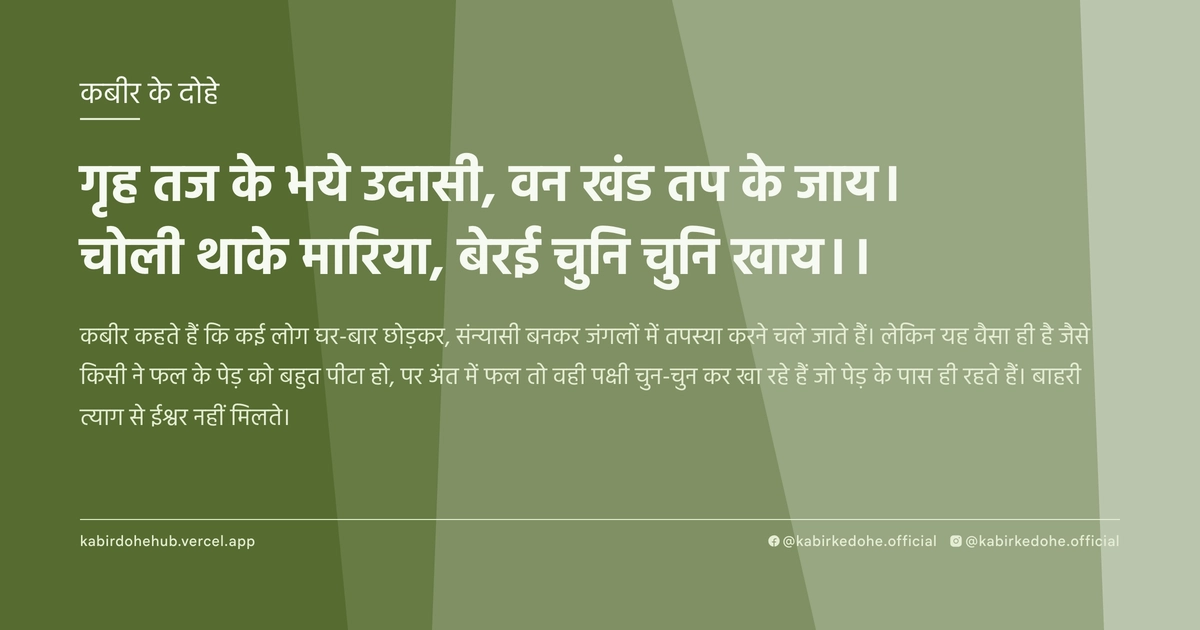
गृह तज के भये उदासी, वन खंड तप के जाय।
चोली थाके मारिया, बेरई चुनि चुनि खाय।।
Grih taj ke bhaye udaasi, van khand tap ke jaaye. Choli thaake maariya, berai chuni chuni khaay.
इस पृष्ठ पर इस कबीर दोहे का अर्थ (meaning), हिंदी व्याख्या और अंग्रेज़ी अनुवाद, दार्शनिक विश्लेषण और व्यावहारिक जीवन सीख दी गई है। यह दोहा वैराग्य (Detachment) विषय से जुड़ा है — Kabir doha meaning and explanation in Hindi and English.
अर्थ (Meaning):
कबीर कहते हैं कि कई लोग घर-बार छोड़कर, संन्यासी बनकर जंगलों में तपस्या करने चले जाते हैं। लेकिन यह वैसा ही है जैसे किसी ने फल के पेड़ को बहुत पीटा हो, पर अंत में फल तो वही पक्षी चुन-चुन कर खा रहे हैं जो पेड़ के पास ही रहते हैं। बाहरी त्याग से ईश्वर नहीं मिलते।
Kabir observes that many abandon their homes and families to become ascetics, seeking enlightenment through rigorous penance in remote forests. He compares this to a person who exhausts themselves beating a berry tree in hopes of fruit, while the birds—who simply dwell there—effortlessly pick and eat the berries. External renunciation is not the path to truth.
व्याख्या (Interpretation):
यह दोहा बाहरी आडंबर और कर्मकांडीय त्याग पर एक तीखा प्रहार है। कबीर यहाँ 'उदासी' (संन्यास) और 'वन खंड' (जंगल) के माध्यम से उस भ्रम को दर्शाते हैं जहाँ साधक यह मानता है कि भौतिक स्थान बदलने से आंतरिक परिवर्तन होगा। 'चोली' (पेड़ की टहनी या फल) को मारने का प्रयास उस व्यर्थ संघर्ष का प्रतीक है जो अहंकार प्रेरित तपस्या में होता है। यहाँ 'बेरई' (बेर का पक्षी) उस सहज व्यक्ति का प्रतीक है जो बिना किसी दिखावे के, अपनी स्वाभाविक अवस्था में रहकर भी सत्य का स्वाद ले लेता है। यह निर्गुण भक्ति का सार है: ईश्वर किसी विशेष स्थान या कठिन तप में नहीं, बल्कि सहजता और आंतरिक शुद्धि में है। यह अद्वैत वेदांत के उस सिद्धांत को पुष्ट करता है कि ब्रह्म सर्वव्यापी है, इसलिए उससे दूर भागना या उसे खोजने के लिए घर छोड़ना निरर्थक है।
This couplet is a sharp critique of external ostentation and ritualistic renunciation. Through the imagery of 'udaasi' (asceticism) and 'van khand' (forests), Kabir illustrates the delusion that changing one's physical location can trigger an internal transformation. The act of 'beating the tree' symbolizes the futile struggle inherent in ego-driven penance. The 'berai' (the bird of the berry tree) represents the effortless seeker who, remaining in their natural state without pretense, tastes the fruit of truth. This encapsulates the essence of Nirgun Bhakti: the Divine is not found in a specific geography or through grueling austerity, but in simplicity and inner purity. It reinforces the Advaita Vedanta principle that Brahman is omnipresent; thus, fleeing the world to find the Truth is a fundamental misunderstanding of reality.
दार्शनिक विश्लेषण (Philosophical Analysis):
कबीर का यह दृष्टिकोण उनके समय के सामाजिक और धार्मिक परिवेश की प्रतिक्रिया है, जहाँ सन्यास को मोक्ष का एकमात्र मार्ग माना जाता था। वे इस विचार को चुनौती देते हैं कि पवित्रता किसी बाहरी स्थान (जैसे जंगल या तीर्थ) से जुड़ी है। उनके लिए, वास्तविक 'त्याग' घर छोड़ना नहीं, बल्कि 'अहंकार' का त्याग करना है। यह सूफी मत के 'फना' (अहंकार का विलीनीकरण) और अद्वैत के 'माया' विसर्जन के समान है।
कबीर तर्क देते हैं कि जो व्यक्ति घर छोड़कर जंगल जाता है, वह अक्सर अपने अहंकार को और बढ़ा लेता है क्योंकि वह खुद को 'त्यागी' समझने लगता है। यह 'आध्यात्मिक अहंकार' सत्य की प्राप्ति में सबसे बड़ी बाधा है। वे सिखाते हैं कि गृहस्थ जीवन में रहकर, अपने कर्तव्यों का पालन करते हुए भी आत्म-साक्षात्कार संभव है।
यहाँ 'बेरई' का उदाहरण यह दर्शाता है कि सत्य 'सहज' है। जब हम प्रयास (effort) को अहंकार (ego) के साथ जोड़ देते हैं, तो वह प्रयास हमें सत्य से दूर ले जाता है। निर्गुण परंपरा में, ईश्वर को पाने के लिए किसी विशेष पोशाक, माला या स्थान की आवश्यकता नहीं है, बल्कि केवल एक शुद्ध हृदय की आवश्यकता है।
यह दर्शन हमें बताता है कि कर्मकांड केवल मन को भ्रमित करते हैं। यदि मन के भीतर वासना और क्रोध है, तो जंगल की शांति भी उसे शांत नहीं कर सकती। इसके विपरीत, एक साधारण व्यक्ति जो प्रेम और करुणा से भरा है, वह उसी घर में ईश्वर को पा लेता है जिसे संन्यासी छोड़कर भागा था।
अंततः, कबीर का संदेश यह है कि मोक्ष कोई गंतव्य नहीं है जहाँ पहुँचा जाए, बल्कि एक दृष्टि है जिससे दुनिया को देखा जाए। जब हम द्वैत (मैं और ईश्वर) को समाप्त कर देते हैं, तब हर स्थान तीर्थ बन जाता है और हर कर्म पूजा बन जाता है।
Kabir’s perspective is a direct reaction to the socio-religious climate of his era, where sannyasa (renunciation) was viewed as the sole gateway to liberation. He challenges the notion that sanctity is tied to a physical location, such as a forest or a pilgrimage site. For Kabir, true 'renunciation' is not the abandonment of the home, but the abandonment of the 'ego'. This aligns with the Sufi concept of 'Fana' (annihilation of the self) and the Advaitic dissolution of 'Maya'.
Kabir argues that the individual who flees to the forest often inadvertently inflates their ego by identifying as a 'renunciant'. This 'spiritual ego' becomes the primary obstacle to realization. He posits that self-realization is entirely possible while living a householder's life and fulfilling one's worldly duties.
The metaphor of the 'berai' suggests that Truth is 'Sahaj' (natural/spontaneous). When effort is coupled with ego, that very effort distances the seeker from the Truth. In the Nirgun tradition, reaching the Divine requires no specific attire, beads, or geography—only a pure heart.
This philosophy asserts that rituals merely confuse the mind. If the mind is riddled with lust and anger, the silence of the forest cannot pacify it. Conversely, a simple person filled with love and compassion finds the Divine within the very home that the ascetic fled.
Ultimately, Kabir’s message is that liberation is not a destination to be reached, but a lens through which to view the world. When the duality between the 'I' and the 'Divine' is erased, every place becomes a shrine and every action becomes an act of worship.
मूल संदेश (Core Message):
- बाहरी त्याग केवल एक भ्रम है, आंतरिक शुद्धि ही वास्तविक मार्ग है।
- ईश्वर किसी भौगोलिक स्थान में नहीं, बल्कि आपकी सहजता में बसता है।
- कठिन तपस्या अक्सर अहंकार का पोषण करती है, जबकि सरलता उसे मिटाती है।
- सत्य को खोजने का प्रयास ही कभी-कभी सत्य की प्राप्ति में बाधा बन जाता है।
- जीवन के साधारण कर्तव्यों का प्रेमपूर्वक पालन करना ही सर्वोच्च साधना है।
- External renunciation is a delusion; inner purification is the only true path.
- The Divine does not reside in a geography, but in your natural spontaneity.
- Rigid austerity often feeds the ego, while simplicity dissolves it.
- The desperate effort to 'find' truth can sometimes become the obstacle to realizing it.
- Performing ordinary life duties with love is the highest form of spiritual practice.
व्यावहारिक उदाहरण (Practical Example):
वाराणसी के एक पुराने मोहल्ले में माधव नाम का एक बुनकर रहता था। वह बहुत ही सरल स्वभाव का था, लेकिन उसके मन में हमेशा यह टीस रहती थी कि वह कभी भी किसी बड़े संत की तरह ईश्वर को प्राप्त नहीं कर पाएगा क्योंकि वह दिन भर करघे पर धागों से जूझता रहता था।
एक दिन माधव ने सुना कि पास के पहाड़ों में एक महान तपस्वी रहते हैं जिन्होंने वर्षों से अन्न-जल त्याग दिया है और केवल ध्यान में लीन रहते हैं। माधव ने सोचा कि शायद वहीं असली ज्ञान है। उसने अपनी छोटी सी दुकान और परिवार को पीछे छोड़कर उन पहाड़ों की ओर प्रस्थान किया।
वहाँ पहुँचकर माधव ने देखा कि वह तपस्वी अत्यंत कमजोर हो चुके थे, लेकिन उनके चेहरे पर एक अजीब सा तनाव था। वे घंटों तक कठिन मुद्राओं में बैठते और स्वयं को दंडित करते ताकि वासनाओं को मार सकें। माधव ने उनके साथ कई महीने बिताए, उपवास रखे और कड़ा अनुशासन अपनाया, लेकिन उसे शांति नहीं मिली, बल्कि वह और अधिक चिड़चिड़ा हो गया।
एक शाम, माधव ने देखा कि उस तपस्वी के आश्रम के पास एक छोटा सा पक्षी बिना किसी प्रयास के पेड़ों के फल खा रहा था और चहचहा रहा था। वह पक्षी न तो उपवास कर रहा था, न ही किसी कठिन मुद्रा में था, फिर भी वह पूर्णतः आनंदित था।
तभी माधव को कबीर का वह दोहा याद आया: 'चोली थाके मारिया, बेरई चुनि चुनि खाय'। उसे अचानक अहसास हुआ कि वह तपस्वी जिस शांति को पाने के लिए अपने शरीर को कष्ट दे रहे थे, वह शांति तो उस पक्षी की सहजता में पहले से मौजूद थी।
माधव को समझ आया कि उसने घर छोड़कर केवल स्थान बदला था, अपना स्वभाव नहीं। उसने महसूस किया कि जिस ईश्वर को वह पहाड़ों में खोज रहा था, वह वास्तव में उसके करघे की लय में, उसके बच्चों की मुस्कान में और उसकी ईमानदारी से की गई बुनाई में छिपा था।
वह तुरंत वापस वाराणसी लौट आया। अब उसने अपना काम नहीं छोड़ा, लेकिन काम करने का तरीका बदल गया। वह अब धागों को केवल कपड़ा बनाने के लिए नहीं, बल्कि ईश्वर की रचना के रूप में देखता था।
उसने पाया कि जब उसने 'ज्ञानी' बनने की कोशिश छोड़ दी और केवल एक 'सहज' इंसान बन गया, तो उसके जीवन का तनाव गायब हो गया। अब वह अपने घर के आंगन में ही वह शांति महसूस करता था जिसे वह पहाड़ों की चोटियों पर ढूंढ रहा था।
गाँव के लोग अब माधव को एक बदला हुआ इंसान देखते थे। वह अब उपदेश नहीं देता था, लेकिन उसकी आँखों की शांति और उसके व्यवहार की विनम्रता लोगों को आकर्षित करती थी।
माधव ने जान लिया था कि असली तपस्या शरीर को सुखाना नहीं, बल्कि मन के अहंकार को सुखाना है। वह अब एक 'गृहस्थ संत' बन चुका था, जिसने जीवन के बीच रहकर ही जीवन का सत्य पा लिया था।
In an old neighborhood of Varanasi lived a weaver named Madhav. He was of a very simple nature, but he always felt a pang of inadequacy, believing he could never attain God like the great saints because he spent his days struggling with threads on a loom.
One day, Madhav heard of a great ascetic living in the nearby mountains who had renounced food and water for years and remained immersed in deep meditation. Madhav thought that perhaps true knowledge lay there. Leaving behind his small shop and family, he set off for those mountains.
Upon arriving, Madhav saw that the ascetic had become extremely frail, yet there was a strange tension on his face. He would sit for hours in grueling postures, punishing his body to kill his desires. Madhav spent several months with him, fasting and following a rigid discipline, but he found no peace; instead, he became more irritable.
One evening, Madhav noticed a small bird near the ascetic's hermitage, effortlessly eating fruits from the trees and chirping happily. The bird was neither fasting nor practicing any difficult posture, yet it was completely blissful.
At that moment, Kabir’s couplet flashed through Madhav's mind: 'Choli thaake maariya, berai chuni chuni khaay'. He suddenly realized that the peace the ascetic was trying to achieve through self-mortification was already present in the bird's spontaneity.
Madhav understood that by leaving home, he had only changed his location, not his nature. He realized that the God he was searching for in the mountains was actually hidden in the rhythm of his loom, the smiles of his children, and the honesty of his weaving.
He immediately returned to Varanasi. He did not abandon his work, but he changed the way he worked. He no longer saw the threads as mere material for cloth, but as a manifestation of the Divine creation.
He found that once he stopped trying to be a 'scholar' and simply became a 'natural' human being, the stress of his life vanished. He now felt the peace in his own courtyard that he had been seeking on the mountain peaks.
The villagers now saw Madhav as a changed man. He did not give sermons, but the peace in his eyes and the humility in his behavior attracted people to him.
Madhav had learned that true penance is not about starving the body, but about starving the ego. He had become a 'householder saint,' finding the truth of life while remaining in the midst of it.
अभ्यास मार्गदर्शन (Practice Guidance):
- सहज ध्यान: प्रतिदिन 20 मिनट शांत बैठें। किसी मंत्र या लक्ष्य के पीछे भागने के बजाय, केवल अपनी स्वाभाविक सांसों को देखें। यह महसूस करें कि आप जहाँ हैं, वहीं पूर्ण हैं।
- अहंकार की पहचान: जब भी आप खुद को दूसरों से 'अधिक आध्यात्मिक' या 'अधिक नैतिक' महसूस करें, तो रुकें और लिखें कि यह विचार आपके अहंकार को कैसे बढ़ा रहा है।
- सेवा का अभ्यास: बिना किसी फल की इच्छा के, अपने दैनिक कार्यों (जैसे खाना बनाना या सफाई करना) को एक पूजा की तरह करें। कार्य को ही ध्यान बना लें।
- निदान चेकलिस्ट: क्या आप शांति पाने के लिए बाहरी बदलावों (नया शहर, नया धर्म, नया समूह) पर निर्भर हैं? यदि हाँ, तो आप 'चोली मारने' की कोशिश कर रहे हैं। क्या आप वर्तमान क्षण में बिना किसी शर्त के खुश हैं? यदि हाँ, तो आप 'बेरई' की तरह सहज हैं।
- Sahaj Meditation: Sit silently for 20 minutes daily. Instead of chasing a mantra or a specific goal, simply observe your natural breath. Feel that wherever you are, you are complete.
- Ego Mapping: Whenever you feel 'more spiritual' or 'more moral' than others, stop and journal how this thought is inflating your ego.
- Karma Yoga: Perform your daily chores (like cooking or cleaning) as an act of worship without desiring a result. Turn the action itself into meditation.
- Diagnostic Checklist: Are you relying on external changes (new city, new religion, new group) to find peace? If yes, you are 'beating the tree'. Are you happy in the present moment without conditions? If yes, you are as spontaneous as the 'berai'.
चिंतन प्रश्न (Reflection Questions):
- क्या मेरा आध्यात्मिक झुकाव वास्तव में मुक्ति के लिए है, या यह समाज में एक 'विशेष' पहचान पाने का गुप्त तरीका है?
- मैं किन बाहरी प्रतीकों (कपड़े, माला, भाषा) के माध्यम से अपनी पवित्रता सिद्ध करने की कोशिश करता हूँ?
- यदि मुझसे मेरे सभी धार्मिक और नैतिक लेबल छीन लिए जाएं, तो मेरे भीतर क्या बचेगा?
- क्या मैं अपने परिवार और समाज के प्रति अपनी जिम्मेदारियों को 'बोझ' मानता हूँ या उन्हें साधना का अवसर?
- मेरे जीवन का वह कौन सा हिस्सा है जहाँ मैं 'बेरई' की तरह सहज हूँ, और कहाँ मैं 'पेड़ को पीट' रहा हूँ?
- Is my spiritual inclination truly for liberation, or is it a covert way to gain a 'special' identity in society?
- Which external symbols (attire, beads, language) do I use to validate my purity?
- If all my religious and moral labels were stripped away, what would remain within me?
- Do I view my responsibilities toward my family and society as a 'burden' or as an opportunity for practice?
- In which area of my life am I as spontaneous as the 'berai', and where am I 'beating the tree'?