
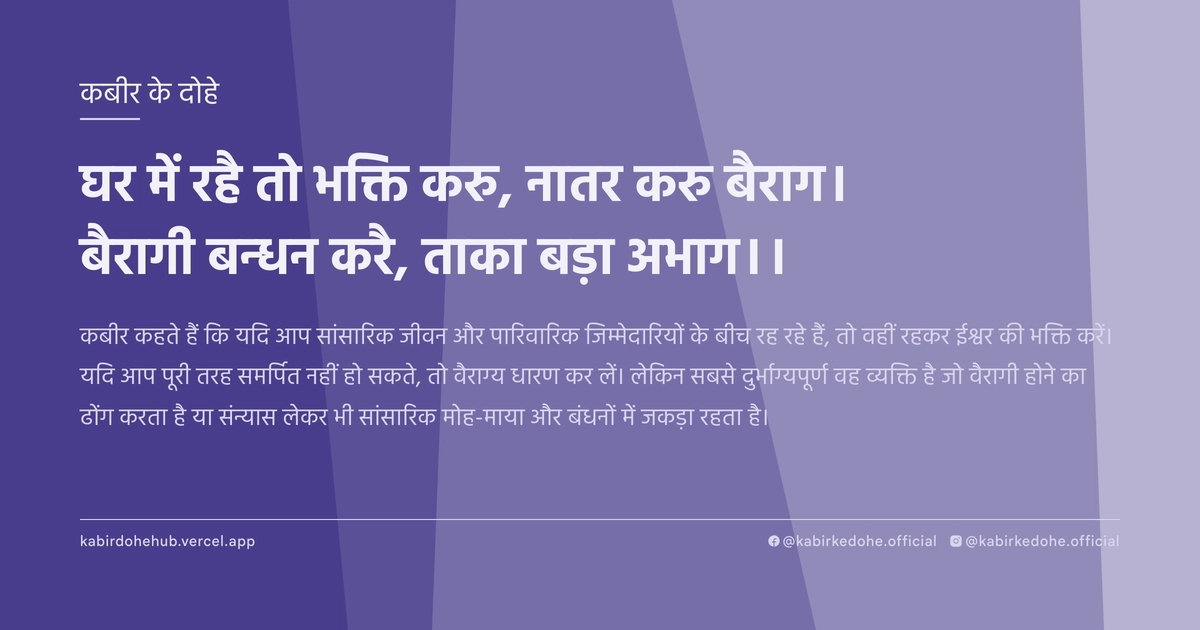
घर में रहै तो भक्ति करु, नातर करु बैराग।
बैरागी बन्धन करै, ताका बड़ा अभाग।।
Ghar me rahai to bhakti karu, naatar karu bairag. Bairagi bandhan karai, taaka bada abhaag.
इस पृष्ठ पर इस कबीर दोहे का अर्थ (meaning), हिंदी व्याख्या और अंग्रेज़ी अनुवाद, दार्शनिक विश्लेषण और व्यावहारिक जीवन सीख दी गई है। यह दोहा भक्ति (Bhakti) विषय से जुड़ा है — Kabir doha meaning and explanation in Hindi and English.
अर्थ (Meaning):
कबीर कहते हैं कि यदि आप सांसारिक जीवन और पारिवारिक जिम्मेदारियों के बीच रह रहे हैं, तो वहीं रहकर ईश्वर की भक्ति करें। यदि आप पूरी तरह समर्पित नहीं हो सकते, तो वैराग्य धारण कर लें। लेकिन सबसे दुर्भाग्यपूर्ण वह व्यक्ति है जो वैरागी होने का ढोंग करता है या संन्यास लेकर भी सांसारिक मोह-माया और बंधनों में जकड़ा रहता है।
Kabir suggests that if one resides within the domestic sphere, one should practice devotion there. Alternatively, one should embrace true renunciation. The most unfortunate soul is the one who adopts the outward appearance of a renunciant (Sannyasi) but remains internally shackled by worldly attachments and desires.
व्याख्या (Interpretation):
यह दोहा गृहस्थ और संन्यास के बीच के द्वंद्व को संबोधित करता है। शाब्दिक अर्थ यह है कि या तो भक्तिपूर्ण गृहस्थ बनें या पूर्ण वैरागी। गहरे स्तर पर, कबीर 'माया' के सूक्ष्म जाल की बात कर रहे हैं। निर्गुण भक्ति में, ईश्वर किसी विशेष स्थान या वेशभूषा में नहीं, बल्कि चेतना की शुद्धता में है। जब एक व्यक्ति बाहरी रूप से संन्यासी बन जाता है लेकिन भीतर से वासनाओं और अहंकार से बंधा रहता है, तो वह एक विरोधाभास बन जाता है। यह 'अभाग' या दुर्भाग्य है क्योंकि उसने सत्य के मार्ग पर चलने का दावा किया, लेकिन अपनी आंतरिक परतों को नहीं हटाया। यह अद्वैत वेदांत के उस सिद्धांत को दर्शाता है जहाँ बाहरी कर्मकांडों की तुलना में आंतरिक बोध (Realization) सर्वोपरि है।
This couplet addresses the tension between domesticity and asceticism. Literally, it advises practicing devotion within the home or choosing total renunciation. Metaphorically, Kabir critiques the illusion of 'Maya' and the superficiality of religious identity. In Nirgun Bhakti, the Divine is not found in a specific location or attire, but in the purity of consciousness. When an individual adopts the external garb of a renunciant while remaining internally shackled by cravings and ego, they embody a spiritual paradox. This 'misfortune' arises because they claim the path of truth while failing to dissolve their internal attachments. It aligns with Advaita Vedanta, where internal realization is prioritized over external ritualistic performance.
दार्शनिक विश्लेषण (Philosophical Analysis):
कबीर का यह दृष्टिकोण उनके समय के धार्मिक पाखंड और औपचारिक संन्यास के विरुद्ध एक कड़ा प्रहार था। मध्यकालीन भारत में, संन्यास को अक्सर केवल गेरुए वस्त्र पहनने और घर छोड़ने के रूप में देखा जाता था, जबकि मन अभी भी सांसारिक सुखों की लालसा करता था। कबीर ने इस 'छद्म वैराग्य' को खारिज किया। उन्होंने तर्क दिया कि वास्तविक वैराग्य मन की स्थिति है, न कि भौगोलिक विस्थापन।
दार्शनिक रूप से, यह सूफीवाद के 'फना' (अहंकार का विनाश) और अद्वैत वेदांत के 'माया' के सिद्धांत से जुड़ता है। यदि कोई व्यक्ति घर में रहकर भी साक्षी भाव (Witness consciousness) से जीता है, तो वह किसी वनवासी संन्यासी से अधिक उन्नत है। कबीर यहाँ 'कर्म योग' का समर्थन कर रहे हैं, जहाँ कार्य ही पूजा बन जाता है।
वह जाति और वर्ण व्यवस्था के साथ-साथ धार्मिक श्रेणियों को भी चुनौती देते हैं। उनके लिए, भक्ति का अर्थ है स्वयं के अहंकार का विसर्जन। जो व्यक्ति संन्यास लेकर भी 'मैं' और 'मेरा' के भाव से चिपका रहता है, वह वास्तव में बंधन में है। यह मनोवैज्ञानिक विश्लेषण बताता है कि बाहरी परिवर्तन तब तक व्यर्थ हैं जब तक आंतरिक रूपांतरण न हो।
कबीर का संदेश यह है कि सत्य का मार्ग सरल है लेकिन कठिन है—यह ईमानदारी की मांग करता है। यदि आप गृहस्थ हैं, तो अपनी जिम्मेदारियों को निस्वार्थ भाव से निभाएं। यदि आप संन्यासी हैं, तो वास्तव में शून्य हो जाएं। बीच का रास्ता, जो केवल दिखावा है, आध्यात्मिक पतन का कारण बनता है।
अंततः, यह दोहा हमें सिखाता है कि पवित्रता कपड़ों में नहीं, बल्कि इरादों में होती है। यह उस 'अद्वैत' स्थिति की ओर इशारा करता है जहाँ गृहस्थ और संन्यासी के बीच का भेद मिट जाता है, और केवल शुद्ध चेतना शेष रह जाती है।
Kabir’s perspective is a sharp critique of the religious hypocrisy and formal asceticism prevalent in his era. In medieval India, renunciation was often reduced to wearing saffron robes and leaving home, while the mind remained enslaved to worldly desires. Kabir rejects this 'pseudo-renunciation,' arguing that true detachment is a state of mind, not a geographical displacement.
Philosophically, this connects to the Sufi concept of 'Fana' (annihilation of the ego) and the Advaita Vedanta principle of 'Maya.' If a person lives within a household but maintains a 'witness consciousness,' they are more spiritually advanced than a forest-dwelling ascetic who is internally conflicted. Kabir here advocates for a form of 'Karma Yoga,' where action itself becomes worship.
He challenges not only caste and class but also religious categories. For Kabir, devotion means the dissolution of the ego. One who takes sannyasa but clings to the notions of 'I' and 'mine' is profoundly bound. This psychological analysis reveals that external changes are futile without internal transformation.
Kabir’s message is that the path to truth is simple yet rigorous—it demands absolute honesty. If you are a householder, fulfill your duties selflessly. If you are a renunciant, become truly void of ego. The middle path of pretense leads to spiritual stagnation.
Ultimately, this doha teaches that sanctity resides in intentions, not in attire. It points toward the 'non-dual' state where the distinction between the householder and the ascetic vanishes, leaving only pure, unadulterated consciousness.
मूल संदेश (Core Message):
- बाहरी वेशभूषा कभी भी आंतरिक शुद्धि का विकल्प नहीं हो सकती।
- सच्चा वैराग्य वस्तुओं का त्याग नहीं, बल्कि वस्तुओं के प्रति मोह का त्याग है।
- गृहस्थी में रहकर भी परमात्मा को पाना संभव है यदि मन निस्वार्थ हो।
- दिखावे का संन्यास आध्यात्मिक प्रगति में सबसे बड़ी बाधा है।
- अहंकार का विसर्जन ही वास्तविक मुक्ति का एकमात्र मार्ग है।
- External attire can never be a substitute for internal purity.
- True renunciation is not the abandonment of things, but the abandonment of attachment to them.
- Attaining the Divine within domesticity is possible if the mind remains selfless.
- Performative asceticism is the greatest obstacle to spiritual progress.
- The dissolution of the ego is the only authentic path to liberation.
व्यावहारिक उदाहरण (Practical Example):
वाराणसी के एक पुराने घाट पर माधव नाम का एक वृद्ध बुनकर रहता था। माधव का जीवन सादगी से भरा था; वह दिन भर कपड़े बुनता और रात को ईश्वर के नाम में लीन रहता। उसका घर छोटा था, लेकिन उसका हृदय विशाल था। वह अपने परिवार की देखभाल करता था, लेकिन कभी भी उनसे मोह नहीं किया। उसके लिए, करघे की हर धड़कन एक प्रार्थना थी।
उसी शहर में एक प्रसिद्ध साधु थे, जिन्हें लोग 'महात्मा' कहकर पुकारते थे। उन्होंने अपना घर छोड़ दिया था, गेरुए वस्त्र पहने थे और एक बड़ी कुटिया में रहते थे। लोग उन्हें दूर-दूर से दर्शन करने आते थे। लेकिन महात्मा के भीतर एक निरंतर युद्ध चल रहा था। वे संन्यास के बावजूद इस बात से चिंतित रहते थे कि उनके अनुयायियों की संख्या कितनी है और अन्य साधुओं की तुलना में उनका सम्मान कितना है।
एक दिन, महात्मा ने माधव को देखा। माधव अपने काम में इतना मग्न था कि उसे आसपास के शोर का पता ही नहीं था। महात्मा ने सोचा, 'यह साधारण बुनकर कैसे इतना शांत हो सकता है जबकि मैं, जिसने सब कुछ त्याग दिया, अभी भी अशांत हूँ?'
महात्मा ने माधव से पूछा, 'तुम घर और परिवार के बंधनों में रहकर भी इतनी शांति कैसे पा लेते हो?' माधव ने विनम्रता से उत्तर दिया, 'महाराज, मैंने घर नहीं छोड़ा, मैंने केवल घर के भीतर के 'मोह' को छोड़ा है। मैं बुनता हूँ, लेकिन यह कपड़े मेरे नहीं, उस परमात्मा के हैं। मैं परिवार के साथ रहता हूँ, लेकिन जानता हूँ कि हम सब केवल यात्री हैं।'
महात्मा को गहरा धक्का लगा। उन्हें एहसास हुआ कि उन्होंने केवल अपना पता बदला था, अपना स्वभाव नहीं। उन्होंने घर तो छोड़ दिया था, लेकिन अपनी 'अहंकार' की इच्छाओं को साथ रखा था। वे एक ऐसे वैरागी थे जो वास्तव में अपनी प्रतिष्ठा के बंधनों में जकड़े हुए थे।
इस बोध ने महात्मा के भीतर एक तूफान ला दिया। उन्होंने महसूस किया कि उनका संन्यास केवल एक मुखौटा था। उन्होंने अपनी बाहरी छवि की चिंता छोड़ दी और माधव की तरह 'साक्षी भाव' को अपनाने का प्रयास किया।
धीरे-धीरे, महात्मा ने अपनी कुटिया के वैभव और अनुयायियों के सम्मान की लालसा को त्याग दिया। उन्होंने सीखा कि असली वैराग्य वह नहीं है जो दुनिया से दूर ले जाए, बल्कि वह है जो दुनिया के बीच रहकर भी दुनिया से अछूता रखे।
अंत में, वह साधु और वह बुनकर एक ही सत्य के दो अलग-अलग चेहरे बन गए। एक ने घर में रहकर भक्ति सीखी, और दूसरे ने संन्यास के भ्रम को तोड़कर वास्तविक वैराग्य पाया।
In the ancient ghats of Varanasi lived an elderly weaver named Madhav. Madhav's life was defined by simplicity; he spent his days weaving cloth and his nights immersed in the name of the Divine. His home was small, but his heart was vast. He cared for his family, yet he never clung to them with possessiveness. For him, every beat of the loom was a prayer.
In the same city lived a renowned monk, hailed by many as a 'Mahatma.' He had abandoned his home, donned saffron robes, and resided in a large cottage. People traveled from afar to seek his blessings. However, within the Mahatma, a constant war raged. Despite his renunciation, he was preoccupied with the number of his followers and how his prestige compared to other monks.
One day, the Mahatma observed Madhav. The weaver was so absorbed in his work that he was oblivious to the surrounding noise. The Mahatma wondered, 'How can this simple weaver be so peaceful while I, who have renounced everything, remain restless?'
The Mahatma asked Madhav, 'How do you find such peace while living amidst the bonds of home and family?' Madhav replied humbly, 'Maharaj, I did not leave my home; I only left the 'attachment' within the home. I weave, but these clothes are not mine—they belong to the Divine. I live with my family, but I know we are all merely travelers.'
This answer struck the Mahatma deeply. He realized he had merely changed his address, not his nature. He had left his house, but he had carried his ego and desires with him. He was a renunciant who was, in reality, shackled by the bonds of his own reputation.
This realization triggered a storm within the Mahatma. He understood that his sannyasa was merely a mask. He stopped worrying about his external image and began striving to adopt the 'witness consciousness' that Madhav possessed.
Gradually, the monk relinquished his craving for the luxury of his cottage and the admiration of his followers. He learned that true renunciation is not that which takes one away from the world, but that which keeps one untouched by the world while living in it.
In the end, the monk and the weaver became two different faces of the same truth. One found devotion within the home, and the other found true renunciation by shattering the illusion of his ascetic identity.
अभ्यास मार्गदर्शन (Practice Guidance):
- दैनिक चिंतन: दिन में तीन बार रुकें और स्वयं से पूछें, 'क्या मैं इस समय अपनी भूमिका (पिता, पुत्र, कर्मचारी) को निभा रहा हूँ या मैं इस भूमिका के अहंकार में फँसा हूँ?'
- साक्षी भाव का अभ्यास: घर के कार्यों को करते समय (जैसे खाना बनाना या सफाई करना) यह महसूस करें कि आप केवल एक माध्यम हैं और कार्य परमात्मा द्वारा किया जा रहा है।
- ईमानदार आत्म-विश्लेषण: एक जर्नल लिखें जिसमें आप उन 'सांसारिक बंधनों' की सूची बनाएं जिन्हें आप संन्यास या धर्म के नाम पर छिपाने की कोशिश कर रहे हैं।
- निदान चेकलिस्ट: यदि आप दूसरों की प्रशंसा के लिए आध्यात्मिक दिखना चाहते हैं, या यदि आप अपनी जिम्मेदारियों से भागकर शांति खोज रहे हैं, तो समझ लें कि आप 'अभागे वैरागी' की श्रेणी में हैं।
- Daily Contemplation: Pause three times a day and ask yourself, 'Am I currently fulfilling my role (parent, child, employee), or am I trapped in the ego of this role?'
- Practice of Witness Consciousness: While performing household chores (like cooking or cleaning), feel that you are merely an instrument and the action is being performed by the Divine.
- Honest Self-Inquiry: Keep a journal listing the 'worldly attachments' you attempt to hide under the guise of spirituality or religion.
- Diagnostic Checklist: If you seek spiritual validation from others or try to find peace by escaping your responsibilities, recognize that you are falling into the trap of the 'unfortunate renunciant.'
चिंतन प्रश्न (Reflection Questions):
- क्या मेरा आध्यात्मिक झुकाव वास्तव में शांति के लिए है, या यह मेरी सामाजिक विफलताओं से बचने का एक तरीका है?
- यदि मुझसे मेरी सभी धार्मिक पहचान (जाति, संप्रदाय, पद) छीन ली जाएं, तो मेरे भीतर क्या बचेगा?
- मैं किन गुप्त इच्छाओं को 'त्याग' के पर्दे के पीछे छिपाकर रखता हूँ?
- क्या मैं अपने परिवार के प्रति प्रेम करता हूँ, या मैं केवल उनके द्वारा दिए जाने वाले समर्थन और पहचान से प्रेम करता हूँ?
- मेरे जीवन का कौन सा हिस्सा 'दिखावे' पर आधारित है और कौन सा 'सत्य' पर?
- Is my spiritual inclination truly for peace, or is it a mechanism to escape my social failures?
- If all my religious identities (caste, sect, title) were stripped away, what would remain within me?
- Which secret desires do I hide behind the curtain of 'renunciation'?
- Do I truly love my family, or do I only love the support and identity they provide me?
- Which part of my life is built on 'performance' and which part is built on 'truth'?