
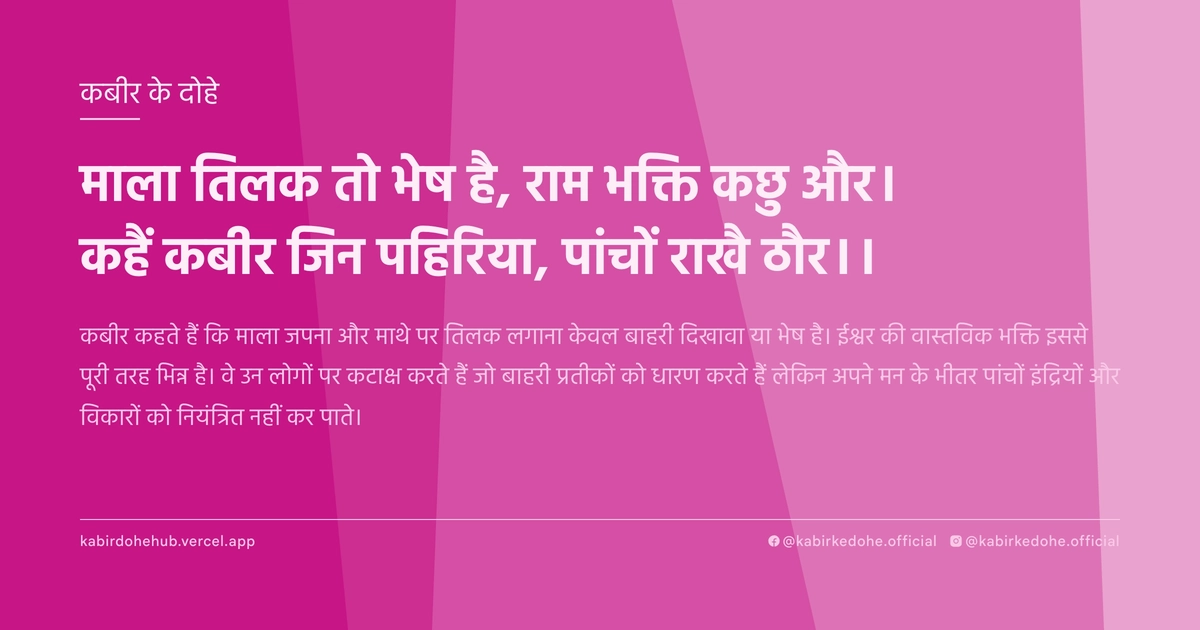
माला तिलक तो भेष है, राम भक्ति कछु और।
कहैं कबीर जिन पहिरिया, पांचों राखै ठौर।।
Maala tilak to bhesh hai, raam bhakti kachu aur. Kahein kabir jin pahiriya, paanchon raakhai thaur.
इस पृष्ठ पर इस कबीर दोहे का अर्थ (meaning), हिंदी व्याख्या और अंग्रेज़ी अनुवाद, दार्शनिक विश्लेषण और व्यावहारिक जीवन सीख दी गई है। यह दोहा धार्मिक पाखंड (Religious Hypocrisy) विषय से जुड़ा है — Kabir doha meaning and explanation in Hindi and English.
अर्थ (Meaning):
कबीर कहते हैं कि माला जपना और माथे पर तिलक लगाना केवल बाहरी दिखावा या भेष है। ईश्वर की वास्तविक भक्ति इससे पूरी तरह भिन्न है। वे उन लोगों पर कटाक्ष करते हैं जो बाहरी प्रतीकों को धारण करते हैं लेकिन अपने मन के भीतर पांचों इंद्रियों और विकारों को नियंत्रित नहीं कर पाते।
Kabir asserts that wearing prayer beads and applying a sectarian mark on the forehead are merely outward costumes or superficial displays. True devotion to the Divine is an entirely different internal experience. He critiques those who adorn themselves with religious symbols while remaining enslaved to their five senses and internal impurities.
व्याख्या (Interpretation):
शाब्दिक अर्थ में, कबीर धार्मिक प्रतीकों की व्यर्थता को दर्शाते हैं। रूपक के स्तर पर, 'भेष' माया के उस आवरण का प्रतीक है जो मनुष्य को यह भ्रम देता है कि वह आध्यात्मिक है। निर्गुण भक्ति के अनुसार, राम कोई बाहरी व्यक्ति नहीं बल्कि अंतरात्मा का शुद्ध स्वरूप हैं। जब तक साधक अपनी पांच इंद्रियों (पाँचों ठौर) को वश में नहीं करता, तब तक बाहरी कर्मकांड केवल अहंकार की तुष्टि हैं। यह अद्वैत वेदांत के उस सिद्धांत को पुष्ट करता है जहाँ आत्मा और ब्रह्म की एकता बाहरी आडंबरों से नहीं, बल्कि आंतरिक शुद्धि से प्राप्त होती है।
Literally, Kabir highlights the futility of religious symbols. Metaphorically, 'bhesh' (costume) represents the veil of Maya that tricks the individual into believing they have achieved spirituality through appearance. In Nirgun Bhakti, 'Ram' is not a deity in a temple but the formless consciousness residing within. Unless the seeker masters the five senses (the five stations), external rituals are merely fuel for the ego. This aligns with Advaita Vedanta, where the non-duality of Atman and Brahman is realized not through ritualistic performance, but through the annihilation of the illusory self.
दार्शनिक विश्लेषण (Philosophical Analysis):
कबीर का यह दोहा उस युग की प्रतिक्रिया है जब धर्म केवल कर्मकांडों और जातिगत श्रेष्ठता का साधन बन गया था। वे यहाँ 'साधना' और 'दिखावे' के बीच के सूक्ष्म अंतर को स्पष्ट करते हैं। उनका विरोध धर्म से नहीं, बल्कि उस पाखंड से है जो धर्म के नाम पर फलता-फूलता है।
दार्शनिक रूप से, यह सूफी मत के 'फना' (अहंकार का विलीनीकरण) और वेदांत के 'नेति-नेति' (यह नहीं, वह नहीं) के करीब है। कबीर तर्क देते हैं कि यदि ईश्वर सर्वव्यापी है, तो उसे पाने के लिए किसी विशेष पोशाक या चिन्ह की आवश्यकता नहीं है। बाहरी चिन्ह वास्तव में एक मनोवैज्ञानिक सुरक्षा कवच हैं, जो व्यक्ति को यह महसूस कराते हैं कि वह 'पवित्र' है, जबकि उसका आंतरिक द्वंद्व यथावत रहता है।
वे जाति और संप्रदाय की सीमाओं को तोड़ते हुए यह संदेश देते हैं कि भक्ति का मार्ग हृदय की शुद्धि से होकर गुजरता है। यहाँ 'राम' शब्द का प्रयोग एक व्यापक चेतना के लिए किया गया है, न कि किसी विशिष्ट पौराणिक व्यक्तित्व के लिए।
मनोवैज्ञानिक स्तर पर, कबीर 'पहचान के संकट' की बात कर रहे हैं। जब व्यक्ति अपनी पहचान बाहरी प्रतीकों (माला, तिलक) से जोड़ता है, तो वह अपनी वास्तविक आंतरिक खोज को रोक देता है। वह 'भक्त' होने का अभिनय करने लगता है, बजाय इसके कि वह वास्तव में भक्ति का अनुभव करे।
अतः, यह दोहा एक क्रांतिकारी आह्वान है: अपनी दृष्टि बाहर से हटाकर भीतर की ओर मोड़ें। वास्तविक मोक्ष प्रतीकों के त्याग में नहीं, बल्कि उन प्रतीकों के पीछे छिपे अहंकार के विसर्जन में है।
This couplet is a visceral reaction to an era where religion had devolved into mere ritualism and a tool for caste-based superiority. Kabir distinguishes between 'Sadhana' (disciplined practice) and 'Display'. His opposition is not toward faith itself, but toward the hypocrisy that flourishes under the guise of faith.
Philosophically, this resonates with the Sufi concept of 'Fana' (annihilation of the ego) and the Vedantic process of 'Neti-Neti' (not this, not that). Kabir argues that if the Divine is omnipresent, no specific costume or mark is required to access Him. External symbols often act as psychological safety blankets, allowing the individual to feel 'holy' while their internal conflicts remain unresolved.
By dismantling the necessity of sectarian markers, he bridges the gap between different faiths, suggesting that the path to the Divine is paved with purity of heart rather than adherence to dogma. Here, 'Ram' is used as a metaphor for the Universal Consciousness, transcending any specific mythological persona.
On a psychological level, Kabir addresses the 'crisis of identity'. When a person anchors their identity to external symbols like beads or tilaks, they cease the actual internal quest. They begin to perform the role of a 'devotee' instead of experiencing the state of devotion.
Consequently, this Doha is a revolutionary call to shift one's gaze from the external world to the internal landscape. True liberation lies not in the rejection of symbols, but in the dissolution of the ego that clings to those symbols for validation.
मूल संदेश (Core Message):
- बाहरी दिखावा आध्यात्मिक प्रगति का प्रमाण नहीं है।
- सच्ची भक्ति हृदय की आंतरिक शुद्धि में निहित है।
- इंद्रियों पर नियंत्रण ही वास्तविक धार्मिकता है।
- अहंकार का विसर्जन ही ईश्वर से मिलन का एकमात्र मार्ग है।
- प्रतीकों को साधन मानें, साध्य नहीं।
- External displays are not evidence of spiritual progress.
- True devotion resides in the internal purification of the heart.
- Mastery over the senses is the only authentic religiosity.
- The dissolution of ego is the sole path to Divine union.
- Treat symbols as tools, never as the destination.
व्यावहारिक उदाहरण (Practical Example):
वाराणसी के एक पुराने घाट पर माधव नाम का एक वृद्ध नाई रहता था। माधव अपनी पूरी जिंदगी दूसरों के बाल काटने और उनकी सेवा करने में बिता चुका था। वह बहुत ही सरल हृदय का था, लेकिन उसके मन में एक गहरी टीस थी कि वह कभी 'पंडित' या 'ज्ञानी' नहीं बन पाया क्योंकि उसके पास न तो कोई शास्त्र था और न ही वह किसी बड़े मंदिर का पुजारी था।
माधव ने देखा कि घाट पर आने वाले कई लोग बड़े-बड़े तिलक लगाते थे, गले में कई मालाएं पहनते थे और जोर-जोर से मंत्र पढ़ते थे। उन्हें देखकर माधव को लगा कि शायद यही ईश्वर तक पहुँचने का सही रास्ता है। उसने भी एक माला खरीदी और माथे पर चंदन लगाना शुरू किया। उसे लगा कि अब वह भी उन 'पवित्र' लोगों की श्रेणी में आ गया है।
लेकिन कुछ समय बाद उसने महसूस किया कि माला पहनने के बाद उसका अहंकार और बढ़ गया। वह अब अन्य नाईयों को तुच्छ समझने लगा था। उसे लगने लगा कि वह अब 'विशेष' है। उसकी विनम्रता गायब हो गई और उसकी जगह एक सूक्ष्म श्रेष्ठता के भाव ने ले ली। वह अब सेवा कम और प्रदर्शन अधिक करने लगा था।
एक दिन, एक फकीर घाट पर आया। उसने माधव को देखा और मुस्कुराते हुए कहा, 'बेटा, यह माला तो लकड़ी के दानों का ढेर है, असली माला तो वह है जो सांसों के जरिए हृदय को परमात्मा से जोड़े। तूने शरीर पर तो तिलक लगा लिया, पर क्या मन के मैल को धोया?'
यह बात माधव के हृदय में तीर की तरह लगी। उसने गौर किया कि जिस तिलक को वह अपनी पवित्रता का प्रमाण मान रहा था, उसी ने उसे दूसरों से अलग कर दिया था। उसने महसूस किया कि उसकी असली भक्ति तब थी जब वह बिना किसी दिखावे के, केवल प्रेमवश लोगों की सेवा करता था।
माधव ने उसी क्षण अपनी माला उतार दी और तिलक पोंछ लिया। उसने महसूस किया कि ईश्वर उसे उसके काम में, उसकी ईमानदारी में और उसकी निस्वार्थ सेवा में मिल रहा था, न कि इन बाहरी प्रतीकों में।
उसने फिर से अपनी कैंची उठाई और उसी विनम्रता के साथ लोगों की सेवा करने लगा। अब उसके चेहरे पर एक अलग ही तेज था—एक ऐसा तेज जो किसी चंदन से नहीं, बल्कि अहंकार के विसर्जन से आया था।
गाँव के लोग हैरान थे कि माधव अब पहले से ज्यादा शांत और प्रसन्न रहने लगा था। जब किसी ने उससे पूछा कि क्या वह अब पूजा-पाठ नहीं करता, तो उसने बस मुस्कुराकर कहा, 'अब मैं पूजा करता हूँ, पूजा का ढोंग नहीं।'
माधव की यह यात्रा दिखाती है कि कैसे बाहरी पहचान अक्सर आंतरिक सत्य को ढक लेती है, और जब वह पर्दा हटता है, तभी वास्तविक मिलन संभव होता है।
On an ancient ghat in Varanasi lived an elderly barber named Madhav. Madhav had spent his entire life cutting hair and serving others. He was simple-hearted but carried a deep ache, feeling he could never become a 'Pandit' or a 'Sage' because he lacked scriptural knowledge and held no official position in any temple.
Madhav observed the visitors to the ghat—men with elaborate tilaks, multiple garlands of beads, and those chanting mantras loudly. He believed this was the only authentic path to the Divine. Consequently, he bought a rosary and began applying sandalwood paste to his forehead, believing he had finally entered the circle of the 'holy'.
However, after some time, he noticed a disturbing change: his ego had grown. He began to look down upon other barbers, feeling himself to be 'special'. His innate humility vanished, replaced by a subtle sense of superiority. He spent more time performing the role of a devotee than actually practicing devotion.
One day, a wandering fakir arrived at the ghat. Seeing Madhav, he smiled and said, 'Son, this rosary is merely a pile of wooden beads. The real rosary is the one that connects the heart to the Divine through every breath. You have marked your forehead, but have you washed the grime from your soul?'
These words pierced Madhav's heart. He realized that the very tilak he viewed as a badge of purity had actually created a wall between him and others. He saw that his true devotion existed when he served people out of pure love, without any need for recognition.
In that moment, Madhav removed his beads and wiped away the sandalwood. He realized that the Divine was manifesting in his work, his honesty, and his selfless service, not in these external ornaments.
He picked up his scissors once again and returned to serving people with his old humility. Yet, there was a new radiance on his face—a glow that didn't come from sandalwood, but from the dissolution of his ego.
The locals were surprised to find Madhav more peaceful and joyful than ever. When asked if he had stopped his religious practices, he simply smiled and replied, 'I have stopped pretending to worship; now, I actually worship.'
Madhav's journey illustrates how external identities often mask internal truths, and only when that veil is lifted does the true union with the Divine become possible.
अभ्यास मार्गदर्शन (Practice Guidance):
- दैनिक आत्म-निरीक्षण: दिन के अंत में यह विश्लेषण करें कि क्या आपने किसी कार्य को केवल दूसरों की प्रशंसा या अपनी छवि सुधारने के लिए किया।
- मौन साधना: प्रतिदिन 20 मिनट पूर्ण मौन में बैठें, जहाँ न कोई मंत्र हो और न कोई बाहरी सहारा, केवल अपनी सांसों और आंतरिक शोर का अवलोकन करें।
- अहंकार की पहचान: जब भी आपको लगे कि आप किसी से 'बेहतर' या 'अधिक आध्यात्मिक' हैं, तो तुरंत उस विचार को पकड़ें और उसे चुनौती दें।
- निदान चेकलिस्ट: क्या मैं अपनी धार्मिक पहचान के बिना भी शांत महसूस करता हूँ? क्या मेरी करुणा केवल उन्हीं के लिए है जो मेरे जैसे दिखते हैं? क्या मैं प्रतीकों के प्रति अधिक आसक्त हूँ या उनके अर्थ के प्रति?
- Daily Self-Audit: At the end of each day, analyze whether any of your actions were performed solely for external validation or to polish your public image.
- Silent Contemplation: Spend 20 minutes daily in absolute silence—no mantras, no external aids—simply observing your breath and the internal noise of the mind.
- Ego-Spotting: Whenever you feel 'superior' or 'more spiritual' than another, immediately catch that thought and challenge its validity.
- Diagnostic Checklist: Do I feel peaceful even without my religious markers? Is my compassion reserved only for those who mirror my beliefs? Am I more attached to the symbol or the essence it represents?
चिंतन प्रश्न (Reflection Questions):
- यदि मुझसे मेरे सभी धार्मिक और सामाजिक प्रतीक छीन लिए जाएं, तो मेरी पहचान में क्या बचेगा?
- क्या मेरा 'आध्यात्मिक' व्यवहार वास्तव में मेरी आत्मा को बदल रहा है, या यह केवल मेरे सामाजिक अहंकार को संतुष्ट कर रहा है?
- मैं किन लोगों को 'अधर्मी' मानता हूँ, और क्या यह निर्णय मेरी अपनी आंतरिक असुरक्षाओं का परिणाम है?
- मेरे जीवन का कौन सा 'भेष' (मुखौटा) सबसे भारी है, जिसे मैं दुनिया के सामने ढो रहा हूँ?
- क्या मैं ईश्वर को खोजने के लिए बाहरी रास्तों पर इतना व्यस्त हूँ कि मैंने अपने भीतर झांकना ही छोड़ दिया है?
- If all my religious and social markers were stripped away, what would remain of my identity?
- Is my 'spiritual' behavior actually transforming my soul, or is it merely feeding my social ego?
- Who do I categorize as 'unrighteous', and is this judgment a projection of my own internal insecurities?
- Which 'costume' (mask) in my life is the heaviest to carry in front of the world?
- Am I so preoccupied with the external paths to find God that I have forgotten to look within?