
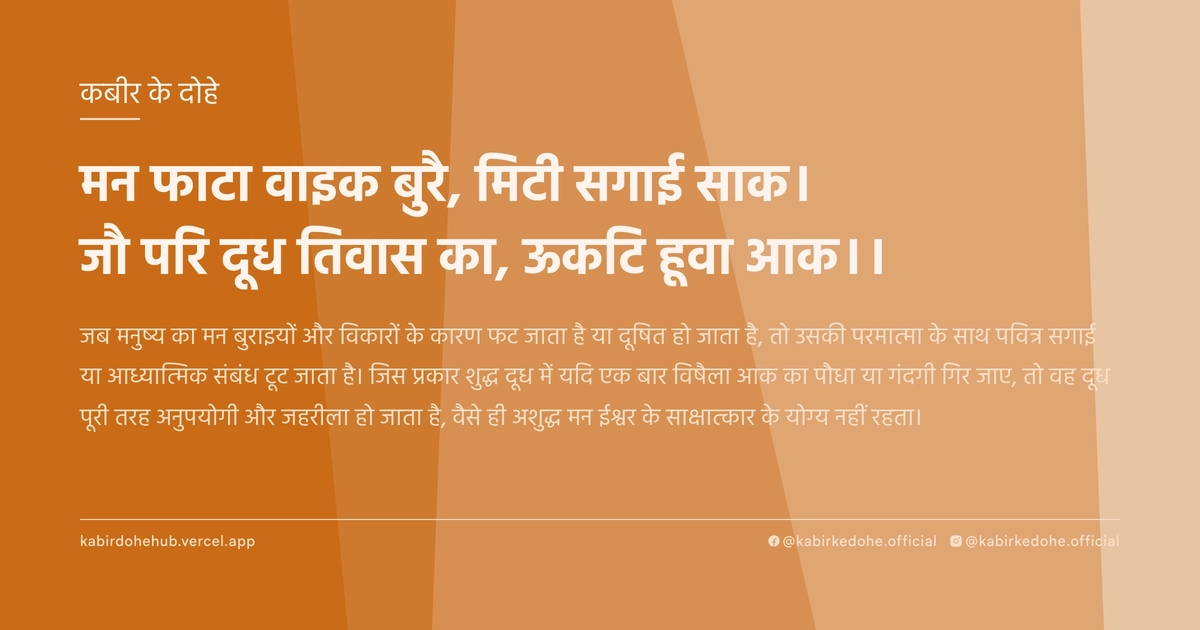
मन फाटा वाइक बुरै, मिटी सगाई साक।
जौ परि दूध तिवास का, ऊकटि हूवा आक।।
Man phaata vaik burai, miti sagai saak. Jau pari doodh tivaas ka, ookati huva aak.
इस पृष्ठ पर इस कबीर दोहे का अर्थ (meaning), हिंदी व्याख्या और अंग्रेज़ी अनुवाद, दार्शनिक विश्लेषण और व्यावहारिक जीवन सीख दी गई है। यह दोहा मन नियंत्रण (Mind Control) विषय से जुड़ा है — Kabir doha meaning and explanation in Hindi and English.
अर्थ (Meaning):
जब मनुष्य का मन बुराइयों और विकारों के कारण फट जाता है या दूषित हो जाता है, तो उसकी परमात्मा के साथ पवित्र सगाई या आध्यात्मिक संबंध टूट जाता है। जिस प्रकार शुद्ध दूध में यदि एक बार विषैला आक का पौधा या गंदगी गिर जाए, तो वह दूध पूरी तरह अनुपयोगी और जहरीला हो जाता है, वैसे ही अशुद्ध मन ईश्वर के साक्षात्कार के योग्य नहीं रहता।
When the mind is torn asunder by vices and impurities, the sacred betrothal—the spiritual union between the soul and the Divine—is severed. Just as pure milk becomes toxic and unusable the moment a poisonous 'Aak' (Calotropis) plant or impurity falls into it, a mind clouded by negativity loses its capacity to hold the purity required for spiritual realization.
व्याख्या (Interpretation):
यह दोहा मन की सूक्ष्मता और उसकी संवेदनशीलता पर प्रहार करता है। 'सगाई' यहाँ आत्मा और परमात्मा के आदि-संबंध का प्रतीक है, जो माया के प्रभाव से विस्मृत हो गया है। कबीर कहते हैं कि मन कोई भौतिक वस्तु नहीं जिसे सिला जा सके, बल्कि यह चेतना का दर्पण है। जब इसमें 'बुरै' (बुराइयाँ) प्रवेश करती हैं, तो यह दर्पण चटक जाता है। निर्गुण भक्ति के अनुसार, ईश्वर बाहर नहीं बल्कि इसी मन के भीतर है, लेकिन यदि मन 'आक' (विष) जैसा हो जाए, तो वह अमृत को विष में बदल देता है। यह अद्वैत वेदांत के उस सिद्धांत को दर्शाता है जहाँ अविद्या (ignorance) सत्य के अनुभव में बाधा बनती है। यहाँ विरोधाभास यह है कि मनुष्य बाहरी शुद्धता (स्नान, अनुष्ठान) पर जोर देता है, जबकि आंतरिक 'दूध' (चेतना) पहले ही विषैला हो चुका है।
This couplet strikes at the subtlety and sensitivity of the human psyche. The 'betrothal' (Sagai) symbolizes the primordial bond between the Atman and Brahman, which has been forgotten due to the veil of Maya. Kabir posits that the mind is not a physical object to be patched, but a mirror of consciousness. When 'burai' (vices) enter, this mirror shatters. In the context of Nirgun Bhakti, the Divine is not external but resides within; however, if the mind becomes like the 'Aak' (poisonous weed), it transforms the nectar of existence into poison. This aligns with Advaita Vedanta, where Avidya (ignorance) acts as the primary obstacle to realizing non-duality. The central paradox highlighted is the human obsession with external ritual purity while the internal 'milk' of consciousness remains contaminated.
दार्शनिक विश्लेषण (Philosophical Analysis):
कबीर का यह दर्शन उनके समय के कट्टरपंथी धार्मिक वातावरण के विरुद्ध एक सशक्त प्रतिक्रिया था। उन्होंने देखा कि लोग मंदिर और मस्जिद की सफाई में तो समय बिताते हैं, लेकिन अपने भीतर के ईर्ष्या, क्रोध और अहंकार के कचरे को नहीं हटाते। यह दोहा कर्मकांडीय शुद्धता (Ritual Purity) के बजाय मानसिक शुद्धता (Mental Purity) पर बल देता है। कबीर यहाँ सूफी मत के 'नफ्स' (अहंकार) के विनाश की बात कर रहे हैं, क्योंकि जब तक 'मैं' का विष मौजूद है, तब तक 'वह' का अनुभव असंभव है।
दार्शनिक स्तर पर, कबीर 'मन' को एक पात्र मानते हैं। यदि पात्र गंदा है, तो उसमें रखा गया अमृत भी दूषित हो जाएगा। यह अद्वैत वेदांत के उस विचार से मिलता है जहाँ चित्त की शुद्धि (Chitta Shuddhi) को ज्ञान प्राप्ति की पहली शर्त माना गया है। कबीर का तर्क है कि बिना आंतरिक रूपांतरण के, कोई भी मंत्र या तीर्थ कार्य नहीं करता।
यहाँ 'आक' का प्रयोग अत्यंत सटीक है। आक का पौधा बाहर से साधारण दिखता है लेकिन उसका दूध विषैला होता है। इसी तरह, समाज में प्रतिष्ठित दिखने वाले लोग अक्सर भीतर से कुटिलता और अहंकार से भरे होते हैं। कबीर इस सामाजिक पाखंड को उजागर करते हैं कि बाहरी आवरण सत्य को छुपा सकता है, लेकिन आत्मा की गहराई में केवल सत्य ही बचता है।
यह विश्लेषण हमें मनोवैज्ञानिक रूपांतरण की ओर ले जाता है। कबीर यह समझा रहे हैं कि बुराइयाँ केवल नैतिक पाप नहीं हैं, बल्कि वे आध्यात्मिक अवरोध (blockages) हैं। जब हम झूठ बोलते हैं या घृणा करते हैं, तो हम केवल दूसरे का नुकसान नहीं करते, बल्कि अपनी उस 'सगाई' को तोड़ते हैं जो हमें अनंत शांति से जोड़ती है।
अंततः, यह दोहा इस बात की चेतावनी है कि आध्यात्मिक मार्ग पर चलने के लिए केवल इच्छाशक्ति पर्याप्त नहीं है, बल्कि 'विवेक' और 'वैराग्य' के माध्यम से मन की सफाई अनिवार्य है। कबीर का मार्ग सरल है लेकिन कठिन—यह स्वयं के अंधेरे का सामना करने का मार्ग है।
Kabir's philosophy serves as a potent reaction against the rigid religious atmosphere of his era. He observed that people spent lifetimes cleaning temples and mosques while ignoring the debris of jealousy, anger, and ego within their own hearts. This couplet emphasizes mental purity (Chitta Shuddhi) over ritualistic purity, challenging the notion that external bathing or chanting can cleanse an impure soul.
On a deeper philosophical level, Kabir views the 'mind' as a vessel. If the vessel is contaminated, even the nectar of divine grace becomes toxic. This resonates with the Sufi concept of destroying the 'Nafs' (the lower self/ego), as the experience of the Divine is impossible as long as the poison of 'I-ness' persists. In Advaita Vedanta, the purification of the mind is the prerequisite for the dawn of Jnana (knowledge).
The metaphor of the 'Aak' plant is particularly poignant. The Calotropis plant appears ordinary but contains a caustic, poisonous latex. Similarly, individuals who maintain a facade of social prestige are often internally consumed by malice and arrogance. Kabir exposes this social hypocrisy, asserting that while an outer shell can deceive the world, it cannot deceive the Atman.
This analysis leads us toward psychological transformation. Kabir suggests that vices are not merely moral failings but spiritual blockages. Every act of hatred or deceit is not just a social transgression but a rupture in the 'sacred betrothal'—the connection to the infinite peace of the universal consciousness.
Ultimately, the couplet warns that willpower alone is insufficient for the spiritual path; it requires 'Viveka' (discernment) and 'Vairagya' (detachment) to scrub the mind clean. Kabir's path is deceptively simple yet profoundly difficult—it is the path of confronting one's own shadows to reclaim the lost union with the Truth.
मूल संदेश (Core Message):
- बाहरी शुद्धता एक भ्रम है; वास्तविक शुद्धि मन के भीतर होती है।
- अहंकार और ईर्ष्या आत्मा और परमात्मा के बीच की दीवार हैं।
- एक छोटा सा बुरा विचार पूरी आध्यात्मिक चेतना को दूषित कर सकता है।
- प्रेम और करुणा ही वह औषधि है जो मन के विष को मिटाती है।
- जब 'मैं' मिटता है, तभी 'वह' (परमात्मा) प्रकट होता है।
- External purity is an illusion; true sanctity resides within the mind.
- Ego and jealousy are the primary walls separating the soul from the Divine.
- A single poisonous thought can contaminate the entire spiritual consciousness.
- Love and compassion are the only antidotes capable of neutralizing mental toxins.
- Only when the 'I' is annihilated does the 'Universal Truth' manifest.
व्यावहारिक उदाहरण (Practical Example):
एक समय की बात है, वाराणसी के घाटों पर रहने वाला एक वृद्ध बुनकर था, जिसका नाम माधव था। माधव अपनी कला में निपुण था और शहर भर में उसके बनाए कपड़ों की मांग थी। लेकिन माधव के भीतर एक गहरा अहंकार था। वह मानता था कि उसकी कला उसे अन्य बुनकरों से श्रेष्ठ बनाती है। वह अक्सर अपने सहयोगियों का उपहास करता और मन ही मन उनसे घृणा करता था।
माधव का जीवन बाहरी तौर पर बहुत धार्मिक था। वह रोज़ सुबह गंगा स्नान करता, घंटों मंदिर में बैठता और दान-पुण्य करता। उसे विश्वास था कि उसकी ये रस्में उसे मोक्ष दिलाएंगी। लेकिन उसके मन के भीतर ईर्ष्या का 'आक' उग आया था। जब भी कोई नया बुनकर उससे बेहतर डिजाइन बनाता, माधव का मन क्रोध और द्वेष से भर जाता।
एक दिन, एक फकीर उसके पास आया और उसने माधव के कपड़ों की प्रशंसा की। माधव ने गर्व से कहा, "मेरे जैसा कोई नहीं है इस शहर में।" फकीर मुस्कुराया और उसने एक कटोरे में शुद्ध दूध लिया और उसमें एक छोटा सा विषैला पत्ता डाल दिया। फकीर ने कहा, "माधव, अब इस दूध को पियो।"
माधव चौंक गया, "यह पागलपन है! इसमें विष है, मैं इसे कैसे पी सकता हूँ?"
फकीर ने शांति से उत्तर दिया, "ठीक वैसे ही जैसे तुम गंगा में स्नान करते हो और मंदिर जाते हो, लेकिन तुम्हारे मन में दूसरों के लिए जहर भरा है। तुम्हारा बाहरी स्नान तो शुद्ध है, लेकिन तुम्हारा आंतरिक दूध (चेतना) इस विषैले पत्ते की तरह दूषित हो चुका है। तुम्हारी परमात्मा से जो सगाई थी, वह तुम्हारी इसी ईर्ष्या ने तोड़ दी है।"
माधव को गहरा धक्का लगा। उसे एहसास हुआ कि उसकी सारी पूजा-पाठ केवल एक मुखौटा थी। उसने महसूस किया कि वह जिस श्रेष्ठता का दावा कर रहा था, वह वास्तव में उसके आध्यात्मिक पतन का कारण बन रही थी। वह फकीर के चरणों में गिर पड़ा और रोने लगा।
अगले कुछ महीनों तक, माधव ने अपनी कला को अहंकार के बजाय सेवा का माध्यम बनाया। उसने उन बुनकरों की मदद करना शुरू किया जिन्हें वह पहले नीचा दिखाता था। उसने सीखा कि असली शुद्धता कपड़े की सफेदी में नहीं, बल्कि हृदय की सरलता में है।
धीरे-धीरे, माधव के मन का वह 'आक' नष्ट हो गया। अब जब वह बुनता था, तो उसके धागों में केवल सूत नहीं, बल्कि प्रेम और करुणा भी गुंथी होती थी। उसकी कला और भी निखर गई, लेकिन अब वह प्रशंसा की भूखा नहीं था।
माधव ने पाया कि जैसे ही उसके मन से द्वेष मिटा, उसे वह शांति महसूस होने लगी जिसे वह सालों तक मंदिरों में खोज रहा था। उसकी 'सगाई' फिर से जुड़ गई थी, क्योंकि अब उसका मन उस अमृत को धारण करने के योग्य हो गया था।
Once in the ancient lanes of Varanasi, there lived an elderly weaver named Madhav. Madhav was a master of his craft, and his fabrics were coveted throughout the city. However, beneath his skill lay a deep-seated ego. He believed his artistry made him superior to all other weavers, and he frequently mocked his peers, harboring a secret contempt for them.
Externally, Madhav's life was a portrait of piety. He bathed in the Ganges every dawn, spent hours in the temple, and donated generously to the poor. He was convinced that these rituals were his ticket to salvation. Yet, within his mind, the 'Aak' of jealousy had taken root. Whenever a fellow weaver created a superior design, Madhav's heart would swell with rage and spite.
One day, a wandering Sufi ascetic visited his workshop and praised the intricacy of his work. Madhav replied with pride, "There is no one in this city who can match my skill." The ascetic smiled, took a bowl of pure milk, and dropped a small, poisonous leaf into it. He then offered the bowl to Madhav, saying, "Drink this, Madhav."
Madhav was horrified. "This is madness! There is poison in this milk; how can I possibly drink it?"
The ascetic replied calmly, "Exactly as you bathe in the Ganges and frequent the temples while harboring poison for others in your heart. Your external cleansing is pure, but your internal milk—your consciousness—has been contaminated by that poisonous leaf. The sacred betrothal you had with the Divine has been severed by your own jealousy."
Madhav was shaken to his core. He realized that his religious practices were merely a mask. He saw that the very superiority he clung to was the anchor dragging him down into spiritual darkness. He collapsed at the ascetic's feet, weeping in genuine remorse.
Over the following months, Madhav transformed his art from a tool of ego into a medium of service. He began mentoring the very weavers he had once belittled. He learned that true purity does not lie in the whiteness of the fabric, but in the simplicity and kindness of the heart.
Gradually, the 'Aak' of malice withered away. Now, as he wove, his threads carried not just cotton, but love and compassion. His art reached new heights of beauty, yet he no longer craved the applause of the world.
Madhav discovered that the moment his hatred vanished, he felt a peace that he had spent decades searching for in temples. His 'betrothal' was restored, for his mind had finally become a vessel worthy of holding the divine nectar.
अभ्यास मार्गदर्शन (Practice Guidance):
- दैनिक आत्म-निरीक्षण: प्रतिदिन 15 मिनट मौन बैठें और देखें कि आज मन में किस प्रकार के 'विषैले' विचार (ईर्ष्या, क्रोध, निर्णय) आए। उन्हें बिना निर्णय के केवल देखें।
- भावनात्मक विरेचन (Journaling): एक डायरी लिखें जिसमें उन लोगों के नाम लिखें जिनसे आप घृणा करते हैं, और फिर उनके प्रति करुणा के तीन कारण खोजें।
- व्यवहार परिवर्तन: दिन में कम से कम एक बार किसी ऐसे व्यक्ति की निस्वार्थ मदद करें जिसे आप नापसंद करते हैं, ताकि अहंकार की परतें टूट सकें।
- निदान चेकलिस्ट: क्या मैं दूसरों की सफलता पर खुशी महसूस करता हूँ? क्या मेरी प्रार्थनाएँ केवल माँगने के लिए हैं या समर्पण के लिए? क्या मैं अपनी पहचान अपनी उपलब्धियों से जोड़ता हूँ? (यदि उत्तर 'नहीं' है, तो मन में 'आक' की उपस्थिति है)।
- Daily Self-Observation: Sit in silence for 15 minutes daily. Observe the 'poisonous' thoughts (jealousy, anger, judgment) that arise. Witness them without judgment to detach from the ego.
- Emotional Catharsis (Journaling): Maintain a journal listing people you harbor resentment toward, and consciously identify three reasons to feel compassion for them.
- Behavioral Shift: Perform one selfless act of service daily for someone you dislike. This actively dissolves the ego's boundaries and breaks the cycle of hatred.
- Diagnostic Checklist: Do I feel genuine joy in others' success? Are my prayers based on demand or surrender? Do I tie my identity to my achievements? (If the answers are negative, the 'Aak' of ego is present).
चिंतन प्रश्न (Reflection Questions):
- मैं दुनिया को जो चेहरा दिखाता हूँ, और जो मैं वास्तव में भीतर हूँ, उनके बीच कितना बड़ा अंतर है?
- क्या मेरी धार्मिकता वास्तव में मुझे विनम्र बना रही है, या यह मेरे अहंकार को और अधिक पोषण दे रही है?
- मेरे जीवन में वह कौन सा 'आक' (विषैला विचार) है जो मुझे शांति से दूर रख रहा है?
- क्या मैं दूसरों को उनकी गलतियों के लिए क्षमा करता हूँ, जबकि मैं अपनी गलतियों के लिए खुद को ढाल ढूँढता हूँ?
- यदि आज मेरी सारी सामाजिक प्रतिष्ठा और उपलब्धियाँ छीन ली जाएँ, तो क्या मेरे भीतर कुछ पवित्र बचेगा?
- क्या मेरा 'डिजिटल ईगो' (सोशल मीडिया इमेज) मेरी वास्तविक आध्यात्मिक प्रगति को बाधित कर रहा है?
- How wide is the chasm between the persona I project to the world and the reality of who I am inside?
- Is my religiosity actually making me humble, or is it merely feeding a more sophisticated form of ego?
- What is the specific 'Aak' (poisonous thought) in my life that consistently disrupts my inner peace?
- Do I readily forgive others for their flaws while constructing elaborate justifications for my own?
- If all my social status and achievements were stripped away today, would anything sacred remain within me?
- Is my 'digital ego' (social media image) acting as a barrier to my genuine spiritual evolution?