
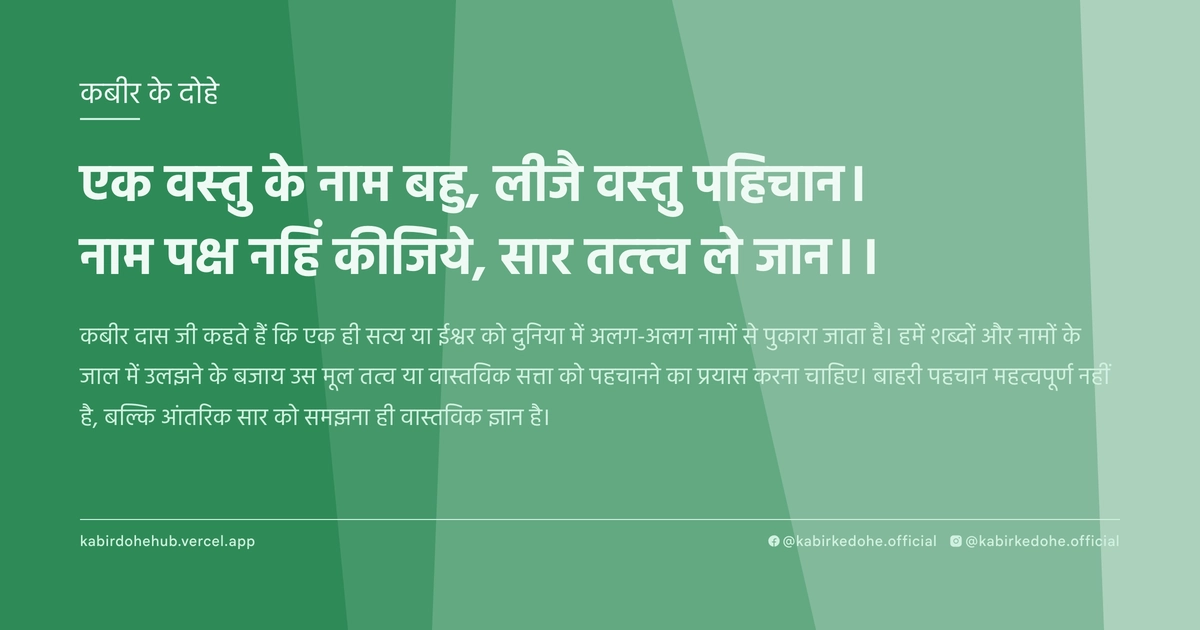
एक वस्तु के नाम बहु, लीजै वस्तु पहिचान।
नाम पक्ष नहिं कीजिये, सार तत्त्व ले जान।।
Ek vastu ke naam bahu, leeje vastu pahichan. Naam paksh nahin kariye, saar tattva le jaan.
इस पृष्ठ पर इस कबीर दोहे का अर्थ (meaning), हिंदी व्याख्या और अंग्रेज़ी अनुवाद, दार्शनिक विश्लेषण और व्यावहारिक जीवन सीख दी गई है। यह दोहा सत्य (Truth) विषय से जुड़ा है — Kabir doha meaning and explanation in Hindi and English.
अर्थ (Meaning):
कबीर दास जी कहते हैं कि एक ही सत्य या ईश्वर को दुनिया में अलग-अलग नामों से पुकारा जाता है। हमें शब्दों और नामों के जाल में उलझने के बजाय उस मूल तत्व या वास्तविक सत्ता को पहचानने का प्रयास करना चाहिए। बाहरी पहचान महत्वपूर्ण नहीं है, बल्कि आंतरिक सार को समझना ही वास्तविक ज्ञान है।
Kabir asserts that a single ultimate reality is called by many different names across the world. Instead of becoming entangled in the web of labels and nomenclature, one must strive to recognize the actual essence of that entity. External designations are irrelevant; the only true knowledge lies in comprehending the core substance.
व्याख्या (Interpretation):
इस दोहे का शाब्दिक अर्थ है कि एक ही वस्तु के कई नाम हो सकते हैं, लेकिन वस्तु वही रहती है। आध्यात्मिक स्तर पर, यह 'निर्गुण भक्ति' का आह्वान है, जहाँ ईश्वर किसी विशेष नाम, रूप या धर्म की सीमाओं में नहीं बंधा है। कबीर यहाँ 'माया' के उस भ्रम की बात कर रहे हैं जहाँ मनुष्य शब्दों को ही सत्य मान लेता है और उस सत्य के पीछे छिपे 'तत्व' को भूल जाता है। यह अद्वैत वेदांत के उस सिद्धांत से मेल खाता है जहाँ आत्मा और ब्रह्म एक ही हैं, बस उनके नाम और धारणाएँ अलग हैं। जब साधक नाम के प्रति मोह छोड़कर 'सार तत्व' की खोज करता है, तब वह द्वैत (दो होने का भाव) से मुक्त होकर अद्वैत (एकता) का अनुभव करता है। यह विरोधाभास है कि हम सत्य को खोजने के लिए शब्दों का सहारा लेते हैं, जबकि सत्य शब्दों के पार है।
Literally, the couplet suggests that while one object may possess numerous names, the object itself remains unchanged. Spiritually, this is a call toward 'Nirgun Bhakti,' where the Divine is not confined by specific names, forms, or religious boundaries. Kabir addresses the illusion of 'Maya,' where humans mistake the label for the truth and forget the underlying 'Tattva' or essence. This aligns with Advaita Vedanta, asserting that Atman and Brahman are identical, despite differing designations. When a seeker relinquishes attachment to names and seeks the 'core essence,' they transcend duality and experience non-dual oneness. It is a profound paradox: we use words to seek a Truth that exists entirely beyond the reach of language.
दार्शनिक विश्लेषण (Philosophical Analysis):
कबीर का यह दृष्टिकोण उनके समय के कट्टरपंथी धार्मिक वातावरण के प्रति एक सशक्त प्रतिक्रिया थी। 15वीं शताब्दी में, हिंदू और मुस्लिम समुदायों के बीच नाम और कर्मकांडों को लेकर गहरा संघर्ष था। कबीर ने इस सामाजिक विभाजन को चुनौती देते हुए यह स्पष्ट किया कि राम, रहीम, अल्लाह या कृष्ण केवल अलग-अलग संबोधन हैं, लेकिन उनके पीछे की ऊर्जा एक ही है। उन्होंने ritualism (कर्मकांड) का विरोध किया क्योंकि कर्मकांड अक्सर बाहरी पहचान को पुख्ता करते हैं, जबकि आंतरिक रूपांतरण को अनदेखा कर देते हैं।
दार्शनिक रूप से, यह विचार सूफीवाद के 'वहदत-अल-वजूद' (अस्तित्व की एकता) के सिद्धांत के बहुत करीब है, जो मानता है कि संपूर्ण ब्रह्मांड एक ही ईश्वरीय वास्तविकता का प्रतिबिंब है। कबीर का तर्क है कि जब हम किसी को 'हिंदू' या 'मुसलमान' कहते हैं, तो हम केवल एक सामाजिक लेबल लगा रहे होते हैं, उस मनुष्य के भीतर की दिव्य चेतना को नहीं देख रहे होते। यह अहंकार का विलोपन है, क्योंकि अहंकार हमेशा 'मेरा धर्म' या 'मेरा नाम' जैसी पहचानों से पोषण पाता है।
अद्वैत वेदांत के परिप्रेक्ष्य में, नाम और रूप (Nama-Rupa) केवल इस भौतिक जगत के आवरण हैं। वास्तविक ज्ञान तब प्राप्त होता है जब व्यक्ति इन आवरणों को हटाकर शुद्ध चेतना का अनुभव करता है। कबीर यहाँ चेतावनी दे रहे हैं कि यदि हम केवल 'नाम पक्ष' (नामों के पक्ष) पर टिके रहे, तो हम सत्य के द्वार तक कभी नहीं पहुँच पाएंगे।
मनोवैज्ञानिक स्तर पर, यह दोहा हमें संज्ञानात्मक पूर्वाग्रहों (cognitive biases) से मुक्त होने के लिए प्रेरित करता है। हम अक्सर किसी व्यक्ति या विचार को उसके नाम या श्रेणी के आधार पर आंकते हैं, जिससे हम उसकी वास्तविक क्षमता और सार को देखने में विफल रहते हैं। कबीर हमें 'लेबलिंग' की मानसिक आदत को छोड़कर प्रत्यक्ष अनुभव की ओर बढ़ने को कहते हैं।
अंततः, कबीर का संदेश यह है कि सत्य किसी धर्मग्रंथ या विशेष भाषा की बपौती नहीं है। वह सार्वभौमिक है। जो व्यक्ति नाम की सीमाओं को तोड़कर सार तत्व को जान लेता है, वह वास्तव में मुक्त हो जाता है। यह ज्ञान ही मनुष्य को संकीर्णता से निकालकर वैश्विक मानवता की ओर ले जाता है।
Kabir's perspective serves as a potent response to the dogmatic religious atmosphere of his era. In the 15th century, deep conflicts persisted between Hindu and Muslim communities over nomenclature and rituals. Challenging this social divide, Kabir clarified that Ram, Rahim, Allah, or Krishna are merely different addresses for the same singular energy. He opposed ritualism because rituals often reinforce external identities while ignoring internal transformation.
Philosophically, this view closely mirrors the Sufi doctrine of 'Wahdat-al-Wujud' (Unity of Existence), which posits that the entire universe is a reflection of a single Divine Reality. Kabir argues that by labeling someone as 'Hindu' or 'Muslim,' we are merely applying a social tag, failing to perceive the divine consciousness within that human being. This is the annihilation of the ego, as the ego thrives on identities like 'my religion' or 'my name.'
From the lens of Advaita Vedanta, name and form (Nama-Rupa) are merely veils of the material world. True knowledge is attained only when one strips away these veils to experience pure consciousness. Kabir warns that if we remain clung to the 'side of names,' we will never reach the gateway of Truth.
On a psychological level, this couplet urges us to liberate ourselves from cognitive biases. We often judge a person or an idea based on its label or category, thereby failing to see its actual potential and essence. Kabir encourages us to abandon the mental habit of labeling and move toward direct experience.
Ultimately, Kabir's message is that Truth is not the monopoly of any scripture or specific language. It is universal. One who breaks the boundaries of names to know the core essence becomes truly liberated. This knowledge is what elevates a human from narrow-mindedness to universal humanity.
मूल संदेश (Core Message):
- शब्द केवल संकेत हैं, गंतव्य नहीं।
- नामों की विविधता सत्य की एकता को नहीं छुपा सकती।
- बाहरी पहचान का मोह ही आध्यात्मिक अंधता है।
- सत्य को जानने के लिए भाषा का त्याग आवश्यक है।
- सार तत्व की पहचान ही वास्तविक मुक्ति है।
- Words are mere signposts, not the destination.
- The diversity of names cannot obscure the unity of Truth.
- Attachment to external identity is the root of spiritual blindness.
- Transcending language is essential to realize the Truth.
- Recognizing the core essence is the only true liberation.
व्यावहारिक उदाहरण (Practical Example):
वाराणसी के घाटों पर रहने वाले एक वृद्ध विधवा, जानकी, का जीवन केवल परंपराओं और नियमों के इर्द-गिर्द घूमता था। वह मानती थी कि केवल विशिष्ट मंत्रों का जाप और कठोर नियमों का पालन ही मोक्ष का मार्ग है। वह अन्य समुदायों के लोगों को अधर्मी मानती थी क्योंकि उनके पूजा करने का तरीका अलग था।
एक दिन, घाट की सीढ़ियों पर उसकी मुलाकात एक फकीर से हुई जो बस मौन बैठा था। जानकी ने उससे पूछा, "तुम किस ईश्वर की पूजा करते हो? तुम्हारा नाम क्या है? तुम्हारा पंथ क्या है?"
फकीर ने मुस्कुराकर पास पड़े एक मिट्टी के घड़े की ओर इशारा किया और पूछा, "माता, इस घड़े को आप क्या कहेंगी?"
जानकी ने कहा, "इसे घड़ा कहते हैं।"
फकीर ने फिर पूछा, "और यदि कोई इसे 'पात्र' कहे, या कोई इसे 'कुंभ' कहे, तो क्या इसके भीतर का पानी बदल जाएगा? क्या इसकी मिट्टी बदल जाएगी?"
जानकी चुप रही। फकीर ने धीरे से कहा, "नाम तो केवल पुकारने के लिए हैं, प्यास तो पानी से बुझती है, नाम से नहीं।"
यह बात जानकी के हृदय में गहरे तक उतर गई। उसने महसूस किया कि वह अब तक केवल 'नामों' और 'पंथों' की लड़ाई लड़ रही थी, जबकि वह उस 'तत्व' को भूल गई थी जिसके लिए प्रार्थना की जाती है।
उस दिन के बाद, जानकी ने अपनी कट्टरता छोड़ दी। उसने देखा कि एक मुस्लिम पड़ोसी जो उसे चुपचाप फल देता था, उसके भीतर वही करुणा थी जो उसके अपने शास्त्रों में लिखी थी।
उसने मंत्रों के यांत्रिक जाप के बजाय, मौन और सेवा को अपना मार्ग बनाया।
उसने समझा कि प्रेम ही वह 'सार तत्व' है, जिसे दुनिया में हजारों नामों से पुकारा जाता है, लेकिन अनुभव एक ही होता है।
जानकी का जीवन अब नियमों की बेड़ियों से मुक्त होकर एक सहज प्रवाह बन गया था, जहाँ हर इंसान उसे उसी एक परमात्मा का रूप लगने लगा।
Janaki, an elderly widow living on the ghats of Varanasi, led a life strictly governed by traditions and rigid rules. She believed that only the chanting of specific mantras and adherence to severe restrictions were the paths to salvation. She viewed people from other communities as unrighteous simply because their way of worship differed.
One day, on the steps of the ghat, she encountered a Fakir who sat in profound silence. Janaki asked him, "Which God do you worship? What is your name? What is your sect?"
The Fakir smiled, pointed to a clay pot lying nearby, and asked, "Mother, what would you call this object?"
Janaki replied, "It is called a pot."
The Fakir asked again, "And if someone calls it a 'vessel,' or someone else calls it a 'Kumbh,' would the water inside it change? Would its clay change?"
Janaki remained silent.
The Fakir softly said, "Names are only for calling; thirst is quenched by water, not by the name."
These words penetrated deep into Janaki's heart. She realized she had been fighting a battle of 'names' and 'sects,' forgetting the 'essence' for which the prayers were offered.
After that day, Janaki abandoned her bigotry. She noticed that a Muslim neighbor who silently offered her fruits possessed the same compassion described in her own scriptures.
Instead of the mechanical chanting of mantras, she adopted silence and service as her path.
She understood that love is the 'core essence,' called by thousands of names in the world, yet experienced as one.
Janaki's life, once bound by the chains of rules, became a spontaneous flow where every human being appeared to her as a manifestation of that one Divine.
अभ्यास मार्गदर्शन (Practice Guidance):
- दैनिक अभ्यास: प्रतिदिन 20 मिनट मौन बैठें। जब भी मन में किसी व्यक्ति या वस्तु के प्रति कोई 'लेबल' (जैसे- अच्छा, बुरा, शत्रु, मित्र) आए, तो उसे हटाकर केवल उसकी उपस्थिति को महसूस करें।
- आत्म-पूछताछ जर्नल: एक डायरी लिखें जिसमें उन धारणाओं की सूची बनाएं जिन्हें आप 'सत्य' मानते हैं। फिर खुद से पूछें, "यदि इस धारणा का नाम बदल दिया जाए, तो क्या सत्य बदल जाएगा?"
- व्यवहार परिवर्तन: किसी ऐसे व्यक्ति के साथ समय बिताएं जिससे आपकी वैचारिक या धार्मिक असहमति हो। शब्दों और तर्कों को छोड़कर, केवल उनकी मानवीय संवेदनाओं और साझा दुखों को समझने का प्रयास करें।
- डायग्नोस्टिक चेकलिस्ट: आप इस ज्ञान को जी रहे हैं यदि: 1. आप लोगों को उनके धर्म या पद से नहीं, बल्कि उनके स्वभाव से पहचानते हैं। 2. आप शब्दों के विवादों में उत्तेजित नहीं होते। 3. आप मौन में अधिक सहज महसूस करते हैं बजाय कि धार्मिक चर्चाओं के।
- Daily Practice: Sit in silence for 20 minutes daily. Whenever a 'label' (e.g., good, bad, enemy, friend) arises in your mind regarding a person or object, consciously remove it and simply feel their presence.
- Self-Inquiry Journal: Maintain a diary listing the beliefs you consider 'Truth.' Then ask yourself, "If the name of this belief were changed, would the underlying truth change?"
- Behavioral Shift: Spend time with someone with whom you have ideological or religious disagreements. Set aside words and arguments, and attempt to connect solely with their human emotions and shared sufferings.
- Diagnostic Checklist: You are living this wisdom if: 1. You recognize people by their nature rather than their religion or status. 2. You remain unprovoked by disputes over terminology. 3. You feel more comfortable in silence than in religious debates.
चिंतन प्रश्न (Reflection Questions):
- मेरे व्यक्तित्व का वह कौन सा हिस्सा है जो केवल एक 'नाम' या 'लेबल' पर टिका है?
- क्या मैं वास्तव में लोगों को देखता हूँ, या मैं केवल अपनी पूर्वधारणाओं के प्रतिबिंब को देखता हूँ?
- यदि मुझसे मेरी सभी सामाजिक और धार्मिक पहचानें छीन ली जाएं, तो मेरा 'सार तत्व' क्या बचेगा?
- मैं किन शब्दों के प्रति इतना आसक्त हूँ कि मैंने उनके पीछे के सत्य को देखना बंद कर दिया है?
- क्या मेरी भक्ति ईश्वर के प्रति है, या उस 'छवि' के प्रति जिसे मैंने ईश्वर का नाम दिया है?
- डिजिटल युग में, मेरी 'प्रोफाइल' और मेरा 'वास्तविक स्वरूप' के बीच कितना अंतर है?
- Which part of my personality relies solely on a 'name' or a 'label'?
- Do I truly see people, or do I only see the reflection of my own preconceptions?
- If all my social and religious identities were stripped away, what would remain of my 'core essence'?
- To which words am I so attached that I have stopped seeing the truth behind them?
- Is my devotion directed toward the Divine, or toward the 'image' I have named as Divine?
- In the digital age, how wide is the gap between my 'profile' and my 'actual self'?