
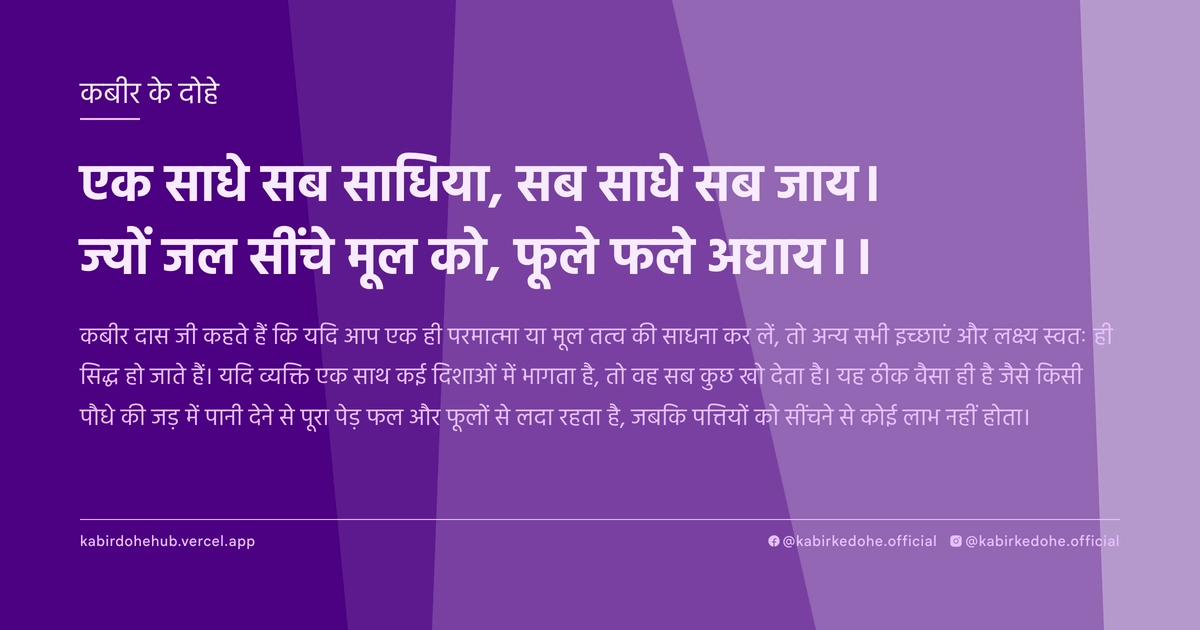
एक साधे सब साधिया, सब साधे सब जाय।
ज्यों जल सींचे मूल को, फूले फले अघाय।।
Ek sadhe sab sadhiya, sab sadhe sab jaaye. Jyon jal seenche mool ko, phule phale aghaye.
इस पृष्ठ पर इस कबीर दोहे का अर्थ (meaning), हिंदी व्याख्या और अंग्रेज़ी अनुवाद, दार्शनिक विश्लेषण और व्यावहारिक जीवन सीख दी गई है। यह दोहा भक्ति (Bhakti) विषय से जुड़ा है — Kabir doha meaning and explanation in Hindi and English.
अर्थ (Meaning):
कबीर दास जी कहते हैं कि यदि आप एक ही परमात्मा या मूल तत्व की साधना कर लें, तो अन्य सभी इच्छाएं और लक्ष्य स्वतः ही सिद्ध हो जाते हैं। यदि व्यक्ति एक साथ कई दिशाओं में भागता है, तो वह सब कुछ खो देता है। यह ठीक वैसा ही है जैसे किसी पौधे की जड़ में पानी देने से पूरा पेड़ फल और फूलों से लदा रहता है, जबकि पत्तियों को सींचने से कोई लाभ नहीं होता।
Kabir suggests that by focusing on the One—the ultimate Truth or the Divine Source—all other fragmented desires and goals are naturally fulfilled. Attempting to pursue countless disparate ends leads to exhaustion and loss. Just as watering the root of a tree nourishes the entire plant, leading to abundant blossoms and fruit, focusing on the singular essence of existence sustains all aspects of life.
व्याख्या (Interpretation):
इस दोहे का शाब्दिक अर्थ है कि एक को साधने से सब संवर जाते हैं। आध्यात्मिक स्तर पर, 'एक' का तात्पर्य निर्गुण ब्रह्म या उस शून्य से है जो समस्त सृष्टि का आधार है। जब साधक अपनी ऊर्जा को बाहरी दुनिया की अनेक मायावी इच्छाओं में बिखेरने के बजाय अंतरात्मा की गहराई में केंद्रित करता है, तो वह द्वैत से अद्वैत की ओर बढ़ता है। यह 'मूल' की साधना है, जहाँ अहंकार का विसर्जन होता है और आत्मा का परमात्मा से मिलन होता है। यहाँ विरोधाभास यह है कि जो सब कुछ पाने की कोशिश करता है, वह कुछ नहीं पाता, लेकिन जो केवल एक (परम सत्य) को खोजता है, उसे संपूर्ण ब्रह्मांड प्राप्त हो जाता है। यह माया के जाल को काटकर सीधे स्रोत से जुड़ने की प्रक्रिया है।
Literally, the verse posits that mastering the One accomplishes all. Spiritually, 'One' refers to the Nirgun Brahman—the formless, attributeless Absolute that underlies all existence. When a seeker ceases to scatter their psychic energy across the myriad illusions of Maya and instead anchors it in the inner core, they transition from duality to non-duality (Advaita). This is the 'cultivation of the root,' where the ego is dissolved and the Atman merges with the Universal Consciousness. The central paradox is that he who chases everything loses everything, while he who seeks only the Singular Truth gains the entire universe. It is a process of bypassing the superficial branches of existence to nourish the primordial source of being.
दार्शनिक विश्लेषण (Philosophical Analysis):
कबीर का यह दर्शन उनके युग के कर्मकांडीय आडंबरों और धार्मिक विखंडन पर एक गहरा प्रहार है। उस समय समाज हिंदू और मुस्लिम पहचानों में बंटा था, और लोग बाहरी पूजा-पाठ और तीर्थयात्राओं में उलझे थे। कबीर ने 'एक' की बात कर यह स्पष्ट किया कि ईश्वर किसी मंदिर, मस्जिद या विशेष जाति के अधिकार में नहीं है, बल्कि वह एक सार्वभौमिक सत्य है जो हर हृदय में स्थित है। यह विचार सूफी मत के 'वहदत-अल-वजूद' (अस्तित्व की एकता) और अद्वैत वेदांत के 'अहं ब्रह्मास्मि' के करीब है।
दार्शनिक रूप से, यह दोहा 'एकाग्रता' और 'प्राथमिकता' के सिद्धांत को स्थापित करता है। कबीर तर्क देते हैं कि मानवीय दुख का कारण हमारी इच्छाओं का विखंडन है। हम बाहरी दुनिया में सुख खोजते हैं, जो कि केवल 'पत्तियों' को सींचने जैसा है। जब तक हम मूल कारण—अर्थात अपनी चेतना के स्रोत—पर ध्यान नहीं देते, तब तक बाहरी उपलब्धियां क्षणभंगुर रहती हैं।
यहाँ 'साधना' का अर्थ केवल पूजा नहीं, बल्कि आत्म-विश्लेषण और अहंकार का विलोपन है। जब साधक यह महसूस करता है कि वह और उसका आराध्य अलग नहीं हैं, तो वह 'सब साधे सब जाय' की स्थिति से बच जाता है। यह मानसिक बिखराव से मुक्ति का मार्ग है।
कबीर की यह दृष्टि सामाजिक समानता को भी पुष्ट करती है। यदि मूल एक ही है, तो जाति, वर्ण और धर्म के आधार पर भेदभाव करना निरर्थक है। यह एक क्रांतिकारी विचार था जिसने तत्कालीन समाज को यह सोचने पर मजबूर किया कि सत्य बाहरी प्रतीकों में नहीं, बल्कि आंतरिक अनुभव में है।
अंततः, यह दोहा मनोवैज्ञानिक रूपांतरण की बात करता है। यह सिखाता है कि जीवन की जटिलताओं को सुलझाने का तरीका उन्हें एक-एक कर हल करना नहीं, बल्कि उस केंद्र को खोजना है जहाँ से ये जटिलताएं उत्पन्न होती हैं। जब केंद्र शांत और जागृत होता है, तो परिधि स्वतः ही व्यवस्थित हो जाती है।
Kabir’s philosophy serves as a profound critique of the ritualistic pomposity and religious fragmentation of his era. During a time when society was sharply divided by Hindu and Muslim identities, with people immersed in external pilgrimages and rigid rites, Kabir asserted the 'One.' He clarified that the Divine is not the property of a temple, mosque, or specific caste, but a universal Truth residing within every heart. This aligns closely with the Sufi concept of 'Wahdat-al-Wujud' (Unity of Existence) and the Advaita Vedanta realization of 'Aham Brahmasmi' (I am Brahman).
Philosophically, this couplet establishes the principle of 'Singularity' and 'Priority.' Kabir argues that human suffering stems from the fragmentation of desire. We seek happiness in the external world, which is akin to watering the leaves of a plant—a futile effort that ignores the source. Until one focuses on the root cause—the source of consciousness—external achievements remain ephemeral and hollow.
In this context, 'Sadhana' does not merely mean worship, but rigorous self-analysis and the annihilation of the ego. When the seeker realizes that they and the Divine are not separate, they avoid the trap of 'trying to master everything and losing it all.' It is a path toward liberation from mental scattering.
Kabir’s vision also reinforces social egalitarianism. If the root is one, then discrimination based on caste, creed, or religion becomes logically absurd. This was a revolutionary stance that forced the contemporary society to recognize that Truth lies in internal experience rather than external symbols.
Ultimately, the verse speaks to psychological transformation. It teaches that the way to resolve life's complexities is not to tackle them individually, but to find the center from which these complexities emerge. When the center is still and awakened, the periphery naturally organizes itself.
मूल संदेश (Core Message):
- बिखराव ही बंधन है, एकाग्रता ही मुक्ति है।
- बाहरी समाधान केवल अस्थायी हैं; आंतरिक रूपांतरण स्थायी है।
- अहंकार को मिटाकर ही मूल तत्व का साक्षात्कार संभव है।
- एकल लक्ष्य (परमात्मा/सत्य) का अनुसरण सभी लक्ष्यों की प्राप्ति है।
- जड़ को सींचें, शाखाओं की चिंता स्वतः समाप्त हो जाएगी।
- Fragmentation is bondage; singularity is liberation.
- External solutions are temporary; internal transformation is eternal.
- The realization of the Source is possible only through the dissolution of ego.
- Pursuing the Single Truth is the only way to achieve all goals.
- Nourish the root, and the anxiety for the branches will vanish.
व्यावहारिक उदाहरण (Practical Example):
वाराणसी के एक पुराने घाट के पास रहने वाले रामदीन नाम के एक वृद्ध बुनकर थे। रामदीन का जीवन बहुत तनावपूर्ण था। वे अपने बेटों की आपसी लड़ाई, घर के कर्ज, और अपनी गिरती सेहत को सुधारने के लिए दिन-रात भागते रहते थे। वे कभी किसी पंडित के पास जाते, कभी किसी ओझा के पास, और कभी शहर के बड़े डॉक्टरों के चक्कर लगाते। वे हर समस्या को अलग-अलग सुलझाने की कोशिश कर रहे थे, लेकिन जैसे-जैसे वे एक समस्या हल करते, दूसरी खड़ी हो जाती। उनका मन एक छिन्न-भिन्न कपड़े की तरह था जिसमें अनगिनत छेद थे।
एक दिन उनकी मुलाकात एक फकीर से हुई, जिन्होंने रामदीन की व्याकुलता को देखा और उन्हें यह दोहा सुनाया: 'एक साधे सब साधिया...'। फकीर ने रामदीन से कहा, 'तुम पत्तियों को सींच रहे हो, रामदीन। तुम अपनी समस्याओं की शाखाओं को काट रहे हो, लेकिन जड़ को भूल गए हो। तुम्हारी सारी समस्याओं की जड़ तुम्हारा अशांत मन और तुम्हारा अहंकार है, जो यह मानता है कि वह सब कुछ नियंत्रित कर सकता है।'
रामदीन को बात समझ आई। उन्होंने बाहरी भागदौड़ कम की और प्रतिदिन सुबह केवल एक घंटे मौन रहकर अपनी सांसों और आंतरिक शांति पर ध्यान केंद्रित करना शुरू किया। उन्होंने यह संकल्प लिया कि वे बाहरी परिस्थितियों को बदलने के बजाय, अपनी आंतरिक प्रतिक्रिया को बदलेंगे। उन्होंने 'एक'—अर्थात अपनी अंतरात्मा की शांति—को साधने का निर्णय लिया।
शुरुआत में उनके बेटों ने उनका मजाक उड़ाया, लेकिन धीरे-धीरे रामदीन के व्यवहार में एक गहरा ठहराव आया। वे अब छोटी-छोटी बातों पर क्रोध नहीं करते थे। उनकी शांति संक्रामक थी। जब उन्होंने अपने बेटों से बिना किसी क्रोध या अपेक्षा के बात करना शुरू किया, तो बेटों के बीच का तनाव कम होने लगा।
अजीब बात यह हुई कि जैसे ही रामदीन ने अपने मन की शांति (मूल) को साधा, उनके घर के झगड़े अपने आप सुलझने लगे। उनके बेटों ने महसूस किया कि उनके पिता अब एक अलग स्तर पर हैं, और उन्होंने भी आपसी सहयोग करना शुरू कर दिया। कर्ज चुकाने के लिए उन्होंने मिलकर काम किया, और जो समस्या पहले पहाड़ जैसी लगती थी, वह अब छोटी दिखने लगी।
रामदीन की सेहत में भी सुधार हुआ क्योंकि उनका मानसिक तनाव समाप्त हो गया था। उन्होंने महसूस किया कि वे अब तक केवल 'पत्तियों' (बाहरी समस्याओं) को सींच रहे थे, जिससे उन्हें थकान तो मिल रही थी लेकिन फल नहीं।
जब उन्होंने अपनी चेतना के केंद्र को साधा, तो उनके जीवन के अन्य सभी क्षेत्र स्वतः ही संतुलित हो गए। यह उनके लिए एक 'कबीर ट्विस्ट' था—जहाँ उन्होंने समस्या का समाधान खोजने के बजाय, स्वयं को समाधान बना लिया।
अब रामदीन केवल एक बुनकर नहीं थे, बल्कि एक जागृत आत्मा थे। उन्होंने सीखा कि जीवन में सफलता का रहस्य अनेक चीजों को नियंत्रित करने में नहीं, बल्कि एक ही सत्य के साथ संरेखित होने में है।
In the narrow lanes near the ghats of Varanasi lived an elderly weaver named Ramdeen. Ramdeen’s life was a whirlwind of stress. He spent his days frantically trying to manage his sons' constant bickering, mounting debts, and his own failing health. He visited priests for rituals, occultists for charms, and city doctors for cures. He attempted to solve every problem as a separate entity, but as soon as one fire was extinguished, another ignited. His mind was like a tattered piece of cloth, riddled with countless holes.
One day, he encountered a wandering dervish who observed Ramdeen’s agitation and recited the couplet: 'Ek saadhe sab saadhiya...' The dervish told him, 'You are watering the leaves, Ramdeen. You are pruning the branches of your problems, but you have forgotten the root. The root of all your turmoil is your restless mind and an ego that believes it can control everything.'
Ramdeen understood the gravity of these words. He reduced his external franticness and began spending one hour every morning in absolute silence, focusing solely on his breath and inner stillness. He resolved that instead of trying to change external circumstances, he would change his internal response. He decided to cultivate the 'One'—the peace of his own soul.
Initially, his sons mocked his silence, but gradually, a profound stillness settled into Ramdeen’s demeanor. He no longer reacted with anger to trivial provocations. His peace became contagious. When he began speaking to his sons without judgment or expectation, the tension between them began to dissolve.
Strangely, as Ramdeen mastered the 'root' (his inner peace), the external conflicts of his household began to resolve themselves. His sons, sensing a shift in their father's energy, started cooperating. They worked together to pay off the debts, and the problems that once seemed like mountains now appeared as mere pebbles.
Ramdeen’s health also improved as his chronic stress vanished. He realized that he had spent years watering the 'leaves' (external symptoms), which brought him only exhaustion and no fruit.
By aligning himself with the center of his being, all other areas of his life naturally fell into balance. This was his 'Kabir Twist'—instead of searching for a solution to the problem, he became the solution himself.
Ramdeen was no longer just a weaver of cloth, but a weaver of consciousness. He learned that the secret to a successful life is not in controlling a thousand variables, but in aligning oneself with the Single Truth.
अभ्यास मार्गदर्शन (Practice Guidance):
- दैनिक ध्यान: प्रतिदिन 20 मिनट 'शून्य' या एक बिंदु पर ध्यान केंद्रित करें। यह अभ्यास मन के बिखराव को रोककर उसे 'एक' की ओर ले जाता है।
- आत्म-पूछताछ जर्नल: प्रतिदिन लिखें कि आज आपने अपनी ऊर्जा कितनी बार अलग-अलग दिशाओं में बिखेरी और आप उस ऊर्जा को केंद्र पर कैसे ला सकते थे।
- व्यवहारिक परिवर्तन: जब भी आप तनाव महसूस करें, बाहरी समस्या को हल करने के बजाय 5 मिनट के लिए अपनी सांसों पर ध्यान दें। पहले आंतरिक शांति प्राप्त करें, फिर समस्या का सामना करें।
- निदान चेकलिस्ट: क्या आप एक साथ कई लक्ष्यों के पीछे भाग रहे हैं? क्या आप बाहरी समाधानों (दवा, सलाह, अनुष्ठान) पर अत्यधिक निर्भर हैं? यदि हाँ, तो आप 'पत्तियों' को सींच रहे हैं। यदि आप शांत रहकर समस्या को देख पा रहे हैं, तो आप 'मूल' को साध रहे हैं।
- Daily Meditation: Spend 20 minutes focusing on a single point or the 'Void' (Shunya). This practice prevents mental fragmentation and directs the consciousness toward the 'One'.
- Self-Inquiry Journaling: Record daily instances where your energy was scattered across disparate desires and reflect on how that energy could have been anchored in the center.
- Behavioral Shift: Whenever stress arises, instead of immediately trying to fix the external problem, spend 5 minutes focusing on your breath. Attain internal stillness first, then address the issue.
- Diagnostic Checklist: Are you chasing multiple contradictory goals simultaneously? Are you overly dependent on external fixes (medications, advice, rituals)? If yes, you are 'watering the leaves.' If you can observe the problem with detached stillness, you are 'cultivating the root.'
चिंतन प्रश्न (Reflection Questions):
- मेरे जीवन के वे कौन से 'पत्ते' हैं जिन्हें मैं सींचने में अपनी पूरी ऊर्जा व्यर्थ कर रहा हूँ?
- क्या मेरी सार्वजनिक पहचान (डिजिटल ईगो) मेरे वास्तविक आंतरिक स्वरूप को ढक रही है?
- यदि मैं अपनी सभी बाहरी उपलब्धियों को खो दूँ, तो मेरे भीतर ऐसा क्या बचेगा जो 'एक' और अविनाशी है?
- मैं किन पूर्वाग्रहों के कारण सत्य को एक अखंड इकाई के बजाय टुकड़ों में देख रहा हूँ?
- क्या मेरी प्रार्थनाएं केवल इच्छाओं की सूची हैं, या वे वास्तव में मूल स्रोत से जुड़ने का प्रयास हैं?
- What are the 'leaves' in my life that I am wasting my entire energy trying to nourish?
- Is my public identity (digital ego) masking my authentic internal essence?
- If I were to lose all my external achievements, what remains within me that is 'One' and indestructible?
- Which biases are forcing me to see Truth as fragmented pieces rather than a unified whole?
- Are my prayers merely lists of desires, or are they genuine attempts to connect with the Source?