
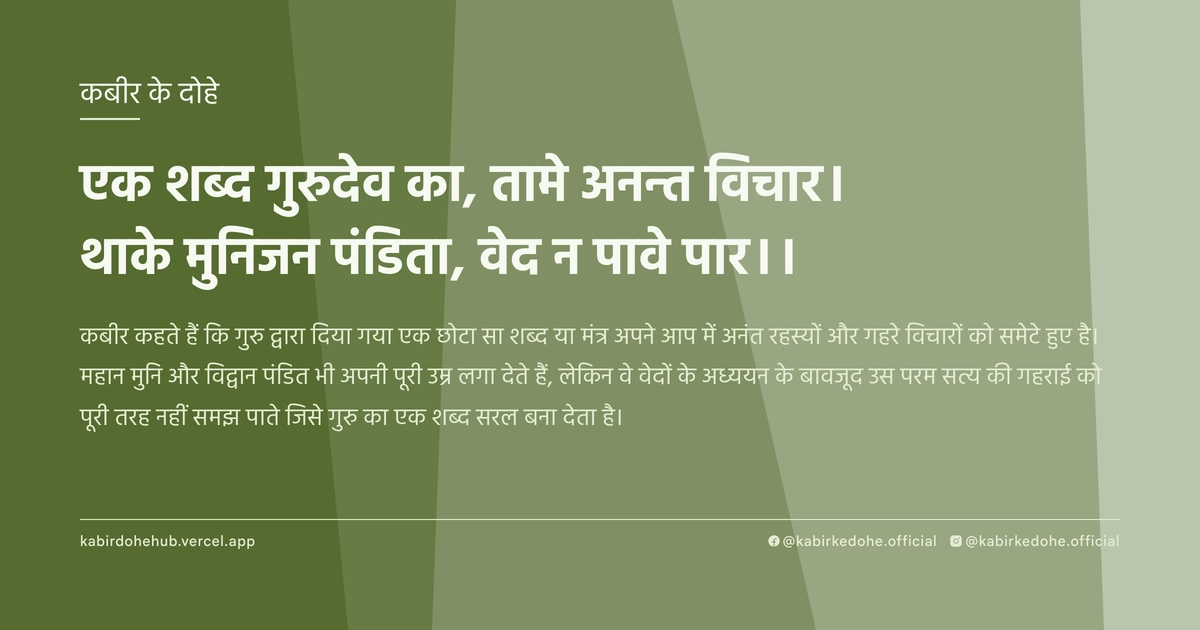
एक शब्द गुरुदेव का, तामे अनन्त विचार।
थाके मुनिजन पंडिता, वेद न पावे पार।।
Ek shabd gurudev ka, taame anant vichaar. Thake munijan pandita, ved na paave paar.
इस पृष्ठ पर इस कबीर दोहे का अर्थ (meaning), हिंदी व्याख्या और अंग्रेज़ी अनुवाद, दार्शनिक विश्लेषण और व्यावहारिक जीवन सीख दी गई है। यह दोहा गुरु महत्व (The Guru's Importance) विषय से जुड़ा है — Kabir doha meaning and explanation in Hindi and English.
अर्थ (Meaning):
कबीर कहते हैं कि गुरु द्वारा दिया गया एक छोटा सा शब्द या मंत्र अपने आप में अनंत रहस्यों और गहरे विचारों को समेटे हुए है। महान मुनि और विद्वान पंडित भी अपनी पूरी उम्र लगा देते हैं, लेकिन वे वेदों के अध्ययन के बावजूद उस परम सत्य की गहराई को पूरी तरह नहीं समझ पाते जिसे गुरु का एक शब्द सरल बना देता है।
Kabir asserts that a single word imparted by the Guru contains infinite dimensions of thought and spiritual truth. Even the most learned sages and scholars, despite their exhaustive study of the Vedas, fail to reach the ultimate shore of realization, whereas the Guru's word provides a direct and concise gateway to the Absolute.
व्याख्या (Interpretation):
शाब्दिक अर्थ में यह दोहा गुरु की महिमा और शास्त्रों की सीमितता को दर्शाता है। रूपकात्मक रूप से, 'एक शब्द' वह बीज-मंत्र या आत्म-ज्ञान है जो साधक के भीतर सोई हुई चेतना को जगाता है। यह निर्गुण भक्ति के उस सिद्धांत को पुष्ट करता है जहाँ बाहरी कर्मकांडों और भारी ग्रंथों के बजाय आंतरिक अनुभव (Sadhana) को प्राथमिकता दी जाती है। माया का पर्दा इतना घना है कि केवल बौद्धिक विश्लेषण (Intellectual analysis) से उसे नहीं हटाया जा सकता; इसके लिए गुरु की कृपा रूपी प्रहार आवश्यक है। यहाँ 'अनंत विचार' का अर्थ है कि सत्य एक है, लेकिन उसकी अभिव्यक्तियाँ अनंत हैं, जिन्हें केवल अनुभव के माध्यम से ही जाना जा सकता है। यह अद्वैत वेदांत के उस सत्य की ओर संकेत करता है जहाँ आत्मा और परमात्मा का भेद मिट जाता है।
Literally, this couplet highlights the supremacy of the Guru over scriptural erudition. Metaphorically, the 'single word' represents the seed-mantra or the spark of gnosis that awakens the dormant consciousness within the seeker. It reinforces the tenet of Nirgun Bhakti, where direct experiential realization is prioritized over the accumulation of ritualistic knowledge. The veil of Maya is so dense that mere intellectual gymnastics cannot pierce it; it requires the surgical precision of the Guru's grace. The 'infinite thoughts' signify that while Truth is One, its manifestations are endless, accessible only through direct experience. This points toward the Advaita Vedanta realization where the duality between the Atman and Brahman dissolves into a singular, non-dual existence.
दार्शनिक विश्लेषण (Philosophical Analysis):
कबीर का यह विचार उनके समय के धार्मिक कट्टरपंथ और शास्त्र-केंद्रित अहंकार पर एक कड़ा प्रहार है। मध्यकालीन भारत में, ज्ञान पर केवल कुछ उच्च जातियों और पंडितों का एकाधिकार था, जो वेदों की व्याख्या के माध्यम से अपनी श्रेष्ठता सिद्ध करते थे। कबीर ने इस व्यवस्था को चुनौती देते हुए यह स्थापित किया कि ईश्वर या सत्य तक पहुँचने का मार्ग पुस्तकालयों में नहीं, बल्कि एक जीवित गुरु के मार्गदर्शन में है।
दार्शनिक स्तर पर, यह सूफी मत के 'पीर' और भारतीय परंपरा के 'गुरु' के संगम को दर्शाता है। सूफीवाद में 'ज़िक्र' (स्मरण) की प्रक्रिया इसी 'एक शब्द' के समान है, जो साधक को शून्य से अनंत की ओर ले जाती है। कबीर यहाँ यह समझा रहे हैं कि ज्ञान (Knowledge) और बोध (Realization) में गहरा अंतर है। पंडितों के पास ज्ञान है, लेकिन बोध नहीं।
अद्वैत वेदांत के परिप्रेक्ष्य में, वेदों का अध्ययन एक साधन हो सकता है, लेकिन अंतिम मुक्ति 'अपरोक्षानुभूति' (Direct Experience) से आती है। जब गुरु वह 'शब्द' देता है, तो वह वास्तव में साधक के भीतर के अज्ञान को नष्ट करता है। यह शब्द कोई बाहरी ध्वनि नहीं, बल्कि एक आंतरिक कंपन है जो अहंकार (Ego) को विलीन कर देता है।
कबीर ritualism (कर्मकांड) का विरोध करते हैं क्योंकि वे जानते हैं कि बाहरी आडंबर केवल मन को भ्रमित करते हैं। वेदों की अनंतता में खो जाना एक प्रकार का बौद्धिक जाल है। वास्तविक सत्य सरल है, लेकिन उसे देखने के लिए अहंकार का विसर्जन आवश्यक है।
अंततः, यह दोहा मनोवैज्ञानिक रूपांतरण की बात करता है। जब एक व्यक्ति अपनी बौद्धिक श्रेष्ठता का त्याग कर समर्पण (Surrender) करता है, तभी वह उस 'एक शब्द' की गहराई को समझ पाता है। यह समर्पण ही वह कुंजी है जो बंद द्वारों को खोलती है और साधक को सीमित व्यक्तित्व से असीमित चेतना की ओर ले जाती है।
Kabir's assertion is a potent critique of the religious orthodoxy and scriptural arrogance of his era. In medieval India, knowledge was monopolized by a priestly class who used the interpretation of the Vedas to assert social and spiritual superiority. Kabir challenged this hegemony, establishing that the path to the Absolute lies not in libraries, but in the living guidance of a realized Master.
Philosophically, this reflects a synthesis between the Sufi concept of the 'Pir' and the Indian 'Guru'. In Sufism, the practice of 'Zikr' (remembrance) mirrors this 'single word,' acting as a vehicle that transports the seeker from the void to the infinite. Kabir distinguishes between 'Knowledge' (information) and 'Realization' (experience); the scholars possess the former, but lack the latter.
From the lens of Advaita Vedanta, while scriptural study is a preparatory tool, ultimate liberation comes through 'Aparokshanubhuti' (direct perception). The Guru's 'word' is not merely a sound but a spiritual catalyst that annihilates the ignorance (Avidya) within the seeker. It is an internal vibration that dissolves the ego, revealing the non-dual nature of reality.
Kabir rejects ritualism because external pomps only clutter the mind. Getting lost in the vastness of the Vedas can become an intellectual trap. The Truth is profoundly simple, yet perceiving it requires the total dissolution of the egoic identity.
Ultimately, this couplet addresses psychological transformation. Only when an individual relinquishes their intellectual pride and embraces total surrender (Prapatti) can they grasp the depth of that 'single word.' This surrender is the key that unlocks the doors of perception, shifting the seeker from a limited personality to a universal consciousness.
मूल संदेश (Core Message):
- शास्त्रों का ज्ञान बोझ बन सकता है यदि उसमें अनुभव न हो।
- सत्य सरल है, लेकिन अहंकार उसे जटिल बना देता है।
- गुरु का एक शब्द अज्ञान के अंधेरे को मिटाने के लिए पर्याप्त है।
- बौद्धिक संचय के बजाय आंतरिक बोध को प्राथमिकता दें।
- परम सत्य शब्दों के पार, मौन के गहरे सागर में स्थित है।
- Scriptural knowledge becomes a burden without direct experiential realization.
- Truth is profoundly simple, yet the ego renders it complex.
- A single word from the Guru suffices to dispel the darkness of ignorance.
- Prioritize internal awakening over the accumulation of intellectual data.
- The Ultimate Truth lies beyond words, in the deep ocean of silence.
व्यावहारिक उदाहरण (Practical Example):
वाराणसी के एक पुराने घाट पर माधव नाम का एक वृद्ध बुनकर रहता था। माधव ने अपना पूरा जीवन केवल कपड़े बुनने और धर्मग्रंथों को सुनने में बिता दिया था। वह शहर के सबसे बड़े पंडितों के पास जाता और उनसे वेदों के कठिन श्लोकों का अर्थ पूछता। पंडित उसे घंटों व्याख्या सुनाते, लेकिन माधव के मन की बेचैनी कभी कम नहीं हुई। उसे लगता था कि सत्य कहीं बहुत दूर है, किसी भारी किताब के पन्नों के बीच छिपा हुआ।
एक दिन, घाट की सीढ़ियों पर एक फकीर बैठा था, जो साधारण सूती वस्त्र पहने हुए था। माधव उसके पास गया और अपनी व्यथा सुनाई कि उसने हज़ारों श्लोक पढ़े, फिर भी शांति नहीं मिली। फकीर ने उसकी ओर देखा और बस एक शब्द कहा—'साक्षी'।
माधव पहले तो चकित हुआ। उसने सोचा कि एक शब्द से क्या होगा? लेकिन उस फकीर की आँखों में एक ऐसी चमक थी जिसने माधव को सोचने पर मजबूर कर दिया। माधव ने तय किया कि वह अब ग्रंथों को नहीं पढ़ेगा, बल्कि केवल इस एक शब्द 'साक्षी' (Witness) पर ध्यान केंद्रित करेगा।
शुरुआत में उसे बहुत कठिनाई हुई। उसका मन पुराने शास्त्रों की याद दिलाता और उसे लगता कि वह समय बर्बाद कर रहा है। लेकिन उसने हार नहीं मानी। वह बुनते समय, चलते समय और सोते समय केवल खुद को यह याद दिलाता—'मैं केवल साक्षी हूँ'।
धीरे-धीरे, माधव के जीवन में बदलाव आने लगा। जब उसका बेटा उससे झगड़ा करता, तो वह क्रोधित होने के बजाय अपने भीतर उस 'साक्षी' को देखता। उसने महसूस किया कि क्रोध उसका नहीं, बल्कि उसके अहंकार का है।
एक दिन, उसके घर में आग लग गई। उसकी जीवन भर की कमाई और कपड़े जल गए। मोह के कारण वह चीखने ही वाला था कि अचानक उसे वह 'एक शब्द' याद आया। वह चुपचाप खड़ा होकर अपनी संपत्ति को जलते हुए देखने लगा।
उस क्षण उसे एक असीम शांति का अनुभव हुआ। उसे समझ आया कि वह न तो वह कपड़ा था, न वह घर, और न ही वह दुखी व्यक्ति। वह तो वह 'साक्षी' था जो इस पूरे खेल को देख रहा है।
पंडितों की हज़ारों व्याख्याएँ उसे यह शांति नहीं दे पाई थीं, जो एक फकीर के एक शब्द ने दे दी। माधव अब ग्रंथों का मोह छोड़कर एक शांत और मुक्त मनुष्य बन गया था।
उसने महसूस किया कि सत्य शब्दों के विस्तार में नहीं, बल्कि उनके सार (Essence) में होता है। उसने अपनी पूरी ज़िंदगी की खोज को उस एक शब्द में समेट लिया।
अब माधव घाट पर बैठने वाले अन्य लोगों को केवल यह सिखाता कि अपने भीतर के दृष्टा को पहचानो। उसकी सादगी में अब वह गहराई थी जिसे पंडित अपनी बड़ी-बड़ी पोथियों में ढूँढ रहे थे।
On an ancient ghat in Varanasi lived an elderly weaver named Madhav. Madhav had spent his entire life weaving cloth and listening to religious discourses. He frequently visited the city's most renowned pundits, asking for the meanings of complex Vedic shlokas. The pundits would provide hours of exhaustive commentary, yet Madhav's inner restlessness never subsided. He felt that Truth was distant, hidden somewhere within the heavy pages of massive tomes.
One day, he encountered a wandering dervish sitting on the stone steps of the ghat, clad in simple cotton rags. Madhav approached him and lamented that despite studying thousands of verses, he had found no peace. The dervish looked at him and uttered a single word: 'Sakshi' (Witness).
Madhav was initially bewildered. He wondered how a single word could possibly suffice. However, there was a luminosity in the dervish's eyes that compelled Madhav to reflect. He decided to stop reading texts and instead focus entirely on this one word: 'Sakshi'.
Initially, he struggled. His mind constantly reminded him of the scriptures, suggesting he was wasting his time. But he persisted. Whether weaving, walking, or sleeping, he reminded himself: 'I am merely the witness.'
Gradually, a transformation occurred. When his son argued with him, instead of reacting in anger, he observed the anger from the perspective of the 'Witness'. He realized that the anger did not belong to his true self, but to his ego.
One day, a fire broke out in his home. His life's savings and all his woven fabrics were consumed by flames. Just as he was about to scream in agony, the 'single word' echoed in his mind. He stood silently, watching his possessions burn.
In that moment, he experienced an unbound peace. He realized he was neither the cloth, nor the house, nor the grieving man. He was the 'Witness' observing the entire play of existence.
Thousands of scholarly interpretations had failed to grant him the peace that one word from a dervish provided. Madhav abandoned his obsession with texts and became a serene, liberated soul.
He understood that Truth does not reside in the expansion of words, but in their essence. He condensed his lifelong search into that one single realization.
Madhav now spent his days teaching others on the ghat to recognize the observer within. His simplicity now possessed a depth that the pundits were still searching for in their voluminous books.
अभ्यास मार्गदर्शन (Practice Guidance):
- प्रतिदिन 20 मिनट मौन रहकर किसी एक पवित्र शब्द या विचार (जैसे 'ॐ', 'शांति' या 'साक्षी') पर ध्यान केंद्रित करें।
- एक डायरी बनाएँ जिसमें लिखें कि दिन भर में किन क्षणों में आपका 'अहंकार' हावी हुआ और कैसे एक सरल सत्य ने आपको शांत किया।
- बौद्धिक बहस और तर्क-वितर्क से दूर रहें; यह अभ्यास करें कि सत्य को तर्क से नहीं, बल्कि अनुभव से जाना जाता है।
- डायग्नोस्टिक चेकलिस्ट: क्या आप अभी भी सत्य को किताबों में ढूँढ रहे हैं? क्या आप दूसरों को अपनी विद्वता से प्रभावित करने की कोशिश कर रहे हैं? यदि हाँ, तो आप अभी भी 'पंडित' की अवस्था में हैं, 'साधक' की नहीं।
- Spend 20 minutes daily in silence, focusing your entire awareness on a single sacred word or concept (such as 'Om', 'Peace', or 'Witness').
- Maintain a journal to record moments when your 'ego' dominated your reactions and how a simple truth helped you regain equilibrium.
- Deliberately withdraw from intellectual debates and arguments; practice the conviction that Truth is realized through experience, not logic.
- Diagnostic Checklist: Are you still searching for Truth exclusively in books? Are you attempting to impress others with your erudition? If yes, you are still in the state of the 'Scholar' rather than the 'Seeker'.
चिंतन प्रश्न (Reflection Questions):
- क्या मेरी आध्यात्मिक खोज वास्तव में सत्य को जानने के लिए है, या यह केवल मेरी बौद्धिक श्रेष्ठता सिद्ध करने का एक तरीका है?
- मेरे जीवन का वह 'एक शब्द' क्या हो सकता है जो मेरे सारे मानसिक द्वंद्वों को शांत कर दे?
- मैं कितनी बार सत्य को जानने के बजाय, सत्य के बारे में 'पढ़ने' में संतुष्ट हो जाता हूँ?
- यदि मुझसे मेरी सारी डिग्रियाँ और ज्ञान छीन लिया जाए, तो मेरे भीतर क्या बचेगा?
- क्या मैं अपनी पहचान अपनी जानकारियों से जोड़ता हूँ या अपनी चेतना से?
- Is my spiritual quest truly about discovering Truth, or is it merely a vehicle to validate my intellectual superiority?
- What could be that 'single word' in my life capable of silencing all my mental conflicts?
- How often do I settle for 'reading about' the Truth instead of actually 'experiencing' it?
- If all my degrees and acquired knowledge were stripped away, what would remain within me?
- Do I anchor my identity in the information I possess or in the consciousness I am?