
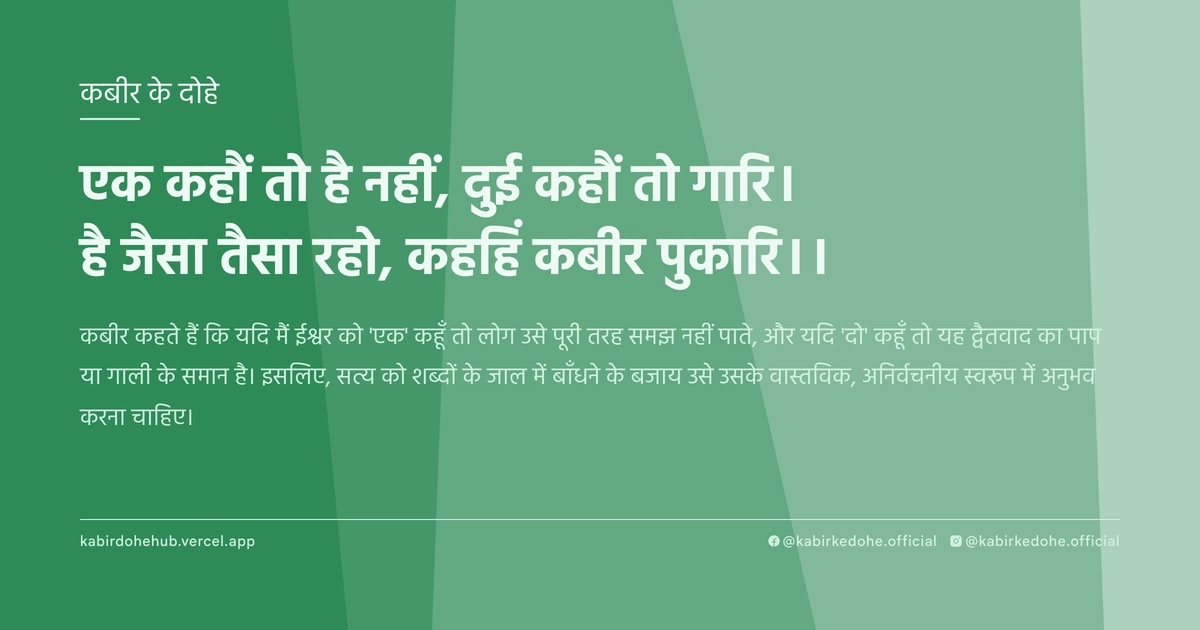
एक कहौं तो है नहीं, दुई कहौं तो गारि।
है जैसा तैसा रहो, कहहिं कबीर पुकारि।।
Ek kahon to hai nahi, dui kahon to gaari. Hai jaisa taisa raho, kahahin Kabir pukari.
इस पृष्ठ पर इस कबीर दोहे का अर्थ (meaning), हिंदी व्याख्या और अंग्रेज़ी अनुवाद, दार्शनिक विश्लेषण और व्यावहारिक जीवन सीख दी गई है। यह दोहा सत्य (Truth) विषय से जुड़ा है — Kabir doha meaning and explanation in Hindi and English.
अर्थ (Meaning):
कबीर कहते हैं कि यदि मैं ईश्वर को 'एक' कहूँ तो लोग उसे पूरी तरह समझ नहीं पाते, और यदि 'दो' कहूँ तो यह द्वैतवाद का पाप या गाली के समान है। इसलिए, सत्य को शब्दों के जाल में बाँधने के बजाय उसे उसके वास्तविक, अनिर्वचनीय स्वरूप में अनुभव करना चाहिए।
Kabir asserts that if he describes the Divine as 'One,' it fails to capture the essence, and if he says 'Two,' it becomes a heresy or a linguistic insult to the Truth. He urges the seeker to remain in the state of 'as it is,' transcending the limitations of numerical and verbal definitions.
व्याख्या (Interpretation):
यह दोहा शब्दों की असमर्थता और सत्य की अनिर्वचनीयता को दर्शाता है। 'एक' कहना भी एक सीमा है क्योंकि यह संख्यात्मकता का बोध कराता है, जबकि परमात्मा असंख्या और अनंत है। 'दो' कहना द्वैत (Duality) को जन्म देता है, जो माया का मूल है। कबीर यहाँ निर्गुण भक्ति और अद्वैत वेदांत के उस शिखर की बात कर रहे हैं जहाँ ज्ञाता, ज्ञान और ज्ञेय का भेद मिट जाता है। यह एक आध्यात्मिक विरोधाभास है: सत्य वह है जिसे शब्दों में व्यक्त नहीं किया जा सकता, केवल अनुभव किया जा सकता है।
This couplet highlights the inadequacy of language and the ineffability of Truth. To call the Divine 'One' still imposes a numerical limitation, whereas the Absolute is beyond count and infinity. To say 'Two' introduces duality (Maya), which is the root of spiritual ignorance. Kabir aligns here with Nirgun Bhakti and Advaita Vedanta, pointing toward the state where the knower, the known, and the knowledge merge. It is a spiritual paradox: the Truth is that which cannot be spoken, only realized in the silence of the Atman.
दार्शनिक विश्लेषण (Philosophical Analysis):
कबीर का यह दृष्टिकोण उनके युग के कट्टरपंथी धार्मिक विमर्श पर एक प्रहार है। उस समय लोग ईश्वर को या तो साकार (Sagun) या निराकार (Nirgun) के संकीर्ण खांचों में बाँध रहे थे। कबीर ने इस कृत्रिम विभाजन को नकारते हुए 'सहज' मार्ग की वकालत की। वे बताते हैं कि जब हम ईश्वर को परिभाषित करते हैं, तो हम वास्तव में अपनी मानसिक सीमाओं को ईश्वर पर थोप रहे होते हैं।
अद्वैत वेदांत के अनुसार, ब्रह्म 'नेति-नेति' (यह नहीं, वह नहीं) है। कबीर इसी विचार को सरल भाषा में प्रस्तुत कर रहे हैं। वे कहते हैं कि किसी भी परिभाषा में आने वाला सत्य सत्य नहीं है, क्योंकि परिभाषा सीमित होती है और सत्य असीम। यह सूफी मत के 'फना' होने की प्रक्रिया के समान है, जहाँ व्यक्ति की अपनी पहचान और उसकी धारणाएँ पूरी तरह मिट जाती हैं।
यहाँ 'गारि' (गाली) शब्द का प्रयोग अत्यंत गहरा है। आध्यात्मिक संदर्भ में, सत्य को विभाजित करना या उसे गुणों में बाँटना सबसे बड़ा अपराध है। यह अहंकार की वह कोशिश है जिसमें मनुष्य अपनी बुद्धि से अनंत को मापने का प्रयास करता है। कबीर इस बौद्धिक अहंकार को ध्वस्त करने का प्रयास कर रहे हैं।
उनका संदेश यह है कि सत्य 'है जैसा तैसा' है। इसका अर्थ है कि वास्तविकता को किसी बाहरी चश्मे, शास्त्र या तर्क से देखने के बजाय, उसे उसकी शुद्धता में स्वीकार करना। यह ritualism (कर्मकांड) के विरुद्ध एक सशक्त तर्क है, क्योंकि कर्मकांड बाहरी प्रतीकों पर आधारित होते हैं, जबकि सत्य आंतरिक अनुभव है।
अंततः, यह दोहा मनोवैज्ञानिक रूपांतरण की बात करता है। जब साधक यह स्वीकार कर लेता है कि उसकी बुद्धि सत्य को पकड़ने में असमर्थ है, तभी वह वास्तविक समर्पण (Surrender) की स्थिति में पहुँचता है। यही वह बिंदु है जहाँ अहंकार का विसर्जन होता है और आत्मा का परमात्मा से मिलन संभव होता है।
Kabir's perspective is a direct critique of the rigid religious discourses of his era. During his time, people were attempting to confine the Divine into narrow categories of either 'Sagun' (with form) or 'Nirgun' (without form). Kabir rejects this artificial dichotomy, advocating instead for the 'Sahaja' path of spontaneous realization.
According to Advaita Vedanta, Brahman is 'Neti-Neti' (not this, not that). Kabir presents this profound concept in the vernacular, suggesting that any truth that can be defined is not the ultimate truth, as definitions are inherently limiting while the Absolute is infinite. This mirrors the Sufi concept of 'Fana,' where the individual ego and its conceptual frameworks are annihilated in the Divine.
The use of the word 'Gaari' (insult/abuse) is particularly poignant. In a spiritual context, to divide the Truth or assign it attributes is the ultimate transgression. It represents the ego's futile attempt to measure the infinite with a finite intellectual ruler. Kabir seeks to shatter this intellectual arrogance.
His exhortation to remain 'as it is' (Hai jaisa taisa) implies that reality should be accepted in its raw, unadulterated purity, without the filters of scripture, logic, or dogma. This serves as a powerful argument against ritualism, which relies on external symbols, whereas truth is an internal, direct experience.
Ultimately, this couplet addresses psychological transformation. When a seeker accepts that their intellect is incapable of capturing the Truth, they reach a state of total surrender. This is the precise moment where the ego dissolves, allowing the Atman to merge with the Brahman without the interference of labels.
मूल संदेश (Core Message):
- शब्द सत्य की ओर इशारा करते हैं, वे स्वयं सत्य नहीं हैं।
- परिभाषाएँ सीमाओं का निर्माण करती हैं, जबकि सत्य असीम है।
- बौद्धिक विश्लेषण को त्यागकर सहज अनुभव को अपनाएँ।
- द्वैत (दो) और अद्वैत (एक) दोनों ही मानसिक अवधारणाएँ हैं।
- सत्य को परिभाषित करने का प्रयास ही सबसे बड़ी बाधा है।
- मौन ही वह भाषा है जिसमें परमात्मा बात करता है।
- Words point toward the Truth; they are not the Truth itself.
- Definitions create boundaries, whereas Truth is boundless.
- Abandon intellectual analysis in favor of spontaneous experience.
- Both duality (two) and non-duality (one) are merely mental constructs.
- The attempt to define Truth is the greatest obstacle to realizing it.
- Silence is the only language in which the Divine speaks.
व्यावहारिक उदाहरण (Practical Example):
वाराणसी के घाटों पर रहने वाले एक वृद्ध विधवा, जानकी, का जीवन अत्यंत सरल था। वह वर्षों से मंदिर जाती थी और ईश्वर को 'दयालु', 'रक्षक' और 'पिता' जैसे शब्दों से पुकारती थी। वह मानती थी कि ईश्वर एक विशेष रूप में है जो उसकी प्रार्थनाएँ सुनता है।
एक दिन उसकी मुलाकात एक घुमक्कड़ फकीर से हुई, जिसने उसे कबीर का यह दोहा सुनाया। फकीर ने उससे पूछा, 'यदि तुम ईश्वर को दयालु कहती हो, तो क्या वह केवल दयालु है? क्या वह क्रोधित नहीं हो सकता? यदि तुम उसे पिता कहती हो, तो क्या वह केवल एक रिश्ते तक सीमित है?'
जानकी उलझन में पड़ गई। उसने महसूस किया कि उसने ईश्वर को अपनी जरूरतों और अपनी सीमित शब्दावली के अनुसार एक सांचे में ढाल लिया था। वह जिस 'एक' ईश्वर की पूजा कर रही थी, वह वास्तव में उसकी अपनी कल्पना का एक प्रतिबिंब था।
उस रात जानकी ने अपनी माला छोड़ दी और चुपचाप गंगा की लहरों को देखने लगी। उसने कोशिश की कि वह ईश्वर के बारे में कुछ भी न सोचे—न दया, न करुणा, न कोई नाम। उसने बस उस सन्नाटे को महसूस किया जो लहरों के शोर के पीछे था।
शुरुआत में उसे डर लगा कि वह ईश्वर को 'खो' रही है, लेकिन धीरे-धीरे उसे समझ आया कि वह वास्तव में ईश्वर को 'पा' रही थी। वह अब ईश्वर को परिभाषित नहीं कर रही थी, बल्कि वह स्वयं उस अनंतता का हिस्सा बन रही थी।
उसने पाया कि जब उसने ईश्वर को 'एक' या 'दो' या 'दयालु' कहना बंद किया, तो उसके मन का बोझ हल्का हो गया। अब उसे मंदिर जाने की मजबूरी महसूस नहीं होती थी, क्योंकि उसे एहसास हुआ कि वह हर सांस में उसी 'जैसा है वैसा' सत्य के साथ है।
उसकी व्यवहारिक जीवन में बदलाव आया; वह अब दूसरों की मदद इसलिए नहीं करती थी कि 'ईश्वर' उसे पुण्य देगा, बल्कि इसलिए क्योंकि वह अब दूसरों में उसी अनिर्वचनीय सत्य को देख पा रही थी।
जानकी का रूपांतरण यह था कि उसने 'परिभाषा' से 'अनुभव' की ओर प्रस्थान किया। उसने सीखा कि सत्य को शब्दों में कैद करना उसे खोने जैसा है।
Janaki, an elderly widow living on the ghats of Varanasi, led a life of simple piety. For years, she visited the temple, calling God 'Merciful,' 'Protector,' and 'Father.' She believed the Divine existed in a specific form that listened to her pleas.
One day, she encountered a wandering fakir who recited this specific Doha of Kabir. The fakir asked her, 'If you call God merciful, is He only merciful? Can He not be wrathful? If you call Him Father, is He limited to a single relationship?'
Janaki was bewildered. She realized she had molded the Divine into a mold of her own needs and limited vocabulary. The 'One' God she worshipped was, in reality, a reflection of her own conceptual projections.
That night, Janaki set aside her prayer beads and sat silently watching the ripples of the Ganges. She attempted to think of nothing regarding God—no mercy, no compassion, no name. She simply felt the silence that existed behind the noise of the waves.
Initially, she feared she was 'losing' God, but gradually she understood she was finally 'finding' Him. She was no longer defining the Divine; she was becoming a part of that nameless infinity.
She discovered that when she stopped calling God 'One' or 'Two' or 'Merciful,' the burden on her mind lifted. She no longer felt the compulsion to visit the temple, realizing she was in communion with the 'as it is' Truth in every breath.
This shifted her behavior; she no longer helped others to earn 'merit' from a deity, but because she saw that same ineffable Truth residing within every human being.
Janaki's transformation was a journey from 'definition' to 'experience.' She learned that attempting to imprison Truth in words is equivalent to losing it entirely.
अभ्यास मार्गदर्शन (Practice Guidance):
- प्रतिदिन 20 मिनट 'मौन साक्षी' अभ्यास करें: किसी भी विचार या भावना को नाम दिए बिना केवल उसे देखें।
- जर्नलिंग प्रॉम्प्ट: 'मेरे जीवन में वे कौन सी धारणाएँ हैं जिन्हें मैं सत्य मान बैठा हूँ, जबकि वे केवल मेरे शब्दों की रचना हैं?'
- व्यवहारिक परिवर्तन: जब आप किसी व्यक्ति की आलोचना करें, तो रुकें और सोचें कि क्या आप उन्हें एक 'लेबल' (जैसे बुरा, लालची) दे रहे हैं, या उन्हें उनके वास्तविक स्वरूप में देख रहे हैं।
- डायग्नोस्टिक चेकलिस्ट: क्या मैं अभी भी ईश्वर या सत्य को शब्दों/किताबों के माध्यम से खोजने की कोशिश कर रहा हूँ? (यदि हाँ, तो आप अभी भी द्वैत में हैं)।
- Practice 20 minutes of 'Silent Witnessing' daily: Observe thoughts and emotions without assigning them any labels or names.
- Journaling Prompt: 'What beliefs in my life have I mistaken for absolute truth, when they are actually just constructs of my own language?'
- Behavioral Shift: When criticizing someone, pause and ask if you are applying a 'label' (e.g., bad, greedy) or seeing them in their raw, unconditioned state.
- Diagnostic Checklist: Am I still trying to find Truth through words or books? (If yes, you are still operating within the realm of duality).
चिंतन प्रश्न (Reflection Questions):
- मेरा 'डिजिटल व्यक्तित्व' (Social Media Profile) मेरी वास्तविक पहचान को कितना सीमित या परिभाषित कर रहा है?
- मैं किन शब्दों या लेबल्स का उपयोग करके अपने जीवन के दुखों को सही ठहराता हूँ?
- यदि मैं अपने बारे में सभी विशेषण (जैसे सफल, असफल, अच्छा, बुरा) हटा दूँ, तो मेरे भीतर क्या बचेगा?
- क्या मेरी भक्ति वास्तव में सत्य की खोज है, या केवल एक मानसिक सुरक्षा कवच?
- मैं सत्य को 'जानने' की कोशिश कर रहा हूँ या सत्य में 'विलीन' होने की?
- To what extent does my 'digital persona' limit or define my actual identity?
- What words or labels do I use to justify the sufferings in my life?
- If I stripped away all adjectives (e.g., successful, failure, good, bad) from myself, what would remain?
- Is my devotion a genuine search for Truth, or merely a mental security blanket?
- Am I trying to 'know' the Truth, or am I trying to 'dissolve' into it?