
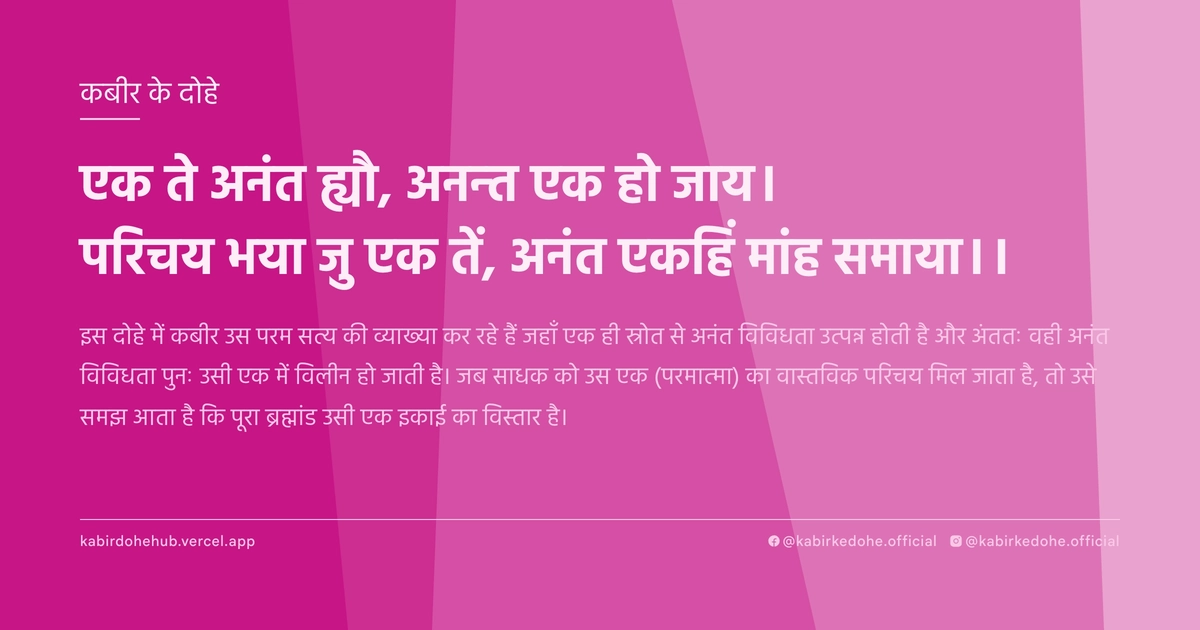
एक ते अनंत ह्यौ, अनन्त एक हो जाय।
परिचय भया जु एक तें, अनंत एकहिं मांह समाया।।
Ek te anant hyau, anant ek ho jaaye. Parichay bhaya ju ek ten, anant ekahin maanh samaya.
इस पृष्ठ पर इस कबीर दोहे का अर्थ (meaning), हिंदी व्याख्या और अंग्रेज़ी अनुवाद, दार्शनिक विश्लेषण और व्यावहारिक जीवन सीख दी गई है। यह दोहा निर्गुण ब्रह्म (Nirguna Brahman) विषय से जुड़ा है — Kabir doha meaning and explanation in Hindi and English.
अर्थ (Meaning):
इस दोहे में कबीर उस परम सत्य की व्याख्या कर रहे हैं जहाँ एक ही स्रोत से अनंत विविधता उत्पन्न होती है और अंततः वही अनंत विविधता पुनः उसी एक में विलीन हो जाती है। जब साधक को उस एक (परमात्मा) का वास्तविक परिचय मिल जाता है, तो उसे समझ आता है कि पूरा ब्रह्मांड उसी एक इकाई का विस्तार है।
In this couplet, Kabir explains the ultimate truth where infinite diversity arises from a single source, and eventually, that same infinity merges back into the One. Once the seeker attains a true introduction to that One (the Divine), they realize that the entire universe is merely an expansion of that single, undivided entity.
व्याख्या (Interpretation):
शाब्दिक रूप से, यह दोहा सृष्टि और प्रलय के चक्र को दर्शाता है। आध्यात्मिक स्तर पर, 'एक' निर्गुण ब्रह्म है और 'अनंत' यह दृश्य जगत और जीव है। कबीर यहाँ अद्वैत वेदांत के सिद्धांत को प्रस्तुत कर रहे हैं कि आत्मा और परमात्मा अलग नहीं हैं। माया के कारण हमें अनेकता दिखाई देती है, लेकिन ज्ञान के उदय होते ही यह भेद मिट जाता है। यह विरोधाभास है कि जो सबसे छोटा (एक बिंदु) है, वही सबसे विशाल (अनंत) भी है। जब 'परिचय' या आत्म-साक्षात्कार होता है, तो द्वैत का अंत हो जाता है। अंततः, साधक यह अनुभव करता है कि वह स्वयं ही वह अनंत है जो एक में समाया है।
Literally, this doha depicts the cycle of creation and dissolution. On a spiritual level, the 'One' represents the Nirgun Brahman (formless absolute), and the 'Infinite' represents the manifest universe and individual souls. Kabir presents the core tenet of Advaita Vedanta: the non-duality of Atman and Brahman. Due to Maya (illusion), we perceive multiplicity, but upon the awakening of knowledge, this distinction vanishes. It is a profound paradox that the smallest point is also the vastest infinity. When 'Parichay' or self-realization occurs, duality ends. Ultimately, the seeker experiences that they themselves are that infinity merged within the One.
दार्शनिक विश्लेषण (Philosophical Analysis):
कबीर का यह दर्शन उनके समय के कट्टर धार्मिक विभाजन और कर्मकांडों के विरुद्ध एक सशक्त प्रहार था। जहाँ एक ओर मंदिर और मस्जिद बाहरी प्रतीकों में ईश्वर को खोज रहे थे, कबीर ने 'एक' के माध्यम से आंतरिक एकता का मार्ग दिखाया। यह दृष्टिकोण सूफी मत के 'वहदत-उल-वजूद' (अस्तित्व की एकता) से गहराई से मेल खाता है, जहाँ खुदा और बंदा अंततः एक ही सत्य के दो पहलू माने जाते हैं।
दार्शनिक रूप से, कबीर यहाँ 'सगुण' और 'निर्गुण' के द्वंद्व को समाप्त कर रहे हैं। वे कहते हैं कि अनंत रूप केवल एक ही सत्य की अभिव्यक्तियाँ हैं। यह विचार जाति और वर्ण व्यवस्था की जड़ों पर प्रहार करता है क्योंकि यदि सब कुछ उसी 'एक' से निकला है, तो कोई भी छोटा या बड़ा, उच्च या नीच नहीं हो सकता।
मनोवैज्ञानिक स्तर पर, यह दोहा अहंकार (Ego) के विसर्जन की बात करता है। अहंकार वह पर्दा है जो 'एक' को 'अनंत' के रूप में अलग दिखाता है। जब व्यक्ति अपनी सीमित पहचान (नाम, पद, जाति) को त्याग कर वैश्विक चेतना में प्रवेश करता है, तब वह 'अनंत' का अनुभव करता है।
अद्वैत वेदांत के अनुसार, यह 'माया' का खेल है। जैसे एक ही सोने से अलग-अलग आभूषण बनते हैं, वैसे ही एक ही चेतना अलग-अलग शरीरों में प्रकट होती है। कबीर इस सत्य को सरल भाषा में समझाकर आम जनमानस को मोक्ष के मार्ग पर ले जाना चाहते थे।
अंततः, यह विश्लेषण हमें सिखाता है कि सत्य किसी एक धर्म या संप्रदाय की जागीर नहीं है। यह सार्वभौमिक है। कबीर का 'एक' वह शून्य है जिसमें सब कुछ समाहित है और जिससे सब कुछ उत्पन्न होता है, जो विज्ञान के आधुनिक सिद्धांतों (जैसे सिंगुलैरिटी) के भी करीब प्रतीत होता है।
Kabir's philosophy here serves as a powerful strike against the rigid religious divisions and ritualism of his era. While temples and mosques sought the Divine in external symbols, Kabir pointed toward internal unity through the concept of the 'One.' This perspective aligns deeply with the Sufi doctrine of 'Wahdat-al-Wujud' (Unity of Existence), where God and the servant are seen as two facets of the same Truth.
Philosophically, Kabir is dissolving the conflict between 'Saguna' (with attributes) and 'Nirgun' (without attributes). He asserts that infinite forms are merely expressions of a single Truth. This idea strikes at the roots of the caste system; if everything emanates from the 'One,' no one can be superior or inferior, high or low.
On a psychological level, this doha speaks of the annihilation of the ego. The ego is the veil that makes the 'One' appear as 'Infinite' separate entities. When an individual transcends their limited identity—name, rank, caste—and enters universal consciousness, they experience the 'Infinite.'
According to Advaita Vedanta, this is the play of 'Maya.' Just as various ornaments are crafted from the same gold, different bodies manifest from the same consciousness. Kabir simplifies this profound truth to guide the common masses toward liberation.
Ultimately, this analysis teaches us that Truth is not the monopoly of any single religion or sect. It is universal. Kabir's 'One' is the void (Shunya) from which everything arises and into which everything returns, echoing modern scientific concepts such as the singularity.
मूल संदेश (Core Message):
- अनेकता केवल एक भ्रम है, एकता ही एकमात्र सत्य है।
- अहंकार का विसर्जन ही अनंत की प्राप्ति का एकमात्र मार्ग है।
- सृष्टि का हर कण उसी एक परमात्मा की अभिव्यक्ति है।
- बाहरी खोज को त्यागकर आंतरिक एकता का अनुभव करें।
- जब 'मैं' मिटता है, तब 'सब' का बोध होता है।
- Multiplicity is but an illusion; unity is the only truth.
- The dissolution of ego is the only path to realizing the infinite.
- Every particle of creation is an expression of the one Divine.
- Abandon the external search to experience internal oneness.
- When the 'I' vanishes, the awareness of 'All' emerges.
व्यावहारिक उदाहरण (Practical Example):
वाराणसी के घाटों पर रहने वाले एक वृद्ध बुनकर थे, जिनका नाम माधव था। माधव जीवन भर रेशमी साड़ियाँ बुनते रहे, लेकिन उनका मन हमेशा इस बात से परेशान रहता था कि उनके परिवार में तीन बेटे हैं जो अलग-अलग विचारधाराओं के कारण आपस में लड़ते रहते हैं। एक बेटा कट्टर परंपरावादी था, दूसरा आधुनिकता का समर्थक और तीसरा पूरी तरह विरक्त। माधव को लगता था कि उनका परिवार टूट गया है और वे तीन अलग-अलग दुनियाओं में जी रहे हैं।
एक दिन माधव ने अपनी करघे पर एक बहुत बड़ा सफेद कपड़ा बुनना शुरू किया। उन्होंने देखा कि हज़ारों छोटे-छोटे सफेद धागे मिलकर एक ही विशाल चादर बना रहे हैं। उन्होंने महसूस किया कि दूर से देखने पर वह केवल एक सफेद कपड़ा है, लेकिन पास जाने पर उसमें हज़ारों अलग-अलग धागे हैं।
तभी उन्हें कबीर का यह दोहा याद आया। उन्होंने अपने बेटों को बुलाया और उन्हें उस कपड़े को दिखाया। उन्होंने कहा, 'देखो, ये धागे अलग-अलग दिख रहे हैं, लेकिन क्या इनमें से कोई भी धागा इस कपड़े से अलग है? यदि मैं एक धागा खींचूँ, तो पूरी चादर प्रभावित होगी।'
बेटों ने ध्यान से सुना। माधव ने आगे समझाया, 'तुम तीनों भी इसी तरह हो। तुम्हारी सोच, तुम्हारी आदतें और तुम्हारी मान्यताएं अलग-अलग धागों की तरह हैं, लेकिन तुम सबका मूल स्रोत एक ही है—हमारा परिवार, हमारा रक्त और वह एक ईश्वर जो हम सबके भीतर है।'
यह बात उनके दिलों को छू गई। उन्हें समझ आया कि उनकी विविधता उनकी कमजोरी नहीं, बल्कि उस 'एक' सत्य की सुंदरता थी। उन्होंने महसूस किया कि वे अलग-अलग होने का ढोंग कर रहे थे, जबकि वे वास्तव में एक ही अस्तित्व के हिस्से थे।
उस दिन के बाद, उन्होंने अपनी वैचारिक भिन्नताओं को झगड़े का कारण बनाने के बजाय, उन्हें एक-दूसरे के पूरक के रूप में देखना शुरू किया। उन्होंने समझा कि जैसे अनंत धागे मिलकर एक चादर बनाते हैं, वैसे ही अलग-अलग विचार मिलकर एक पूर्ण सत्य का निर्माण करते हैं।
माधव के घर में अब शांति थी। उन्होंने सीखा कि जब हम अपनी व्यक्तिगत पहचान (अहंकार) को छोड़कर उस मूल एकता को पहचान लेते हैं, तो सारे विवाद समाप्त हो जाते हैं।
यह 'कबीर ट्विस्ट' था—एक साधारण कपड़े के टुकड़े ने उन्हें ब्रह्मांडीय एकता का पाठ पढ़ा दिया। माधव अब केवल कपड़े नहीं बुन रहे थे, बल्कि दिलों को जोड़ने का काम कर रहे थे।
In the ghats of Varanasi lived an elderly weaver named Madhav. For a lifetime, Madhav wove exquisite silk sarees, but his heart was heavy because his three sons were constantly fighting due to their conflicting ideologies. One son was a rigid traditionalist, the second a champion of modernity, and the third completely detached from the world. Madhav felt his family had shattered into three different worlds.
One day, Madhav began weaving a massive white cloth on his loom. He observed how thousands of tiny white threads were merging to create a single, vast sheet. He realized that from a distance, it looked like one white fabric, but upon closer inspection, it consisted of thousands of individual threads.
At that moment, Kabir's doha resonated within him. He called his sons and showed them the cloth. He said, 'Look, these threads appear separate, but is any single thread distinct from this fabric? If I pull one thread, the entire sheet is affected.'
The sons listened intently. Madhav continued, 'You three are just like this. Your thoughts, habits, and beliefs are like these separate threads, but your root source is one—our family, our blood, and the one Divine that resides within all of us.'
These words touched their hearts. They realized that their diversity was not a weakness, but the beauty of that 'One' truth. They understood they had been pretending to be separate while actually being parts of a single existence.
From that day forward, instead of letting ideological differences cause conflict, they began to see them as complementary. They understood that just as infinite threads create one cloth, diverse perspectives construct a complete truth.
Peace returned to Madhav's home. They learned that when we let go of our individual identity (ego) and recognize the primal unity, all disputes vanish.
This was the 'Kabir Twist'—a simple piece of fabric taught them the lesson of cosmic unity. Madhav was no longer just weaving cloth; he was weaving hearts together.
अभ्यास मार्गदर्शन (Practice Guidance):
- प्रतिदिन 20 मिनट 'शून्य ध्यान' का अभ्यास करें, जहाँ आप स्वयं को एक बिंदु से अनंत विस्तार में फैलते हुए और पुनः उस बिंदु में सिमटते हुए महसूस करें।
- एक जर्नल बनाएँ जिसमें लिखें: 'आज मैंने किन लोगों में खुद को देखा?' उन गुणों को पहचानें जो दूसरों में हैं लेकिन वास्तव में आपकी अपनी चेतना का हिस्सा हैं।
- व्यवहार परिवर्तन: जब भी किसी से विवाद हो, तो मन में दोहराएँ—'यह व्यक्ति भी उसी एक का विस्तार है जिससे मैं बना हूँ।'
- नैदानिक चेकलिस्ट: क्या मैं अभी भी 'मैं' और 'तुम' के बीच भेद कर रहा हूँ? क्या मैं दूसरों की सफलता में अपनी खुशी देख पा रहा हूँ? यदि नहीं, तो आप अभी भी द्वैत (Duality) में जी रहे हैं।
- Practice 20 minutes of 'Shunya Meditation' daily, visualizing yourself expanding from a single point into an infinite void and then contracting back into that point.
- Maintain a journal with the prompt: 'In whom did I see myself today?' Identify qualities in others that are actually reflections of your own consciousness.
- Behavioral Shift: Whenever a conflict arises, mentally repeat—'This person is also an expansion of the same One from which I am made.'
- Diagnostic Checklist: Am I still perceiving a divide between 'I' and 'Thou'? Can I find my own joy in the success of others? If not, you are still living in the illusion of duality.
चिंतन प्रश्न (Reflection Questions):
- मेरी वह कौन सी पहचान (नाम, पद, धर्म) है जिसे मैं सबसे अधिक पकड़ कर रखता हूँ, और यदि यह छिन जाए तो मैं कौन रहूँगा?
- क्या मेरा 'डिजिटल व्यक्तित्व' मेरी वास्तविक आत्मा को छिपाने वाला एक नया पर्दा बन गया है?
- मैं उन लोगों के प्रति घृणा क्यों महसूस करता हूँ जो मुझसे भिन्न हैं, जबकि हम एक ही स्रोत से उपजे हैं?
- क्या मैं वास्तव में दूसरों की मदद करता हूँ, या मैं केवल अपनी 'परोपकारी' होने की छवि को संतुष्ट कर रहा हूँ?
- मेरे जीवन का वह कौन सा क्षेत्र है जहाँ मैं अभी भी 'मेरा' और 'तेरा' के बीच संघर्ष कर रहा हूँ?
- Which identity (name, rank, religion) do I cling to most, and who would I be if it were stripped away?
- Has my 'digital persona' become a new veil hiding my authentic soul?
- Why do I feel hatred toward those different from me, knowing we emerge from the same source?
- Do I truly help others, or am I merely satisfying the image of being 'charitable'?
- In which area of my life am I still struggling with the divide between 'mine' and 'thine'?