
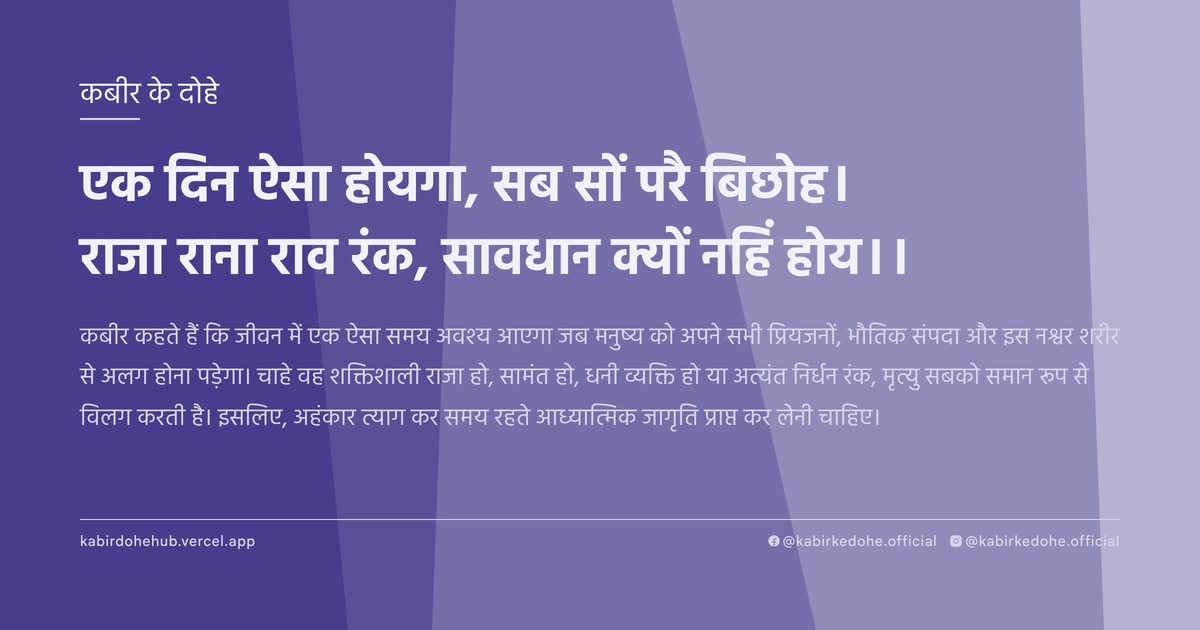
एक दिन ऐसा होयगा, सब सों परै बिछोह।
राजा राना राव रंक, सावधान क्यों नहिं होय।।
Ek din aisa hoyga, sab son parai bichoh. Raja rana rao rank, savdhan kyon nahin hoye.
इस पृष्ठ पर इस कबीर दोहे का अर्थ (meaning), हिंदी व्याख्या और अंग्रेज़ी अनुवाद, दार्शनिक विश्लेषण और व्यावहारिक जीवन सीख दी गई है। यह दोहा मृतुक्यता (Mortality) विषय से जुड़ा है — Kabir doha meaning and explanation in Hindi and English.
अर्थ (Meaning):
कबीर कहते हैं कि जीवन में एक ऐसा समय अवश्य आएगा जब मनुष्य को अपने सभी प्रियजनों, भौतिक संपदा और इस नश्वर शरीर से अलग होना पड़ेगा। चाहे वह शक्तिशाली राजा हो, सामंत हो, धनी व्यक्ति हो या अत्यंत निर्धन रंक, मृत्यु सबको समान रूप से विलग करती है। इसलिए, अहंकार त्याग कर समय रहते आध्यात्मिक जागृति प्राप्त कर लेनी चाहिए।
Kabir asserts that a day will inevitably come when every human being must face an absolute separation from all loved ones, material possessions, and the physical body itself. Whether one is a powerful king, a nobleman, a wealthy merchant, or a destitute pauper, death acts as the ultimate equalizer. Thus, one must awaken spiritually and abandon ego before time runs out.
व्याख्या (Interpretation):
यह दोहा मृत्यु की अपरिहार्यता और सांसारिक मोह की व्यर्थता का चित्रण करता है। 'बिछोह' यहाँ केवल शारीरिक मृत्यु नहीं, बल्कि आत्मा का मायावी बंधनों से विलग होना है। कबीर राजा और रंक का उल्लेख कर यह स्पष्ट करते हैं कि सामाजिक प्रतिष्ठा और आर्थिक स्थिति मोक्ष के मार्ग में कोई सहायता नहीं करती। यह निर्गुण भक्ति का सार है, जहाँ ईश्वर किसी बाहरी आडंबर में नहीं बल्कि आंतरिक सत्य में है। यहाँ 'सावधान' होने का अर्थ है कि व्यक्ति अपनी पहचान को पद या संपत्ति से न जोड़कर अपनी वास्तविक आत्मा (Atman) को पहचाने। जब व्यक्ति यह समझ लेता है कि शरीर नश्वर है और केवल चेतना शाश्वत है, तब वह द्वैत से अद्वैत की ओर बढ़ता है। यह विरह का वह क्षण है जो वास्तव में परमात्मा से मिलन की पहली सीढ़ी है।
This couplet depicts the inevitability of death and the futility of worldly attachments. 'Bichoh' (separation) here refers not merely to physical death, but to the soul's detachment from the illusions of Maya. By mentioning the king and the pauper, Kabir clarifies that social prestige and economic status offer no sanctuary or advantage on the path to liberation. This is the essence of Nirgun Bhakti, where the Divine is found not in external rituals but in internal truth. To be 'savdhan' (alert) means to cease identifying oneself with titles or wealth and instead recognize the true Self (Atman). When one realizes that the body is transient and only consciousness is eternal, they transition from duality to non-duality (Advaita). This moment of separation is, paradoxically, the first step toward an eternal union with the Universal Truth.
दार्शनिक विश्लेषण (Philosophical Analysis):
कबीर का यह दर्शन उनके समय के कट्टरपंथी सामाजिक ढांचे और कर्मकांडीय धर्म के विरुद्ध एक सशक्त प्रहार है। उन्होंने देखा कि लोग जाति, धर्म और पद के अहंकार में इतने डूबे थे कि वे जीवन के अंतिम सत्य को भूल गए थे। उनका दृष्टिकोण अद्वैत वेदांत से मेल खाता है, जहाँ यह माना जाता है कि व्यक्तिगत अहंकार (Ahamkara) ही वह पर्दा है जो जीव को ब्रह्म से अलग करता है। मृत्यु इस पर्दे को अनिवार्य रूप से हटा देती है, लेकिन कबीर सुझाव देते हैं कि इसे मृत्यु के भरोसे छोड़ने के बजाय जीवित रहते हुए 'जीवित समाधि' या अहंकार के विसर्जन के माध्यम से प्राप्त किया जाए।
सूफी मत के 'फना' (अस्तित्व का मिट जाना) के सिद्धांत की तरह, कबीर यहाँ भी स्वयं को मिटाने की बात करते हैं। जब 'मैं' मिटता है, तभी 'वह' प्रकट होता है। राजा और रंक का उदाहरण देकर वे यह सिद्ध करते हैं कि मृत्यु एकमात्र ऐसा सत्य है जो पूरी तरह लोकतांत्रिक है। यह सामाजिक पदानुक्रम को ध्वस्त करने का एक आध्यात्मिक तरीका है।
मनोवैज्ञानिक स्तर पर, यह दोहा 'Memento Mori' (मृत्यु को याद रखो) की याद दिलाता है। यह भय पैदा करने के लिए नहीं, बल्कि वर्तमान क्षण की मूल्यवत्ता को समझने के लिए है। जब मनुष्य को अपनी नश्वरता का बोध होता है, तो उसकी वासनाएँ और ईर्ष्याएँ स्वतः कम होने लगती हैं।
कबीर ritualism (कर्मकांड) का विरोध करते हैं क्योंकि वे जानते हैं कि बाहरी पूजा-पाठ मृत्यु के भय को कम नहीं कर सकते। केवल आंतरिक रूपांतरण और प्रेम ही वह सेतु है जो आत्मा को परमात्मा से जोड़ता है। वे चेतावनी देते हैं कि जो व्यक्ति केवल बाहरी दुनिया को संवारने में लगा है, वह अंत समय में रिक्त हाथ रह जाएगा।
अंततः, यह विश्लेषण हमें सिखाता है कि मुक्ति किसी विशेष वर्ग के लिए आरक्षित नहीं है। यह उस व्यक्ति के लिए उपलब्ध है जो सजग है और जिसने यह जान लिया है कि संसार एक सराय है, जहाँ ठहरना क्षणिक है और प्रस्थान अनिवार्य।
Kabir's philosophy here is a potent strike against the rigid social hierarchies and ritualistic religions of his era. He observed that people were so immersed in the ego of caste, creed, and status that they forgot the ultimate truth of existence. His perspective aligns with Advaita Vedanta, which posits that the individual ego (Ahamkara) is the only veil separating the Jiva (individual soul) from Brahman (Universal Consciousness). While death inevitably removes this veil, Kabir suggests achieving this 'living liberation' through the conscious dissolution of the ego while still alive.
Similar to the Sufi concept of 'Fana' (the annihilation of the self), Kabir emphasizes the necessity of erasing the 'I' to reveal the 'He'. By juxtaposing the king and the pauper, he proves that death is the only truly democratic force in the universe. This is a spiritual method of dismantling social hierarchies; in the grave, the crown and the rag are identical.
Psychologically, this doha serves as a 'Memento Mori'. It is not intended to instill fear, but to highlight the preciousness of the present moment. When a human truly internalizes their mortality, cravings and jealousies naturally diminish, replaced by a sense of urgency for spiritual growth.
Kabir rejects ritualism because he understands that external ceremonies cannot alleviate the existential dread of death. Only internal transformation and selfless love serve as the bridge between the soul and the Divine. He warns that those who spend their lives solely decorating their external world will find themselves empty-handed at the final hour.
Ultimately, this analysis reveals that liberation is not reserved for a specific elite class. It is accessible to anyone who is mindful and recognizes that the world is merely an inn—a temporary shelter where the stay is brief and the departure is mandatory.
मूल संदेश (Core Message):
- मृत्यु अंतिम सत्य है, जो सभी भेदों को मिटा देती है।
- पद और प्रतिष्ठा केवल अस्थायी आवरण हैं, वास्तविक नहीं।
- अहंकार का त्याग ही वास्तविक स्वतंत्रता का एकमात्र मार्ग है।
- सांसारिक मोह एक सुंदर स्वप्न है, जिससे जागना अनिवार्य है।
- आत्मा का परमात्मा से मिलन ही एकमात्र स्थायी संबंध है।
- Death is the final truth that erases all distinctions.
- Rank and prestige are merely temporary veils, not reality.
- Relinquishing the ego is the only path to true freedom.
- Worldly attachment is a beautiful dream from which one must awaken.
- The union of the Atman with the Divine is the only permanent bond.
व्यावहारिक उदाहरण (Practical Example):
वाराणसी के एक पुराने घाट पर रहने वाले मदनलाल एक अत्यंत अभिमानी स्वर्णकार थे। उनके पास सोने के भारी भंडार थे और शहर के सबसे अमीर लोग उनसे गहने बनवाते थे। मदनलाल को अपनी कला और संपत्ति पर इतना गर्व था कि वे अपने से नीचे के लोगों को देखते तक नहीं थे। वे अक्सर कहते थे, 'मेरी यह दौलत और हुनर ही मेरी पहचान है, जो मुझे इस दुनिया में अमर रखेगा।'
एक दिन, मदनलाल ने देखा कि उनके बचपन का एक मित्र, जो अब एक अत्यंत निर्धन भिखारी बन चुका था, घाट की सीढ़ियों पर बैठा था। मदनलाल ने उसे तिरस्कार से देखा और अपनी सोने की अंगूठियों को चमकाते हुए उसके पास से गुजर गए। उन्होंने मन ही मन सोचा कि कैसे समय ने इस व्यक्ति को रंक बना दिया, जबकि वे स्वयं राजा के समान वैभवशाली हैं।
उसी शाम, मदनलाल को एक तीव्र हृदयघात हुआ। अचानक, वे सोने के गहनों से घिरे अपने कमरे में अकेले पड़े थे। उनके पास नौकर थे, लेकिन कोई ऐसा नहीं था जो उनके हाथ को प्रेम से पकड़ सके। उस क्षण उन्हें कबीर का यह दोहा याद आया कि एक दिन सबको बिछोड़ना है। उन्हें अहसास हुआ कि उनकी सारी संपत्ति केवल धातु के टुकड़े थे, जो उनकी सांसों को वापस नहीं ला सकते थे।
मृत्यु के करीब पहुँचकर, उन्हें वह भिखारी मित्र याद आया। उन्हें महसूस हुआ कि उस भिखारी के पास खोने के लिए कुछ नहीं था, इसलिए वह वास्तव में उनसे अधिक स्वतंत्र था। मदनलाल का अहंकार एक पल में ढह गया। उन्होंने महसूस किया कि उन्होंने अपना पूरा जीवन एक ऐसी इमारत बनाने में लगा दिया जिसकी नींव ही रेत थी।
अचानक, मदनलाल ने अपने पास मौजूद सोने के सिक्कों की पोटली को देखा। वे अब उन्हें बोझ समझने लगे। उन्होंने अपनी अंतिम चेतना के साथ अपने पास मौजूद धन को उन लोगों में बाँटने का संकल्प लिया जो वास्तव में अभाव में थे, ताकि वे कम से कम कुछ प्रेम के बीज बो सकें।
जब उनके परिजन आए, तो उन्होंने देखा कि मदनलाल के चेहरे पर एक अजीब सी शांति थी, जो उनके जीवन में कभी नहीं देखी गई थी। उन्होंने अपनी संपत्ति का मोह छोड़ दिया था। उनके अंतिम शब्द थे, 'सब मिट्टी है, बस प्रेम ही सच है।'
यह परिवर्तन मदनलाल के लिए एक 'कबीर ट्विस्ट' था। जिस सोने ने उन्हें दुनिया से अलग किया था, उसी की व्यर्थता के बोध ने उन्हें अंततः मानवता से जोड़ दिया।
मदनलाल की कहानी हमें सिखाती है कि जब हम अपनी पहचान को बाहरी वस्तुओं से जोड़ते हैं, तो हम वास्तव में एक भ्रम में जीते हैं। वास्तविक सुरक्षा केवल आत्म-ज्ञान और करुणा में है।
अंत में, मदनलाल का जीवन यह प्रमाण बना कि जागृति कभी भी देर से नहीं आती, बशर्ते व्यक्ति सत्य को स्वीकार करने का साहस रखे।
Madanlal was an incredibly arrogant goldsmith living on an ancient ghat in Varanasi. He possessed vast reserves of gold, and the wealthiest people in the city came to him for their jewelry. Madanlal was so proud of his craft and wealth that he refused to even look at those he deemed inferior. He often boasted, 'My wealth and skill are my identity; they will make me immortal in this world.'
One day, Madanlal noticed a childhood friend, who had since become a destitute beggar, sitting on the steps of the ghat. Madanlal looked at him with contempt, polishing his gold rings as he walked past. He thought to himself how time had reduced this man to a pauper, while he himself enjoyed a magnificence akin to a king.
That very evening, Madanlal suffered a severe heart attack. Suddenly, he found himself alone in his room, surrounded by gold ornaments. He had servants, but no one who could hold his hand with genuine love. In that moment, Kabir's words echoed in his mind: a day will come when everyone must face separation. He realized that all his wealth was merely pieces of metal that could not bring back his breath.
As he neared death, he remembered the beggar friend. He felt that because the beggar had nothing to lose, he was actually far more free than Madanlal had ever been. Madanlal's ego collapsed in an instant. He realized he had spent his entire life building an edifice on a foundation of sand.
Suddenly, Madanlal looked at the pouch of gold coins beside him. He began to perceive them as a burden. With his remaining consciousness, he resolved to distribute his wealth among those in genuine need, hoping to sow at least a few seeds of love before the end.
When his relatives arrived, they noticed a strange peace on Madanlal's face, a serenity never seen during his life. He had relinquished his attachment to wealth. His final words were, 'Everything is dust; only love is true.'
This transformation was the 'Kabir Twist' for Madanlal. The very gold that had isolated him from the world, through the realization of its futility, finally connected him to humanity.
Madanlal's story teaches us that when we tie our identity to external objects, we live in a delusion. True security exists only in self-knowledge and compassion.
Ultimately, Madanlal's life became a testament that awakening is never too late, provided one has the courage to accept the Truth.
अभ्यास मार्गदर्शन (Practice Guidance):
- प्रतिदिन 15 मिनट मौन ध्यान करें, जिसमें यह कल्पना करें कि आप अपनी सभी सामाजिक उपाधियों, संपत्ति और रिश्तों को धीरे-धीरे त्याग रहे हैं।
- एक 'नश्वरता जर्नल' (Mortality Journal) लिखें: हर सप्ताह एक ऐसी चीज़ की सूची बनाएं जिससे आप अत्यधिक जुड़े हैं, और विचार करें कि यदि वह कल गायब हो जाए, तो आपके भीतर क्या शेष रहेगा।
- व्यवहार परिवर्तन: दिन में कम से कम एक बार किसी ऐसे व्यक्ति की निस्वार्थ मदद करें जिससे आपका कोई सामाजिक या व्यावसायिक संबंध न हो, ताकि 'अहंकार' का विसर्जन हो सके।
- निदान चेकलिस्ट: क्या मैं अपनी उपलब्धियों के बारे में बात करते समय 'मैं' शब्द का अत्यधिक प्रयोग करता हूँ? क्या मैं दूसरों को उनकी सामाजिक स्थिति से आंकता हूँ? यदि हाँ, तो आप अभी भी माया के प्रभाव में हैं।
- Practice 15 minutes of silent meditation daily, visualizing yourself gradually shedding all social titles, possessions, and relationships.
- Maintain a 'Mortality Journal': Each week, list one thing you are deeply attached to and contemplate what would remain within you if it vanished tomorrow.
- Behavioral Change: At least once a day, help someone selflessly with whom you have no social or professional connection, to facilitate the dissolution of the ego.
- Diagnostic Checklist: Do I over-use the word 'I' when discussing my achievements? Do I judge others based on their social status? If yes, you are still under the influence of Maya.
चिंतन प्रश्न (Reflection Questions):
- यदि आज आपकी सारी सामाजिक पहचान छीन ली जाए, तो आप स्वयं को कैसे परिभाषित करेंगे?
- आपकी कौन सी ऐसी 'डिजिटल पहचान' या छवि है जिसे आप खोने से सबसे ज्यादा डरते हैं?
- क्या आपका धर्म और नैतिकता केवल सामाजिक स्वीकृति के लिए है, या यह आपके आंतरिक सत्य पर आधारित है?
- आप किन लोगों को अपने से 'नीचा' समझते हैं, और यह धारणा आपके अहंकार को कैसे पोषण देती है?
- मृत्यु के क्षण में, आप अपनी किस उपलब्धि को साथ ले जाना चाहेंगे, और क्या वह वास्तव में संभव है?
- If all your social identities were stripped away today, how would you define yourself?
- What 'digital identity' or image of yourself are you most afraid of losing?
- Is your religion and morality merely for social acceptance, or is it based on your internal truth?
- Whom do you perceive as 'inferior' to you, and how does this perception nourish your ego?
- At the moment of death, which achievement would you wish to take with you, and is that even possible?