
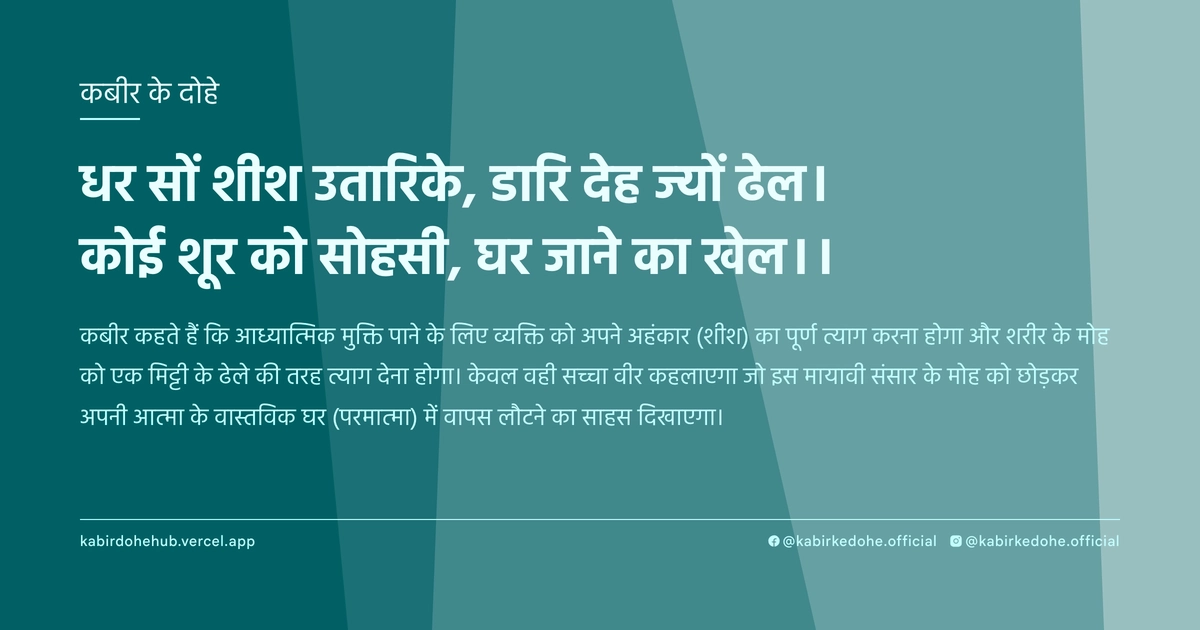
धर सों शीश उतारिके, डारि देह ज्यों ढेल।
कोई शूर को सोहसी, घर जाने का खेल।।
Dhar son sheesh utarike, dari deh jyon dhel. Koi shoor ko sohasi, ghar jaane ka khel.
इस पृष्ठ पर इस कबीर दोहे का अर्थ (meaning), हिंदी व्याख्या और अंग्रेज़ी अनुवाद, दार्शनिक विश्लेषण और व्यावहारिक जीवन सीख दी गई है। यह दोहा प्रपत्ति (Surrender) विषय से जुड़ा है — Kabir doha meaning and explanation in Hindi and English.
अर्थ (Meaning):
कबीर कहते हैं कि आध्यात्मिक मुक्ति पाने के लिए व्यक्ति को अपने अहंकार (शीश) का पूर्ण त्याग करना होगा और शरीर के मोह को एक मिट्टी के ढेले की तरह त्याग देना होगा। केवल वही सच्चा वीर कहलाएगा जो इस मायावी संसार के मोह को छोड़कर अपनी आत्मा के वास्तविक घर (परमात्मा) में वापस लौटने का साहस दिखाएगा।
Kabir asserts that to achieve spiritual liberation, one must decisively sever the head of the ego and cast away the physical body's attachment as if it were a mere lump of clay. Only the truly courageous soul, who transcends the illusions of the material world, will be recognized as a spiritual warrior capable of returning to the eternal home of the Divine.
व्याख्या (Interpretation):
यहाँ 'शीश उतारना' शारीरिक मृत्यु नहीं, बल्कि अहंकार की मृत्यु का प्रतीक है। शरीर को 'ढेल' या मिट्टी का टुकड़ा कहना इस बात पर जोर देता है कि यह भौतिक ढांचा नश्वर और गौण है। यह दोहा निर्गुण भक्ति के उस मार्ग को दर्शाता है जहाँ साधक को अपनी पहचान (Identity) को पूरी तरह मिटाना पड़ता है। जब तक 'मैं' का भाव रहता है, तब तक आत्मा और ब्रह्म की एकता (अद्वैत) संभव नहीं है। यह एक आध्यात्मिक विरोधाभास है: स्वयं को पूरी तरह खोकर ही स्वयं को पाना संभव है। माया का पर्दा तभी हटता है जब व्यक्ति अपनी सामाजिक और शारीरिक छवि से ऊपर उठ जाता है। अंततः, 'घर जाना' उस शून्य या परम चेतना में विलीन होना है जहाँ कोई द्वैत शेष नहीं रहता।
The act of 'severing the head' is not a literal decapitation but a potent metaphor for the annihilation of the ego. Describing the body as a 'dhel' or a lump of clay emphasizes the transient and secondary nature of the physical vessel. This verse embodies the path of Nirgun Bhakti, where the seeker must completely dissolve their individual identity. As long as the sense of 'I' persists, the non-duality of Atman and Brahman remains obscured. It presents a spiritual paradox: only by utterly losing oneself can one truly be found. The veil of Maya is lifted only when the individual transcends their social and physical image. Ultimately, 'returning home' signifies merging into the void or supreme consciousness where all duality ceases to exist.
दार्शनिक विश्लेषण (Philosophical Analysis):
कबीर का यह दोहा मध्यकालीन भारत के उस सामाजिक परिवेश से उपजा है जहाँ धर्म बाहरी आडंबरों और जातिगत श्रेष्ठता में कैद था। कबीर ने ritualism (कर्मकांड) का कड़ा विरोध किया और बताया कि मोक्ष किसी मंदिर या मस्जिद में नहीं, बल्कि आंतरिक रूपांतरण में है। यह विचार अद्वैत वेदांत के 'अहं ब्रह्मास्मि' से मेल खाता है, जहाँ व्यक्तिगत अहंकार का विसर्जन ही सत्य का साक्षात्कार है।
सूफीवाद के संदर्भ में, इसे 'फना' (Fana) कहा जाता है—अर्थात ईश्वर की इच्छा में स्वयं को पूरी तरह मिटा देना। कबीर यहाँ एक 'आध्यात्मिक योद्धा' की बात कर रहे हैं, क्योंकि अहंकार को मारना दुनिया की सबसे कठिन लड़ाई है। यह लड़ाई बाहरी शत्रुओं से नहीं, बल्कि अपने भीतर के सूक्ष्म मोह और गर्व से है।
ऐतिहासिक रूप से, कबीर ने बुनकर समुदाय से होते हुए भी उस ज्ञान को प्राप्त किया जो केवल उच्च वर्ग के पंडितों तक सीमित माना जाता था। उन्होंने यह सिद्ध किया कि आध्यात्मिक वीरता का संबंध जन्म या जाति से नहीं, बल्कि साहस और वैराग्य से है।
मनोवैज्ञानिक स्तर पर, यह दोहा 'पहचान के संकट' को संबोधित करता है। हम अक्सर अपनी उपाधियों, शरीर और उपलब्धियों को ही अपनी वास्तविकता मान लेते हैं। कबीर चेतावनी देते हैं कि यह पहचान ही वह बंधन है जो हमें हमारे वास्तविक स्वरूप से दूर रखती है।
अंततः, यह शिक्षण हमें सिखाता है कि मृत्यु का भय केवल शरीर का भय है। यदि हम जीवन में ही अहंकार की मृत्यु कर लें, तो भौतिक मृत्यु केवल एक वस्त्र बदलने जैसी प्रक्रिया बन जाती है, जिससे हम भयमुक्त होकर परम सत्य में लीन हो जाते हैं।
This verse emerges from the socio-religious landscape of medieval India, where spirituality was often imprisoned within external rituals and caste hierarchies. Kabir vehemently rejected ritualism, asserting that liberation is found not in temples or mosques, but through profound internal transformation. This aligns with the Advaita Vedanta concept of 'Aham Brahmasmi,' where the dissolution of the individual ego is the only gateway to realizing the Absolute Truth.
In the context of Sufism, this process is known as 'Fana'—the annihilation of the self in the Divine Will. Kabir speaks of a 'spiritual warrior' because slaying the ego is the most grueling battle one can fight. This conflict is not against external enemies, but against the subtle attachments and pride residing within the subconscious.
Historically, despite belonging to the weaver community, Kabir accessed wisdom that was traditionally reserved for the priestly elite. He demonstrated that spiritual valor is independent of birth or caste, rooted instead in courage and detachment (Vairagya).
Psychologically, the verse addresses the 'crisis of identity.' Humans often mistake their titles, physical bodies, and achievements for their true essence. Kabir warns that this constructed identity is the very chain that prevents the soul from recognizing its origin.
Ultimately, the teaching suggests that the fear of death is merely the fear of the body. If one can achieve the 'death of the ego' while still alive, physical death becomes nothing more than changing a garment, allowing the soul to merge fearlessly into the Supreme Consciousness.
मूल संदेश (Core Message):
- अहंकार वह अंतिम पर्दा है जो आत्मा को परमात्मा से अलग करता है।
- शरीर की नश्वरता को स्वीकार करना ही वास्तविक स्वतंत्रता की पहली सीढ़ी है।
- सच्ची वीरता युद्ध जीतने में नहीं, बल्कि स्वयं के 'मैं' को जीतने में है।
- जब व्यक्तिगत पहचान मिटती है, तब सार्वभौमिक सत्य प्रकट होता है।
- मोक्ष कोई स्थान नहीं, बल्कि अहंकार-रहित चेतना की एक अवस्था है।
- The ego is the final veil separating the individual soul from the Universal Divine.
- Accepting the transience of the body is the first step toward true liberation.
- Real valor lies not in conquering others, but in conquering the 'I' within.
- When the personal identity dissolves, the universal truth reveals itself.
- Liberation is not a destination, but a state of consciousness void of ego.
व्यावहारिक उदाहरण (Practical Example):
एक समय की बात है, वाराणसी के घाटों पर माधव नाम का एक वृद्ध कुम्हार रहता था। माधव अपनी मिट्टी की कलाकृतियों के लिए पूरे शहर में प्रसिद्ध था। उसे अपनी कला पर इतना गर्व था कि वह खुद को 'मिट्टी का सम्राट' समझने लगा था। वह अन्य कुम्हारों को नीचा दिखाता और मानता था कि उसकी उंगलियों का जादू ईश्वरीय है, जबकि अन्य केवल मजदूर हैं।
एक दिन, एक फकीर उसके पास आया और माधव की सबसे सुंदर मूर्ति को देख कर मुस्कुराया। फकीर ने पूछा, "इस मिट्टी के ढेर में तुम्हें क्या दिखता है?" माधव ने गर्व से कहा, "इसमें मेरी श्रेष्ठता और मेरी कला की अमरता दिखती है।"
फकीर ने बिना कुछ कहे, उस मूर्ति को जमीन पर पटक दिया और उसे पैरों से कुचलकर फिर से मिट्टी का ढेर बना दिया। माधव क्रोध से लाल हो गया और चिल्लाया, "तुमने मेरी मेहनत और मेरी पहचान को नष्ट कर दिया!"
फकीर शांत स्वर में बोला, "यही तो समस्या है, माधव। तुम इस मिट्टी के ढेले को अपनी पहचान मान बैठे थे। जिस क्षण यह टूटा, तुम्हें लगा कि तुम मिट गए। क्या तुम इतने कमजोर हो कि एक मिट्टी के टुकड़े के टूटने से तुम्हारी सत्ता खत्म हो जाए?"
माधव स्तब्ध रह गया। उसे अचानक अहसास हुआ कि उसका पूरा जीवन उस 'अहंकार' के इर्द-गिर्द घूम रहा था जिसे वह अपनी श्रेष्ठता समझता था। वह जिसे अपनी 'पहचान' कह रहा था, वह वास्तव में एक बोझ था जो उसे दूसरों से अलग कर रहा था।
उस रात माधव सो नहीं सका। उसने सोचा कि वह अपनी कला से प्रेम करता था, लेकिन वास्तव में वह उस 'प्रशंसा' से प्रेम करता था जो उसे उस कला के कारण मिलती थी। उसने महसूस किया कि उसका 'शीश' (अहंकार) उसकी दृष्टि को धुंधला कर रहा था।
अगले दिन से माधव ने अपनी कार्यशैली बदल दी। अब वह मूर्तियाँ बनाता, लेकिन यह मानकर कि वह केवल एक माध्यम है। उसने अपनी श्रेष्ठता का दावा छोड़ दिया और अन्य कुम्हारों को सिखाने लगा, बिना किसी गर्व के।
उसने पाया कि जब उसने अपनी 'विशेषता' होने के अहंकार को त्याग दिया, तो उसे एक असीम शांति मिली। अब वह मिट्टी के ढेले से नहीं डरता था, क्योंकि उसने जान लिया था कि वह मिट्टी नहीं, बल्कि वह चेतना है जो मिट्टी को आकार देती है।
माधव का जीवन अब एक खेल बन गया था। वह अब 'घर जाने' की तैयारी कर रहा था—अर्थात वह उस अवस्था में पहुँच गया था जहाँ न कोई छोटा था, न बड़ा, केवल एक अखंड प्रेम था।
यह 'कबीर ट्विस्ट' था: जब माधव ने अपनी पहचान को मिट्टी की तरह बिखेर दिया, तभी वह वास्तव में एक महान कलाकार और एक मुक्त आत्मा बन पाया।
Once, on the ghats of Varanasi, lived an elderly potter named Madhav. Madhav was renowned throughout the city for his exquisite clay sculptures. Over time, he grew so proud of his craft that he began to see himself as the 'Emperor of Clay.' He looked down upon other potters, believing that the magic in his fingers was a divine gift that made him superior to mere laborers.
One day, a wandering fakir approached him and smiled upon seeing Madhav's most beautiful creation. The fakir asked, "What do you see in this heap of clay?" Madhav replied with pride, "I see my superiority and the immortality of my art."
Without a word, the fakir knocked the sculpture to the ground and crushed it under his feet, turning it back into a shapeless lump of mud. Madhav turned red with rage and screamed, "You have destroyed my hard work and my identity!"
The fakir spoke calmly, "That is precisely the problem, Madhav. You had mistaken this lump of clay for your identity. The moment it broke, you felt as if you yourself had been erased. Are you so fragile that your existence depends on a piece of clay?"
Madhav stood frozen. He suddenly realized that his entire life had revolved around an 'ego' that he mistook for excellence. What he called his 'identity' was actually a burden that separated him from the rest of humanity.
Madhav could not sleep that night. He reflected that while he claimed to love his art, he actually loved the 'admiration' he received because of it. He realized that his 'head' (ego) was clouding his vision, preventing him from seeing the truth.
From the next day, Madhav changed his way of living. He continued to create sculptures, but he did so believing he was merely a medium. He abandoned all claims of superiority and began teaching other potters without a shred of pride.
He discovered that once he discarded the ego of being 'special,' an infinite peace descended upon him. He no longer feared the breaking of the clay, for he understood he was not the clay, but the consciousness that gives the clay its form.
Madhav's life became a divine play. He was now preparing to 'go home'—meaning he had reached a state where there was no high or low, only an unbroken flow of love.
This was the 'Kabir Twist': only when Madhav allowed his identity to be scattered like dust did he truly become a master artist and a liberated soul.
अभ्यास मार्गदर्शन (Practice Guidance):
- प्रतिदिन 20 मिनट 'साक्षी भाव' का अभ्यास करें: अपने विचारों को देखें जैसे वे किसी और के हों, यह महसूस करते हुए कि 'मैं' वह विचार नहीं हूँ।
- स्व-अन्वेषण जर्नल: प्रतिदिन एक ऐसी घटना लिखें जहाँ आपके अहंकार ने आपको चोट पहुँचाई या आपको दूसरों से अलग किया। विश्लेषण करें कि वह 'शीश' (अहंकार) कहाँ था।
- सेवा का अभ्यास: सप्ताह में एक बार ऐसा कार्य करें जिसमें आपको कोई श्रेय न मिले और आपकी पहचान गुप्त रहे, ताकि 'कर्ता' होने का भाव मिट सके।
- निदान चेकलिस्ट: क्या मैं किसी की आलोचना सुनकर विचलित होता हूँ? क्या मैं अपनी उपलब्धियों का बार-बार उल्लेख करता हूँ? क्या मैं खुद को दूसरों से श्रेष्ठ या निम्न महसूस करता हूँ? यदि हाँ, तो अहंकार अभी जीवित है।
- Practice 'Witness Consciousness' for 20 minutes daily: Observe your thoughts as if they belong to someone else, realizing that 'I' am not those thoughts.
- Self-Inquiry Journal: Daily record one instance where your ego caused you pain or separated you from others. Analyze where that 'head' (ego) was operating.
- Practice of Anonymous Service: Once a week, perform an act of kindness where you receive no credit and your identity remains hidden, to dissolve the sense of being the 'doer'.
- Diagnostic Checklist: Do I get agitated by criticism? Do I frequently mention my achievements? Do I feel superior or inferior to others? If yes, the ego is still active.
चिंतन प्रश्न (Reflection Questions):
- यदि आपकी सभी उपाधियाँ, संपत्ति और शारीरिक सुंदरता छीन ली जाए, तो आपके पास 'मैं' कहने के लिए क्या बचेगा?
- आपकी वह कौन सी 'छवि' है जिसे आप दुनिया के सामने बनाए रखने के लिए सबसे अधिक संघर्ष करते हैं, और वह संघर्ष आपको कैसे थका रहा है?
- क्या आप वास्तव में सत्य की खोज कर रहे हैं, या आप केवल अपनी बौद्धिक श्रेष्ठता को सिद्ध करना चाहते हैं?
- आपके भीतर का वह कौन सा हिस्सा है जो अभी भी यह मानता है कि वह दूसरों से अलग और विशेष है?
- क्या आप अपनी मृत्यु के विचार से डरते हैं, या आप उस 'पहचान' के खोने से डरते हैं जिसे आपने जीवन भर संजोया है?
- If all your titles, possessions, and physical beauty were stripped away, what would remain for you to call 'I'?
- Which 'image' of yourself do you struggle most to maintain before the world, and how is that struggle exhausting you?
- Are you truly seeking the Truth, or are you merely trying to validate your own intellectual superiority?
- Which part of you still clings to the belief that you are separate and special compared to others?
- Do you fear death itself, or do you fear the loss of the 'identity' you have spent a lifetime constructing?