
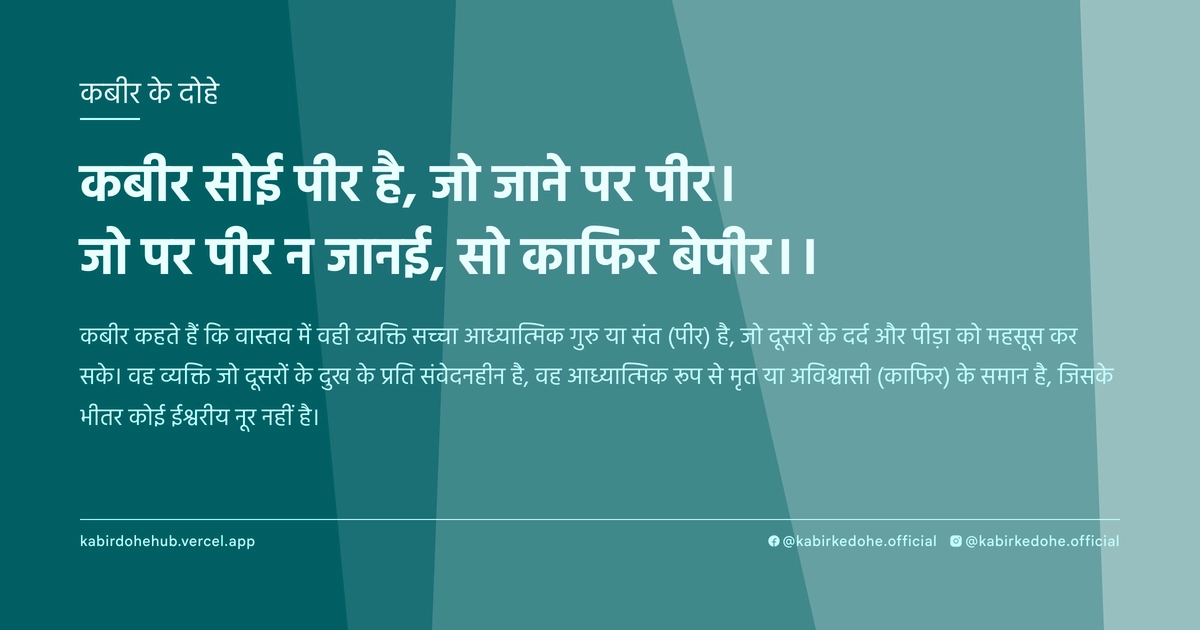
कबीर सोई पीर है, जो जाने पर पीर।
जो पर पीर न जानई, सो काफिर बेपीर।।
Kabir soi peer hai, jo jaane par peer. Jo par peer na jaanai, so kaafir bepeer.
इस पृष्ठ पर इस कबीर दोहे का अर्थ (meaning), हिंदी व्याख्या और अंग्रेज़ी अनुवाद, दार्शनिक विश्लेषण और व्यावहारिक जीवन सीख दी गई है। यह दोहा करुणा (Compassion) विषय से जुड़ा है — Kabir doha meaning and explanation in Hindi and English.
अर्थ (Meaning):
कबीर कहते हैं कि वास्तव में वही व्यक्ति सच्चा आध्यात्मिक गुरु या संत (पीर) है, जो दूसरों के दर्द और पीड़ा को महसूस कर सके। वह व्यक्ति जो दूसरों के दुख के प्रति संवेदनहीन है, वह आध्यात्मिक रूप से मृत या अविश्वासी (काफिर) के समान है, जिसके भीतर कोई ईश्वरीय नूर नहीं है।
Kabir asserts that a true spiritual guide or saint (Peer) is one who possesses the capacity to feel the pain of others. He who remains indifferent to the suffering of fellow beings is likened to an unbeliever or a spiritual void (Kaafir), devoid of divine light and genuine compassion.
व्याख्या (Interpretation):
इस दोहे का शाब्दिक अर्थ है कि करुणा ही आध्यात्मिकता की कसौटी है। यहाँ 'पीर' शब्द के दो अर्थ हैं: एक 'संत' और दूसरा 'पीड़ा'। कबीर एक गहरा विरोधाभास प्रस्तुत करते हैं कि जिसे हम बाहरी रूप से संत मानते हैं, वह तब तक संत नहीं है जब तक वह दूसरे की पीड़ा को अपनी पीड़ा न मान ले। यह निर्गुण भक्ति का सार है, जहाँ ईश्वर मंदिर या मस्जिद में नहीं, बल्कि मानवता की सेवा और सहानुभूति में निवास करता है। यह अद्वैत वेदांत के उस सिद्धांत की ओर संकेत करता है जहाँ 'मैं' और 'तू' का भेद समाप्त हो जाता है, और केवल एक साझा चेतना बचती है। माया का सबसे बड़ा पर्दा अहंकार है, जो हमें दूसरों से अलग करता है; इस पर्दे को केवल करुणा के माध्यम से ही हटाया जा सकता है। अंततः, यह दोहा बताता है कि बिना सहानुभूति के किया गया कोई भी जप या तप केवल एक पाखंड है।
The literal meaning posits compassion as the ultimate litmus test for spirituality. Kabir employs a linguistic play on 'Peer,' meaning both a 'spiritual guide' and 'pain.' He presents a profound paradox: the person we externally recognize as a saint is not truly a saint unless they internalize the suffering of others as their own. This is the essence of Nirgun Bhakti, where the Divine resides not in temples or mosques, but in the empathy shown to humanity. It aligns with Advaita Vedanta's principle of non-duality, where the distinction between 'I' and 'Thou' dissolves into a shared consciousness. The greatest veil of Maya is the ego, which isolates the individual; this veil can only be pierced through radical compassion. Ultimately, the Doha suggests that any ritual or austerity performed without empathy is merely a hollow performance.
दार्शनिक विश्लेषण (Philosophical Analysis):
कबीर का यह दोहा उस युग की प्रतिक्रिया है जहाँ धर्म केवल कर्मकांडों, बाहरी पहनावे और जातिगत श्रेष्ठता तक सीमित हो गया था। उन्होंने 'पीर' और 'काफिर' जैसे शब्दों का प्रयोग करके हिंदू और मुस्लिम दोनों परंपराओं को एक साथ संबोधित किया, यह बताते हुए कि ईश्वर की प्राप्ति किसी विशेष धर्म के लेबल से नहीं, बल्कि हृदय की शुद्धता से होती है। यह सूफीवाद के 'इश्क-ए-हकीकी' (ईश्वरीय प्रेम) के करीब है, जहाँ प्रेमी अपने अस्तित्व को मिटाकर दूसरे के दुख में विलीन हो जाता है।
दार्शनिक स्तर पर, कबीर यहाँ 'अहंकार' के विसर्जन की बात कर रहे हैं। जब तक मनुष्य स्वयं को दूसरों से अलग मानता है, वह माया के प्रभाव में है। जब वह दूसरे की पीड़ा को महसूस करता है, तो वह 'अद्वैत' की स्थिति में पहुँच जाता है, जहाँ केवल एक ही आत्मा (ब्रह्म) सर्वव्यापी रूप में कार्य करती है। यह मनोवैज्ञानिक रूपांतरण है—स्वयं के संकुचित दायरे से निकलकर वैश्विक चेतना में प्रवेश करना।
कबीर ने स्पष्ट किया कि धार्मिक कट्टरता वास्तव में एक आध्यात्मिक बीमारी है। जो व्यक्ति स्वयं को धर्म का रक्षक मानता है लेकिन पड़ोसी के आंसू नहीं देख पाता, वह 'बेपीर' है, यानी वह आध्यात्मिक शून्यता में है। यह विचार उस समय के सामाजिक ढांचे को चुनौती देता था जहाँ ऊँची जातियों के लोग पूजा-पाठ तो करते थे, लेकिन दलितों और वंचितों की पीड़ा के प्रति अंधे थे।
यहाँ 'काफिर' शब्द का प्रयोग किसी विशेष धर्म के विरुद्ध नहीं, बल्कि उस चेतना के विरुद्ध है जो प्रेम से रहित है। कबीर के अनुसार, वास्तविक नास्तिकता ईश्वर को न मानना नहीं है, बल्कि मनुष्य के भीतर बसे ईश्वर (मानवता) की उपेक्षा करना है। यह एक क्रांतिकारी विचार था जिसने भक्ति आंदोलन को केवल व्यक्तिगत मोक्ष से हटाकर सामाजिक न्याय और करुणा से जोड़ा।
अंततः, यह विश्लेषण हमें सिखाता है कि करुणा कोई नैतिक गुण नहीं है, बल्कि एक आध्यात्मिक उपलब्धि है। जब हम दूसरे के दुख को महसूस करते हैं, तो हमारा अहंकार टूटता है, और उसी दरार से ईश्वरीय प्रकाश भीतर प्रवेश करता है। यही वह बिंदु है जहाँ साधक और साध्य एक हो जाते हैं, और जीवन एक निरंतर प्रार्थना बन जाता है।
This Doha is a visceral reaction to an era where religion had devolved into mere rituals, external attire, and caste-based superiority. By utilizing terms like 'Peer' and 'Kaafir,' Kabir addresses both Hindu and Islamic traditions, asserting that divine realization is not achieved through religious labels but through the purity of the heart. This closely mirrors the Sufi concept of 'Ishq-e-Haqiqi' (Divine Love), where the lover annihilates their own existence to merge with the suffering of the other.
On a philosophical plane, Kabir discusses the dissolution of the 'Ego.' As long as a human perceives themselves as separate from others, they remain under the spell of Maya. When one feels the pain of another, they enter the state of 'Advaita' (non-duality), where a single, omnipresent Soul (Brahman) operates through all forms. This is a psychological transformation—moving from the constricted boundary of the self into a universal consciousness.
Kabir clarifies that religious bigotry is, in fact, a spiritual pathology. The person who claims to be a protector of faith but remains blind to a neighbor's tears is 'Bepeer,' existing in a state of spiritual void. This thought challenged the social structures of his time, where high-caste practitioners performed elaborate rituals while remaining indifferent to the agony of the marginalized.
Here, the term 'Kaafir' is not used against a specific faith, but against a consciousness devoid of love. According to Kabir, true atheism is not the denial of God, but the neglect of the God residing within humanity. This revolutionary perspective shifted the Bhakti movement from a quest for individual salvation to a mission of social justice and compassion.
Ultimately, this analysis reveals that compassion is not merely a moral virtue but a spiritual achievement. When we feel the pain of another, the ego fractures, and it is through that crack that divine light enters. This is the precise point where the seeker and the sought become one, and life transforms into a continuous, living prayer.
मूल संदेश (Core Message):
- बाहरी धार्मिकता एक मुखौटा है; वास्तविक धर्म करुणा है।
- अहंकार का अंत तभी होता है जब हम दूसरे के दुख को अपना मानते हैं।
- बिना सहानुभूति के किया गया आध्यात्मिक अभ्यास व्यर्थ है।
- ईश्वर की सबसे सच्ची पूजा पीड़ित मानवता की सेवा है।
- सच्चा संत वह है जो हृदय से महसूस करता है, न कि वह जो केवल उपदेश देता है।
- External religiosity is a mask; true religion is compassion.
- The ego dissolves only when we internalize the suffering of others.
- Spiritual practice without empathy is a futile exercise.
- The truest worship of God is the service of suffering humanity.
- A true saint is one who feels deeply, not one who merely preaches.
व्यावहारिक उदाहरण (Practical Example):
वाराणसी के एक पुराने घाट पर रामू नाम का एक वृद्ध नाविक रहता था। रामू का जीवन केवल अपनी नाव चलाने और दिन भर की कमाई से पेट भरने तक सीमित था। वह स्वभाव से शांत था, लेकिन दुनिया की भागदौड़ से बेखबर अपनी छोटी सी दुनिया में खुश था।
एक दिन, घाट पर एक बहुत बड़ा धार्मिक आयोजन हुआ। वहाँ एक प्रसिद्ध विद्वान आए, जिन्होंने घंटों तक करुणा और मोक्ष पर लंबे प्रवचन दिए। हज़ारों लोग उनकी बातों से मंत्रमुग्ध थे और उन्हें 'महान संत' मान रहे थे। रामू भी दूर खड़ा उन्हें सुन रहा था।
तभी, भीड़ के बीच एक छोटा बच्चा अपने माता-पिता से बिछड़ गया और ज़ोर-ज़ोर से रोने लगा। वह बच्चा भूख और डर से कांप रहा था। विद्वान संत अपने प्रवचन के बीच में थे और उन्होंने बच्चे के रोने की आवाज़ सुनी, लेकिन उन्होंने इसे एक 'बाधा' माना और अपने शिष्यों को इशारा किया कि वे बच्चे को वहाँ से हटा दें ताकि उनका प्रवाह न टूटे।
रामू ने यह देखा। वह चुपचाप अपनी नाव छोड़कर भीड़ को चीरता हुआ आगे बढ़ा। उसने उस बच्चे को अपनी गोद में उठाया, उसे अपनी पोटली से थोड़ा गुड़ खिलाया और बड़ी कोमलता से उसे चुप कराया। रामू ने अगले दो घंटों तक उस बच्चे को संभाला और अंततः उसके घबराए हुए माता-पिता को खोज निकाला।
जब रामू वापस लौटा, तो उसके कपड़े गंदे थे और वह थका हुआ था। विद्वान संत ने उसे देखा और तिरस्कार से कहा, 'तुम जैसे साधारण लोग क्या जानो कि आध्यात्मिक शांति क्या होती है, तुम बस भौतिक सुखों में उलझे रहते हो।'
रामू ने बस मुस्कुराकर सिर झुका लिया। उस क्षण, वहाँ मौजूद कई लोगों ने महसूस किया कि जिस विद्वान ने 'करुणा' पर घंटों भाषण दिया, वह एक बच्चे के दुख से विचलित नहीं हुआ। लेकिन एक अनपढ़ नाविक ने उस करुणा को जी कर दिखाया।
रामू के भीतर कोई दिखावा नहीं था, कोई शास्त्र नहीं थे, लेकिन उसके हृदय में दूसरे की पीड़ा के प्रति जो संवेदनशीलता थी, वही उसे वास्तव में 'पीर' बना रही थी।
इस घटना ने वहाँ मौजूद कई लोगों की सोच बदल दी। उन्होंने समझा कि धर्म मंदिर की सीढ़ियों पर नहीं, बल्कि किसी रोते हुए बच्चे की आँखों में छिपे दुख को समझने और उसे दूर करने में है।
रामू की इस सरल क्रिया ने उस दिन हज़ारों लोगों को वह पाठ पढ़ा दिया जो वह विद्वान अपनी पूरी उम्र की किताबों से नहीं पढ़ा पाया था।
यही कबीर का 'ट्विस्ट' था—जहाँ बाहरी ज्ञान हार गया और आंतरिक अनुभूति की जीत हुई।
On an ancient ghat in Varanasi lived an elderly boatman named Ramu. Ramu's life was limited to rowing his boat and earning just enough to feed himself. He was quiet by nature, content in his small world, oblivious to the frantic pace of the city.
One day, a massive religious gathering took place at the ghat. A renowned scholar arrived, delivering lengthy discourses on compassion and liberation. Thousands were mesmerized by his words, hailing him as a 'Great Saint.' Ramu stood at a distance, listening.
Suddenly, a small child became separated from his parents in the crowd and began to cry hysterically. The child was shivering from hunger and fear. The scholar-saint was in the middle of his discourse; he heard the child's cries but viewed it as a 'distraction' and signaled his disciples to remove the child so his flow would not be interrupted.
Ramu witnessed this. He silently left his boat, pushed through the crowd, and reached the child. He lifted the boy into his arms, fed him a piece of jaggery from his own bundle, and gently soothed him. For the next two hours, Ramu tended to the child until he finally located the frantic parents.
When Ramu returned, his clothes were soiled and he was exhausted. The scholar-saint looked at him with disdain and said, 'Ordinary folk like you cannot understand what spiritual peace is; you are merely entangled in material existence.'
Ramu simply smiled and bowed his head. In that moment, many in the crowd realized that the scholar who spoke for hours on 'compassion' was unmoved by a child's distress. Yet, an illiterate boatman had lived that compassion.
There was no pretense in Ramu, no scriptures, but the sensitivity he held for another's pain made him a true 'Peer' in the eyes of the Divine.
This incident shifted the perspective of many onlookers. They understood that religion does not reside on the steps of a temple, but in the ability to recognize and alleviate the sorrow hidden in a crying child's eyes.
Ramu's simple act taught thousands a lesson that the scholar could not convey through a lifetime of reading books.
This was the 'Kabir Twist'—where external knowledge failed, and internal realization triumphed.
अभ्यास मार्गदर्शन (Practice Guidance):
- दैनिक अभ्यास: दिन में कम से कम एक बार किसी ऐसे व्यक्ति के प्रति सहानुभूति व्यक्त करें जिससे आपका कोई निजी स्वार्थ न हो।
- आत्म-पूछताछ जर्नल: हर रात यह लिखें कि आज आपने किसका दुख महसूस किया और क्या आपने उसे दूर करने का प्रयास किया, या क्या आपने उसे अनदेखा किया?
- व्यवहारिक परिवर्तन: जब भी आप किसी की आलोचना करने लगें, रुकें और खुद से पूछें, 'क्या मैं इस व्यक्ति की पीड़ा को देख पा रहा हूँ या केवल उसकी गलती को?'
- निदान चेकलिस्ट: यदि आप दूसरों के दुख को देखकर 'यह उनका कर्म है' कहकर टाल देते हैं, तो समझें कि आपका अहंकार अभी भी सक्रिय है और आप 'बेपीर' की स्थिति में हैं।
- Daily Practice: At least once a day, consciously express empathy toward someone from whom you have nothing to gain personally.
- Self-Inquiry Journal: Every night, record whether you felt another's pain today and if you attempted to alleviate it, or if you consciously ignored it.
- Behavioral Shift: Whenever you are about to criticize someone, pause and ask yourself, 'Am I seeing this person's pain, or only their mistake?'
- Diagnostic Checklist: If you dismiss others' suffering by saying 'it is their karma,' recognize that your ego is still active and you are currently in the state of 'Bepeer'.
चिंतन प्रश्न (Reflection Questions):
- क्या मेरा 'धार्मिक' होना मुझे दूसरों के प्रति अधिक न्यायप्रिय बनाता है, या यह मुझे एक श्रेष्ठता का भ्रम देता है?
- मैं उन लोगों के प्रति कितना संवेदनहीन हूँ जिन्हें मैं सामाजिक या वैचारिक रूप से अपना शत्रु मानता हूँ?
- क्या मैं वास्तव में दूसरों की मदद करता हूँ, या मैं केवल अपनी 'मदद करने वाली' छवि (Digital Ego) को संतुष्ट कर रहा हूँ?
- मेरे जीवन में ऐसा कौन सा 'अदृश्य दुख' है जिसे मैं दूसरों में देखता हूँ लेकिन स्वीकार करने से डरता हूँ?
- यदि मेरी सारी उपाधियाँ और पहचान छीन ली जाएँ, तो क्या मेरे भीतर केवल करुणा शेष रहेगी?
- Does my 'religious' identity make me more just toward others, or does it grant me an illusion of superiority?
- How indifferent am I toward those whom I consider social or ideological enemies?
- Do I truly help others, or am I merely satisfying my image as a 'helper' (Digital Ego)?
- What is the 'invisible pain' in others that I recognize but am afraid to acknowledge within myself?
- If all my titles and identities were stripped away, would compassion be the only thing remaining within me?