
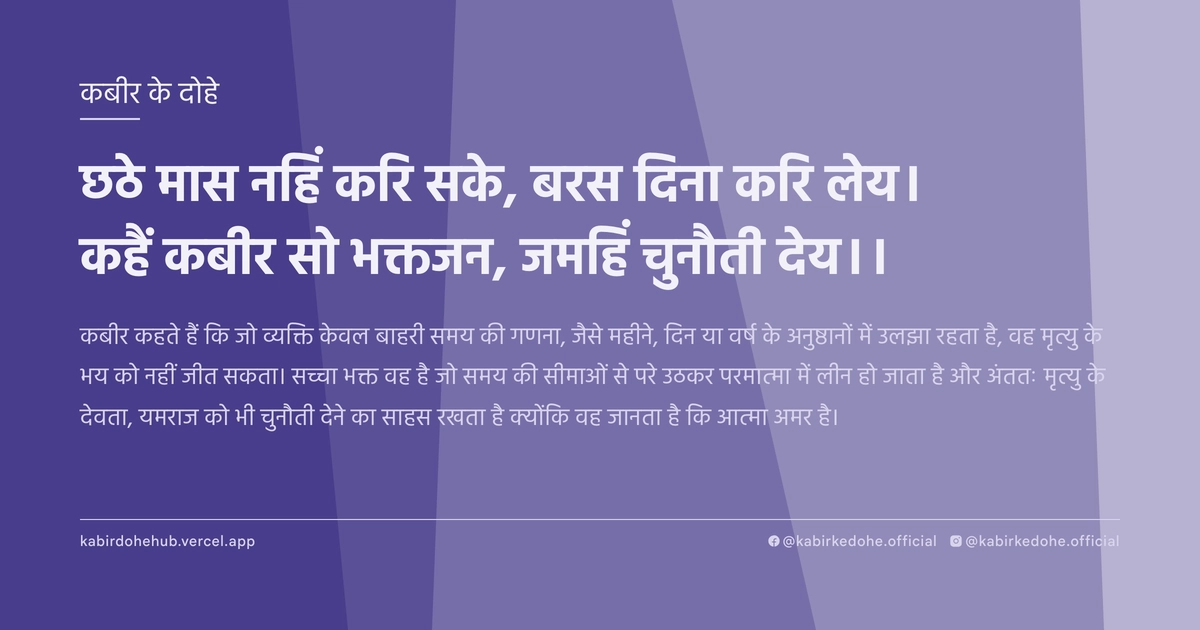
छठे मास नहिं करि सके, बरस दिना करि लेय।
कहैं कबीर सो भक्तजन, जमहिं चुनौती देय।।
Chhathe maas nahin kari sake, baras dina kari ley. Kahen kabir so bhaktjan, jamahin chunauti dey.
इस पृष्ठ पर इस कबीर दोहे का अर्थ (meaning), हिंदी व्याख्या और अंग्रेज़ी अनुवाद, दार्शनिक विश्लेषण और व्यावहारिक जीवन सीख दी गई है। यह दोहा मुक्ति (Liberation) विषय से जुड़ा है — Kabir doha meaning and explanation in Hindi and English.
अर्थ (Meaning):
कबीर कहते हैं कि जो व्यक्ति केवल बाहरी समय की गणना, जैसे महीने, दिन या वर्ष के अनुष्ठानों में उलझा रहता है, वह मृत्यु के भय को नहीं जीत सकता। सच्चा भक्त वह है जो समय की सीमाओं से परे उठकर परमात्मा में लीन हो जाता है और अंततः मृत्यु के देवता, यमराज को भी चुनौती देने का साहस रखता है क्योंकि वह जानता है कि आत्मा अमर है।
Kabir asserts that those who rely solely on the external measurement of time—counting months, days, or years through ritualistic observance—cannot overcome the fear of death. The true devotee is one who transcends the linear constraints of time to merge with the Eternal Divine, thereby gaining the spiritual audacity to challenge Yama, the Lord of Death, recognizing the immortal nature of the Atman.
व्याख्या (Interpretation):
यहाँ 'मास' और 'बरस' केवल कैलेंडर के समय नहीं, बल्कि उन औपचारिक धार्मिक क्रियाओं के प्रतीक हैं जो समय-बद्ध होती हैं। कबीर यह स्पष्ट करते हैं कि मोक्ष किसी समय सारणी या निर्धारित तिथियों के पालन से नहीं मिलता। यह दोहा निर्गुण भक्ति के उस शिखर को दर्शाता है जहाँ साधक माया के जाल (समय और स्थान) को तोड़ देता है। जब व्यक्ति 'अहं' का त्याग कर ब्रह्म के साथ एकाकार होता है, तो वह द्वैत से अद्वैत की ओर बढ़ता है। इस अवस्था में, मृत्यु केवल एक वस्त्र बदलने जैसी प्रक्रिया बन जाती है, जिससे भय समाप्त हो जाता है। यह विरोधाभास है कि समय को जीतने के लिए समय का त्याग करना पड़ता है।
In this verse, 'months' and 'years' are not mere chronological markers but symbols of formal religious rituals bound by time. Kabir clarifies that liberation is not achieved through the adherence to a spiritual timetable or auspicious dates. This doha illustrates the pinnacle of Nirgun Bhakti, where the seeker shatters the illusions of Maya—specifically the constructs of time and space. When the individual transcends the 'I' (ego) and merges with the Absolute (Brahman), they move from duality to non-duality. In this state, death becomes nothing more than the changing of a garment, rendering fear obsolete. The central paradox is that to conquer time, one must first surrender the notion of time entirely.
दार्शनिक विश्लेषण (Philosophical Analysis):
कबीर का यह विचार उनके समय के कट्टरपंथी कर्मकांडों पर एक तीखा प्रहार है। उस युग में, लोग विशिष्ट तिथियों पर व्रत और पूजा करके मोक्ष की आशा करते थे, जिसे कबीर 'भ्रम' मानते थे। वे तर्क देते हैं कि परमात्मा समय के अधीन नहीं है, इसलिए उसे समय-बद्ध विधियों से नहीं पाया जा सकता। यह दृष्टिकोण अद्वैत वेदांत के करीब है, जहाँ यह माना जाता है कि आत्मा (Atman) और परमात्मा (Brahman) एक ही हैं; यदि आप स्वयं को अनंत मानते हैं, तो समय की सीमाएं अर्थहीन हो जाती हैं।
सूफीवाद के 'फना' (अहंकार का विनाश) के सिद्धांत के साथ इसका गहरा संबंध है। जब साधक अपनी व्यक्तिगत पहचान को ईश्वर में विलीन कर देता है, तो वह 'इंसान-ए-कामिल' बन जाता है, जिसे मृत्यु का भय नहीं सताता। कबीर यहाँ यह समझा रहे हैं कि वास्तविक भक्ति बाहरी प्रदर्शन नहीं, बल्कि आंतरिक रूपांतरण है।
वे जाति और धर्म के उन बंधनों को भी चुनौती देते हैं जो मनुष्य को यह विश्वास दिलाते हैं कि कुछ विशेष समूहों के पास ही मोक्ष का मार्ग है। उनके लिए, 'भक्तजन' वह है जिसने अपने भीतर के सत्य को पहचान लिया है, चाहे उसकी सामाजिक स्थिति कुछ भी हो।
मनोवैज्ञानिक स्तर पर, यह दोहा मृत्यु की चिंता (Death Anxiety) के समाधान का मार्ग दिखाता है। जब हम अपना पूरा जीवन बाहरी उपलब्धियों और समय की गणना में बिताते हैं, तो मृत्यु एक अंत की तरह लगती है। लेकिन जब केंद्र आंतरिक चेतना बन जाती है, तो मृत्यु एक नए आयाम का द्वार बन जाती है।
अंततः, कबीर यह संदेश देते हैं कि आध्यात्मिक जागृति किसी बाहरी कैलेंडर की मोहताज नहीं है। यह एक क्षणिक बोध है जो निरंतर अभ्यास और समर्पण से आता है, जिससे साधक समय के चक्र से मुक्त होकर शाश्वत शांति को प्राप्त करता है।
Kabir's assertion is a sharp critique of the rigid ritualism prevalent during his era. In that period, people sought salvation through fasts and prayers performed on specific dates, which Kabir dismissed as a delusion. He argues that since the Divine is not subject to time, the Divine cannot be reached through time-bound methods. This perspective aligns closely with Advaita Vedanta, which posits that the Atman and Brahman are identical; once one realizes their infinite nature, the constraints of time become meaningless.
There is a profound connection here to the Sufi concept of 'Fana' (the annihilation of the ego). When a seeker dissolves their individual identity into the Divine, they become 'Al-Insan al-Kamil' (the Perfect Human), for whom the fear of death vanishes. Kabir emphasizes that true devotion is not an external performance but an internal transmutation.
He further challenges the caste and religious hierarchies that suggested only certain privileged groups possessed the key to liberation. For Kabir, the 'devotee' is anyone who has realized the internal truth, regardless of their social standing or birth.
On a psychological level, this doha addresses 'Death Anxiety.' When we spend our lives chasing external milestones and counting days, death appears as a definitive end. However, when the center of gravity shifts to internal consciousness, death is perceived as a gateway to a new dimension of existence.
Ultimately, Kabir conveys that spiritual awakening is not dependent on an external calendar. It is an instantaneous realization born of constant practice and surrender, allowing the seeker to break free from the cycle of time and attain eternal peace.
मूल संदेश (Core Message):
- समय की गणना आध्यात्मिक प्रगति का पैमाना नहीं है।
- बाहरी कर्मकांड केवल मन को भ्रमित करते हैं, मुक्त नहीं।
- सच्ची भक्ति समय की सीमाओं को लांघकर अनंत में विलीन होना है।
- मृत्यु का भय केवल तब तक है जब तक 'अहं' जीवित है।
- वर्तमान क्षण ही वह द्वार है जहाँ समय और अनंत मिलते हैं।
- The calculation of time is not a metric for spiritual progress.
- External rituals only confuse the mind; they do not liberate it.
- True devotion is merging into the Infinite by transcending time's limits.
- The fear of death exists only as long as the 'ego' survives.
- The present moment is the only portal where time and eternity meet.
व्यावहारिक उदाहरण (Practical Example):
वाराणसी के एक पुराने घाट पर माधव नाम का एक वृद्ध बुनकर रहता था। माधव का पूरा जीवन समय की गणना में बीता—वह हर महीने की पूर्णिमा को मंदिर जाता, हर साल की विशेष तिथियों पर व्रत रखता और अपनी मृत्यु के बाद स्वर्ग पाने के लिए कठोर नियमों का पालन करता। वह हमेशा इस बात से डरा रहता था कि यदि उसने किसी एक भी तिथि का अनुष्ठान छोड़ दिया, तो उसका मोक्ष रुक जाएगा।
उसकी चिंता इतनी बढ़ गई थी कि वह अब वर्तमान का आनंद नहीं ले पाता था। वह केवल यह गिनता रहता था कि उसे कितने व्रत और कितने पाठ और करने हैं। वह समय का गुलाम बन गया था, और मृत्यु का भय उसके मन में एक गहरे साये की तरह बैठा था।
एक दिन उसकी मुलाकात एक घुमक्कड़ फकीर से हुई, जिसने माधव की घबराहट को देखा। फकीर ने उससे पूछा, 'माधव, तुम इन तारीखों को गिन रहे हो या ये तारीखें तुम्हें गिन रही हैं?'
माधव ने उत्तर दिया, 'मैं तो बस धर्म के नियमों का पालन कर रहा हूँ ताकि यमराज मुझे क्षमा कर दें।'
फकीर मुस्कुराया और बोला, 'जिसने समय को अपना मालिक बना लिया, वह कभी स्वतंत्र नहीं हो सकता। तू उस परमात्मा को खोज जो समय से परे है। जब तू खुद को समय की सीमाओं से मुक्त कर लेगा, तब तुझे पता चलेगा कि जिसे तू यमराज कह रहा है, वह केवल एक भ्रम है।'
माधव को यह बात गहरी लगी। उसने धीरे-धीरे उन बाहरी अनुष्ठानों को छोड़ दिया जो केवल डर पर आधारित थे। उसने अपना ध्यान वर्तमान क्षण में जीना शुरू किया और अपने काम (बुनाई) को ही प्रार्थना बना लिया।
अब वह पूर्णिमा का इंतजार नहीं करता था, बल्कि हर सांस में उस अनंत शक्ति का अनुभव करने लगा। उसने महसूस किया कि जब वह पूरी तरह से 'वर्तमान' में होता है, तो भविष्य का डर और अतीत का बोझ गायब हो जाता है।
वर्षों बाद, जब माधव की अंतिम घड़ियाँ आईं, उसके चेहरे पर कोई डर नहीं था। उसके परिवार ने देखा कि वह मुस्कुरा रहा था।
उसने अपनी अंतिम सांस लेते हुए कहा, 'मैंने समय को जीत लिया है, अब यमराज मेरा कुछ नहीं बिगाड़ सकते।'
माधव का रूपांतरण यह था कि उसने 'समय के डर' को 'समय के आनंद' में बदल दिया। वह अब एक ऐसा भक्त बन चुका था जिसने मृत्यु को चुनौती दे दी थी क्योंकि उसने जीवन में ही अमरता को पा लिया था।
On an ancient ghat in Varanasi lived an elderly weaver named Madhav. Madhav's entire life was spent in the calculation of time—he visited the temple every full moon, observed fasts on specific annual dates, and followed rigid rules to ensure a place in heaven after death. He lived in constant fear that missing a single ritual on a specific date would jeopardize his salvation.
His anxiety grew so intense that he could no longer enjoy the present. He spent his days counting how many more fasts and recitations he needed to complete. He had become a slave to time, and the fear of death sat in his mind like a deep, oppressive shadow.
One day, he encountered a wandering fakir who noticed Madhav's agitation. The fakir asked, 'Madhav, are you counting the dates, or are the dates counting you?'
Madhav replied, 'I am merely following the laws of religion so that Yama may grant me mercy.'
The fakir smiled and said, 'He who makes time his master can never be free. Seek the Divine that exists beyond time. When you liberate yourself from the boundaries of time, you will realize that the Yama you fear is but an illusion.'
These words struck a chord deep within Madhav. He gradually abandoned the external rituals that were based solely on fear. He began to focus on living in the present moment, turning his craft of weaving into a living prayer.
He no longer waited for the full moon; instead, he began to experience the Infinite Power in every single breath. He realized that when he was fully present, the fear of the future and the burden of the past vanished.
Years later, as Madhav's final moments approached, there was no trace of fear on his face. His family observed that he was smiling peacefully.
As he took his last breath, he whispered, 'I have conquered time; now Yama has no power over me.'
Madhav's transformation lay in shifting from the 'fear of time' to the 'joy of the timeless.' He had become a devotee who challenged death because he had discovered immortality within his own living existence.
अभ्यास मार्गदर्शन (Practice Guidance):
- प्रतिदिन 20 मिनट 'शून्य ध्यान' का अभ्यास करें, जहाँ आप समय की अवधारणा को पूरी तरह त्याग दें और केवल अपनी श्वास के साक्षी बनें।
- एक जर्नल लिखें जिसमें आप उन सभी 'समय-बद्ध' डर (जैसे उम्र बढ़ना, समय निकल जाना) को सूचीबद्ध करें और विश्लेषण करें कि क्या वे वास्तव में सत्य हैं या केवल मानसिक रचनाएँ हैं।
- व्यवहार परिवर्तन: दिन में कम से कम एक बार ऐसा कार्य करें जिसमें आप समय की परवाह न करें (जैसे बिना घड़ी देखे टहलना या किसी की निस्वार्थ सेवा करना)।
- निदान चेकलिस्ट: क्या आप अभी भी मोक्ष या शांति के लिए किसी विशेष तिथि या मुहूर्त का इंतजार कर रहे हैं? क्या मृत्यु का विचार आपको बेचैन करता है? यदि हाँ, तो आप अभी भी 'समय के बंधन' में हैं।
- Practice 20 minutes of 'Zero Meditation' daily, where you completely discard the concept of time and simply remain a witness to your breath.
- Maintain a journal listing all 'time-bound' fears (such as aging or running out of time) and analyze whether they are absolute truths or mere mental constructs.
- Behavioral Shift: At least once a day, engage in an activity where you ignore time entirely (such as walking without a watch or performing selfless service without a deadline).
- Diagnostic Checklist: Are you still waiting for a specific date or auspicious moment to find peace? Does the thought of death cause restlessness? If yes, you are still bound by the illusion of time.
चिंतन प्रश्न (Reflection Questions):
- क्या मेरी धार्मिकता केवल 'सही समय' पर सही कार्य करने का एक सामाजिक नाटक है?
- यदि मुझे पता चले कि मेरा समय समाप्त हो गया है, तो क्या मेरे पास ऐसा कुछ है जो समय से परे है?
- मैं अपनी डिजिटल पहचान (सोशल मीडिया) के माध्यम से समय को कैसे नियंत्रित करने की कोशिश करता हूँ, और यह मुझे आंतरिक रूप से कितना खोखला बना रहा है?
- क्या मेरा डर मृत्यु से है, या उस पहचान के खोने से जिसे मैंने समय के साथ संजोया है?
- मैं अपनी दिनचर्या में 'अनंत' को कहाँ पाता हूँ, या मैं केवल घड़ियों के बीच जी रहा हूँ?
- Is my religiosity merely a social performance of doing the right thing at the 'right time'?
- If I were told my time had run out, do I possess anything that exists beyond time?
- How do I attempt to control time through my digital identity, and how is this hollowing me out internally?
- Is my fear truly about death, or is it about the loss of the identity I have carefully constructed over time?
- Where do I encounter the 'Infinite' in my daily routine, or am I merely living between the ticks of a clock?