
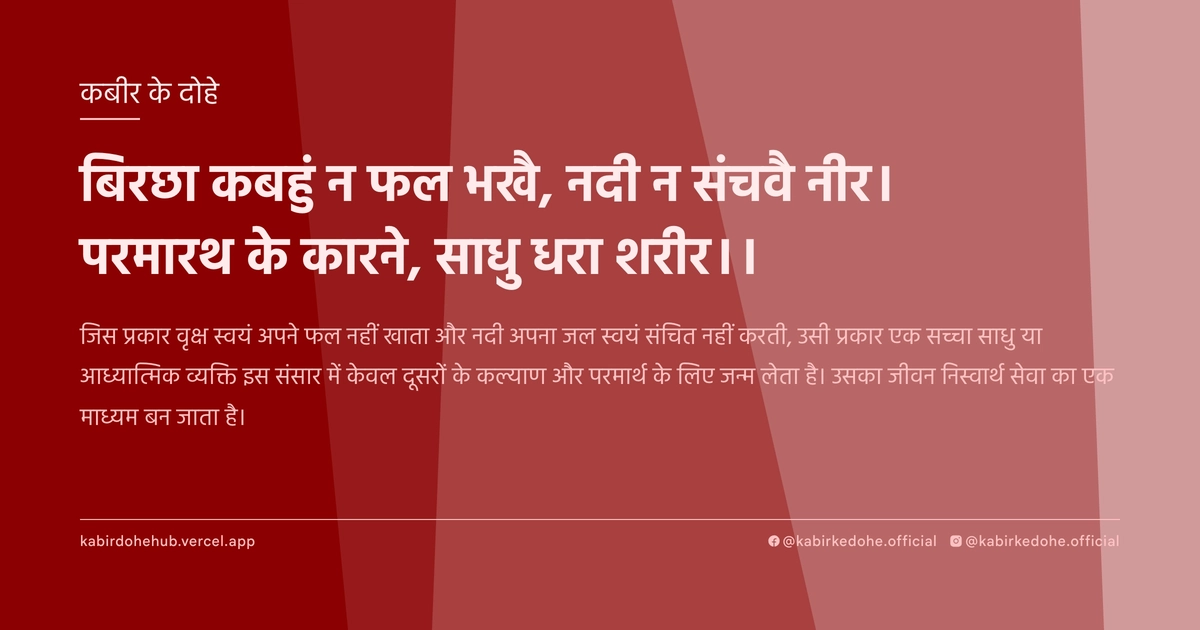
बिरछा कबहुं न फल भखै, नदी न संचवै नीर।
परमारथ के कारने, साधु धरा शरीर।।
Birchha kabhun na phal bhakhai, nadi na sanchavai neer. Parmarth ke kaarane, sadhu dhara shareer.
इस पृष्ठ पर इस कबीर दोहे का अर्थ (meaning), हिंदी व्याख्या और अंग्रेज़ी अनुवाद, दार्शनिक विश्लेषण और व्यावहारिक जीवन सीख दी गई है। यह दोहा वैराग्य (Detachment) विषय से जुड़ा है — Kabir doha meaning and explanation in Hindi and English.
अर्थ (Meaning):
जिस प्रकार वृक्ष स्वयं अपने फल नहीं खाता और नदी अपना जल स्वयं संचित नहीं करती, उसी प्रकार एक सच्चा साधु या आध्यात्मिक व्यक्ति इस संसार में केवल दूसरों के कल्याण और परमार्थ के लिए जन्म लेता है। उसका जीवन निस्वार्थ सेवा का एक माध्यम बन जाता है।
Just as a tree never consumes its own fruit and a river never hoards its own water, a true seeker or saint embodies a physical form solely for the purpose of altruism. Their existence is dedicated to the selfless service of others and the pursuit of the ultimate truth for the collective good.
व्याख्या (Interpretation):
यह दोहा प्रकृति के निस्वार्थ स्वभाव के माध्यम से मानवीय अस्तित्व के उच्चतम उद्देश्य की व्याख्या करता है। शाब्दिक रूप से, कबीर प्रकृति के दो उदाहरण देते हैं—वृक्ष और नदी—जो केवल देना जानते हैं। रूपकात्मक स्तर पर, यह 'अहंकार' के विसर्जन की बात है। जब व्यक्ति 'मैं' और 'मेरा' के भ्रम (माया) से मुक्त होता है, तब वह समझता है कि उसकी आत्मा (Atman) और ब्रह्मांडीय चेतना (Brahman) एक ही हैं। निर्गुण भक्ति के संदर्भ में, यहाँ 'साधु' वह नहीं है जिसने गेरुआ वस्त्र पहना है, बल्कि वह है जिसकी चेतना अब व्यक्तिगत लाभ से ऊपर उठकर सार्वभौमिक प्रेम में विलीन हो गई है। यह द्वैत से अद्वैत की ओर संक्रमण है, जहाँ सेवा ही पूजा बन जाती है।
This couplet employs the selfless nature of the physical world to illustrate the highest purpose of human existence. Literally, Kabir presents two natural archetypes—the tree and the river—which exist in a state of perpetual giving. Metaphorically, this is a discourse on the dissolution of the ego. When an individual transcends the illusion of 'I' and 'mine' (Maya), they realize the non-duality of the Atman and Brahman. In the context of Nirgun Bhakti, the 'Sadhu' is not defined by external asceticism or saffron robes, but by a consciousness that has evolved beyond personal gain into universal love. It is the transition from duality to non-duality, where service becomes the ultimate form of worship and the only authentic way to experience the Divine.
दार्शनिक विश्लेषण (Philosophical Analysis):
कबीर का यह दर्शन उस समय की सामाजिक और धार्मिक जड़ता पर एक प्रहार था जहाँ धर्म केवल कर्मकांडों और व्यक्तिगत मोक्ष तक सीमित था। उन्होंने 'परमार्थ' को मोक्ष से ऊपर रखा, क्योंकि व्यक्तिगत मोक्ष की इच्छा भी एक सूक्ष्म अहंकार है। अद्वैत वेदांत के अनुसार, यदि सब कुछ एक ही चेतना है, तो दूसरे की सेवा वास्तव में स्वयं की सेवा है।
सूफीवाद के 'फना' (अहंकार का विनाश) के सिद्धांत से यह गहराई से जुड़ा है। जब साधु का 'स्व' समाप्त हो जाता है, तब वह ईश्वरीय इच्छा का एक माध्यम बन जाता है। कबीर यहाँ यह स्पष्ट करते हैं कि शरीर केवल एक यंत्र है, लक्ष्य नहीं। शरीर धारण करना एक अवसर है ताकि हम अपनी संचित वासनाओं को सेवा के माध्यम से जला सकें।
यहाँ ritualism (कर्मकांड) का पूर्ण तिरस्कार है। मंदिर या मस्जिद में जाकर पूजा करने से अधिक पवित्र वह कार्य है जो किसी भूखे को भोजन कराने या किसी दुखी को सांत्वना देने में निहित है। यह 'कर्म योग' का उच्चतम स्तर है जहाँ कर्ता भाव समाप्त हो जाता है।
मनोवैज्ञानिक स्तर पर, यह दोहा 'संग्रह वृत्ति' (hoarding tendency) के विरुद्ध है। मनुष्य की अधिकांश पीड़ा इस बात से है कि वह संचित करना चाहता है। नदी और वृक्ष का उदाहरण यह सिखाता है कि प्रवाह ही जीवन है और ठहराव मृत्यु।
अंततः, कबीर यह स्थापित करते हैं कि आध्यात्मिकता का प्रमाण एकांत में ध्यान लगाना नहीं, बल्कि समाज के बीच रहकर निस्वार्थ भाव से कार्य करना है। यह एक क्रांतिकारी विचार था जिसने भक्ति आंदोलन को सामाजिक सुधार के साथ जोड़ा।
Kabir’s philosophy serves as a poignant critique of the social and religious rigidity of his era, where spirituality was often confined to ritualistic performance and the pursuit of individual salvation. He elevates 'Paramarth' (altruism) above personal liberation, suggesting that even the desire for individual Moksha can be a subtle form of ego. According to Advaita Vedanta, if all existence is a single consciousness, then serving another is fundamentally serving oneself.
This teaching aligns deeply with the Sufi concept of 'Fana' (the annihilation of the self). When the seeker's ego is extinguished, they become a transparent medium for the Divine Will. Kabir clarifies that the physical body is merely an instrument, not the destination. Embodiment is an opportunity to incinerate accumulated desires through the fire of selfless service.
There is a total rejection of ritualism here. Kabir posits that an act of feeding the hungry or comforting the distressed is infinitely more sacred than performing elaborate prayers in a temple or mosque. This represents the pinnacle of 'Karma Yoga,' where the sense of being the 'doer' completely vanishes.
Psychologically, this couplet attacks the 'hoarding instinct.' Most human suffering stems from the urge to accumulate. The imagery of the river and the tree teaches that flow is life, while stagnation is death. To hold onto one's resources or merits is to obstruct the natural spiritual current.
Ultimately, Kabir establishes that the proof of spirituality is not found in solitary meditation, but in living amidst society while remaining detached from personal gain. This was a revolutionary shift that bridged the gap between mystical devotion and social activism within the Bhakti movement.
मूल संदेश (Core Message):
- संग्रह दुख का कारण है, वितरण आनंद का मार्ग है।
- अहंकार का विसर्जन ही वास्तविक आध्यात्मिक उपलब्धि है।
- प्रकृति निस्वार्थता का सबसे बड़ा शिक्षक है।
- सेवा केवल कर्म नहीं, बल्कि स्वयं को जानने की प्रक्रिया है।
- परमार्थ ही वह सेतु है जो व्यक्ति को परमात्मा से जोड़ता है।
- Hoarding is the root of suffering; distribution is the path to bliss.
- The dissolution of the ego is the only authentic spiritual achievement.
- Nature is the supreme teacher of selfless existence.
- Service is not a chore, but a process of self-realization.
- Altruism is the bridge connecting the individual to the Universal Truth.
व्यावहारिक उदाहरण (Practical Example):
वाराणसी के एक पुराने घाट पर माधव नाम का एक वृद्ध बुनकर रहता था। माधव ने अपना पूरा जीवन कपड़ों की बुनाई में बिताया था, लेकिन उसके जीवन में एक अजीब सा संतोष था। वह अपनी कमाई का एक बड़ा हिस्सा उन अनाथ बच्चों की शिक्षा पर खर्च करता था जिन्हें समाज ने त्याग दिया था।
गाँव के लोग उसे मूर्ख समझते थे। वे कहते थे, 'माधव, तुम अपनी वृद्धावस्था के लिए धन क्यों नहीं बचाते? तुम्हारी अपनी कोई संतान नहीं है, कल तुम्हें कौन देखेगा?' माधव बस मुस्कुराता और अपनी करघाई पर काम करता रहता।
एक बार शहर में भीषण बाढ़ आई। घाटों पर हाहाकार मच गया। लोग अपनी जान और संपत्ति बचाने के लिए भाग रहे थे। माधव का छोटा सा घर पानी में डूब गया और उसकी सारी जमापूंजी बह गई। वह सड़क पर आ गया, उसके पास पहनने के लिए केवल एक फटी हुई चादर बची थी।
लेकिन तभी एक चमत्कार हुआ। जिन बच्चों को उसने पढ़ाया था, वे अब बड़े हो चुके थे। कोई डॉक्टर था, कोई शिक्षक, तो कोई प्रशासनिक अधिकारी। उन सभी ने मिलकर माधव को सहारा दिया। उन्होंने उसे केवल घर ही नहीं दिया, बल्कि उसकी सेवा को एक संस्था का रूप दे दिया।
माधव ने महसूस किया कि उसने जो 'बीज' बोए थे, वे अब विशाल वृक्ष बन चुके थे। उसने कभी अपने लिए संचय नहीं किया, ठीक उसी नदी की तरह जो अपना पानी खुद नहीं पीती।
उसकी इस निस्वार्थता ने पूरे गाँव की सोच बदल दी। लोगों ने देखा कि संचय किया हुआ धन बाढ़ में बह गया, लेकिन 'परमार्थ' में लगाया गया धन जीवनभर का सुरक्षा कवच बन गया।
माधव की कहानी ने यह सिद्ध कर दिया कि जब हम दूसरों के लिए जीते हैं, तो पूरा ब्रह्मांड हमारा परिवार बन जाता है।
उसने अपने अंतिम दिनों में केवल एक बात कही—'मैंने कभी कुछ खोया नहीं, क्योंकि मैंने कभी कुछ अपना माना ही नहीं था।' यह उसकी चेतना का पूर्ण रूपांतरण था।
On an ancient ghat in Varanasi lived an elderly weaver named Madhav. Madhav had spent his entire life weaving fabrics, but there was a peculiar serenity in his existence. He spent a significant portion of his meager earnings on the education of orphaned children whom society had discarded.
The villagers considered him a fool. They would ask, 'Madhav, why don't you save money for your old age? You have no children of your own; who will care for you tomorrow?' Madhav would simply smile and continue working his loom.
One year, a devastating flood hit the city. Chaos erupted on the ghats. People scrambled to save their lives and possessions. Madhav's small hut was submerged, and all his modest savings were swept away by the current. He found himself on the street with nothing but a torn shawl.
Then, a miracle unfolded. The children he had educated had grown into successful adults. Some were doctors, some teachers, and others administrative officers. All of them returned to support Madhav. They didn't just provide him a home; they institutionalized his spirit of service.
Madhav realized that the 'seeds' he had sown had now become towering trees. He had never hoarded for himself, much like the river that never drinks its own water.
His selfless nature transformed the mindset of the entire village. People witnessed that the wealth they had hoarded was washed away by the flood, but the wealth invested in 'Paramarth' became a lifelong shield of security.
Madhav's story proved that when we live for others, the entire universe becomes our family.
In his final days, he uttered one sentence: 'I never lost anything, for I never considered anything to be mine.' This was the complete transformation of his consciousness.
अभ्यास मार्गदर्शन (Practice Guidance):
- दैनिक अभ्यास: प्रतिदिन कम से कम एक ऐसा कार्य करें जिसका कोई व्यक्तिगत लाभ न हो और जिसे आप गुप्त रखें।
- आत्म-चिंतन: हर रात सोने से पहले डायरी में लिखें—'आज मैंने अपनी किस इच्छा या अहंकार का त्याग दूसरों की खुशी के लिए किया?'
- व्यवहार परिवर्तन: जब भी आप किसी की मदद करें, तो मन में यह भाव लाएं कि आप मदद नहीं कर रहे, बल्कि प्रकृति अपना स्वभाव पूरा कर रही है।
- डायग्नोस्टिक चेकलिस्ट: यदि आप मदद करने के बाद प्रशंसा की उम्मीद करते हैं, तो आप अभी भी 'संचय' मोड में हैं। यदि मदद करने के बाद आप शून्य और शांत महसूस करते हैं, तो आप 'साधु' भाव की ओर बढ़ रहे हैं।
- Daily Practice: Perform at least one act of kindness daily that offers zero personal gain and keep it strictly anonymous.
- Self-Inquiry: Before sleep, journal the response to: 'Which specific desire or ego-driven impulse did I surrender today for the benefit of another?'
- Behavioral Shift: While helping others, consciously shift the perspective from 'I am helping' to 'Nature is fulfilling its inherent nature through me.'
- Diagnostic Checklist: If you feel a need for recognition after helping, you are still in 'hoarding' mode. If you feel a sense of void and peace, you are aligning with the 'Sadhu' consciousness.
चिंतन प्रश्न (Reflection Questions):
- मेरे जीवन में वह कौन सी चीज़ है जिसे मैं इतनी मजबूती से पकड़े हुए हूँ कि वह मेरा बोझ बन गई है?
- यदि मेरी सारी सामाजिक पहचान (पद, प्रतिष्ठा, संपत्ति) छीन ली जाए, तो मेरे पास दूसरों को देने के लिए क्या बचेगा?
- क्या मेरी परोपकार की भावना वास्तव में निस्वार्थ है, या यह मेरी 'अच्छे इंसान' होने की छवि (Digital/Social Ego) को पुष्ट करने का एक तरीका है?
- मैं अपनी उपलब्धियों का श्रेय किसे देता हूँ—स्वयं को या उस अज्ञात शक्ति को जिसने मुझे सक्षम बनाया?
- क्या मैं वास्तव में एक नदी की तरह बहना चाहता हूँ, या मैं अपनी सुरक्षा के लिए एक मानसिक बांध बना रहा हूँ?
- What is the one thing in my life I am holding onto so tightly that it has become a burden?
- If all my social identifiers—title, status, wealth—were stripped away, what would I have left to offer others?
- Is my altruism truly selfless, or is it a tool to reinforce my image as a 'good person' (Digital/Social Ego)?
- To whom do I attribute my achievements—to my own effort, or to the unseen force that enabled me?
- Do I truly wish to flow like a river, or am I building mental dams for a false sense of security?