
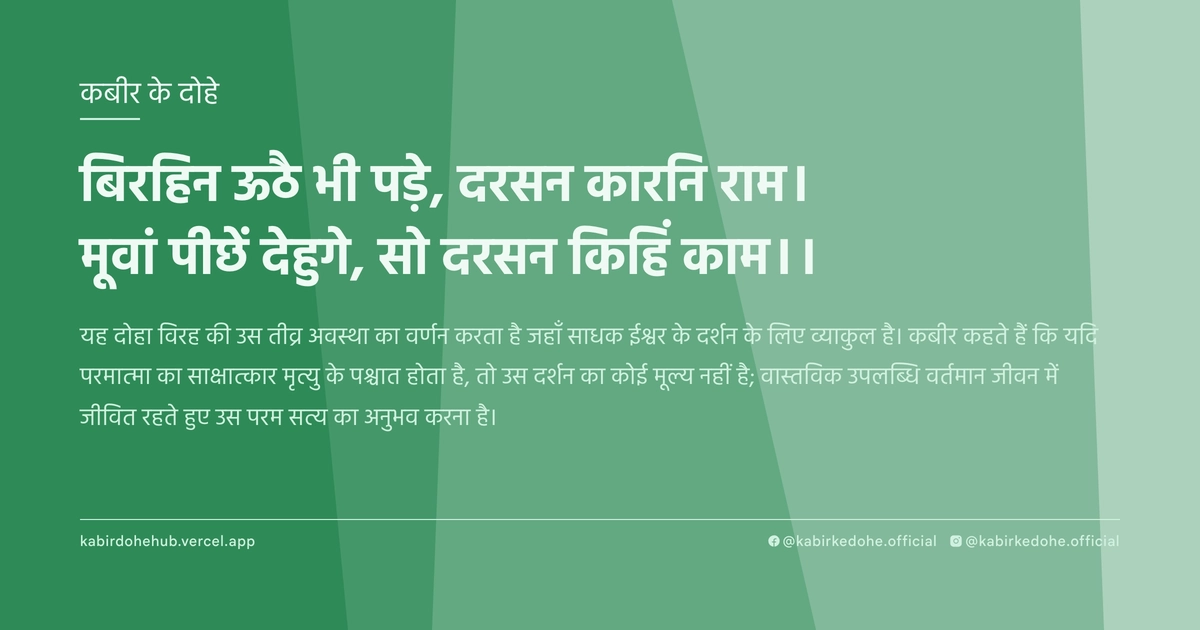
बिरहिन ऊठै भी पड़े, दरसन कारनि राम।
मूवां पीछें देहुगे, सो दरसन किहिं काम।।
Birahin oothai bhi pade, darsan karani ram. Moovan peechhen dehuge, so darsan kihim kaam.
इस पृष्ठ पर इस कबीर दोहे का अर्थ (meaning), हिंदी व्याख्या और अंग्रेज़ी अनुवाद, दार्शनिक विश्लेषण और व्यावहारिक जीवन सीख दी गई है। यह दोहा भक्ति (Bhakti) विषय से जुड़ा है — Kabir doha meaning and explanation in Hindi and English.
अर्थ (Meaning):
यह दोहा विरह की उस तीव्र अवस्था का वर्णन करता है जहाँ साधक ईश्वर के दर्शन के लिए व्याकुल है। कबीर कहते हैं कि यदि परमात्मा का साक्षात्कार मृत्यु के पश्चात होता है, तो उस दर्शन का कोई मूल्य नहीं है; वास्तविक उपलब्धि वर्तमान जीवन में जीवित रहते हुए उस परम सत्य का अनुभव करना है।
This couplet describes the intense state of longing where the seeker is desperate for a vision of the Divine. Kabir asserts that if the realization of the Truth occurs only after death, such a vision is useless; the only meaningful achievement is the experiential realization of the Supreme Truth while still alive in this physical body.
व्याख्या (Interpretation):
शाब्दिक अर्थ में, यह एक विरहिणी की तड़प है जो राम के दर्शन के लिए छटपटा रही है। आध्यात्मिक स्तर पर, 'बिरहिन' वह आत्मा है जो माया के बंधन में है और अपने मूल स्रोत (ब्रह्म) से अलग महसूस करती है। यहाँ 'राम' सगुण ईश्वर नहीं, बल्कि निर्गुण निराकार तत्व हैं। कबीर इस विरोधाभास को उजागर करते हैं कि लोग मृत्यु के बाद मोक्ष या स्वर्ग की प्रतीक्षा करते हैं, जबकि वास्तविक मुक्ति 'जीवन्मुक्ति' है। यह अद्वैत वेदांत के उस सिद्धांत को पुष्ट करता है जहाँ आत्मा और परमात्मा का मिलन इसी क्षण, इसी शरीर में संभव है, बशर्ते अहंकार का विसर्जन हो जाए।
Literally, it depicts the agony of a longing soul yearning for the vision of Ram. Spiritually, the 'longing one' is the Atman trapped in Maya, feeling estranged from its source (Brahman). Here, 'Ram' refers not to a deity with a form, but to the formless, attributeless Absolute. Kabir highlights the paradox where seekers await salvation or heaven after death, whereas true liberation is 'Jivanmukti'—liberation while living. This aligns with Advaita Vedanta, suggesting that the union of the individual soul and the Universal Soul is possible in the present moment, provided the ego is annihilated.
दार्शनिक विश्लेषण (Philosophical Analysis):
कबीर का यह दोहा उस दौर की प्रतिक्रिया है जब धर्म केवल कर्मकांडों और मृत्यु-पश्चात के पुरस्कारों तक सीमित था। उन्होंने पुरोहितवाद और उन मान्यताओं को चुनौती दी जो कहती थीं कि ईश्वर केवल मृत्यु के बाद या कठिन तपस्या के बाद प्राप्त होता है। कबीर का दृष्टिकोण सूफी मत के 'इश्क-ए-हकीकी' (दिव्य प्रेम) से प्रेरित है, जहाँ विरह की अग्नि साधक के अहंकार को जलाकर राख कर देती है।
निर्गुण भक्ति के संदर्भ में, यह दोहा स्पष्ट करता है कि परमात्मा कहीं बाहर या किसी अन्य लोक में नहीं है। यदि हम उसे मृत्यु के बाद खोजने की बात करते हैं, तो हम द्वैत (duality) को स्वीकार कर रहे हैं। अद्वैत दर्शन के अनुसार, 'अहं ब्रह्मास्मि' (मैं ही ब्रह्म हूँ); अतः खोज बाहर नहीं, बल्कि भीतर है।
यहाँ 'दर्शन' का अर्थ आँखों से देखना नहीं, बल्कि चेतना का विस्तार है। कबीर तर्क देते हैं कि यदि ज्ञान केवल मृत्यु के बाद आता है, तो वह ज्ञान व्यर्थ है क्योंकि अनुभव करने वाला 'मैं' (अहंकार) तब तक नष्ट हो चुका होगा या वह केवल एक काल्पनिक सांत्वना होगी। वास्तविक रूपांतरण वर्तमान में होना चाहिए।
यह मनोवैज्ञानिक रूप से 'विलंब' की प्रवृत्ति पर प्रहार है। मनुष्य अक्सर कल की तैयारी में आज को खो देता है। कबीर चेतावनी देते हैं कि आध्यात्मिक आलस्य मृत्यु के बाद के वादों में छिप जाता है। वे आग्रह करते हैं कि जागृति अभी होनी चाहिए, क्योंकि केवल जीवित चेतना ही रूपांतरण का अनुभव कर सकती है।
अंततः, यह दोहा ritualism के विरुद्ध एक घोषणापत्र है। यह बताता है कि मंदिर, मस्जिद या तीर्थयात्राएं केवल बाहरी आडंबर हैं यदि हृदय में विरह की वह अग्नि नहीं है जो सत्य को खोजने के लिए बेचैन करे। ईश्वर का दर्शन कोई घटना नहीं, बल्कि एक निरंतर होने वाली अवस्था है जिसे केवल प्रेम और समर्पण से प्राप्त किया जा सकता है।
This couplet is a reaction to an era where religion was confined to rituals and rewards promised after death. Kabir challenged the priestly class and the belief that God is attained only after death or through extreme asceticism. His perspective is influenced by the Sufi concept of 'Ishq-e-Haqiqi' (Divine Love), where the fire of longing incinerates the seeker's ego.
In the context of Nirgun Bhakti, this verse clarifies that the Divine is not located externally or in some distant realm. To speak of finding God after death is to accept duality. According to Advaita Vedanta, 'Aham Brahmasmi' (I am Brahman); therefore, the search is not outward, but inward.
Here, 'Darsan' (vision) does not mean visual perception, but an expansion of consciousness. Kabir argues that if enlightenment occurs only after death, it is futile, as the 'I' (ego) that sought it would either be gone or the vision would be a mere posthumous consolation. True transformation must occur in the present.
Psychologically, this is an attack on the tendency of procrastination. Humans often lose the present while preparing for a future. Kabir warns that spiritual lethargy hides behind promises of the afterlife. He insists that awakening must happen now, for only a living consciousness can experience transformation.
Ultimately, this couplet is a manifesto against ritualism. It suggests that temples, mosques, or pilgrimages are mere external facades if the heart lacks the fire of longing that compels the search for Truth. The vision of God is not a singular event, but a continuous state of being achieved through love and surrender.
मूल संदेश (Core Message):
- मृत्यु के बाद की आशा एक आध्यात्मिक भ्रम है।
- वर्तमान क्षण ही एकमात्र द्वार है जहाँ सत्य का साक्षात्कार संभव है।
- विरह की तड़प को बाहरी खोज के बजाय आंतरिक जागृति में बदलें।
- अहंकार का विसर्जन ही वास्तविक 'दर्शन' की पहली शर्त है।
- जीवन्मुक्ति ही एकमात्र सार्थक उपलब्धि है।
- Hope for the afterlife is a spiritual delusion.
- The present moment is the only portal where Truth can be realized.
- Transform the agony of longing from an external search into internal awakening.
- The dissolution of ego is the primary condition for true 'Vision'.
- Liberation while living (Jivanmukti) is the only meaningful achievement.
व्यावहारिक उदाहरण (Practical Example):
एक समय की बात है, वाराणसी के घाटों पर रहने वाला एक वृद्ध बुनकर था, जिसका नाम माधव था। माधव जीवन भर केवल इस उम्मीद में रहा कि वह जितना अधिक दान करेगा और जितने अधिक व्रत रखेगा, मृत्यु के बाद उसे मोक्ष मिलेगा और वह ईश्वर के दर्शन कर पाएगा। वह वर्तमान की खुशियों और रिश्तों को नजरअंदाज करता था, यह सोचकर कि यह संसार केवल एक माया है और असली सुख मृत्यु के बाद मिलेगा।
माधव का एक बेटा था, जो अपने पिता की इस उदासीनता से दुखी था। वह चाहता था कि उसके पिता उसके साथ समय बिताएं और जीवन की सुंदरता का आनंद लें। लेकिन माधव हमेशा कहता, "बेटा, यह सब क्षणभंगुर है, मुझे तो बस उस पार के दर्शन की प्रतीक्षा है।"
एक दिन माधव की मुलाकात एक घुमक्कड़ फकीर से हुई, जो कबीर की वाणी गा रहा था। फकीर ने माधव की स्थिति देखी और हँसते हुए कहा, "अरे ओ बुनकर! तू उस फल की प्रतीक्षा कर रहा है जो पेड़ के सूखने के बाद आएगा? यदि तूने आज अपनी आँखों में प्रेम और अपने हाथों में करुणा नहीं देखी, तो मृत्यु के बाद तुझे क्या दिखेगा?"
माधव को पहले तो यह बात समझ नहीं आई। लेकिन फकीर ने उसे एक चुनौती दी: "अगले सात दिनों तक, तू यह मान ले कि ईश्वर तेरे सामने है, और तू जो भी कार्य करे, वह उसी के दर्शन के समान हो।"
माधव ने वैसा ही किया। पहले दिन उसने एक भूखे कुत्ते को रोटी खिलाई और उसे महसूस हुआ कि उस कुत्ते की आँखों में एक अजीब सी चमक थी। दूसरे दिन उसने अपनी पत्नी के पुराने फटे कपड़ों को बिना किसी शिकायत के सिला और उसे महसूस हुआ कि सेवा ही सबसे बड़ा दर्शन है।
तीसरे दिन उसने अपने बेटे के कंधे पर हाथ रखा और उसे पहली बार वास्तव में 'देखा'। उसे एहसास हुआ कि वह जिस ईश्वर को मृत्यु के बाद ढूंढ रहा था, वह तो उसके बेटे की मुस्कुराहट और उसकी पत्नी के धैर्य में जीवित था।
चौथे दिन उसने महसूस किया कि जब वह करघे पर सूत बुनता है, तो उस लय में एक संगीत है, जो उसे ब्रह्मांड की धड़कन से जोड़ता है। उसे समझ आया कि 'दर्शन' कोई जादुई घटना नहीं, बल्कि वर्तमान में पूरी तरह उपस्थित होना है।
पाँचवें दिन, माधव का अहंकार कि वह 'पुण्य' कमा रहा है, टूट गया। उसने महसूस किया कि वह पुण्य केवल अपनी तृप्ति के लिए कमा रहा था, न कि प्रेम के लिए।
छठे दिन उसने अपने शत्रुओं को क्षमा किया और पाया कि उसके हृदय का बोझ हल्का हो गया है। वह अब मृत्यु से नहीं डर रहा था, क्योंकि उसने जीवन को जीना सीख लिया था।
सातवें दिन, जब वह फकीर से दोबारा मिला, माधव की आँखों में आँसू थे। उसने कहा, "बाबा, मैं अब तक मृत था, आज मैं जीवित हुआ हूँ। मुझे अब मृत्यु के बाद के दर्शन की आवश्यकता नहीं, क्योंकि मैंने राम को इसी क्षण, इसी शरीर में पा लिया है।"
इस 'कबीर ट्विस्ट' ने माधव के जीवन को बदल दिया। वह अब भी बुनता था, लेकिन अब उसका हर धागा प्रेम का था। उसने सीखा कि जो व्यक्ति वर्तमान में जागृत नहीं है, उसके लिए मृत्यु के बाद का कोई भी वादा केवल एक भ्रम है।
Once, in the ghats of Varanasi, lived an elderly weaver named Madhav. All his life, Madhav lived in the hope that the more charity he gave and the more fasts he observed, the more likely he was to attain salvation and see God after death. He ignored present joys and relationships, believing the world was merely an illusion and true happiness awaited him beyond the grave.
Madhav had a son who was deeply saddened by his father's indifference. He wanted his father to spend time with him and enjoy the beauty of life. But Madhav always replied, "Son, all this is ephemeral; I only await the vision on the other side."
One day, Madhav encountered a wandering fakir who was singing the verses of Kabir. Seeing Madhav's state, the fakir laughed and said, "O weaver! Are you waiting for a fruit that will grow only after the tree has withered? If you have not seen love in your eyes and compassion in your hands today, what will you see after death?"
At first, Madhav did not understand. But the fakir gave him a challenge: "For the next seven days, act as if God is standing right before you, and let every action be a form of seeing Him."
Madhav did as told. On the first day, he fed a hungry dog and noticed a strange, divine spark in the animal's eyes. On the second day, he mended his wife's torn clothes without complaint and felt that service was the highest vision.
On the third day, he placed his hand on his son's shoulder and truly 'saw' him for the first time. He realized that the God he was seeking after death was living in his son's smile and his wife's patience.
On the fourth day, he felt that as he wove the threads on his loom, there was a rhythm—a music that connected him to the heartbeat of the universe. He understood that 'Darsan' is not a magical event, but the act of being fully present.
On the fifth day, Madhav's ego—the belief that he was 'earning merit'—collapsed. He realized he was accumulating merit for his own satisfaction, not out of love.
On the sixth day, he forgave his enemies and found the burden on his heart lifted. He no longer feared death because he had finally learned how to live.
On the seventh day, when he met the fakir again, Madhav had tears in his eyes. He said, "Baba, I was dead until now; today I have come alive. I no longer need a vision after death, for I have found Ram in this very moment, in this very body."
This 'Kabir Twist' transformed Madhav's life. He continued to weave, but now every thread was woven with love. He learned that for one who is not awake in the present, any promise of the afterlife is a mere delusion.
अभ्यास मार्गदर्शन (Practice Guidance):
- दैनिक ध्यान: प्रतिदिन 20 मिनट मौन बैठें और यह विचार करें कि 'परमात्मा' कोई बाहरी लक्ष्य नहीं, बल्कि आपकी वर्तमान श्वास में मौजूद एक उपस्थिति है।
- आत्म-पूछताछ जर्नल: प्रतिदिन लिखें—'आज मैंने किन क्षणों में अपने अहंकार को प्राथमिकता दी और कहाँ मैंने वर्तमान क्षण में पूर्ण समर्पण का अनुभव किया?'
- व्यवहार परिवर्तन: किसी ऐसे व्यक्ति की निस्वार्थ सेवा करें जिससे आपका मतभेद हो, और उस सेवा के दौरान यह अनुभव करने का प्रयास करें कि आप स्वयं को ही सेवा दे रहे हैं।
- डायग्नोस्टिक चेकलिस्ट: यदि आप अभी भी भविष्य के पुरस्कारों (स्वर्ग, मोक्ष, पद) के लिए वर्तमान की शांति का त्याग कर रहे हैं, तो आप इस ज्ञान के विपरीत जी रहे हैं। यदि आप वर्तमान कार्य में ही पूर्णता पाते हैं, तो आप इस मार्ग पर हैं।
- Daily Meditation: Sit in silence for 20 minutes daily, contemplating that the Divine is not an external goal, but a presence existing within your current breath.
- Self-Inquiry Journal: Write daily—'In which moments today did I prioritize my ego, and where did I experience total surrender to the present moment?'
- Behavioral Change: Perform selfless service for someone with whom you have a conflict, attempting to feel that you are serving the Divine within them.
- Diagnostic Checklist: If you are still sacrificing present peace for future rewards (heaven, salvation, status), you are living contrary to this wisdom. If you find fulfillment in the current action, you are on the path.
चिंतन प्रश्न (Reflection Questions):
- क्या मेरी धार्मिक मान्यताएं मुझे वर्तमान जीवन से दूर ले जा रही हैं?
- मैं किन 'भविष्य के पुरस्कारों' के लालच में आज की सहजता और प्रेम को खो रहा हूँ?
- यदि आज मेरी मृत्यु हो जाए, तो क्या मेरा 'ईश्वर' केवल एक विचार होगा या एक जीवित अनुभव?
- मेरे भीतर का 'विरह' क्या वास्तव में सत्य की खोज है, या केवल एक अधूरी इच्छा?
- क्या मैं अपनी डिजिटल पहचान और सामाजिक छवि के निर्माण में इतना व्यस्त हूँ कि मैं अपनी वास्तविक आत्मा को देखना भूल गया हूँ?
- Are my religious beliefs distancing me from the reality of my present life?
- Which 'future rewards' am I craving that cause me to lose today's simplicity and love?
- If I were to die today, would my 'God' be merely a concept or a living experience?
- Is the 'longing' within me truly a search for Truth, or just an unfulfilled desire?
- Am I so preoccupied with building my digital identity and social image that I have forgotten to see my own soul?