
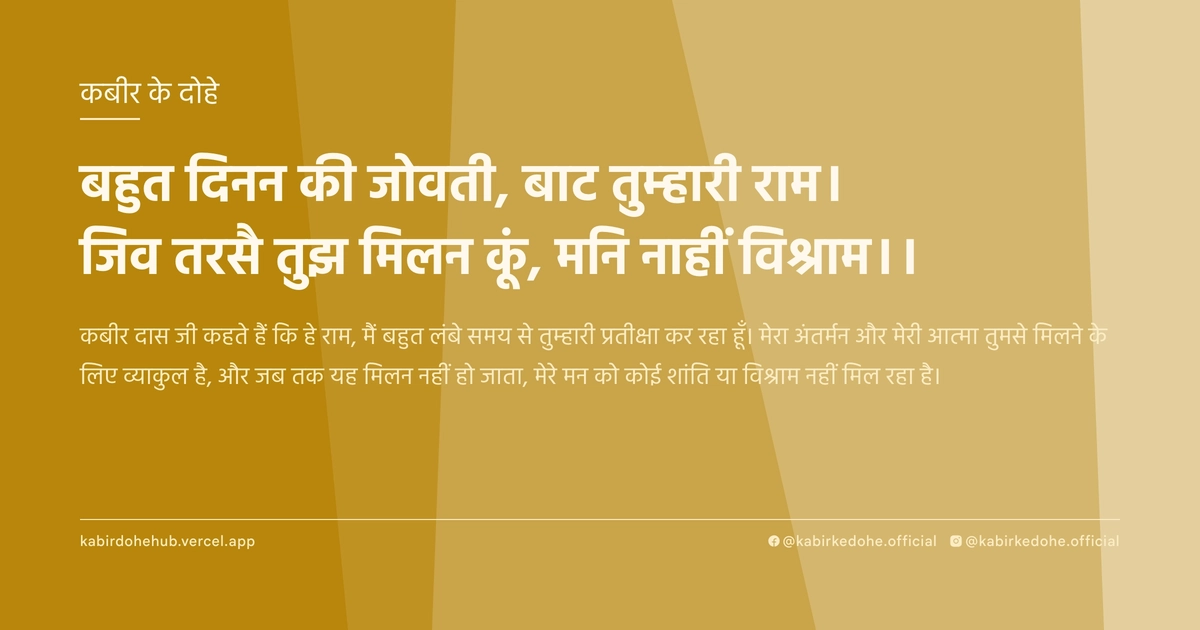
बहुत दिनन की जोवती, बाट तुम्हारी राम।
जिव तरसै तुझ मिलन कूं, मनि नाहीं विश्राम।।
Bahut dinan ki jovati, baat tumhari ram. Jiv tarsai tujh milan kun, mani naahin vishram.
इस पृष्ठ पर इस कबीर दोहे का अर्थ (meaning), हिंदी व्याख्या और अंग्रेज़ी अनुवाद, दार्शनिक विश्लेषण और व्यावहारिक जीवन सीख दी गई है। यह दोहा भक्ति (Bhakti) विषय से जुड़ा है — Kabir doha meaning and explanation in Hindi and English.
अर्थ (Meaning):
कबीर दास जी कहते हैं कि हे राम, मैं बहुत लंबे समय से तुम्हारी प्रतीक्षा कर रहा हूँ। मेरा अंतर्मन और मेरी आत्मा तुमसे मिलने के लिए व्याकुल है, और जब तक यह मिलन नहीं हो जाता, मेरे मन को कोई शांति या विश्राम नहीं मिल रहा है।
Kabir expresses a profound, enduring longing for the Divine. He states that he has waited for an eternity for the arrival of the Beloved (Ram), and his soul yearns with an intense thirst for union, leaving the mind in a state of perpetual restlessness until that spiritual merger occurs.
व्याख्या (Interpretation):
यहाँ 'राम' शब्द किसी व्यक्ति विशेष के लिए नहीं, बल्कि उस निराकार ब्रह्म या अंतरात्मा के लिए प्रयुक्त हुआ है जो सर्वव्यापी है। यह दोहा विरह की पराकाष्ठा को दर्शाता है, जहाँ भक्त और भगवान के बीच का द्वैत (separation) एक असहनीय पीड़ा बन जाता है। यह 'विरह' वास्तव में आत्मा की वह पुकार है जो माया के आवरण को हटाकर अपने मूल स्रोत से जुड़ना चाहती है। जब कबीर कहते हैं कि 'मनि नाहीं विश्राम', तो वे मानसिक अशांति की नहीं, बल्कि उस आध्यात्मिक छटपटाहट की बात कर रहे हैं जो केवल पूर्ण समर्पण और आत्म-साक्षात्कार से शांत होती है। यह स्थिति निर्गुण भक्ति की उस अवस्था को दर्शाती है जहाँ साधक बाहरी कर्मकांडों को त्यागकर केवल आंतरिक मिलन की प्रतीक्षा करता है। अंततः, यह प्रतीक्षा ही साधना है, और यह व्याकुलता ही वह अग्नि है जो अहंकार को जलाकर भस्म करती है।
In this verse, 'Ram' does not refer to the mythological king but to the Nirgun Brahman—the formless, omnipresent Absolute. The doha depicts the peak of 'Viraha' (longing in separation), where the perceived duality between the seeker and the Divine becomes an unbearable ache. This yearning is the soul's instinctive cry to pierce through the veil of Maya and return to its primordial source. When Kabir mentions the lack of 'vishram' (rest), he is not describing psychological anxiety, but a spiritual restlessness that serves as a catalyst for awakening. It highlights the central paradox: the longing for God is itself the presence of God within the seeker. This state aligns with the non-duality of Advaita Vedanta, where the realization that the seeker and the sought are one is the only cure for this divine restlessness. The agony of separation is thus the very fire that purifies the ego, preparing the Atman for final merger.
दार्शनिक विश्लेषण (Philosophical Analysis):
कबीर का यह दोहा मध्यकालीन भारत के उस सामाजिक-धार्मिक परिवेश में रचा गया जहाँ धर्म केवल बाहरी कर्मकांडों, मूर्तियों और जातिगत श्रेष्ठता तक सीमित था। कबीर ने इन सभी कृत्रिम बाधाओं को नकारते हुए 'प्रेम मार्ग' और 'सहज साधना' पर बल दिया। यहाँ उनकी विचारधारा सूफीवाद के 'इश्क-ए-हकीकी' (दिव्य प्रेम) से गहराई से मेल खाती है, जहाँ प्रेमी (साधक) अपने प्रिय (ईश्वर) के लिए तड़पता है।
दार्शनिक स्तर पर, यह दोहा अद्वैत वेदांत के उस सत्य को उद्घाटित करता है कि आत्मा और परमात्मा वास्तव में एक ही हैं, परंतु अज्ञानता के कारण हम स्वयं को अलग अनुभव करते हैं। यह 'अलग होने का भ्रम' ही वह पीड़ा पैदा करता है जिसे कबीर 'तरस' कह रहे हैं। जब तक साधक यह नहीं समझता कि जिसे वह बाहर खोज रहा है, वह उसके अपने हृदय में स्थित है, तब तक यह प्रतीक्षा जारी रहती है।
कबीर ritualism (कर्मकांड) का विरोध करते हैं क्योंकि वे जानते हैं कि मंदिर, मस्जिद या तीर्थयात्राएं मन को शांत नहीं कर सकतीं। उनके लिए वास्तविक तीर्थ वह आंतरिक यात्रा है जो अहंकार के विसर्जन से शुरू होती है। यह दोहा सिखाता है कि आध्यात्मिक प्रगति केवल ज्ञान से नहीं, बल्कि तीव्र भावना और तड़प से होती है।
मनोवैज्ञानिक रूप से, यह 'विश्राम का अभाव' वास्तव में चेतना का एक उच्च स्तर है। यह वह बिंदु है जहाँ व्यक्ति सांसारिक सुखों से पूरी तरह विरक्त हो जाता है और उसे केवल एक ही लक्ष्य दिखाई देता है। यह 'शून्य' की ओर बढ़ने की प्रक्रिया है, जहाँ 'मैं' समाप्त हो जाता है और केवल 'वह' शेष रहता है।
अंततः, कबीर यह संदेश देते हैं कि ईश्वर की प्राप्ति किसी बाहरी प्रयास से नहीं, बल्कि आंतरिक पात्रता और तीव्र अभिलाषा से होती है। यह प्रतीक्षा कोई निष्क्रिय प्रतीक्षा नहीं है, बल्कि एक सक्रिय आत्म-मंथन है, जहाँ साधक अपनी हर सांस को उस परमात्मा के समर्पण में लगा देता है।
This doha emerged during a period of rigid religious orthodoxy in medieval India, where spirituality was often reduced to ritualistic performances and caste-based exclusions. Kabir dismantled these structures by proposing a direct, unmediated relationship between the individual and the Divine. His approach mirrors the Sufi concept of 'Ishq-e-Haqiqi' (Divine Love), where the longing of the lover for the Beloved is the primary vehicle for spiritual ascension.
Philosophically, the verse resonates with Advaita Vedanta's core tenet: the fundamental oneness of Atman and Brahman. The 'longing' described is actually the subconscious memory of the soul's original unity, now obscured by the illusions of Maya. The perceived separation is the source of the agony; therefore, the thirst for union is the soul's attempt to resolve this cosmic contradiction.
Kabir's rejection of ritualism is evident here. He suggests that neither the pilgrimage to Kashi nor the recitation of scriptures can provide the 'vishram' (rest) he seeks. True peace is not a product of external adherence to law but an internal alchemy of love and surrender. He shifts the locus of the sacred from the temple to the human heart.
From a psychological perspective, this state of restlessness is a 'divine discontent.' It is the stage where worldly achievements and sensory pleasures lose their luster, leaving a void that only the Infinite can fill. This void is not a lack, but a calling—a spiritual vacuum that pulls the seeker toward a higher state of consciousness.
Ultimately, Kabir teaches that the intensity of the desire for God is the only true qualification for attaining God. The 'waiting' is not a passive act but an active process of ego-annihilation. By dwelling in this longing, the seeker burns away the layers of identity, eventually realizing that the one who was waiting and the one being waited for are, in essence, the same.
मूल संदेश (Core Message):
- बाहरी खोज व्यर्थ है; वास्तविक मिलन आंतरिक तड़प में निहित है।
- अहंकार का अंत वहीं से होता है जहाँ पूर्ण समर्पण और विरह शुरू होता है।
- शांति का अभाव वास्तव में आत्मा की जागृति का संकेत है।
- ईश्वर कोई लक्ष्य नहीं, बल्कि वह प्रेम है जो हमें उसकी ओर खींचता है।
- जब 'मैं' मिटता है, तभी 'राम' का अनुभव संभव होता है।
- External searches are futile; true union resides in internal longing.
- The ego dissolves where absolute surrender and divine separation begin.
- The absence of peace is actually a signal of the soul's awakening.
- God is not a destination, but the very love that pulls us forward.
- Only when the 'I' vanishes does the experience of the Divine begin.
व्यावहारिक उदाहरण (Practical Example):
वाराणसी के एक पुराने घाट पर रहने वाली एक वृद्ध विधवा, जानकी, का जीवन केवल एक ही लय में बीत रहा था। उसने अपने जीवन के कई दशक मंदिर की सीढ़ियों पर बिताए, मंत्रों का जाप किया और कठिन उपवास रखे, लेकिन उसके मन के भीतर एक खालीपन था जो कभी नहीं भरा। वह मानती थी कि ईश्वर केवल उन लोगों को मिलते हैं जो बहुत बड़े तपस्वी होते हैं, और वह खुद को एक साधारण, अधूरी स्त्री मानती थी।
एक दिन, वह घाट पर बैठी एक छोटे बच्चे को देख रही थी जो अपनी माँ के आने का इंतज़ार कर रहा था। वह बच्चा बार-बार सड़क की ओर देखता, उसकी आँखों में एक ऐसी तड़प थी कि वह अपनी भूख और प्यास भी भूल चुका था। उसे किसी मंत्र की ज़रूरत नहीं थी, न ही किसी विशेष आसन की; उसकी पूरी सत्ता केवल अपनी माँ के मिलन की प्रतीक्षा में सिमटी हुई थी।
जानकी को अचानक कबीर का यह दोहा याद आया। उसे अहसास हुआ कि उसने अब तक ईश्वर को एक 'पुरस्कार' की तरह खोजा था, जिसे कठिन नियमों के पालन के बाद प्राप्त किया जाता है। उसने कभी उस 'तड़प' को महसूस नहीं किया था, क्योंकि वह धर्म को एक कर्तव्य मानकर चल रही थी, प्रेम नहीं।
उस रात, जानकी ने अपनी माला और अपनी पुरानी धारणाओं को एक तरफ रख दिया। उसने अपनी आँखें बंद कीं और पहली बार यह नहीं माँगा कि उसकी समस्याएँ दूर हो जाएँ, बल्कि यह माँगा कि उसे उस परमात्मा के लिए वैसी ही तड़प महसूस हो जैसी उस बच्चे को अपनी माँ के लिए थी। उसने अपने भीतर के उस खालीपन को स्वीकार किया और उसे एक 'पीड़ा' के रूप में नहीं, बल्कि एक 'पुकार' के रूप में देखा।
जैसे ही उसने अपनी 'धार्मिक श्रेष्ठता' के अहंकार को छोड़ा, उसे महसूस हुआ कि वह जिसे बाहर खोज रही थी, वह उसके भीतर की इसी तड़प में मौजूद है। उसकी बेचैनी अब उसे डरा नहीं रही थी, बल्कि उसे एक असीम शांति की ओर ले जा रही थी।
उसने पाया कि जब तक वह 'पाने' की कोशिश कर रही थी, वह दूर थी; लेकिन जब वह केवल 'तरसने' लगी, तो वह मिलन के करीब पहुँच गई। उसकी प्रार्थनाएँ अब यांत्रिक नहीं रहीं, बल्कि एक प्रेमी की पुकार बन गईं।
धीरे-धीरे, जानकी का व्यवहार बदल गया। वह अब दूसरों की सेवा इसलिए नहीं करती थी क्योंकि यह 'पुण्य' था, बल्कि इसलिए क्योंकि वह हर इंसान में उसी विरही आत्मा की झलक देखती थी।
उसकी आँखों में अब एक अलग चमक थी। वह अब भी घाट पर बैठती थी, लेकिन अब वह किसी बाहरी चमत्कार का इंतज़ार नहीं करती थी। उसने जान लिया था कि प्रतीक्षा ही मिलन का पहला चरण है और तड़प ही ईश्वर का सबसे सच्चा रूप है।
In the ancient alleys of Varanasi, an elderly widow named Janaki lived a life of rigid piety. For decades, she had adhered to the strictest rituals—chanting complex mantras, observing grueling fasts, and spending her days on the stone steps of the ghats. Yet, despite her outward devotion, a profound emptiness lingered within her, a void that no amount of ritual could fill. She believed God was a distant entity, accessible only to the most ascetic of saints.
One afternoon, while sitting by the river, Janaki observed a small child waiting for his mother. The child's gaze was fixed on the road, his entire being vibrating with an intensity that made him oblivious to his hunger or the scorching sun. He didn't need a prayer book or a sacred thread; his entire existence was concentrated on the singular desire for his mother's return.
In that moment, Kabir's words flashed through Janaki's mind. She realized that she had been treating God as a 'reward' to be earned through the accumulation of merit and the following of rules. She had approached spirituality as a transaction, a duty, rather than a love affair. She had the discipline, but she lacked the 'tars'—the raw, aching longing.
That night, Janaki set aside her beads and her preconceived notions of holiness. She closed her eyes and, for the first time, did not pray for her burdens to be lifted. Instead, she prayed for the grace to feel the same desperate longing for the Divine that the child felt for his mother. She stopped fighting the emptiness and instead embraced it as a sacred invitation.
As she surrendered her ego—the pride of being a 'perfect devotee'—she experienced a shift. The restlessness she had feared for years suddenly transformed into a bridge. She realized that the very ache in her heart was not a sign of absence, but the presence of the Divine calling her home.
She discovered a profound truth: as long as she tried to 'attain' God through effort, she remained separate. But the moment she surrendered to the longing itself, the distance vanished. Her prayers ceased to be mechanical recitations and became the cries of a lover.
This transformation seeped into her daily life. She began serving the poor and the sick, not to earn 'punya' (merit), but because she recognized the same divine longing in every suffering soul she encountered.
Janaki continued to sit on the ghats, but her posture had changed. She was no longer waiting for a miracle to happen; she had realized that the waiting itself was the miracle, and the longing was the most authentic form of union.
अभ्यास मार्गदर्शन (Practice Guidance):
- प्रतिदिन 20 मिनट के लिए मौन बैठें और अपने भीतर की उस 'अतृप्ति' या 'खालीपन' को महसूस करें जिसे आप आमतौर पर दबा देते हैं। इसे रोकने के बजाय, इसे एक दिव्य पुकार के रूप में स्वीकार करें।
- एक 'विरह जर्नल' (Longing Journal) बनाएँ। इसमें यह न लिखें कि आप क्या चाहते हैं, बल्कि यह लिखें कि आप उस परम सत्य के लिए कितनी व्याकुल हैं। अपनी भावनाओं को शब्दों में ढालें।
- व्यवहार परिवर्तन: जब भी आप किसी चीज़ के लिए अधीर हों (जैसे सफलता या प्रशंसा), तो उस मानसिक ऊर्जा को मोड़कर यह सोचें कि यह वास्तव में आपकी आत्मा की परमात्मा से मिलने की तड़प है।
- निदान चेकलिस्ट: क्या आप अभी भी ईश्वर को 'पाने' के लिए सौदेबाजी कर रहे हैं? क्या आपकी प्रार्थनाएँ केवल माँगने तक सीमित हैं? यदि हाँ, तो आप अभी भी अहंकार के स्तर पर हैं। यदि आपकी प्रार्थना में केवल 'मिलन की तड़प' है, तो आप सही मार्ग पर हैं।
- Dedicate 20 minutes daily to sit in absolute silence. Instead of trying to quiet the 'emptiness' or 'restlessness' within, lean into it. Experience this void not as a lack, but as a divine calling.
- Maintain a 'Longing Journal.' Instead of listing material desires, document the intensity of your yearning for the Ultimate Truth. Translate your spiritual ache into poetic expression.
- Behavioral Shift: Whenever you feel impatient for worldly success or validation, consciously redirect that energy. Recognize that this restlessness is a misplaced longing for the Infinite.
- Diagnostic Checklist: Are you still bargaining with the Divine for rewards? Are your prayers merely a list of requests? If so, you are operating from the ego. If your prayer has become a simple, aching desire for union, you have entered the path of Bhakti.
चिंतन प्रश्न (Reflection Questions):
- क्या मेरी आध्यात्मिक खोज वास्तव में सत्य की प्यास है, या केवल मेरी मानसिक बेचैनी को शांत करने का एक तरीका?
- मैं अपनी पहचान (नाम, पद, प्रतिष्ठा) को बचाने के लिए कितनी मेहनत करता हूँ, और क्या यह पहचान मुझे मेरे मूल स्वरूप से अलग कर रही है?
- यदि आज मेरे जीवन से सभी बाहरी धार्मिक पहचान छीन ली जाएँ, तो क्या मेरे भीतर अभी भी उस परमात्मा के लिए कोई तड़प शेष रहेगी?
- क्या मैं अपनी 'अशांति' से डरता हूँ, या मैं इसे उस सत्य तक पहुँचने के मार्ग के रूप में देख सकता हूँ?
- मेरे जीवन का वह कौन सा हिस्सा है जहाँ मैं अभी भी 'सौदेबाजी' कर रहा हूँ, बजाय इसके कि मैं पूरी तरह समर्पित हो जाऊँ?
- Is my spiritual quest a genuine thirst for Truth, or merely a sophisticated way to soothe my psychological anxiety?
- How much energy do I spend protecting my identity (name, status, ego), and is this very identity the wall separating me from my essence?
- If all my external religious and social labels were stripped away today, would there still be a longing for the Divine within me?
- Do I fear my inner restlessness, or can I perceive it as the compass pointing toward the Ultimate Truth?
- In which areas of my life am I still 'bargaining' with existence instead of practicing absolute surrender?