
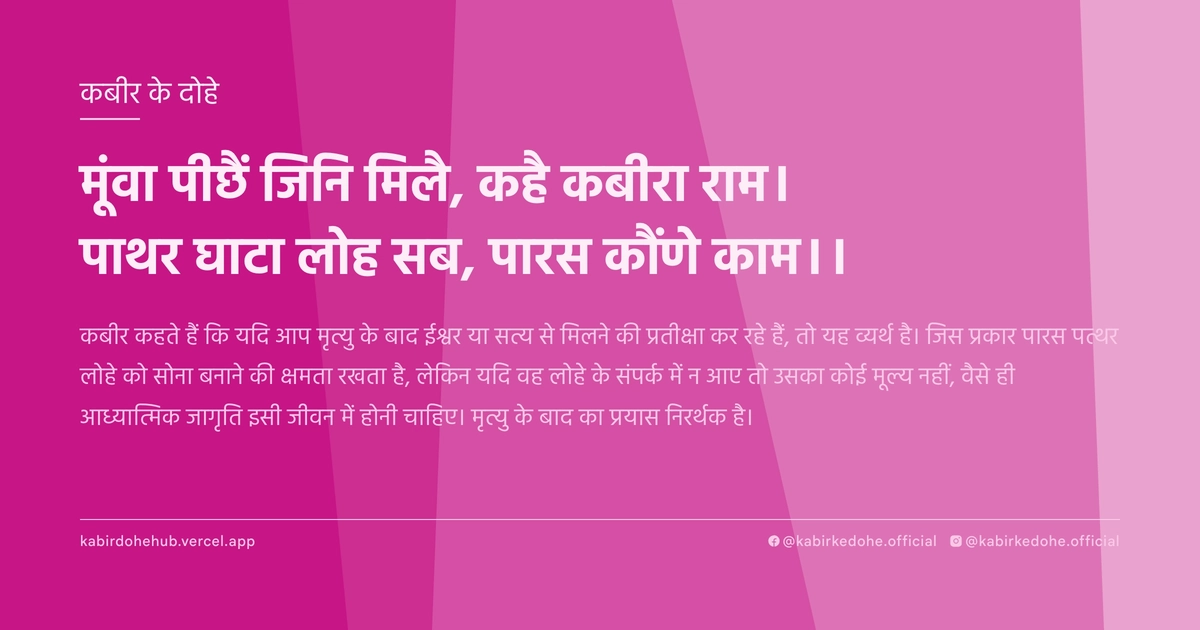
मूंवा पीछैं जिनि मिलै, कहै कबीरा राम।
पाथर घाटा लोह सब, पारस कौंणे काम।।
Moonva peechhen jini milai, kahai kabira ram. Pathar ghata loh sab, paras kaune kaam.
इस पृष्ठ पर इस कबीर दोहे का अर्थ (meaning), हिंदी व्याख्या और अंग्रेज़ी अनुवाद, दार्शनिक विश्लेषण और व्यावहारिक जीवन सीख दी गई है। यह दोहा भक्ति (Bhakti) विषय से जुड़ा है — Kabir doha meaning and explanation in Hindi and English.
अर्थ (Meaning):
कबीर कहते हैं कि यदि आप मृत्यु के बाद ईश्वर या सत्य से मिलने की प्रतीक्षा कर रहे हैं, तो यह व्यर्थ है। जिस प्रकार पारस पत्थर लोहे को सोना बनाने की क्षमता रखता है, लेकिन यदि वह लोहे के संपर्क में न आए तो उसका कोई मूल्य नहीं, वैसे ही आध्यात्मिक जागृति इसी जीवन में होनी चाहिए। मृत्यु के बाद का प्रयास निरर्थक है।
Kabir asserts that waiting to unite with the Divine or Truth after death is a futile endeavor. Just as the mythical Paras stone possesses the power to transmute iron into gold, its existence is meaningless if it never touches the iron. Similarly, spiritual awakening must occur in the present living moment; seeking liberation only after the body perishes is a wasted opportunity.
व्याख्या (Interpretation):
इस दोहे का शाब्दिक अर्थ है कि मृत्यु के पश्चात परमात्मा से मिलने की इच्छा करना मूर्खता है। रूपक के माध्यम से कबीर समझाते हैं कि मानव जीवन वह 'लोहा' है जिसे 'पारस' (गुरु या आत्म-ज्ञान) के स्पर्श से 'सोना' (मोक्ष) बनना है। यहाँ 'राम' किसी व्यक्ति विशेष नहीं, बल्कि निर्गुण ब्रह्म या अंतरात्मा का प्रतीक हैं। माया का प्रभाव मनुष्य को यह विश्वास दिलाता है कि मुक्ति मृत्यु के बाद मिलेगी, जबकि अद्वैत वेदांत के अनुसार, ब्रह्म और जीव एक ही हैं; केवल अज्ञान का पर्दा है। यदि इस भौतिक शरीर के रहते हुए अहंकार का विसर्जन नहीं हुआ, तो मृत्यु केवल एक अवस्था परिवर्तन है, मुक्ति नहीं। यह दोहा वर्तमान क्षण की महत्ता और जीवंत साधना पर बल देता है।
Literally, the verse warns against the delusion of seeking God after death. Through a potent metaphor, Kabir describes human life as 'iron' and spiritual wisdom as the 'Paras stone'—the catalyst that transmutes the base into the divine. 'Ram' here does not signify a deity in a heaven, but the Nirgun Brahman, the formless absolute residing within. The paradox lies in the human tendency to postpone spiritual evolution, blinded by Maya (illusion), believing liberation is a post-mortem reward. In the light of Advaita Vedanta, the Atman is already Brahman; the only obstacle is the ego. If the alchemy of self-realization does not occur while the breath still flows, death is merely a transition, not a liberation. The doha emphasizes that the 'now' is the only portal to the eternal.
दार्शनिक विश्लेषण (Philosophical Analysis):
कबीर का यह दृष्टिकोण उनके युग के कर्मकांडीय आडंबरों और परलोक की काल्पनिक अवधारणाओं पर एक कड़ा प्रहार है। उस समय समाज में यह धारणा व्याप्त थी कि कठिन व्रत, तीर्थयात्रा और मृत्यु के बाद के संस्कारों से मोक्ष प्राप्त होता है। कबीर ने इस 'मृत्यु-केंद्रित' आध्यात्मिकता को खारिज कर 'जीवन-केंद्रित' अनुभववाद की वकालत की। वे कहते हैं कि यदि आप इस शरीर में, इस सांस में सत्य को नहीं पहचान सके, तो श्मशान की राख में वह नहीं मिलेगा।
दार्शनिक स्तर पर, यह सूफी मत के 'फना' और अद्वैत वेदांत के 'साक्षी भाव' का संगम है। सूफीवाद में जैसे खुदा को पाने के लिए स्वयं के अस्तित्व को मिटाना होता है, वैसे ही कबीर अहंकार के विलोपन की बात करते हैं। वे स्पष्ट करते हैं कि मोक्ष कोई भौगोलिक स्थान (जैसे वैकुंठ या स्वर्ग) नहीं है, बल्कि चेतना की एक अवस्था है।
कबीर का 'पारस' वास्तव में वह गुरु-तत्त्व या आत्म-बोध है जो लोहे जैसी जड़ता (अज्ञान) को सोने जैसी चैतन्यता (ज्ञान) में बदल देता है। वे जाति और धर्म के भेदों को इसलिए नकारते हैं क्योंकि लोहा चाहे किसी भी जाति का हो, पारस का स्पर्श उसे समान रूप से सोना बना देता है। यह सार्वभौमिक मानवता का संदेश है।
मनोवैज्ञानिक रूप से, यह दोहा 'विलंबण' (Procrastination) की प्रवृत्ति पर प्रहार करता है। मनुष्य अक्सर अपनी आध्यात्मिक यात्रा को कल पर टालता है, यह सोचकर कि बुढ़ापे में या मृत्यु के करीब आकर वह ईश्वर को खोज लेगा। कबीर चेतावनी देते हैं कि यह मानसिक जाल अंततः विनाशकारी है।
अंततः, यह शिक्षण हमें सिखाता है कि शरीर केवल एक माध्यम है। यदि माध्यम का उपयोग करके लक्ष्य (परमात्मा) को नहीं पाया गया, तो माध्यम के नष्ट होने पर लक्ष्य और भी दूर हो जाएगा। यह 'सहज मार्ग' की शिक्षा है, जहाँ साधना जीवन के दैनिक कार्यों के बीच ही संपन्न होती है।
Kabir's perspective is a scathing critique of the ritualistic pomposity and the imaginative constructs of the afterlife prevalent during his era. The societal belief held that salvation was achieved through rigorous fasting, pilgrimages, and post-death rites. Kabir dismantles this 'death-centric' spirituality, advocating instead for a 'life-centric' experiential realization. He argues that if Truth is not recognized within this breathing body, it will not be found in the ashes of the cremation ground.
Philosophically, this verse represents a confluence of the Sufi concept of 'Fana' (annihilation of the self) and the Advaita Vedanta principle of 'Sakshi' (the witness consciousness). Just as Sufism demands the dissolution of the ego to merge with the Beloved, Kabir speaks of the annihilation of the 'I' to realize the 'All'. He clarifies that liberation is not a geographical destination like Vaikuntha or Heaven, but a state of consciousness.
The 'Paras' stone in Kabir's imagery is the Guru-element or the spark of self-awareness that transmutes the inertia of ignorance (iron) into the luminosity of wisdom (gold). By emphasizing the catalyst over the ritual, he rejects caste and creed; iron, regardless of its origin, becomes gold upon the touch of the Paras. This is a profound declaration of universal human equality.
Psychologically, the doha attacks the habit of spiritual procrastination. Humans often defer their inner journey, believing that devotion in old age or near death will suffice. Kabir warns that this mental trap is a delusion that leads to a wasted existence.
Ultimately, this teaching posits that the physical body is merely a vehicle. If the vehicle is not used to reach the destination (the Divine) while it is functional, the destruction of the vehicle will not magically transport the soul to the goal. This is the essence of the 'Sahaj Marg' (the Natural Path), where spiritual practice is integrated into the mundane flow of daily life.
मूल संदेश (Core Message):
- मृत्यु के बाद की प्रतीक्षा एक आध्यात्मिक भ्रम है।
- सत्य की खोज वर्तमान क्षण में ही संभव है।
- अहंकार का विसर्जन ही वास्तविक पारस पत्थर है।
- मानव जीवन वह अवसर है जहाँ रूपांतरण होना चाहिए।
- परमात्मा कोई गंतव्य नहीं, बल्कि एक जीवंत अनुभव है।
- Waiting for the afterlife is a spiritual delusion.
- The discovery of Truth is possible only in the present.
- The dissolution of ego is the true Paras stone.
- Human life is the only window for fundamental transformation.
- The Divine is not a destination, but a living experience.
व्यावहारिक उदाहरण (Practical Example):
एक समय की बात है, वाराणसी के घाटों पर माधव नाम का एक वृद्ध बुनकर रहता था। माधव अपनी पूरी जिंदगी केवल इस विश्वास में बिता दी कि जब वह मरेगा, तब भगवान शिव उसे अपने पास बुला लेंगे। वह दिन भर कपड़े बुनता, लेकिन उसका मन हमेशा 'अगले जन्म' और 'परलोक' की कल्पनाओं में खोया रहता। वह वर्तमान की खुशियों और रिश्तों को यह कहकर नजरअंदाज करता कि "यह संसार तो मिथ्या है, असली सुख तो मृत्यु के बाद मिलेगा।"
माधव का एक बेटा था, जो बीमार रहता था, और एक पत्नी थी जो उसकी देखभाल करती थी। लेकिन माधव ने कभी उनके प्रति वास्तविक प्रेम या करुणा नहीं दिखाई, क्योंकि वह अपनी 'आध्यात्मिक तैयारी' में व्यस्त था, जो वास्तव में केवल मृत्यु के बाद के पुरस्कार की प्रतीक्षा थी। वह मंदिर जाता, घंटों मंत्र पढ़ता, लेकिन घर लौटकर चिड़चिड़ा हो जाता।
एक दिन उसकी मुलाकात एक घुमक्कड़ फकीर से हुई। फकीर ने माधव की व्यथा सुनी और मुस्कुराते हुए कहा, "माधव, तुम उस लोहे की तरह हो जो सोने बनने का इंतजार कर रहा है, लेकिन तुमने पारस को छुआ ही नहीं। तुम मृत्यु के बाद मिलने वाले सोने की बात कर रहे हो, जबकि पारस तुम्हारे सामने खड़ा है।"
माधव ने हैरान होकर पूछा, "वह पारस क्या है?"
फकीर ने जवाब दिया, "तुम्हारी पत्नी की सेवा, तुम्हारे बेटे का दर्द, और इस क्षण में तुम्हारा पूर्णतः उपस्थित होना ही पारस है। यदि तुम इस शरीर के रहते हुए प्रेम और करुणा को नहीं पहचान सके, तो मृत्यु के बाद तुम केवल एक खाली आत्मा रहोगे, सोना नहीं बनोगे।"
यह बात माधव के हृदय में बिजली की तरह कौंधी। उसे समझ आया कि वह 'परलोक' के लालच में 'इस लोक' के वास्तविक ईश्वर को खो रहा था। उसने महसूस किया कि उसकी भक्ति केवल एक मानसिक पलायन थी।
अगले ही दिन से माधव का व्यवहार बदल गया। उसने अब मंत्रों को केवल रटा नहीं, बल्कि उन्हें अपने व्यवहार में उतारा। उसने अपने बीमार बेटे की सेवा को ही ईश्वर की पूजा मान लिया। उसने अपनी पत्नी के हाथों की थकान को महसूस करना शुरू किया और उसे सहारा दिया।
उसने पाया कि जब वह दूसरों के दुख में डूबता, तो उसके भीतर का अहंकार पिघलने लगता। वह अब मृत्यु से नहीं डरता था और न ही उसका इंतजार करता था, क्योंकि उसने जीवन के हर क्षण में उस 'राम' को पा लिया था।
माधव अब एक ऐसा बुनकर बन गया था जिसके कपड़ों में केवल धागे नहीं, बल्कि प्रेम और शांति बुनी हुई थी। उसने जान लिया था कि पारस पत्थर कहीं बाहर नहीं, बल्कि वर्तमान क्षण की जागरूकता में छिपा है।
Once, in the bustling ghats of Varanasi, lived an elderly weaver named Madhav. Madhav spent his entire life anchored in the belief that upon his death, Lord Shiva would summon him to the divine abode. He spent his days weaving cloth, but his mind was perpetually adrift in fantasies of the 'next life' and the 'afterworld.' He ignored the joys and relationships of the present, dismissing them by saying, "This world is an illusion; true happiness awaits only after death."
Madhav had a son who was chronically ill and a wife who tirelessly cared for the family. Yet, Madhav showed them little genuine love or compassion, convinced that his 'spiritual preparation'—which was essentially just waiting for a post-mortem reward—was more important.
One day, he encountered a wandering Fakir. After listening to Madhav's aspirations, the Fakir smiled and said, "Madhav, you are like a piece of iron waiting to become gold, but you have never touched the Paras stone. You speak of gold that comes after death, while the Paras stands right before you."
Confused, Madhav asked, "What is this Paras stone?"
The Fakir replied, "The service to your wife, the pain of your son, and your total presence in this very moment—that is the Paras. If you cannot recognize love and compassion while inhabiting this body, you will remain a hollow soul after death, never becoming gold."
These words struck Madhav like a bolt of lightning. He realized he was losing the living God of 'this world' in the greed for the 'next world.' He saw that his devotion was nothing more than a mental escape from his responsibilities.
From that day forward, Madhav's behavior transformed. He stopped merely reciting mantras and began embodying them. He viewed the care of his sick son as the highest form of worship. He began to feel the exhaustion in his wife's hands and offered her his strength.
He discovered that whenever he immersed himself in the suffering of others, his ego began to melt. He no longer feared death, nor did he long for it, for he had found 'Ram' in every fleeting second of his existence.
Madhav became a weaver whose cloths held not just threads, but woven peace and love. He had finally understood that the Paras stone was not a mythical object, but the awareness of the present moment.
अभ्यास मार्गदर्शन (Practice Guidance):
- वर्तमान क्षण का अभ्यास: दिन में तीन बार 5 मिनट के लिए रुकें और केवल अपनी सांसों और आस-पास की आवाजों को महसूस करें, बिना किसी निर्णय के।
- सेवा-साधना: प्रतिदिन एक ऐसा कार्य करें जिसमें आपका कोई व्यक्तिगत लाभ न हो, केवल दूसरे की निस्वार्थ सहायता हो। इसे ही 'पारस स्पर्श' मानें।
- आत्म-पूछताछ जर्नल: हर रात लिखें कि आज आपने कितनी बार 'कल' या 'परलोक' के भरोसे अपनी जिम्मेदारी या प्रेम को टाला।
- निदान चेकलिस्ट: क्या आप ईश्वर को केवल मंदिर/मस्जिद में ढूंढ रहे हैं? क्या आप दूसरों की मदद केवल पुण्य कमाने के लिए करते हैं? यदि हाँ, तो आप अभी भी 'लोहे' की अवस्था में हैं।
- Presence Practice: Three times a day, pause for 5 minutes to simply feel your breath and the surrounding sounds without judgment.
- Service as Sadhana: Perform one act daily that offers no personal gain, only selfless aid to another. Treat this as the 'Touch of the Paras'.
- Self-Inquiry Journaling: Every night, record instances where you deferred your responsibilities or expressions of love by relying on 'tomorrow' or 'the afterlife'.
- Diagnostic Checklist: Are you seeking God only in temples or mosques? Do you help others solely to earn spiritual merit? If yes, you are still in the state of 'iron'.
चिंतन प्रश्न (Reflection Questions):
- क्या मेरी धार्मिक आस्था वास्तव में मुझे वर्तमान में जागरूक बना रही है, या यह केवल मृत्यु के भय से बचने का एक तरीका है?
- मैं अपने जीवन में किन 'लोहे' जैसी आदतों (जड़ता, क्रोध, मोह) को ढो रहा हूँ जिन्हें मैं बदलना चाहता हूँ?
- यदि मुझे पता चले कि कोई 'परलोक' नहीं है, तो क्या मेरा आज का व्यवहार और मेरा प्रेम बदल जाएगा?
- क्या मैं अपनी आध्यात्मिक पहचान का उपयोग दूसरों को छोटा दिखाने के लिए कर रहा हूँ?
- मेरे जीवन का वह कौन सा क्षेत्र है जहाँ मैं 'पारस' के स्पर्श की सबसे अधिक प्रतीक्षा कर रहा हूँ, जबकि वह मेरे भीतर ही है?
- Does my religious faith actually make me conscious in the present, or is it merely a mechanism to escape the fear of death?
- What 'iron-like' habits (inertia, anger, attachment) am I carrying that I truly wish to transmute?
- If I were to discover that there is no 'afterlife', would my behavior and my capacity to love change today?
- Am I using my spiritual identity as a tool to feel superior to others?
- In which area of my life am I most longing for the 'touch of the Paras', unaware that the catalyst already resides within me?