
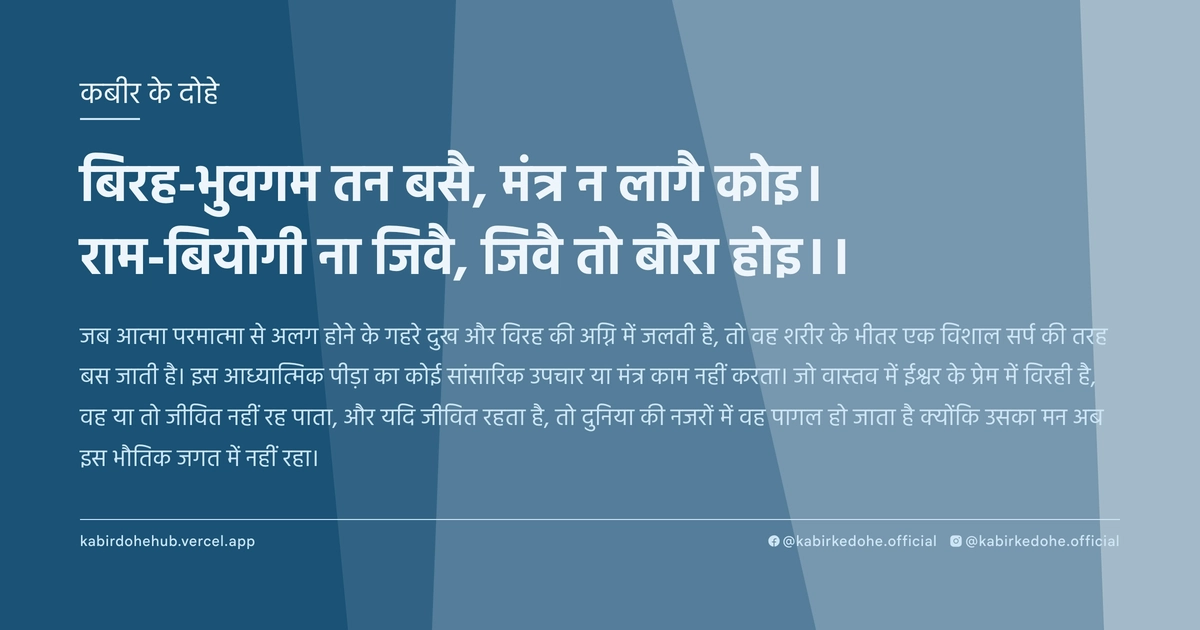
बिरह-भुवगम तन बसै, मंत्र न लागै कोइ।
राम-बियोगी ना जिवै, जिवै तो बौरा होइ।।
Birah-bhuvgam tan basai, mantra na laagai koi. Ram-biyogi na jivai, jivai to baura hoye.
इस पृष्ठ पर इस कबीर दोहे का अर्थ (meaning), हिंदी व्याख्या और अंग्रेज़ी अनुवाद, दार्शनिक विश्लेषण और व्यावहारिक जीवन सीख दी गई है। यह दोहा भक्ति (Bhakti) विषय से जुड़ा है — Kabir doha meaning and explanation in Hindi and English.
अर्थ (Meaning):
जब आत्मा परमात्मा से अलग होने के गहरे दुख और विरह की अग्नि में जलती है, तो वह शरीर के भीतर एक विशाल सर्प की तरह बस जाती है। इस आध्यात्मिक पीड़ा का कोई सांसारिक उपचार या मंत्र काम नहीं करता। जो वास्तव में ईश्वर के प्रेम में विरही है, वह या तो जीवित नहीं रह पाता, और यदि जीवित रहता है, तो दुनिया की नजरों में वह पागल हो जाता है क्योंकि उसका मन अब इस भौतिक जगत में नहीं रहा।
When the soul burns in the profound agony of separation from the Divine, this longing resides within the body like a venomous serpent. No worldly remedy or ritualistic mantra can cure this spiritual ache. One who is truly estranged from the Divine cannot endure the pain of existence; if they survive, they appear mad to the world, for their consciousness has transcended the mundane reality of the physical plane.
व्याख्या (Interpretation):
कबीर यहाँ 'बिरह' (विछोह) को एक 'भुवगम' यानी विशाल सर्प के रूप में चित्रित करते हैं, जो शरीर के भीतर गहरे तक पैठा हुआ है। यह सर्प कोई बाहरी शत्रु नहीं, बल्कि आत्मा की वह तड़प है जो उसे अपने मूल स्रोत (ब्रह्म) की याद दिलाती है। यह स्थिति 'निर्गुण भक्ति' की पराकाष्ठा है, जहाँ भक्त को यह अहसास होता है कि वह माया के कारण अपने वास्तविक स्वरूप से अलग हो गया है। यह विरह केवल दुख नहीं, बल्कि एक शुद्धिकरण प्रक्रिया है जो अहंकार को नष्ट करती है। जब साधक इस अवस्था में पहुँचता है, तो वह 'बौरा' यानी पागल कहलाता है, क्योंकि उसकी प्राथमिकताएँ बदल जाती हैं। वह अब सामाजिक मर्यादाओं और सांसारिक लाभों से ऊपर उठकर केवल उस निराकार राम की खोज में लीन रहता है। यह विरोधाभास है कि जिसे दुनिया पागलपन कहती है, वही वास्तव में सर्वोच्च चेतना की जागृति है।
Kabir depicts 'Birah' (separation) as a 'Bhuvgam'—a colossal serpent dwelling within the physical frame. This serpent is not an external enemy but the soul's visceral longing for its primordial source, the Brahman. This state represents the zenith of Nirgun Bhakti, where the seeker realizes that Maya (illusion) has created a perceived duality between the self and the Divine. This separation is not merely sorrow but a purgative fire that incinerates the ego. When the seeker reaches this intensity, they are labeled 'Baura' or mad, as their priorities shift entirely. They transcend social conventions and worldly gains, becoming consumed by the search for the Formless Ram. It is a profound paradox: what the world perceives as insanity is, in truth, the awakening of the highest consciousness, where the Atman recognizes its non-duality with the Absolute.
दार्शनिक विश्लेषण (Philosophical Analysis):
कबीर का यह दोहा मध्यकालीन भारत के उस सामाजिक-धार्मिक परिवेश में रचा गया था जहाँ कर्मकांड और बाहरी आडंबरों का बोलबाला था। कबीर ने स्पष्ट किया कि ईश्वर की प्राप्ति किसी मंदिर, मस्जिद या मंत्रोच्चार से नहीं, बल्कि हृदय की सच्ची तड़प और प्रेम से होती है। यहाँ 'मंत्र न लागै कोइ' कहकर उन्होंने उन सभी पुरोहितों और पाखंडियों को चुनौती दी है जो दावा करते थे कि वे मंत्रों के माध्यम से मोक्ष दिला सकते हैं। उनके लिए, विरह ही वह एकमात्र मार्ग है जो मनुष्य को उसके अहंकार से मुक्त करता है।
अद्वैत वेदांत के परिप्रेक्ष्य में, यह विरह वास्तव में 'अविद्या' का अंत है। जब आत्मा को यह आभास होता है कि वह ब्रह्म से अलग है, तो वह विरह का अनुभव करती है; लेकिन यही विरह उसे अंततः इस सत्य की ओर ले जाता है कि वह और ब्रह्म एक ही हैं। यह सूफी मत के 'इश्क-ए-हकीकी' (दिव्य प्रेम) के समान है, जहाँ प्रेमी अपने महबूब (ईश्वर) के लिए खुद को मिटा देता है।
मनोवैज्ञानिक स्तर पर, 'पागलपन' यहाँ मानसिक विकार नहीं, बल्कि एक संज्ञानात्मक बदलाव है। जब एक व्यक्ति सांसारिक पहचान (नाम, पद, जाति) को पूरी तरह त्याग देता है, तो समाज उसे असामान्य मानता है। कबीर इस 'पागलपन' को एक उपलब्धि मानते हैं क्योंकि यह उस बिंदु को दर्शाता है जहाँ 'मैं' (अहंकार) समाप्त हो जाता है और केवल 'वह' (परमात्मा) शेष रहता है।
कबीर का विरोध केवल धर्म से नहीं, बल्कि उस जड़ता से था जो मनुष्य को उसकी आंतरिक यात्रा से रोकती है। वे बताते हैं कि जब तक हृदय में विरह की अग्नि नहीं जलती, तब तक ज्ञान केवल बौद्धिक व्यायाम रहता है। वास्तविक ज्ञान वह है जो हृदय को पिघला दे और व्यक्ति को करुणा और प्रेम के सागर में डुबो दे।
अंततः, यह दोहा हमें सिखाता है कि आध्यात्मिक यात्रा सुखद नहीं होती। यह एक विनाशकारी प्रक्रिया है जहाँ पुराना व्यक्तित्व मरता है ताकि एक नया, दिव्य व्यक्तित्व जन्म ले सके। यह विरह ही वह ईंधन है जो आत्मा को भौतिकता के अंधकार से निकालकर सत्य के प्रकाश की ओर ले जाता है।
This couplet was composed during a medieval Indian era dominated by rigid ritualism and external piety. Kabir asserts that the realization of the Divine is achieved not through temples, mosques, or the chanting of mantras, but through the authentic agony of the heart. By stating 'mantra na laagai koi,' he challenges the priesthood and the pretenders who claimed that liberation could be engineered through ritualistic formulas. For Kabir, longing is the only catalyst capable of liberating a human from the shackles of the ego.
From the lens of Advaita Vedanta, this separation is the manifestation of 'Avidya' (ignorance). When the soul perceives itself as distinct from Brahman, it experiences the pain of separation; however, this very longing drives it toward the ultimate truth of non-duality. This mirrors the Sufi concept of 'Ishq-e-Haqiqi' (Divine Love), where the lover annihilates their existence in the pursuit of the Beloved.
Psychologically, the 'madness' mentioned here is not a clinical disorder but a cognitive shift. When an individual completely discards their social identity—name, rank, and caste—society labels them abnormal. Kabir views this 'insanity' as an achievement, for it marks the point where the 'I' (ego) vanishes, leaving only the 'Thou' (Divine).
Kabir's rebellion was not merely against organized religion, but against the spiritual inertia that prevents the internal journey. He suggests that until the fire of longing burns in the heart, spiritual knowledge remains a mere intellectual exercise. True gnosis is that which melts the heart and immerses the seeker in an ocean of compassion and love.
Ultimately, this doha teaches us that the spiritual path is not one of comfort. It is a destructive process where the old personality must die so that a divine identity can emerge. This longing is the fuel that propels the soul from the darkness of materiality toward the light of Absolute Truth.
मूल संदेश (Core Message):
- बाहरी अनुष्ठान आंतरिक विरह का विकल्प नहीं हो सकते।
- सच्ची आध्यात्मिक जागृति अक्सर सामाजिक पागलपन जैसी दिखती है।
- अहंकार का विनाश ही परमात्मा से मिलन का एकमात्र द्वार है।
- दुख जब दिव्य बन जाता है, तो वह मुक्ति का मार्ग बन जाता है।
- आत्मा की तड़प ही वह ईंधन है जो माया के पर्दे को जलाती है।
- External rituals cannot substitute for internal longing.
- True spiritual awakening often resembles social insanity.
- The annihilation of ego is the only gateway to Divine union.
- When sorrow becomes divine, it transforms into the path of liberation.
- The soul's yearning is the fuel that burns the veil of Maya.
व्यावहारिक उदाहरण (Practical Example):
वाराणसी के घाटों पर रहने वाला एक वृद्ध विधवा, जिसे लोग 'पागल दादी' कहते थे, इस दोहे का जीवंत उदाहरण थी। वह दिन भर गंगा किनारे बैठती और शून्य में ताकते हुए कभी हंसती तो कभी फूट-फूट कर रोती। लोग उसे पागल समझते थे क्योंकि उसने अपने परिवार और समाज के सभी नियमों को त्याग दिया था।
उसका जीवन एक समय बहुत समृद्ध था, लेकिन उसने अपने पति और पुत्र को खो दिया था। शुरुआत में वह शोक में डूबी रही, लेकिन धीरे-धीरे उसका दुख एक आध्यात्मिक खोज में बदल गया। उसने महसूस किया कि उसका दुख वास्तव में उस अनंत परमात्मा से मिलने की एक पुकार है।
वह अब किसी से बात नहीं करती थी, बस एक ही नाम 'राम' को अपनी सांसों में बसाए हुए थी। लोग उसे उपहास की दृष्टि से देखते थे, लेकिन उसकी आंखों में एक ऐसी शांति थी जो किसी भी भौतिक सुख से परे थी।
एक दिन एक विद्वान पंडित उसके पास आया और उसे 'मंत्र' सिखाने की कोशिश की ताकि वह अपने दुख से मुक्त हो सके। उसने उसे कई कठिन अनुष्ठान बताए और कहा कि इन मंत्रों से उसका मन शांत हो जाएगा।
वृद्ध महिला ने केवल मुस्कुराकर पंडित की ओर देखा और कहा, 'बेटा, जिस आग में मैं जल रही हूँ, वह मंत्रों से नहीं, केवल उसी के आने से बुझेगी जिसने यह आग लगाई है।'
पंडित चकित रह गया। उसने देखा कि महिला की स्थिति बाहरी दुख की नहीं, बल्कि एक आंतरिक प्यास की थी। वह प्यास इतनी गहरी थी कि दुनिया की कोई भी चीज़ उसे तृप्त नहीं कर सकती थी।
उस महिला ने अपनी सारी सामाजिक प्रतिष्ठा, संपत्ति और रिश्तों का मोह छोड़ दिया था। उसके लिए अब केवल वह निराकार सत्ता ही सत्य थी। वह 'बौरा' इसलिए थी क्योंकि उसने दुनिया के झूठ को पहचान लिया था।
उसकी इस स्थिति ने पंडित को यह सोचने पर मजबूर कर दिया कि क्या उसकी अपनी किताबी विद्या वास्तव में सत्य है या केवल शब्दों का जाल। उसने महसूस किया कि वह महिला उस स्तर पर पहुँच चुकी थी जहाँ वह स्वयं प्रेम बन गई थी।
अंत में, उस महिला की मृत्यु एक शांत मुस्कान के साथ हुई, जैसे वह किसी पुराने मित्र से मिलने जा रही हो। उसकी मृत्यु ने शहर के लोगों को यह सिखाया कि सच्चा प्रेम और विरह मनुष्य को दुनिया से अलग कर उसे ईश्वर से जोड़ देता है।
यह कहानी दिखाती है कि जब विरह शरीर में सर्प की तरह बस जाता है, तो वह व्यक्ति को सांसारिक बंधनों से मुक्त कर उसे एक ऐसी अवस्था में ले जाता है जहाँ केवल परमात्मा का वास होता है।
An elderly widow living on the ghats of Varanasi, whom people called 'Mad Grandmother,' was a living embodiment of this doha. She spent her days by the Ganges, staring into the void, sometimes laughing and sometimes weeping uncontrollably. People deemed her insane because she had abandoned all familial ties and social norms.
Her life had once been prosperous, but she had lost both her husband and son. Initially, she was consumed by grief, but gradually, her sorrow evolved into a spiritual quest. She realized that her pain was actually a call to reunite with the Infinite Divine.
She no longer engaged in conversation; she simply breathed the name 'Ram' into her very existence. People looked at her with mockery, yet her eyes held a peace that transcended any material pleasure.
One day, a learned scholar approached her and tried to teach her 'mantras' to cure her sorrow. He suggested complex rituals, claiming these formulas would calm her mind.
The old woman simply smiled and said, 'My son, the fire in which I burn cannot be extinguished by mantras; it can only be quenched by the One who lit it.'
The scholar was stunned. He realized her state was not one of worldly depression, but of an internal thirst—a thirst so profound that nothing in the physical world could satisfy it.
She had renounced all social prestige, wealth, and attachments. For her, only the Formless Absolute was real. She was 'mad' because she had seen through the illusions of the world.
Her condition forced the scholar to question whether his own bookish knowledge was truth or merely a web of words. He recognized that she had reached a state where she had become Love itself.
Eventually, the woman passed away with a serene smile, as if departing to meet an old friend. Her death taught the town that true longing separates a person from the world to unite them with the Divine.
This story illustrates that when separation resides in the body like a serpent, it liberates the individual from worldly bonds and leads them to a state where only the Divine exists.
अभ्यास मार्गदर्शन (Practice Guidance):
- प्रतिदिन 20 मिनट मौन रहकर अपने भीतर की उस 'तड़प' या 'अधूरेपन' को महसूस करें, उसे दबाएं नहीं बल्कि उसे परमात्मा की पुकार के रूप में स्वीकार करें।
- एक डायरी लिखें जिसमें आप अपनी उन इच्छाओं को दर्ज करें जो आपको संसार से बांधती हैं, और फिर विश्लेषण करें कि क्या ये इच्छाएं वास्तव में उस एक अनंत प्रेम की खोज का छद्म रूप हैं।
- व्यवहार में बदलाव: जब भी क्रोध या ईर्ष्या आए, तो रुककर सोचें कि यह अहंकार का शोर है या आत्मा का विरह। अपनी भावनाओं को 'मैं' से हटाकर 'परमात्मा' की ओर मोड़ें।
- निदान चेकलिस्ट: क्या आप अभी भी बाहरी प्रशंसा के भूखे हैं? क्या आप अभी भी दूसरों को बदलने की कोशिश कर रहे हैं? यदि हाँ, तो आप विरह की अग्नि में नहीं, बल्कि अहंकार के मोह में हैं।
- Spend 20 minutes daily in absolute silence, feeling the 'longing' or 'emptiness' within; do not suppress it, but accept it as the call of the Divine.
- Maintain a journal recording the desires that bind you to the world, then analyze whether these desires are merely masked forms of a search for the one Infinite Love.
- Behavioral Shift: Whenever anger or jealousy arises, pause and reflect whether this is the noise of the ego or the longing of the soul. Redirect your emotions from 'I' toward the 'Divine'.
- Diagnostic Checklist: Are you still hungry for external validation? Are you still trying to change others? If yes, you are not in the fire of longing, but in the delusion of ego.
चिंतन प्रश्न (Reflection Questions):
- क्या मेरी वर्तमान उपलब्धियां वास्तव में मेरी हैं, या मैं केवल एक सामाजिक मुखौटा पहनकर अपनी आंतरिक रिक्तता को छिपा रहा हूँ?
- यदि मैं आज अपनी सारी पहचान (नाम, पद, रिश्ता) खो दूँ, तो मेरे भीतर क्या बचेगा?
- क्या मैं वास्तव में ईश्वर को चाहता हूँ, या मैं केवल उस सुख को चाहता हूँ जो ईश्वर के नाम पर बेचा जाता है?
- मेरे जीवन का वह कौन सा 'पागलपन' है जिसे मैं दुनिया के डर से दबाकर बैठा हूँ?
- क्या मैं अपने विरह को स्वीकार करने का साहस रखता हूँ, या मैं उसे मनोरंजन और विलासिता से शांत कर रहा हूँ?
- Are my current achievements truly mine, or am I merely wearing a social mask to hide my internal void?
- If I were to lose all my identities—name, rank, relationship—today, what would remain within me?
- Do I truly desire the Divine, or do I only desire the comfort that is sold in the name of God?
- What is that 'madness' in my life that I keep suppressed for fear of societal judgment?
- Do I have the courage to embrace my longing, or am I silencing it with entertainment and luxury?