
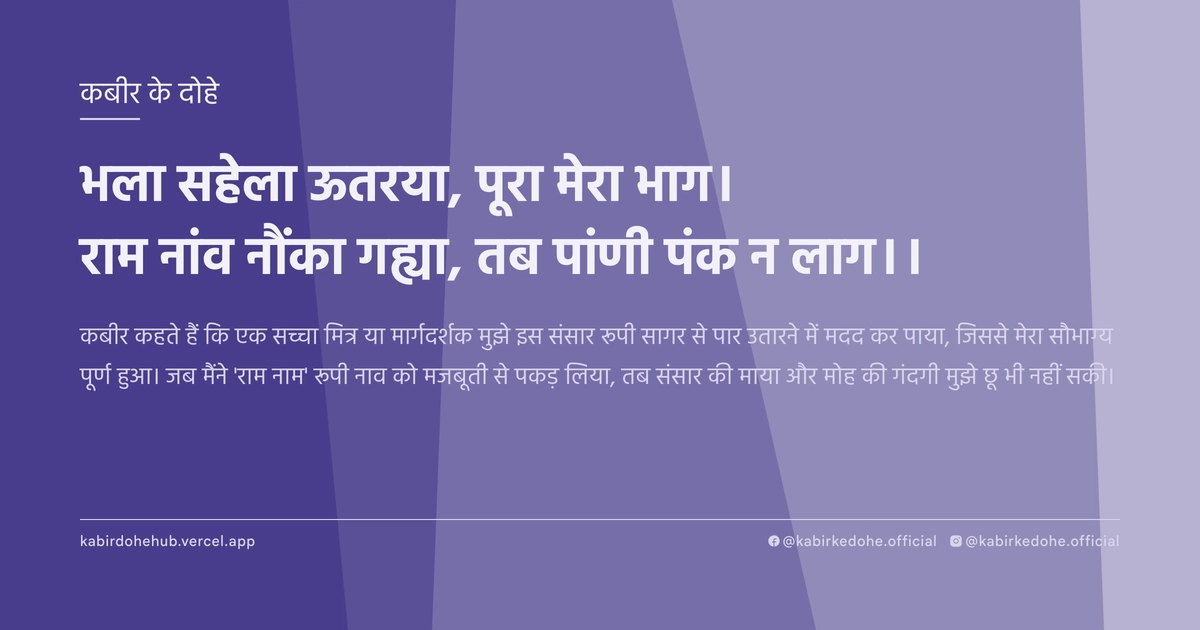
भला सहेला ऊतरया, पूरा मेरा भाग।
राम नांव नौंका गह्या, तब पांणी पंक न लाग।।
Bhala sahela utarya, poora mera bhaag. Ram naan nounka gahya, tab paani pank na laag.
इस पृष्ठ पर इस कबीर दोहे का अर्थ (meaning), हिंदी व्याख्या और अंग्रेज़ी अनुवाद, दार्शनिक विश्लेषण और व्यावहारिक जीवन सीख दी गई है। यह दोहा प्रपत्ति (Surrender) विषय से जुड़ा है — Kabir doha meaning and explanation in Hindi and English.
अर्थ (Meaning):
कबीर कहते हैं कि एक सच्चा मित्र या मार्गदर्शक मुझे इस संसार रूपी सागर से पार उतारने में मदद कर पाया, जिससे मेरा सौभाग्य पूर्ण हुआ। जब मैंने 'राम नाम' रूपी नाव को मजबूती से पकड़ लिया, तब संसार की माया और मोह की गंदगी मुझे छू भी नहीं सकी।
Kabir asserts that a true companion or spiritual guide has helped him cross the treacherous ocean of worldly existence, fulfilling his destiny. By clutching the boat of 'Ram Naam' (the Divine Name), he remained untouched by the filth and turbulence of material illusion and attachment.
व्याख्या (Interpretation):
यहाँ 'सहेला' केवल एक मित्र नहीं, बल्कि सद्गुरु का प्रतीक है जो अज्ञान के अंधकार में प्रकाश दिखाता है। 'पांणी पंक' संसार की माया और वासनाओं को दर्शाता है जो मनुष्य को आध्यात्मिक रूप से मलिन कर देती हैं। यह दोहा निर्गुण भक्ति की उस अवस्था को दर्शाता है जहाँ साधक आकार-रूप से ऊपर उठकर उस निराकार तत्व में लीन हो जाता है। अद्वैत वेदांत के अनुसार, जब जीव को यह बोध होता है कि वह स्वयं ब्रह्म है, तब संसार की द्वैतता समाप्त हो जाती है। राम यहाँ किसी व्यक्ति विशेष नहीं, बल्कि उस सर्वव्यापी चेतना का प्रतीक हैं जो आत्मा और परमात्मा के मिलन का सेतु बनती है।
In this verse, the 'companion' is not a mere friend but represents the Satguru, the spiritual catalyst who illuminates the darkness of ignorance. 'Paani Pank' (muddy water) symbolizes the Maya and sensory cravings that stain the human soul. This doha reflects the state of Nirgun Bhakti, where the seeker transcends form and attribute to merge with the Formless Absolute. According to Advaita Vedanta, when the Jiva realizes its identity as Brahman, the duality of the world vanishes. 'Ram' here is not a mythological figure but the cosmic consciousness, acting as the bridge between the individual soul and the Universal Truth.
दार्शनिक विश्लेषण (Philosophical Analysis):
कबीर का यह दोहा मध्यकालीन भारत के उस सामाजिक परिवेश में रचा गया जहाँ कर्मकांड और बाहरी आडंबरों का बोलबाला था। कबीर ने स्पष्ट रूप से मंदिर-मस्जिद के विवादों को नकारते हुए 'नाम' की आंतरिक साधना पर बल दिया। यह दृष्टिकोण सूफी मत के 'फना' (अहंकार का विलीनीकरण) और वेदांत के 'अहं ब्रह्मास्मि' के करीब है।
यहाँ 'नाव' का रूपक अत्यंत महत्वपूर्ण है। संसार को एक नदी या सागर माना गया है जिसमें अहंकार की लहरें साधक को डुबोने का प्रयास करती हैं। ritualism या बाहरी पूजा-पाठ केवल किनारे पर खड़े होने जैसा है, जबकि 'नाम' का जाप उस नाव पर सवार होने जैसा है जो वास्तव में पार लगाती है।
कबीर जाति और वर्ग के भेदभाव को पूरी तरह खारिज करते हैं। उनके लिए 'राम नाम' एक सार्वभौमिक चाबी है जो किसी विशेष जाति या धर्म के लिए आरक्षित नहीं है। यह मनोवैज्ञानिक रूपांतरण की प्रक्रिया है जहाँ व्यक्ति अपनी सीमित पहचान (ego) को त्यागकर अनंत में विलीन होता है।
अद्वैत दर्शन के अनुसार, माया वह पर्दा है जो हमें सत्य देखने नहीं देता। 'पंक' या कीचड़ इसी माया का रूप है। जब साधक नाम-स्मरण के माध्यम से अपनी चेतना को शुद्ध करता है, तो वह माया के बीच रहकर भी उससे अछूता रहता है, ठीक वैसे ही जैसे कमल का पत्ता पानी में रहकर भी गीला नहीं होता।
अंततः, यह दोहा यह संदेश देता है कि मोक्ष किसी बाहरी क्रिया से नहीं, बल्कि आंतरिक समर्पण और निरंतर जागरूकता से प्राप्त होता है। यह एक ऐसी यात्रा है जहाँ गुरु का मार्गदर्शन और स्वयं का प्रयास मिलकर आत्मा को परमात्मा के साथ एकाकार कर देते हैं।
This doha was composed during a period of intense ritualism and religious rigidity in medieval India. Kabir explicitly rejected the conflict between temples and mosques, emphasizing the internal practice of 'Naam' (the Divine Name). This approach aligns closely with the Sufi concept of 'Fana' (annihilation of the ego) and the Vedantic realization of 'Aham Brahmasmi' (I am Brahman).
The metaphor of the 'boat' is pivotal. The world is envisioned as a turbulent river or ocean where the waves of ego threaten to drown the seeker. Ritualism and external worship are likened to merely standing on the shore, whereas the practice of 'Naam' is the act of boarding the vessel that actually ensures crossing.
Kabir completely dismantles caste and class hierarchies. For him, 'Ram Naam' is a universal key, not reserved for any specific caste or creed. This is a process of psychological transformation where the individual sheds their limited identity (the ego) to merge into the Infinite.
According to Advaita philosophy, Maya is the veil that obscures the Truth. The 'mud' or 'filth' represents this Maya. When a seeker purifies their consciousness through constant remembrance of the Divine, they remain untouched by the world, much like a lotus leaf that stays dry despite being in the water.
Ultimately, the doha teaches that liberation is not achieved through external rites but through internal surrender and constant mindfulness. It is a journey where the guidance of the Guru and the effort of the seeker converge to unify the soul with the Absolute.
मूल संदेश (Core Message):
- अहंकार की नाव डूबने वाली है, सत्य की नाव को थामें।
- संसार की गंदगी केवल आंतरिक शुद्धता से ही दूर हो सकती है।
- सच्चा गुरु वह है जो आपको स्वयं से मिलवा दे।
- नाम का जाप केवल शब्द नहीं, बल्कि चेतना का विस्तार है।
- मोक्ष बाहरी यात्रा नहीं, बल्कि आंतरिक रूपांतरण है।
- The boat of ego is destined to sink; cling to the boat of Truth.
- The filth of the world can only be cleansed through inner purity.
- A true Guru is one who introduces you to your own True Self.
- The remembrance of the Name is not a word, but an expansion of consciousness.
- Liberation is not an external journey, but an internal transformation.
व्यावहारिक उदाहरण (Practical Example):
एक समय की बात है, वाराणसी के घाटों पर रहने वाला एक वृद्ध बुनकर था जिसका नाम माधव था। माधव अपनी पूरी जिंदगी रेशमी कपड़े बुनने में बिता चुका था, लेकिन उसका मन हमेशा अशांत रहता था। वह समाज में अपनी प्रतिष्ठा और धन को ही अपनी सफलता मानता था।
माधव का एक मित्र था, जो एक साधारण सा दिखने वाला फकीर था। वह फकीर अक्सर माधव को समझाता कि असली संपत्ति वह नहीं जो कपड़ों में चमकती है, बल्कि वह है जो भीतर की शांति में बसती है। माधव इसे केवल किताबी बातें मानता था।
एक बार माधव के जीवन में भारी संकट आया। उसके व्यापार में बड़ा घाटा हुआ और उसके करीबी रिश्तेदारों ने उसे धोखा दिया। वह जिस प्रतिष्ठा के पीछे भाग रहा था, वह रेत की तरह हाथ से फिसल गई। वह गहरे अवसाद में डूब गया और उसे लगा कि उसका जीवन व्यर्थ है।
वह फकीर मित्र उसके पास आया और उसने माधव से कहा, 'तुम अब तक उस नाव पर सवार थे जो दूसरों की नजरों से बनी थी। अब समय है कि तुम उस नाव को पकड़ो जो कभी नहीं डूबती—परमात्मा का नाम और स्वयं का बोध।'
माधव ने पहले तो विरोध किया, लेकिन फिर उसने फकीर के मार्गदर्शन में मौन और नाम-स्मरण का अभ्यास शुरू किया। उसने महसूस किया कि उसकी पीड़ा बाहरी नुकसान से नहीं, बल्कि उसके भीतर के अहंकार के टूटने से थी।
धीरे-धीरे माधव ने देखा कि वह अब भी वही काम कर रहा है, लेकिन अब वह परिणामों से नहीं बंधा है। वह अब रेशम के धागों में नहीं, बल्कि जीवन के सत्य में रुचि लेने लगा।
उसने अपने धन का एक हिस्सा गरीबों की सेवा में लगाना शुरू किया, न कि दिखावे के लिए। उसके व्यवहार में एक ऐसी विनम्रता आई जिसने उसके शत्रुओं को भी मित्र बना दिया।
एक दिन जब वह घाट पर बैठा था, उसने महसूस किया कि दुनिया की भीड़ और शोर अब उसे विचलित नहीं करते। वह भीड़ के बीच था, लेकिन उसका मन एक शांत झील की तरह था।
माधव को समझ आया कि 'राम नाम' कोई मंत्र मात्र नहीं था, बल्कि एक ऐसी मानसिक स्थिति थी जहाँ वह स्वयं को ब्रह्मांड का हिस्सा महसूस करने लगा।
इस 'कबीर ट्विस्ट' ने माधव को एक सफल व्यापारी से एक शांत और संतुष्ट मनुष्य बना दिया, जिसने जान लिया कि असली पार उतरना बाहरी सफलता नहीं, बल्कि आंतरिक शांति है।
Once, in the ghats of Varanasi, lived an elderly weaver named Madhav. Madhav had spent his entire life weaving exquisite silk fabrics, yet his mind was perpetually restless. He believed his success lay in his social prestige and accumulated wealth.
Madhav had a friend, a simple-looking wandering dervish. The dervish often told Madhav that true wealth is not what glitters in the fabric, but what resides in inner peace. Madhav dismissed these as mere poetic platitudes.
One day, a severe crisis hit Madhav's life. He suffered massive losses in business, and his closest relatives betrayed him. The prestige he had chased slipped through his fingers like sand. He fell into a deep depression, feeling his life was a failure.
The dervish friend approached him and said, 'Until now, you were aboard a boat built from the perceptions of others. It is time to grasp the boat that never sinks—the Divine Name and self-awareness.'
Madhav initially resisted, but under the dervish's guidance, he began the practice of silence and the remembrance of the Divine. He realized that his agony stemmed not from the external loss, but from the shattering of his ego.
Gradually, Madhav noticed that while he continued his work, he was no longer bound by the outcomes. He stopped seeking perfection in the silk threads and started seeking truth in life.
He began dedicating a portion of his earnings to the poor, not for show, but out of genuine compassion. A newfound humility entered his demeanor, turning even his enemies into friends.
One day, sitting on the ghats, he realized that the noise and chaos of the crowd no longer disturbed him. He was in the midst of the crowd, yet his mind was like a still lake.
Madhav understood that 'Ram Naam' was not just a mantra, but a state of consciousness where he felt himself as an integral part of the universe.
This 'Kabir Twist' transformed Madhav from a successful merchant into a peaceful and content human being, realizing that truly 'crossing over' is not about external success, but internal liberation.
अभ्यास मार्गदर्शन (Practice Guidance):
- प्रतिदिन 20 मिनट के लिए 'नाम-स्मरण' या किसी एक पवित्र शब्द पर ध्यान केंद्रित करें, ताकि मन की चंचलता कम हो सके।
- एक डायरी लिखें जिसमें आप उन 'पंक' (मानसिक गंदगी/नकारात्मकता) को सूचीबद्ध करें जो आपको आध्यात्मिक शांति से रोक रहे हैं।
- व्यवहार परिवर्तन: दिन में कम से कम एक बार किसी ऐसे व्यक्ति की निस्वार्थ मदद करें जिससे आपका कोई व्यक्तिगत लाभ न हो।
- निदान चेकलिस्ट: क्या आप अभी भी दूसरों की प्रशंसा पर निर्भर हैं? क्या छोटी सी आलोचना आपको विचलित करती है? यदि हाँ, तो आप अभी भी 'माया' की नाव पर हैं।
- Practice 'Naam-Smaran' or focus on a single sacred word for 20 minutes daily to reduce mental turbulence.
- Maintain a journal to list the 'Pank' (mental impurities/negativities) that hinder your spiritual peace.
- Behavioral Change: Perform one act of selfless service daily for someone from whom you expect absolutely nothing in return.
- Diagnostic Checklist: Are you still dependent on external validation? Does a small criticism disturb your peace? If yes, you are still aboard the 'boat of Maya'.
चिंतन प्रश्न (Reflection Questions):
- मेरी वह कौन सी 'नाव' है जिसे मैं इतनी मजबूती से पकड़े हुए हूँ कि मैं डूबने के डर से नया रास्ता नहीं देख पा रहा?
- मेरा 'डिजिटल अहंकार' (सोशल मीडिया इमेज) मुझे वास्तविक सत्य से कितना दूर ले जा रहा है?
- क्या मैं वास्तव में धर्म का पालन कर रहा हूँ, या मैं केवल सामाजिक स्वीकार्यता के लिए कर्मकांड कर रहा हूँ?
- मेरे जीवन में वह 'सहेला' या मार्गदर्शक कौन है, और क्या मैं उसके प्रति वास्तव में समर्पित हूँ?
- यदि आज मेरी सारी बाहरी उपलब्धियाँ छीन ली जाएँ, तो मेरे भीतर क्या बचेगा?
- What is the 'boat' I am clinging to so tightly that I cannot see a new path for fear of sinking?
- How much is my 'digital ego' (social media image) distancing me from the actual Truth?
- Am I truly practicing spirituality, or am I merely performing rituals for social acceptance?
- Who is the 'companion' or guide in my life, and am I genuinely surrendered to their wisdom?
- If all my external achievements were stripped away today, what would remain within me?