
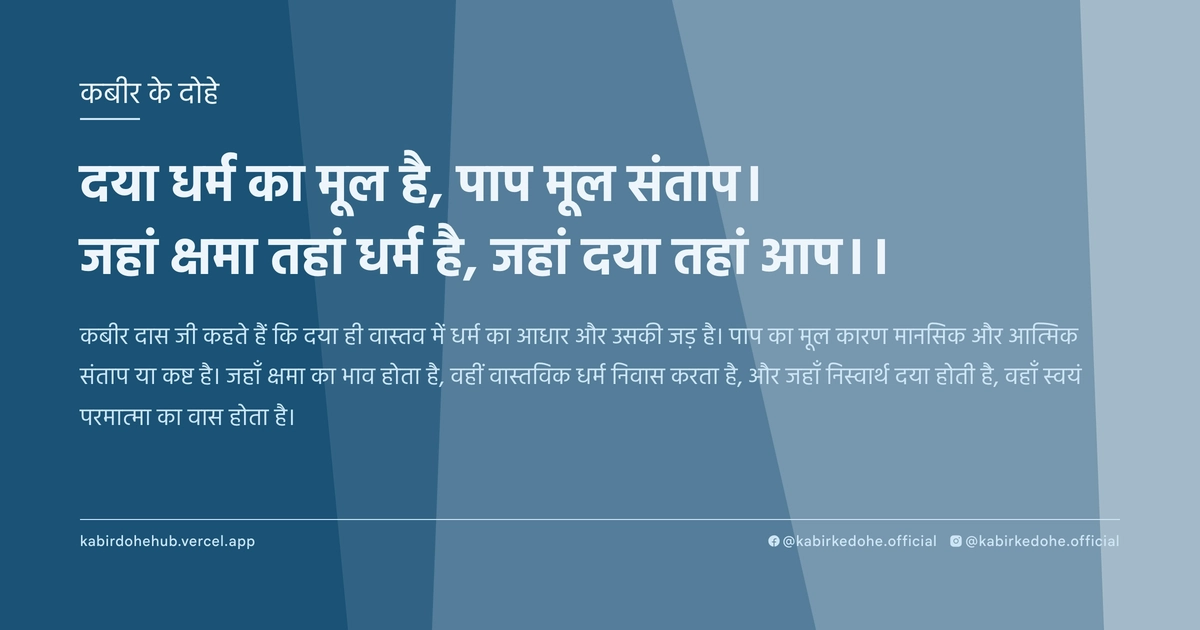
दया धर्म का मूल है, पाप मूल संताप।
जहां क्षमा तहां धर्म है, जहां दया तहां आप।।
Daya dharm ka mool hai, paap mool santaap. Jahan kshama tahaan dharm hai, jahan daya tahaan aap.
इस पृष्ठ पर इस कबीर दोहे का अर्थ (meaning), हिंदी व्याख्या और अंग्रेज़ी अनुवाद, दार्शनिक विश्लेषण और व्यावहारिक जीवन सीख दी गई है। यह दोहा करुणा (Compassion) विषय से जुड़ा है — Kabir doha meaning and explanation in Hindi and English.
अर्थ (Meaning):
कबीर दास जी कहते हैं कि दया ही वास्तव में धर्म का आधार और उसकी जड़ है। पाप का मूल कारण मानसिक और आत्मिक संताप या कष्ट है। जहाँ क्षमा का भाव होता है, वहीं वास्तविक धर्म निवास करता है, और जहाँ निस्वार्थ दया होती है, वहाँ स्वयं परमात्मा का वास होता है।
Kabir asserts that compassion is the very root and foundation of all true religion. Sin originates from the seed of suffering and agitation. Where forgiveness exists, there lies true righteousness; and where genuine compassion dwells, there resides the Divine Presence itself.
व्याख्या (Interpretation):
इस दोहे का शाब्दिक अर्थ है कि करुणा ही धर्म की बुनियाद है। गहराई में, कबीर 'धर्म' को कर्मकांडों से हटाकर मानवीय संवेदनाओं से जोड़ते हैं। यहाँ 'दया' केवल बाहरी मदद नहीं, बल्कि 'अद्वैत' की अनुभूति है—यह समझना कि दूसरे का दुख मेरा अपना दुख है। 'संताप' वह मानसिक द्वंद्व है जो अहंकार से उपजता है और पाप की ओर ले जाता है। जब साधक क्षमा को अपनाता है, तो वह अपने अहंकार का विसर्जन करता है, जिससे धर्म का वास्तविक स्वरूप प्रकट होता है। अंततः, दयालु हृदय ही वह मंदिर है जहाँ 'आप' यानी निराकार ब्रह्म का साक्षात्कार होता है। यह विरोधाभास है कि बाहरी आडंबरों को त्यागकर केवल आंतरिक करुणा के माध्यम से ही ईश्वर प्राप्त किया जा सकता है।
Literally, the verse states that compassion is the basis of religion. Metaphorically, Kabir shifts the definition of 'Dharma' from ritualistic adherence to profound human empathy. Here, 'Daya' (compassion) is not mere charity, but an experience of 'Advaita' (non-duality)—the realization that the suffering of another is identical to one's own. 'Santap' refers to the psychic agitation born of ego, which inevitably leads to sin. When a seeker embraces 'Kshama' (forgiveness), they dissolve the ego, allowing the true essence of righteousness to emerge. Ultimately, the compassionate heart is the only sanctuary where 'Aap' (the Divine/Self) resides. It presents the paradox that by abandoning external religious structures and embracing internal mercy, one finds the Formless Absolute.
दार्शनिक विश्लेषण (Philosophical Analysis):
कबीर का यह दृष्टिकोण उनके युग के कट्टरपंथी धार्मिक वातावरण के विरुद्ध एक सशक्त प्रतिक्रिया था। उस समय धर्म को केवल पूजा-पाठ, तीर्थयात्रा और जातिगत श्रेष्ठता के रूप में देखा जाता था। कबीर ने इस धारणा को चुनौती देते हुए 'निगुण भक्ति' का मार्ग प्रशस्त किया, जहाँ ईश्वर किसी मंदिर या मस्जिद में नहीं, बल्कि मनुष्य की करुणा में बसता है।
अद्वैत वेदांत के परिप्रेक्ष्य में, यदि पूरी सृष्टि एक ही ब्रह्म का विस्तार है, तो किसी अन्य जीव के प्रति घृणा करना स्वयं के विरुद्ध अपराध है। दया वास्तव में इस सत्य की व्यावहारिक अभिव्यक्ति है। जब हम किसी को क्षमा करते हैं, तो हम उस द्वैत (मैं और तुम) को समाप्त करते हैं जो हमें अलग करता है।
सूफीवाद के 'इश्क-ए-हकीकी' (ईश्वरीय प्रेम) के साथ इसका गहरा संबंध है। सूफी संतों की तरह, कबीर मानते हैं कि बिना प्रेम और दया के कोई भी इबादत व्यर्थ है। पाप को यहाँ केवल नैतिक गलती नहीं, बल्कि 'अज्ञान' और 'अलगाव' के रूप में देखा गया है, जो आत्मा को परमात्मा से दूर करता है।
मनोवैज्ञानिक स्तर पर, 'संताप' या मानसिक क्लेश ही वह बीज है जो क्रोध और हिंसा को जन्म देता है। कबीर सुझाव देते हैं कि इस चक्र को तोड़ने का एकमात्र तरीका क्षमा है। क्षमा केवल दूसरे को मुक्त नहीं करती, बल्कि क्षमा करने वाले को उसके अपने मानसिक बोझ से मुक्त करती है।
अंततः, कबीर का दर्शन यह है कि धर्म कोई बाहरी आवरण नहीं, बल्कि एक आंतरिक रूपांतरण है। जब अहंकार मरता है, तब दया जन्म लेती है, और दया के माध्यम से ही मनुष्य अपनी मूल प्रकृति—जो कि शुद्ध प्रेम है—को पुनः प्राप्त करता है।
Kabir's perspective serves as a potent reaction against the dogmatic religious atmosphere of his era. During his time, religion was narrowly viewed as a collection of rituals, pilgrimages, and caste hierarchies. Kabir challenged this by paving the way for 'Nirgun Bhakti,' where the Divine is found not in temples or mosques, but within human compassion.
From the lens of Advaita Vedanta, if the entire universe is an extension of a single Brahman, then hatred toward another being is a crime against oneself. Compassion is the practical manifestation of this non-dual truth. By forgiving, one dismantles the duality of 'I' and 'Thou' that creates separation.
This aligns deeply with the Sufi concept of 'Ishq-e-Haqiqi' (Divine Love). Like the Sufi saints, Kabir believed that any act of worship devoid of love and mercy is futile. Sin is interpreted here not merely as a moral lapse, but as 'Avidya' (ignorance) and alienation, which distances the Atman from the Paramatman.
Psychologically, 'Santap' or mental agitation is the seed that sprouts into anger and violence. Kabir suggests that the only mechanism to break this cycle is forgiveness. Forgiveness does not merely liberate the offender; it liberates the forgiver from the psychic burden of resentment.
Ultimately, Kabir's philosophy asserts that religion is not an external cloak but an internal transformation. When the ego is annihilated, compassion is born, and through this compassion, the human being recovers their original nature—which is pure, unconditional love.
मूल संदेश (Core Message):
- अहंकार का त्याग ही वास्तविक धर्म की पहली सीढ़ी है।
- करुणा केवल एक भावना नहीं, बल्कि अद्वैत सत्य का अनुभव है।
- क्षमा दूसरों के लिए उपहार है, लेकिन स्वयं के लिए मुक्ति।
- पाप बाहरी क्रिया नहीं, बल्कि आंतरिक अशांति और द्वेष है।
- जहाँ दया है, वहाँ ईश्वर को खोजने के लिए कहीं और जाने की आवश्यकता नहीं।
- The surrender of ego is the first step toward true righteousness.
- Compassion is not just an emotion, but the experience of non-dual truth.
- Forgiveness is a gift to others, but a liberation for oneself.
- Sin is not an external act, but internal turmoil and malice.
- Where compassion dwells, there is no need to search for God elsewhere.
व्यावहारिक उदाहरण (Practical Example):
वाराणसी के एक पुराने घाट पर रामदीन नाम का एक वृद्ध नाविक रहता था। वह स्वभाव से अत्यंत क्रोधी था और अपनी छोटी सी नाव के लिए दूसरों से अक्सर झगड़ता था। उसका मानना था कि दुनिया केवल चालाकी से चलती है और दया कमजोरी की निशानी है।
एक दिन, एक युवा यात्री उसकी नाव पर सवार हुआ। वह यात्री बहुत शांत था और उसकी आँखों में एक अजीब सी गहराई थी। यात्रा के दौरान, रामदीन ने अपनी आदत के अनुसार उस यात्री पर चिल्लाना शुरू किया क्योंकि उसने नाव के किनारे पर कुछ सामान गलत रखा था।
युवा यात्री ने न केवल रामदीन के क्रोध को शांति से सहा, बल्कि जब रामदीन की नाव एक पत्थर से टकराकर थोड़ा पानी अंदर भरने लगी, तो उस यात्री ने बिना किसी शिकायत के रामदीन की मदद की और उसके पुराने, फटे हुए कपड़ों को सुखाने के लिए अपना अंगवस्त्र दे दिया।
रामदीन हैरान था। उसने जीवन भर लोगों को केवल अपनी शर्तों पर झुकते देखा था, लेकिन यहाँ कोई ऐसा व्यक्ति था जो उसकी कड़वाहट के बदले उसे निस्वार्थ करुणा दे रहा था। उस रात रामदीन सो नहीं सका। उसे महसूस हुआ कि उसका क्रोध उसे अंदर से जला रहा था, जबकि उस युवक की शांति उसे सुकून दे रही थी।
अगले दिन, रामदीन ने एक ऐसे व्यक्ति को अपनी नाव में मुफ्त बिठाया जो बहुत गरीब था और जिसे शहर जाना था। जब उस गरीब व्यक्ति ने उसे दुआएं दीं, तो रामदीन को पहली बार अपने सीने में एक हल्कापन महसूस हुआ।
धीरे-धीरे, रामदीन का व्यवहार बदलने लगा। उसने घाट के अन्य नाविकों के साथ अपने विवाद सुलझाना शुरू किया। उसने महसूस किया कि जब वह दूसरों को क्षमा करता है, तो उसका अपना मानसिक तनाव (संताप) कम हो जाता है।
वह अब केवल एक नाविक नहीं था, बल्कि घाट पर विवादों को सुलझाने वाला एक सम्मानित व्यक्ति बन गया था। लोग उसके पास शांति की तलाश में आने लगे।
रामदीन ने समझा कि उसकी नाव तो लकड़ी की थी, लेकिन उसका असली सफर उसके अहंकार से करुणा की ओर था। वह जान गया कि जिस ईश्वर को वह गंगा की लहरों में खोज रहा था, वह वास्तव में उसके भीतर की दया में छिपा था।
On an ancient ghat in Varanasi lived an elderly boatman named Ramdeen. He was notoriously temperamental, frequently clashing with others over the placement of his small boat. He believed the world operated solely on cunning and that compassion was a mark of weakness.
One day, a young traveler boarded his boat. This traveler possessed a profound stillness and an unusual depth in his eyes. During the journey, Ramdeen began shouting at the traveler, as per his habit, because the man had placed his luggage slightly askew.
The young traveler not only endured Ramdeen's rage with silence but, when the boat struck a submerged rock and began taking on water, he immediately helped Ramdeen bail it out without a single word of complaint. He even offered his own shawl to dry Ramdeen's soaked, tattered clothes.
Ramdeen was bewildered. Throughout his life, he had only seen people bend to his will through fear or transaction, but here was someone offering selfless mercy in exchange for bitterness. That night, Ramdeen could not sleep. He realized his anger was incinerating him from within, while the youth's peace was an invitation to serenity.
The following day, Ramdeen offered a free ride to a destitute man who needed to reach the city. When the poor man blessed him with genuine gratitude, Ramdeen felt a lightness in his chest for the first time in decades.
Gradually, Ramdeen's behavior shifted. He began resolving his long-standing disputes with other boatmen. He discovered that whenever he forgave another, his own internal agitation (Santap) diminished.
He was no longer just a boatman; he became a respected mediator on the ghats. People began seeking him out for peace and counsel.
Ramdeen realized that while his boat was made of wood, his true journey was from the shores of ego to the ocean of compassion. He understood that the Divine he had been searching for in the currents of the Ganges was actually hidden within his own capacity for mercy.
अभ्यास मार्गदर्शन (Practice Guidance):
- दैनिक करुणा अभ्यास: प्रतिदिन कम से कम एक व्यक्ति के प्रति, विशेषकर उनके प्रति जिनसे आप असहमत हैं, मन में वास्तविक दया का भाव लाएं और उनके कल्याण की कामना करें।
- क्षमा जर्नल: एक डायरी लिखें जिसमें उन लोगों के नाम हों जिनसे आप नाराज हैं। उनके नाम के आगे लिखें कि उन्हें क्षमा करना आपके अपने मानसिक स्वास्थ्य के लिए क्यों आवश्यक है।
- मौन निरीक्षण: जब भी क्रोध आए, 10 सेकंड के लिए रुकें और स्वयं से पूछें—'क्या यह क्रोध मेरे अहंकार को संतुष्ट कर रहा है या मेरी आत्मा को?'
- निदान चेकलिस्ट: क्या आप दूसरों की गलतियों पर तुरंत प्रतिक्रिया देते हैं? क्या आप स्वयं को दूसरों से श्रेष्ठ महसूस करते हैं? यदि हाँ, तो आप अभी भी 'संताप' के प्रभाव में हैं और दया के मार्ग से दूर हैं।
- Daily Compassion Practice: Every day, consciously cultivate a feeling of genuine mercy toward at least one person, especially someone you disagree with, and wish for their highest well-being.
- Forgiveness Journaling: Maintain a diary listing individuals you harbor resentment toward. Next to each name, write why forgiving them is essential for your own psychic liberation.
- Silent Observation: Whenever anger arises, pause for 10 seconds and ask yourself: 'Is this anger feeding my ego or nourishing my soul?'
- Diagnostic Checklist: Do you react impulsively to others' mistakes? Do you secretly feel superior to those around you? If yes, you are still under the influence of 'Santap' and distant from the path of Daya.
चिंतन प्रश्न (Reflection Questions):
- मेरे जीवन में 'धर्म' का अर्थ क्या है—बाहरी नियमों का पालन या आंतरिक करुणा का विस्तार?
- मैं जिन लोगों को क्षमा नहीं कर पा रहा हूँ, क्या वे वास्तव में अपराधी हैं, या वे मेरे अहंकार के लिए दर्पण हैं?
- मेरी 'दया' वास्तव में निस्वार्थ है, या यह मेरी श्रेष्ठता की भावना को पुष्ट करने का एक तरीका है?
- मेरे भीतर का 'संताप' (मानसिक क्लेश) किन परिस्थितियों में सबसे अधिक सक्रिय होता है और वह मुझे किस प्रकार के 'पाप' की ओर धकेलता है?
- यदि मैं आज अपनी पूरी पहचान (नाम, पद, जाति) खो दूँ, तो क्या मेरे पास केवल 'दया' शेष रहेगी?
- What does 'Dharma' mean in my life—adherence to external rules or the expansion of internal compassion?
- Are the people I cannot forgive truly the offenders, or are they mirrors reflecting my own ego?
- Is my 'compassion' truly selfless, or is it a covert way to reinforce my sense of superiority?
- In which circumstances is my 'Santap' (mental agitation) most active, and how does it push me toward 'sin'?
- If I were to lose my entire identity (name, rank, caste) today, would compassion be the only thing remaining of me?