
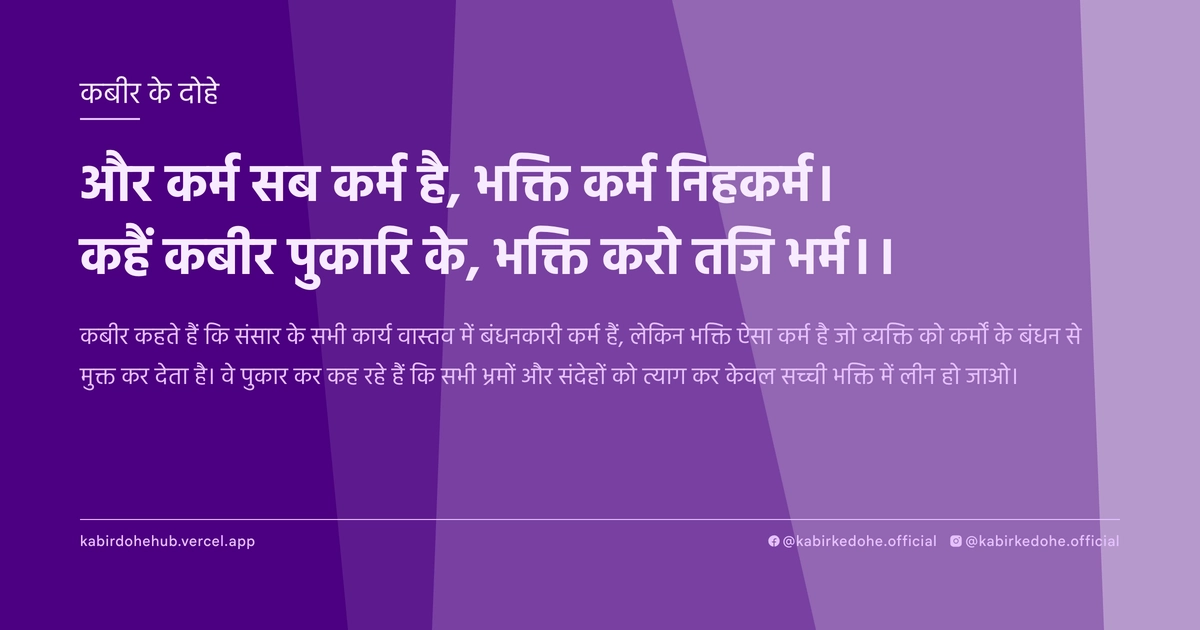
और कर्म सब कर्म है, भक्ति कर्म निहकर्म।
कहैं कबीर पुकारि के, भक्ति करो तजि भर्म।।
Aur karm sab karm hai, bhakti karm nihkarm. Kahein kabir pukari ke, bhakti karo taji bharm.
इस पृष्ठ पर इस कबीर दोहे का अर्थ (meaning), हिंदी व्याख्या और अंग्रेज़ी अनुवाद, दार्शनिक विश्लेषण और व्यावहारिक जीवन सीख दी गई है। यह दोहा भक्ति (Bhakti) विषय से जुड़ा है — Kabir doha meaning and explanation in Hindi and English.
अर्थ (Meaning):
कबीर कहते हैं कि संसार के सभी कार्य वास्तव में बंधनकारी कर्म हैं, लेकिन भक्ति ऐसा कर्म है जो व्यक्ति को कर्मों के बंधन से मुक्त कर देता है। वे पुकार कर कह रहे हैं कि सभी भ्रमों और संदेहों को त्याग कर केवल सच्ची भक्ति में लीन हो जाओ।
Kabir asserts that all worldly actions are binding karmas, but the act of devotion (Bhakti) is a 'non-action' that liberates one from the cycle of cause and effect. He urgently calls upon the seeker to abandon all delusions and doubts to embrace pure, unwavering devotion.
व्याख्या (Interpretation):
इसका शाब्दिक अर्थ है कि सांसारिक गतिविधियाँ हमें कर्म-जाल में फँसाती हैं, जबकि भक्ति हमें मुक्त करती है। रूपक के स्तर पर, 'कर्म' यहाँ अहंकार-प्रेरित इच्छाओं का प्रतीक है, जबकि 'निहकर्म' वह अवस्था है जहाँ कर्ता भाव समाप्त हो जाता है। यह निर्गुण भक्ति का सार है, जहाँ ईश्वर किसी मूर्ति में नहीं बल्कि स्वयं के भीतर शून्य में स्थित है। माया हमें यह विश्वास दिलाती है कि हम अलग हैं, लेकिन भक्ति उस पर्दे को हटा देती है। जब भक्त और भगवान एक हो जाते हैं, तो कर्म का अस्तित्व मिट जाता है। यह अद्वैत वेदांत के उस सिद्धांत को दर्शाता है जहाँ आत्मा और ब्रह्म की एकता स्थापित होती है। अंततः, यह विरोधाभास है कि एक 'कर्म' (भक्ति) ही हमें सभी 'कर्मों' से मुक्त करता है।
Literally, the verse distinguishes between binding worldly actions and the liberating act of devotion. Metaphorically, 'karm' represents ego-driven desires and the illusion of agency, while 'nihkarm' (non-action) signifies the state where the sense of 'doer-ship' dissolves. This aligns with Nirgun Bhakti, where the Divine is not an external idol but the formless void within. Maya creates the illusion of separation, but devotion acts as the solvent for this veil. When the devotee and the Divine merge, the duality required for karma to exist vanishes. This mirrors Advaita Vedanta's non-duality, where the Atman is realized as Brahman. The central paradox is that one specific 'action'—devotion—is the only path to achieving a state of total actionlessness.
दार्शनिक विश्लेषण (Philosophical Analysis):
कबीर का यह दोहा उस समय के सामाजिक और धार्मिक परिवेश की प्रतिक्रिया है जहाँ कर्मकांडों और बाहरी आडंबरों को मोक्ष का मार्ग माना जाता था। कबीर ने स्पष्ट किया कि केवल मंदिर जाना या तीर्थ यात्रा करना 'कर्म' है, जो अहंकार को बढ़ाता है, जबकि आंतरिक समर्पण 'निहकर्म' है।
यहाँ 'निहकर्म' का अर्थ आलस्य नहीं, बल्कि 'निष्काम कर्म' है। यह भगवद गीता के उस सिद्धांत से मिलता है जहाँ फल की इच्छा का त्याग कर दिया जाता है। जब व्यक्ति यह मान लेता है कि वह केवल एक माध्यम है और वास्तविक कर्ता परमात्मा है, तो वह कर्म के बंधनों से मुक्त हो जाता है।
सूफीवाद के 'फना' (अहंकार का विनाश) के सिद्धांत के साथ इसका गहरा संबंध है। जैसे सूफी संत अपनी पहचान को ईश्वर में विलीन कर देते हैं, वैसे ही कबीर भक्ति के माध्यम से 'मैं' को मिटाने की बात करते हैं। बिना 'मैं' के, कोई कर्म नहीं होता और बिना कर्म के कोई बंधन नहीं होता।
अद्वैत वेदांत के परिप्रेक्ष्य में, यह दोहा अज्ञान (Avidya) के विनाश की बात करता है। भ्रम (Bharm) वह पर्दा है जो हमें यह सोचने पर मजबूर करता है कि हम शरीर हैं। भक्ति यहाँ एक मानसिक उपकरण है जो चेतना को स्थूल जगत से हटाकर सूक्ष्म सत्य की ओर ले जाता है।
कबीर का दृष्टिकोण क्रांतिकारी था क्योंकि उन्होंने जाति और वर्ण के आधार पर निर्धारित 'कर्मों' को नकार दिया। उन्होंने तर्क दिया कि ईश्वर तक पहुँचने के लिए किसी पुरोहित या विशेष अनुष्ठान की आवश्यकता नहीं है, बल्कि केवल एक शुद्ध हृदय और संदेह-रहित समर्पण ही पर्याप्त है।
This couplet is a direct response to the ritualistic environment of Kabir's era, where external ceremonies and pilgrimages were mistaken for the path to liberation. Kabir clarifies that such activities are merely 'karm'—actions that often inflate the ego—whereas internal surrender is 'nihkarm'.
'Nihkarm' here does not imply laziness or inaction, but rather 'Nishkama Karma' (desireless action). It resonates with the Bhagavad Gita's teaching of relinquishing the fruits of labor. When an individual realizes they are merely an instrument and the Divine is the true actor, the binding nature of karma dissolves.
There is a profound connection to the Sufi concept of 'Fana' (annihilation of the self). Just as Sufi mystics seek to dissolve their identity into the Beloved, Kabir advocates for the erasure of the 'I' through devotion. Without the ego, there is no 'doer,' and without a doer, no karmic debt can be accrued.
From the lens of Advaita Vedanta, this verse addresses the destruction of Avidya (ignorance). The 'Bharm' (delusion) is the veil that convinces us we are limited physical entities. Devotion serves as a psychological tool to shift consciousness from the gross material world to the subtle, absolute truth.
Kabir's approach was revolutionary because he rejected the caste-based division of labor and spiritual merit. He argued that reaching the Divine requires no priestly intermediary or complex ritual, but only a pure heart and a surrender devoid of doubt.
मूल संदेश (Core Message):
- बाहरी कर्म बंधन हैं, आंतरिक समर्पण मुक्ति है।
- अहंकार द्वारा किया गया पुण्य भी एक जंजीर है।
- भक्ति वह अग्नि है जो कर्मों के बीज जला देती है।
- संदेह और भ्रम ही सत्य के मार्ग की सबसे बड़ी बाधाएं हैं।
- जब 'मैं' मिटता है, तब केवल अनंत सत्य शेष रहता है।
- External rituals bind; internal surrender liberates.
- Merit earned through ego is still a golden chain.
- Devotion is the fire that incinerates the seeds of karma.
- Doubt and delusion are the primary obstacles to Truth.
- When the 'I' vanishes, only the Infinite Truth remains.
व्यावहारिक उदाहरण (Practical Example):
वाराणसी के घाटों पर रहने वाले एक वृद्ध विधवा, जानकी, का जीवन केवल दूसरों के लिए भोजन बनाने और दान देने में बीत रहा था। वह मानती थी कि उसके द्वारा किए गए ये सभी 'पुण्य कर्म' उसे स्वर्ग ले जाएंगे। वह हर दिन घंटों मंत्र जाप करती, लेकिन उसके मन में हमेशा यह डर रहता कि क्या वह सही विधि अपना रही है या नहीं।
एक दिन उसकी मुलाकात एक घुमक्कड़ फकीर से हुई जिसने उसे कबीर का यह दोहा सुनाया। फकीर ने उससे पूछा, 'माँ, तुम यह सब किसके लिए कर रही हो? स्वर्ग के लिए या उस परमात्मा के लिए?' जानकी चुप रही, क्योंकि उसे अहसास हुआ कि उसका सारा पुण्य वास्तव में उसके अपने 'स्वर्ग' के अहंकार को पोषित कर रहा था।
उसने महसूस किया कि वह 'पुण्य' कमाने के कर्म में इतनी व्यस्त थी कि वह उस ईश्वर को भूल गई थी जिसे वह खोज रही थी। वह भक्ति को एक कार्य (Task) मान रही थी, न कि एक अवस्था (State)।
जानकी ने धीरे-धीरे अपनी बाहरी दिखावटी पूजा कम कर दी। उसने अब भोजन बनाना बंद नहीं किया, लेकिन अब वह इसे 'पुण्य कमाने' के लिए नहीं, बल्कि 'ईश्वर की सेवा' के रूप में करने लगी।
उसने अपने मन से यह भ्रम निकाल दिया कि मोक्ष किसी विशेष विधि या मंत्र से मिलता है। उसने केवल मौन रहकर अपने भीतर के शून्य को निहारना शुरू किया।
अब जब वह किसी भूखे को रोटी देती, तो उसे यह महसूस नहीं होता था कि वह 'दान' कर रही है, बल्कि यह कि वह स्वयं उस भूखे के भीतर मौजूद परमात्मा को खिला रही है।
उसका डर गायब हो गया और उसकी जगह एक गहरी शांति ने ले ली। वह अब कर्मों के बोझ तले दबी हुई नहीं थी, बल्कि भक्ति के प्रवाह में बह रही थी।
अंततः, जानकी ने पाया कि जब 'मैं' (दाता) मर गया, तो केवल 'प्रेम' (भक्ति) शेष रहा। यही वह 'निहकर्म' था जिसने उसे जीवन रहते ही मुक्त कर दिया।
Janaki, an elderly widow living on the ghats of Varanasi, spent her days cooking for others and donating food. She believed that these 'meritorious deeds' (punya karmas) would secure her a place in heaven. She spent hours chanting mantras, yet was plagued by the constant fear of whether she was following the rituals correctly.
One day, she met a wandering fakir who recited this specific Doha to her. The fakir asked, 'Mother, for whom are you doing all this? For a reward in heaven, or for the Divine?' Janaki fell silent, realizing that her pursuit of merit was actually nourishing her own ego's desire for a celestial reward.
She realized she had been so preoccupied with the 'action' of earning merit that she had forgotten the very Divine she claimed to seek. She had treated devotion as a task to be completed, rather than a state of being.
Gradually, Janaki reduced her performative rituals. She did not stop cooking, but she shifted her intention; she no longer cooked to 'earn' anything, but as a selfless offering to the Divine.
She discarded the delusion that liberation is achieved through a specific method or a precise mantra. Instead, she began to practice silence, observing the void within herself.
Now, when she fed a hungry person, she no longer felt like a 'donor' giving to a 'receiver.' She felt as though she was feeding the Divine residing within the hungry soul.
Her fear vanished, replaced by a profound, unshakable peace. She was no longer burdened by the weight of accumulating karmas, but was flowing in the current of pure devotion.
Ultimately, Janaki discovered that when the 'I' (the giver) died, only 'Love' (Bhakti) remained. This was the 'nihkarm' that liberated her while she was still alive.
अभ्यास मार्गदर्शन (Practice Guidance):
- साक्षी भाव का अभ्यास: दिन भर में किए जाने वाले कार्यों के दौरान स्वयं को एक 'कर्ता' के बजाय एक 'साक्षी' के रूप में देखें। यह सोचें कि कार्य हो रहा है, मैं नहीं कर रहा।
- भ्रम-निरीक्षण जर्नल: प्रतिदिन एक ऐसी बात लिखें जहाँ आपका अहंकार (Ego) आपको यह महसूस करा रहा है कि आप 'विशेष' हैं या 'पुण्य' कमा रहे हैं। फिर उसे चुनौती दें।
- मौन समर्पण ध्यान: प्रतिदिन 20 मिनट के लिए पूर्ण मौन में बैठें। किसी मंत्र का जाप न करें, बस अपने भीतर के शून्य में विलीन होने का प्रयास करें।
- डायग्नोस्टिक चेकलिस्ट: क्या मैं यह कार्य फल की इच्छा से कर रहा हूँ? क्या मुझे इस कार्य के बाद प्रशंसा की उम्मीद है? क्या मैं स्वयं को दूसरों से श्रेष्ठ महसूस कर रहा हूँ? यदि हाँ, तो आप अभी भी 'कर्म' में हैं, 'निहकर्म' में नहीं।
- Practice of Witness Consciousness: During daily activities, view yourself as a 'witness' rather than a 'doer.' Remind yourself: 'The action is happening, I am not the actor.'
- Delusion-Inspection Journal: Daily, record one instance where your ego made you feel 'special' or as if you were 'earning merit.' Then, intellectually challenge that feeling.
- Silent Surrender Meditation: Sit in complete silence for 20 minutes daily. Avoid mantras or structured prayers; simply attempt to merge into the inner void.
- Diagnostic Checklist: Am I performing this act with an expectation of reward? Do I crave recognition after this deed? Do I feel superior to others because of this? If yes, you are still in 'karm,' not 'nihkarm.'
चिंतन प्रश्न (Reflection Questions):
- क्या मेरी धार्मिकता वास्तव में ईश्वर के प्रति प्रेम है, या यह मेरे स्वयं के 'अच्छे इंसान' होने के अहंकार को संतुष्ट कर रही है?
- यदि मुझे मेरे अच्छे कार्यों के लिए कोई प्रशंसा या स्वर्ग का फल न मिले, तो क्या मैं फिर भी उन कार्यों को उसी प्रेम से करूँगा?
- मेरे जीवन में वह कौन सा 'भ्रम' है जिसे मैं सत्य मानकर पकड़ कर बैठा हूँ?
- क्या मैं वास्तव में समर्पित हूँ, या मैं ईश्वर के साथ एक 'सौदेबाजी' कर रहा हूँ?
- मेरी सार्वजनिक आध्यात्मिक छवि और मेरे निजी आंतरिक संघर्षों के बीच कितना अंतर है?
- Is my religiosity truly love for the Divine, or is it merely feeding my ego's image of being a 'good person'?
- If I were guaranteed no praise or heavenly reward for my good deeds, would I still perform them with the same love?
- What is the specific 'delusion' in my life that I am clinging to as if it were the absolute truth?
- Am I truly surrendered, or am I engaged in a subconscious 'bargain' with the Divine?
- How wide is the gap between my public spiritual persona and my private internal shadows?