
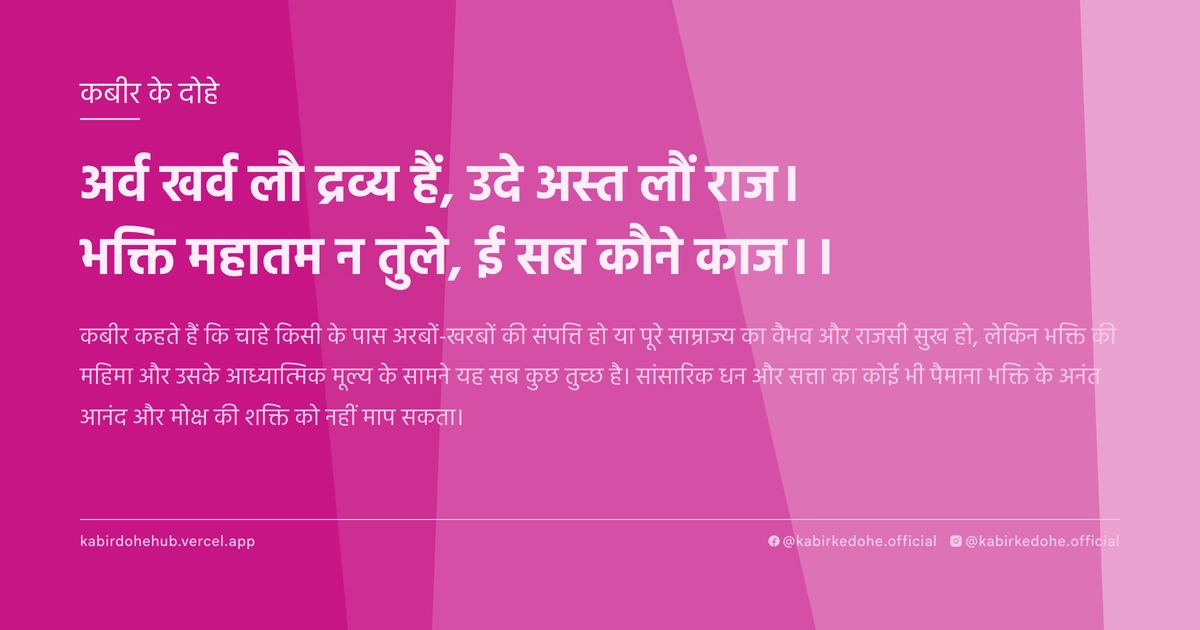
अर्व खर्व लौ द्रव्य हैं, उदे अस्त लौं राज।
भक्ति महातम न तुले, ई सब कौने काज।।
Arv kharv lau dravya hain, ude ast laun raaj. Bhakti mahatam na tule, ee sab kaune kaaj.
इस पृष्ठ पर इस कबीर दोहे का अर्थ (meaning), हिंदी व्याख्या और अंग्रेज़ी अनुवाद, दार्शनिक विश्लेषण और व्यावहारिक जीवन सीख दी गई है। यह दोहा भक्ति (Bhakti) विषय से जुड़ा है — Kabir doha meaning and explanation in Hindi and English.
अर्थ (Meaning):
कबीर कहते हैं कि चाहे किसी के पास अरबों-खरबों की संपत्ति हो या पूरे साम्राज्य का वैभव और राजसी सुख हो, लेकिन भक्ति की महिमा और उसके आध्यात्मिक मूल्य के सामने यह सब कुछ तुच्छ है। सांसारिक धन और सत्ता का कोई भी पैमाना भक्ति के अनंत आनंद और मोक्ष की शक्ति को नहीं माप सकता।
Kabir asserts that whether one possesses wealth in the billions and trillions, or holds the sovereign power of vast empires, such material abundance is insignificant compared to the greatness of devotion. No earthly measure of gold or governance can outweigh the spiritual liberation and eternal bliss derived from true devotion to the Divine.
व्याख्या (Interpretation):
इस दोहे का शाब्दिक अर्थ भौतिक संपदा और आध्यात्मिक संपदा के बीच के अंतर को स्पष्ट करना है। यहाँ 'अर्व' और 'खर्व' केवल संख्याओं को नहीं, बल्कि मानवीय लालसा की चरम सीमा को दर्शाते हैं। रूपकात्मक रूप से, कबीर यह समझा रहे हैं कि माया (सांसारिक भ्रम) हमें यह विश्वास दिलाती है कि बाहरी संचय से शांति मिलेगी, जबकि वास्तविक शांति 'निर्गुण भक्ति' में है। यह अद्वैत वेदांत के उस सिद्धांत को पुष्ट करता है जहाँ आत्मा का परमात्मा से मिलन ही एकमात्र सत्य है, और बाकी सब क्षणभंगुर है। भक्ति यहाँ केवल पूजा-पाठ नहीं, बल्कि अहंकार का पूर्ण विसर्जन है, जो व्यक्ति को द्वैत से अद्वैत की ओर ले जाता है।
Literally, the couplet contrasts material accumulation with spiritual attainment. The terms 'Arva' and 'Kharva' represent the zenith of human greed and worldly success. Metaphorically, Kabir exposes the illusion of Maya, which tricks the soul into believing that external abundance leads to internal peace. This aligns with Advaita Vedanta, where the realization of the non-duality of Atman and Brahman is the only enduring truth. Devotion here is not ritualistic piety but the total annihilation of the ego. The paradox lies in the fact that while the world chases 'more' to feel complete, the seeker finds completeness in 'nothingness'—the void where the individual self merges with the formless Divine.
दार्शनिक विश्लेषण (Philosophical Analysis):
कबीर का यह विचार उनके समय के सामाजिक और धार्मिक परिवेश की एक सशक्त प्रतिक्रिया है, जहाँ धर्म को कर्मकांडों और बाहरी दिखावे में बदल दिया गया था। उन्होंने स्पष्ट किया कि मोक्ष किसी मंदिर, मस्जिद या राजसी दान से नहीं, बल्कि हृदय की शुद्धता से मिलता है। यह दृष्टिकोण सूफी मत के 'इश्क-ए-हकीकी' (ईश्वरीय प्रेम) के समान है, जहाँ प्रेमी अपने अस्तित्व को मिटाकर प्रियतम में विलीन हो जाता है।
दार्शनिक स्तर पर, कबीर यहाँ 'साधन' और 'साध्य' के बीच के अंतर को स्पष्ट कर रहे हैं। धन एक साधन हो सकता है, लेकिन वह साध्य (लक्ष्य) नहीं हो सकता। जब मनुष्य धन को ही लक्ष्य मान लेता है, तो वह स्वयं एक बंधन बन जाता है। यह विश्लेषण हमें बताता है कि अहंकार जब संपत्ति के साथ जुड़ता है, तो वह और अधिक कठोर हो जाता है, जिससे आध्यात्मिक जागृति कठिन हो जाती है।
अद्वैत वेदांत के अनुसार, संसार एक मिथ्या है। कबीर इस मिथ्या को 'राज' और 'द्रव्य' के माध्यम से चित्रित करते हैं। वे तर्क देते हैं कि यदि आत्मा अमर है, तो उसकी तृप्ति किसी नश्वर वस्तु से कैसे हो सकती है? यह एक मनोवैज्ञानिक परिवर्तन का आह्वान है, जहाँ व्यक्ति बाहरी दुनिया की खोज छोड़कर अंतर्मुखी होता है।
कबीर का विरोध केवल धन से नहीं, बल्कि उस मानसिकता से है जो मूल्य को केवल भौतिकता में मापती है। वे एक ऐसी मूल्य प्रणाली का प्रस्ताव रखते हैं जहाँ 'करुणा', 'सत्य' और 'समर्पण' ही वास्तविक मुद्रा हैं। यह सामाजिक समानता का भी संदेश है, क्योंकि भक्ति किसी जाति या वर्ग की बपौती नहीं है; यह राजा और रंक दोनों के लिए समान रूप से सुलभ है।
अंततः, यह दोहा हमें सिखाता है कि आध्यात्मिक उत्थान के लिए 'त्याग' आवश्यक नहीं है, बल्कि 'अनासक्ति' (detachment) अनिवार्य है। जब हम यह जान लेते हैं कि साम्राज्य भी अंततः मिट्टी में मिल जाएंगे, तब हम उस शाश्वत तत्व की खोज शुरू करते हैं जो समय और स्थान से परे है।
Kabir's insight is a potent reaction to the socio-religious climate of his era, where spirituality had been reduced to hollow rituals and external displays of piety. He clarifies that liberation is not achieved through the patronage of temples, mosques, or royal donations, but through the purity of the heart. This mirrors the Sufi concept of 'Ishq-e-Haqiqi' (Divine Love), where the lover annihilates their existence to merge with the Beloved.
On a philosophical plane, Kabir distinguishes between the 'means' and the 'end.' Wealth may be a tool, but it can never be the destination. When humanity mistakes accumulation for fulfillment, they inadvertently construct their own spiritual prison. This analysis suggests that when the ego attaches itself to material possession, it becomes more rigid, obstructing the path to spiritual awakening.
According to Advaita Vedanta, the material world is 'Maya' or illusion. Kabir illustrates this through 'Raj' (kingdoms) and 'Dravya' (wealth). He argues that if the soul is eternal, how can its thirst be quenched by something perishable? This is a call for a psychological shift—a transition from outward seeking to inward contemplation.
Kabir's critique is not merely against wealth, but against the mindset that measures value solely through materiality. He proposes a spiritual economy where compassion, truth, and surrender are the only true currencies. This is also a message of radical social equality; devotion is not the monopoly of any caste or class; it is equally accessible to the emperor and the pauper.
Ultimately, this couplet teaches that spiritual ascent does not necessarily require the physical abandonment of wealth, but rather the cultivation of 'Vairagya' or detachment. Once we realize that even the greatest empires eventually return to dust, we begin the quest for the eternal element that transcends time and space.
मूल संदेश (Core Message):
- भौतिक संपदा केवल एक अस्थायी आवरण है, सत्य नहीं।
- अहंकार का विसर्जन ही वास्तविक आध्यात्मिक समृद्धि का द्वार है।
- भक्ति का मूल्य किसी भी सांसारिक मुद्रा से ऊपर है।
- शांति संचय में नहीं, बल्कि समर्पण में निहित है।
- आत्मा की तृप्ति केवल परमात्मा के साथ एकाकार होने से संभव है।
- Material wealth is but a temporary veil, not the ultimate truth.
- The dissolution of ego is the only gateway to true spiritual abundance.
- The value of devotion transcends every earthly currency.
- Peace resides not in accumulation, but in total surrender.
- The soul's fulfillment is possible only through union with the Divine.
व्यावहारिक उदाहरण (Practical Example):
वाराणसी के घाटों पर रहने वाले एक वृद्ध बुनकर, माधव की कहानी है। माधव ने अपना पूरा जीवन रेशमी साड़ियाँ बुनने में बिताया और अपनी मेहनत से काफी धन अर्जित किया। वह शहर के सबसे समृद्ध बुनकरों में गिना जाता था और उसका घर विलासिता से भरा था।
माधव को अपनी संपत्ति पर गर्व था। वह अक्सर अन्य बुनकरों को यह महसूस कराता था कि उसकी सफलता उसकी श्रेष्ठता का प्रमाण है। वह दान-पुण्य तो करता था, लेकिन उसमें विनम्रता के बजाय अहंकार अधिक था।
एक दिन, माधव की मुलाकात एक फकीर से हुई जो घाट की सीढ़ियों पर बैठा था। फकीर के पास न तो घर था और न ही धन, लेकिन उसके चेहरे पर एक ऐसी शांति थी जिसे माधव ने अपने महलों में कभी नहीं पाया था।
माधव ने फकीर से पूछा, "मेरे पास सब कुछ है, फिर भी मैं बेचैन रहता हूँ। तुम्हारे पास कुछ नहीं है, फिर भी तुम इतने प्रसन्न कैसे हो?"
फकीर ने मुस्कुराकर माधव के कीमती रेशमी वस्त्रों की ओर देखा और कहा, "तुमने धागों को तो बहुत खूबसूरती से जोड़ा, लेकिन अपनी आत्मा के धागे को परमात्मा से जोड़ना भूल गए। तुम्हारी संपत्ति तुम्हारी पहचान बन गई है, और पहचान ही बंधन है।"
यह बात माधव के हृदय में गहरे तक उतर गई। उसे एहसास हुआ कि वह अपनी संपत्ति को ही अपनी उपलब्धि मान बैठा था, जबकि वह केवल एक बोझ था जिसने उसे उसके वास्तविक स्वरूप से दूर कर दिया था।
माधव ने धीरे-धीरे अपनी जीवनशैली बदली। उसने अपनी संपत्ति का उपयोग केवल विलासिता के लिए नहीं, बल्कि निःस्वार्थ सेवा के लिए करना शुरू किया। उसने गरीब बच्चों के लिए एक मुफ्त बुनकर केंद्र खोला।
जैसे-जैसे उसका मोह कम हुआ, उसकी आंतरिक शांति बढ़ने लगी। अब वह अपनी साड़ियों की कीमत नहीं, बल्कि उनमें निहित प्रेम और समर्पण को देखने लगा।
वह अब केवल एक 'धनी बुनकर' नहीं था, बल्कि एक 'भक्त' बन गया था। उसने पाया कि जिस शांति को वह सोने की मोहरों में खोज रहा था, वह तो अहंकार के विसर्जन में छिपी थी।
माधव की कहानी यह सिद्ध करती है कि जब हम भौतिकता के शिखर पर पहुँचकर भी खालीपन महसूस करते हैं, तो वह वास्तव में एक संकेत होता है कि अब हमें भक्ति और समर्पण के मार्ग पर चलने की आवश्यकता है।
Consider the story of Madhav, an elderly weaver living on the ghats of Varanasi. Madhav spent his entire life weaving exquisite silk sarees and accumulated significant wealth through his craftsmanship. He was regarded as one of the most affluent weavers in the city, and his home was filled with luxury.
Madhav took immense pride in his possessions. He often made other weavers feel that his success was a testament to his inherent superiority. While he engaged in charity, it was driven more by a desire for social recognition than by genuine humility.
One day, Madhav encountered a wandering dervish sitting on the stone steps of the ghat. The dervish possessed neither a home nor a single coin, yet his face radiated a profound peace that Madhav had never experienced in his opulent halls.
Madhav asked the dervish, "I possess everything the world offers, yet I remain restless. You have nothing, yet you are so serene. How is this possible?"
The dervish smiled, glanced at Madhav's expensive silk robes, and replied, "You have woven the threads of cloth beautifully, but you forgot to weave the thread of your soul with the Divine. Your wealth has become your identity, and identity is the ultimate shackle."
These words pierced Madhav's heart. He realized he had mistaken his accumulation for achievement, and that his wealth had become a veil separating him from his true self.
Slowly, Madhav transformed his life. He stopped using his wealth for luxury and began dedicating it to selfless service. He established a free weaving center for underprivileged children in the village.
As his attachment diminished, his inner peace flourished. He stopped valuing his sarees by their market price and began valuing them by the love and surrender infused into every weave.
He was no longer just a 'wealthy weaver'; he had become a 'devotee.' He discovered that the peace he sought in gold coins was actually hidden in the dissolution of his ego.
Madhav's journey proves that when we feel an emptiness despite reaching the pinnacle of material success, it is a divine signal that it is time to walk the path of devotion and surrender.
अभ्यास मार्गदर्शन (Practice Guidance):
- प्रतिदिन 20 मिनट मौन ध्यान करें, जहाँ आप अपनी सांसों को देखें और यह विचार करें कि आपका अस्तित्व भौतिक वस्तुओं से परे है।
- एक 'अनासक्ति पत्रिका' (Detachment Journal) लिखें: प्रतिदिन एक ऐसी वस्तु या विचार के बारे में लिखें जिससे आप बहुत जुड़े हुए हैं, और फिर कल्पना करें कि यदि वह कल न रहे, तो आपकी आत्मा की शांति पर क्या प्रभाव पड़ेगा।
- व्यवहार परिवर्तन: सप्ताह में एक बार अपनी क्षमता से अधिक किसी ऐसे व्यक्ति की मदद करें जो आपको बदले में कुछ नहीं दे सकता, ताकि 'लेन-देन' की मानसिकता समाप्त हो सके।
- निदान चेकलिस्ट: क्या मैं अपनी उपलब्धियों के बारे में बात करते समय गर्व महसूस करता हूँ? क्या मैं दूसरों की तुलना में खुद को श्रेष्ठ मानता हूँ? यदि हाँ, तो यह संकेत है कि अहंकार अभी भी हावी है।
- Practice 20 minutes of silent meditation daily, observing your breath and contemplating that your essence exists beyond all material possessions.
- Maintain a 'Detachment Journal': Each day, write about one object or status symbol you are deeply attached to, and then visualize how your inner peace would remain intact even if it vanished tomorrow.
- Behavioral Shift: Once a week, help someone who can offer you absolutely nothing in return, specifically to dismantle the psychological habit of 'transactional' kindness.
- Diagnostic Checklist: Do I feel a surge of pride when discussing my achievements? Do I subconsciously compare my status to others to feel validated? If yes, it is a sign that the ego is still dominating the spirit.
चिंतन प्रश्न (Reflection Questions):
- यदि मेरी सारी सामाजिक प्रतिष्ठा और संपत्ति आज छीन ली जाए, तो मेरे व्यक्तित्व में क्या बचेगा?
- मैं अपनी 'सफलता' को कैसे परिभाषित करता हूँ—बाहरी प्रशंसा से या आंतरिक शांति से?
- क्या मेरा दान वास्तव में निस्वार्थ है, या यह मेरे अहंकार को संतुष्ट करने का एक तरीका है?
- डिजिटल युग में, मेरी 'ऑनलाइन पहचान' मेरे वास्तविक स्वरूप को कितना ढक रही है?
- मैं किन सूक्ष्म पूर्वाग्रहों के कारण खुद को दूसरों से श्रेष्ठ महसूस करता हूँ?
- If all my social status and material assets were stripped away today, what would remain of my identity?
- How do I define 'success'—by external validation or by internal stillness?
- Is my charity truly selfless, or is it a sophisticated tool to feed my ego?
- In this digital age, how much does my 'online persona' obscure my authentic self?
- What subtle biases lead me to feel superior to others, and where do they stem from?