
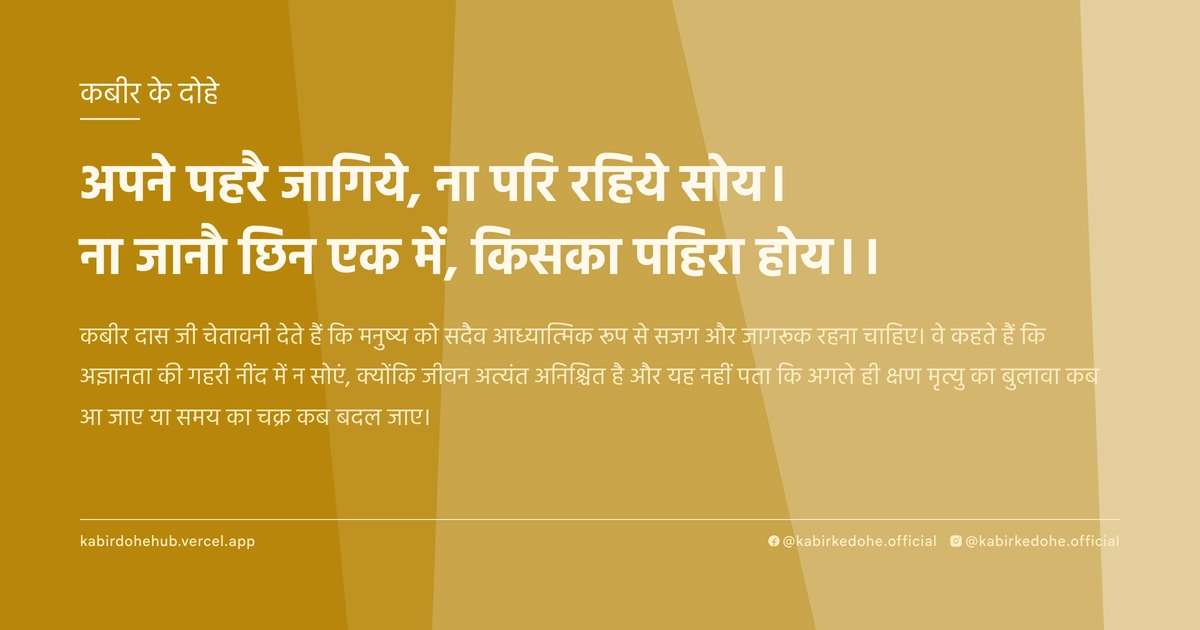
अपने पहरै जागिये, ना परि रहिये सोय।
ना जानौ छिन एक में, किसका पहिरा होय।।
Apne pahrai jaagiye, na pari rahiye soy. Na jaanau chin ek me, kiska pahira hoye.
इस पृष्ठ पर इस कबीर दोहे का अर्थ (meaning), हिंदी व्याख्या और अंग्रेज़ी अनुवाद, दार्शनिक विश्लेषण और व्यावहारिक जीवन सीख दी गई है। यह दोहा जागृति (The Wake-up Call) विषय से जुड़ा है — Kabir doha meaning and explanation in Hindi and English.
अर्थ (Meaning):
कबीर दास जी चेतावनी देते हैं कि मनुष्य को सदैव आध्यात्मिक रूप से सजग और जागरूक रहना चाहिए। वे कहते हैं कि अज्ञानता की गहरी नींद में न सोएं, क्योंकि जीवन अत्यंत अनिश्चित है और यह नहीं पता कि अगले ही क्षण मृत्यु का बुलावा कब आ जाए या समय का चक्र कब बदल जाए।
Kabir warns that one must remain spiritually vigilant and awake at all times. He urges us not to succumb to the slumber of ignorance, for life is profoundly unpredictable, and one never knows in which fleeting moment the call of death may arrive or the tide of time may turn.
व्याख्या (Interpretation):
शाब्दिक अर्थ में यह नींद और जागने की बात है, परंतु आध्यात्मिक स्तर पर 'सोना' माया और अज्ञानता का प्रतीक है। 'जागना' का अर्थ है आत्म-साक्षात्कार और वर्तमान क्षण में पूर्ण उपस्थिति। यह दोहा निर्गुण भक्ति के उस सिद्धांत को दर्शाता है जहाँ आत्मा को अपने वास्तविक स्वरूप (ब्रह्म) को पहचानना होता है। माया हमें एक ऐसे भ्रम में डालती है जहाँ हम संसार को स्थायी मानते हैं, जबकि सत्य यह है कि हम केवल एक क्षणिक यात्रा पर हैं। अद्वैत वेदांत के अनुसार, जब तक अहंकार जीवित है, हम सो रहे हैं; जब अहंकार मिटता है, तब हम जागते हैं। यह विरोधाभास है कि हम जीवित रहते हुए भी मृतवत (अचेत) होते हैं और केवल मृत्यु के भय या बोध से ही जागते हैं।
Literally, this speaks of sleep and waking, but spiritually, 'sleeping' symbolizes the state of Maya and profound ignorance. 'Waking' refers to self-realization and absolute presence in the current moment. This couplet reflects the core of Nirgun Bhakti, where the soul must recognize its true essence as the formless Brahman. Maya casts a veil of illusion, making us perceive the transient world as permanent, while the truth is that we are on a fleeting journey. According to Advaita Vedanta, as long as the ego persists, we are asleep; only when the ego dissolves do we truly awaken. It is a poignant paradox that humans often remain unconscious while physically alive, waking only through the sudden realization of their own mortality.
दार्शनिक विश्लेषण (Philosophical Analysis):
कबीर का यह संदेश उनके युग के उस सामाजिक और धार्मिक पाखंड के विरुद्ध एक प्रहार था जहाँ लोग केवल कर्मकांडों में व्यस्त थे और वास्तविक आंतरिक जागृति को भूल चुके थे। वे बाहरी पूजा-पाठ को 'नींद' मानते थे क्योंकि वह केवल अहंकार को संतुष्ट करती है, सत्य को नहीं।
दार्शनिक रूप से, यह दोहा सूफी मत के 'यक़ज़ा' (जागृति) और वेदांत के 'बोध' से मेल खाता है। सूफीवाद में, दुनिया को एक सपना माना गया है और ईश्वर की प्राप्ति को वास्तविक जागृति। कबीर यहाँ समय की अनिश्चितता (काल) को केंद्र में रखकर मनुष्य को वर्तमान में जीने और आत्म-निरीक्षण करने के लिए प्रेरित करते हैं।
वे जाति और धर्म के भेदों को नकारते हुए यह समझाते हैं कि मृत्यु सबको समान रूप से अपनी चपेट में लेती है। इसलिए, किसी विशेष वर्ग या धर्म का होने का अहंकार व्यर्थ है। वास्तविक मोक्ष केवल उसी को मिलता है जो अपनी चेतना को जाग्रत कर चुका है।
मनोवैज्ञानिक स्तर पर, यह 'अस्तित्वगत चिंता' (Existential Anxiety) को एक उपकरण के रूप में उपयोग करता है। मृत्यु का स्मरण करना डराने के लिए नहीं, बल्कि जीवन की गुणवत्ता और उद्देश्य को सुधारने के लिए है। यह अहंकार के विसर्जन की प्रक्रिया है।
अंततः, कबीर यह स्थापित करते हैं कि ईश्वर कहीं बाहर नहीं, बल्कि इसी जागृत चेतना के भीतर है। जब हम बाहरी शोर और मानसिक निद्रा से मुक्त होते हैं, तब हम उस निराकार सत्ता का अनुभव करते हैं जो सर्वव्यापी है।
Kabir's message is a direct strike against the social and religious hypocrisy of his era, where people were consumed by ritualism while remaining oblivious to true inner awakening. He viewed external rituals as a form of 'sleep' because they merely fed the ego rather than revealing the Truth.
Philosophically, this doha aligns with the Sufi concept of 'Yaqza' (spiritual awakening) and the Vedantic notion of 'Bodha'. In Sufism, the material world is often likened to a dream, and the realization of the Divine is the only true awakening. Kabir emphasizes the unpredictability of Time (Kaal), urging the seeker to live in the present and engage in rigorous self-inquiry.
By rejecting caste and creed, he argues that death is the ultimate equalizer. Therefore, the pride of belonging to a particular sect or social stratum is futile. Liberation is reserved only for those who have awakened their consciousness from the slumber of duality.
On a psychological level, Kabir utilizes 'existential anxiety' not as a source of fear, but as a catalyst for transformation. The remembrance of death (Memento Mori) is intended to refine the quality and purpose of one's life, facilitating the annihilation of the ego.
Ultimately, Kabir establishes that the Divine is not an external entity but resides within this awakened consciousness. When we liberate ourselves from external noise and mental lethargy, we experience the Nirgun (formless) reality that permeates every atom of existence.
मूल संदेश (Core Message):
- अज्ञानता की निद्रा ही सबसे बड़ा बंधन है।
- वर्तमान क्षण ही एकमात्र सत्य और द्वार है।
- मृत्यु का स्मरण जीवन को सार्थकता प्रदान करता है।
- बाहरी कर्मकांड आंतरिक जागृति का विकल्प नहीं हैं।
- आत्मा का जागरण ही वास्तविक मोक्ष है।
- The slumber of ignorance is the greatest bondage.
- The present moment is the only truth and the only gateway.
- The remembrance of death gives profound meaning to life.
- External rituals are no substitute for internal awakening.
- The awakening of the soul is the only true liberation.
व्यावहारिक उदाहरण (Practical Example):
एक समय की बात है, वाराणसी के घाटों पर रहने वाला एक वृद्ध बुनकर था जिसका नाम माधव था। माधव अपनी कला में निपुण था, लेकिन उसका मन हमेशा भविष्य की चिंताओं और अतीत के पछतावे में डूबा रहता था। वह मानता था कि जब वह बूढ़ा होगा और उसके पास पर्याप्त धन होगा, तब वह ईश्वर की खोज करेगा।
वह दिन भर करघे पर काम करता, लेकिन उसका मन कहीं और होता। वह अपने आस-पास के लोगों से बात तो करता, पर उनकी पीड़ा को नहीं सुनता था। वह एक 'जागती हुई नींद' में जी रहा था, जहाँ जीवन केवल एक दिनचर्या बन गया था।
एक दिन, माधव ने देखा कि उसका एक युवा मित्र, जो बहुत महत्वाकांक्षी था, अचानक एक गंभीर बीमारी के कारण दुनिया छोड़ गया। उस युवक के पास भविष्य के लिए हज़ारों योजनाएं थीं, लेकिन एक पल में सब समाप्त हो गया।
इस घटना ने माधव को भीतर तक झकझोर दिया। उसे कबीर का वह दोहा याद आया कि 'ना जानौ छिन एक में, किसका पहिरा होय'। उसे अहसास हुआ कि वह अब तक केवल जीवित था, जाग नहीं रहा था।
माधव ने उसी क्षण निर्णय लिया कि वह अब कल का इंतज़ार नहीं करेगा। उसने अपने काम को ही प्रार्थना बना लिया। जब वह धागों को बुनता, तो वह हर धागे में उस निराकार परमात्मा को देखने का प्रयास करता।
उसने अपने अहंकार को त्याग दिया और उन लोगों की मदद करना शुरू किया जिन्हें वह पहले अनदेखा करता था। उसने पाया कि जब वह वर्तमान क्षण में पूरी तरह उपस्थित रहा, तो उसका तनाव गायब हो गया और एक असीम शांति का अनुभव हुआ।
उसकी बुनाई में अब एक नई चमक थी, क्योंकि वह अब केवल कपड़े नहीं, बल्कि अपनी चेतना बुन रहा था। लोग उसकी शांति और सौम्यता की ओर आकर्षित होने लगे।
माधव ने सीखा कि जागने का अर्थ यह नहीं है कि आप काम छोड़ दें, बल्कि यह है कि आप काम करते हुए भी अपनी आत्मा के प्रति सजग रहें।
उसने अपने जीवन के अंतिम वर्षों को एक उत्सव बना लिया, क्योंकि उसने जान लिया था कि मृत्यु का समय अनिश्चित है, लेकिन जागृति का समय 'अभी' है।
इस प्रकार, एक साधारण बुनकर ने अपनी मानसिक निद्रा को त्यागकर आत्म-साक्षात्कार के मार्ग पर कदम रखा और जीवन की सार्थकता को पाया।
Once, on the ghats of Varanasi, lived an elderly weaver named Madhav. Madhav was a master of his craft, yet his mind was perpetually adrift, drowned in anxieties about the future and regrets over the past. He believed that once he reached a certain age and accumulated enough wealth, he would finally seek the Divine.
He spent his days at the loom, but his spirit was absent. He spoke to those around him, yet he never truly heard their pain. He was living in a 'waking sleep,' where existence had become nothing more than a repetitive routine.
One day, Madhav witnessed the sudden passing of a young friend—a man full of ambition and vigor who succumbed to a sudden, severe illness. That youth had thousands of plans for the future, yet in a single heartbeat, everything vanished.
This event shook Madhav to his core. He recalled Kabir's words: 'One knows not in which fleeting moment the call may come.' He realized that he had merely been surviving, not truly awakening.
In that instant, Madhav decided he would no longer wait for 'tomorrow.' He transformed his work into a prayer. As he wove the threads, he attempted to perceive the formless Divine within every single strand.
He shed his ego and began helping those he had previously ignored. He discovered that by being fully present in the current moment, his chronic stress vanished, replaced by an infinite sense of peace.
There was now a new radiance in his weaving, for he was no longer just weaving cloth, but weaving his own consciousness. People began to be drawn to his serenity and gentleness.
Madhav learned that awakening does not mean abandoning one's duties, but rather remaining conscious of the soul while performing those duties.
He turned the remaining years of his life into a celebration, knowing that while the hour of death is uncertain, the hour of awakening is always 'now.'
Thus, a simple weaver discarded his mental slumber, stepped onto the path of self-realization, and discovered the true meaning of existence.
अभ्यास मार्गदर्शन (Practice Guidance):
- प्रतिदिन 20 मिनट 'साक्षी भाव' का अभ्यास करें: अपने विचारों को बिना किसी निर्णय के केवल एक दर्शक की तरह देखें, जैसे आप किसी और के सपने देख रहे हों।
- स्व-पूछताछ जर्नल: प्रतिदिन लिखें—'आज मैं किन क्षणों में अचेत (autopilot) था और किन क्षणों में वास्तव में जागृत था?'
- व्यवहार परिवर्तन: दिन में तीन बार (सुबह, दोपहर, शाम) एक मिनट के लिए रुकें और स्वयं से पूछें, 'यदि यह मेरा अंतिम क्षण हो, तो क्या मैं इस स्थिति में शांत रहूँगा?'
- नैदानिक चेकलिस्ट: यदि आप छोटी बातों पर अत्यधिक क्रोधित होते हैं, भविष्य की चिंता में वर्तमान को खो देते हैं, या केवल बाहरी प्रशंसा से खुश होते हैं, तो आप अभी भी 'सो रहे' हैं।
- Practice 'Witness Consciousness' for 20 minutes daily: Observe your thoughts without judgment, as if you are watching someone else's dream.
- Self-Inquiry Journaling: Write daily—'In which moments today was I on autopilot, and in which moments was I truly awake?'
- Behavioral Shift: Three times a day (morning, noon, evening), pause for one minute and ask yourself, 'If this were my final moment, would I be at peace with my current state?'
- Diagnostic Checklist: If you react with excessive anger to trivialities, lose the present to future anxieties, or derive happiness solely from external validation, you are still 'asleep'.
चिंतन प्रश्न (Reflection Questions):
- मेरी वह कौन सी 'मानसिक नींद' है जिसे मैं सच मानकर जी रहा हूँ?
- यदि मेरा सामाजिक मुखौटा (डिजिटल ईगो) छीन लिया जाए, तो क्या मेरे भीतर कोई जागृत चेतना शेष रहेगी?
- मैं किन पूर्वाग्रहों के कारण दूसरों की आत्मा को देखने में असमर्थ हूँ?
- क्या मेरी आध्यात्मिक खोज वास्तव में सत्य की प्यास है, या केवल एक नया मानसिक अहंकार?
- मेरे जीवन का वह कौन सा हिस्सा है जिसे मैं 'कल' पर टाल रहा हूँ, यह जानते हुए कि कल अनिश्चित है?
- What is the specific 'mental sleep' I am mistaking for reality?
- If my social mask (digital ego) were stripped away, would any awakened consciousness remain within me?
- Which deep-seated biases prevent me from seeing the soul in others?
- Is my spiritual quest a genuine thirst for Truth, or merely a new form of intellectual ego?
- Which part of my life am I postponing until 'tomorrow,' despite knowing that tomorrow is uncertain?