
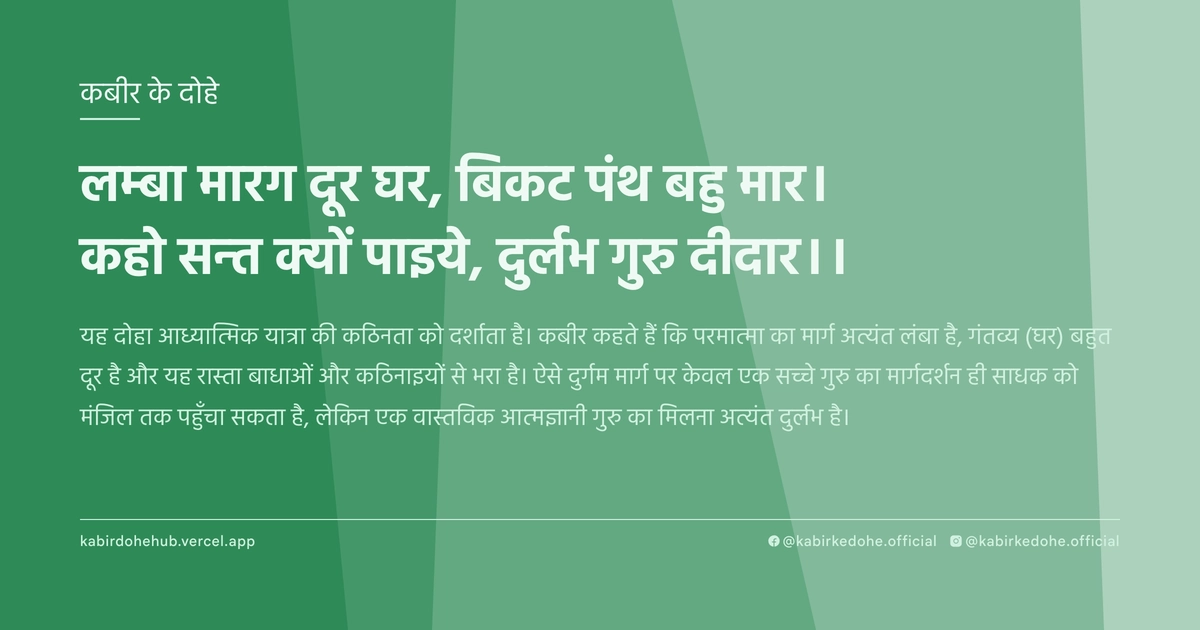
लम्बा मारग दूर घर, बिकट पंथ बहु मार।
कहो सन्त क्यों पाइये, दुर्लभ गुरु दीदार।।
Lamba maarag door ghar, bikat panth bahu maar. Kaho sant kyon paiye, durlabh guru deedaar.
इस पृष्ठ पर इस कबीर दोहे का अर्थ (meaning), हिंदी व्याख्या और अंग्रेज़ी अनुवाद, दार्शनिक विश्लेषण और व्यावहारिक जीवन सीख दी गई है। यह दोहा गुरु महत्व (The Guru's Importance) विषय से जुड़ा है — Kabir doha meaning and explanation in Hindi and English.
अर्थ (Meaning):
यह दोहा आध्यात्मिक यात्रा की कठिनता को दर्शाता है। कबीर कहते हैं कि परमात्मा का मार्ग अत्यंत लंबा है, गंतव्य (घर) बहुत दूर है और यह रास्ता बाधाओं और कठिनाइयों से भरा है। ऐसे दुर्गम मार्ग पर केवल एक सच्चे गुरु का मार्गदर्शन ही साधक को मंजिल तक पहुँचा सकता है, लेकिन एक वास्तविक आत्मज्ञानी गुरु का मिलना अत्यंत दुर्लभ है।
This couplet highlights the arduous nature of the spiritual journey. Kabir asserts that the path to the Divine is incredibly long, the ultimate destination (the home) is distant, and the trail is fraught with perils and distractions. On such a treacherous road, only the guidance of a true spiritual master can lead the seeker to liberation, yet finding such an enlightened Guru is an exceedingly rare occurrence.
व्याख्या (Interpretation):
यहाँ 'घर' का अर्थ भौतिक निवास नहीं, बल्कि आत्मा का परमात्मा में विलीनीकरण या मोक्ष है। 'लंबा मारग' मानव जीवन के जन्म-मरण के चक्र और अज्ञानता की परतों को दर्शाता है। 'बिकट पंथ' माया के प्रलोभनों और अहंकार के अवरोधों का प्रतीक है जो साधक को भ्रमित करते हैं। यह दोहा निर्गुण भक्ति के उस सिद्धांत को पुष्ट करता है जहाँ ईश्वर किसी मंदिर या मस्जिद में नहीं, बल्कि स्वयं के भीतर है, लेकिन वहाँ तक पहुँचने का मार्ग कठिन है। अद्वैत वेदांत के अनुसार, जब तक 'मैं' और 'तू' का भेद है, तब तक दूरी बनी रहती है। गुरु वह सेतु है जो इस द्वैत को समाप्त कर साधक को उसकी वास्तविक प्रकृति से परिचित कराता है। इस प्रकार, गुरु की दुर्लभता वास्तव में हमारी अपनी पात्रता और अहंकार के त्याग की दुर्लभता है।
Here, 'home' does not refer to a physical residence, but to the merging of the Atman with Brahman or the state of Moksha. The 'long road' symbolizes the endless cycle of birth and death (Samsara) and the dense layers of ignorance (Avidya) covering the soul. The 'treacherous path' represents the illusions of Maya and the barriers of the ego that constantly mislead the seeker. This Doha reinforces the principle of Nirgun Bhakti, suggesting that the Divine is not found in external shrines but within, though the internal journey is grueling. According to Advaita Vedanta, as long as the duality of 'I' and 'Thou' exists, the distance remains. The Guru acts as the bridge that dissolves this duality, introducing the seeker to their true nature. Thus, the rarity of the Guru is a reflection of the rarity of the seeker's own readiness and the surrender of the ego.
दार्शनिक विश्लेषण (Philosophical Analysis):
कबीर का यह कथन उनके समय के धार्मिक पाखंड और कर्मकांडीय जटिलताओं पर एक गहरा प्रहार है। उन्होंने देखा कि लोग तीर्थयात्राओं और बाहरी अनुष्ठानों में उलझे हुए थे, जबकि वास्तविक यात्रा अंतर्मन की थी। कबीर का दर्शन सूफीवाद के 'फना' (अहंकार का विनाश) और वेदांत के 'अहं ब्रह्मास्मि' के बीच एक सेतु बनाता है। वे तर्क देते हैं कि बिना एक जीवित मार्गदर्शक के, शास्त्र केवल शब्दों का जाल हैं।
ऐतिहासिक रूप से, कबीर ने जाति और धर्म की सीमाओं को तोड़कर एक सार्वभौमिक सत्य की खोज की। उनके लिए 'गुरु' कोई व्यक्ति नहीं, बल्कि वह चेतना है जो अंधकार को मिटा सके। यह विश्लेषण स्पष्ट करता है कि आध्यात्मिक प्रगति केवल इच्छा से नहीं, बल्कि अनुशासन और सही दिशा से आती है।
मनोवैज्ञानिक स्तर पर, 'बिकट पंथ' हमारे अपने मानसिक संस्कारों और कंडीशनिंग का प्रतिनिधित्व करता है। हम जिन आदतों और पूर्वाग्रहों के गुलाम हैं, वे ही हमारे मार्ग की सबसे बड़ी बाधाएं हैं। कबीर हमें चेतावनी देते हैं कि बिना गुरु के, साधक अक्सर 'अध्यात्मिक अहंकार' का शिकार हो जाता है, जहाँ वह अपनी अज्ञानता को ही ज्ञान मान बैठता है।
सूफी परंपरा में इसे 'मुर्शिद' की आवश्यकता के समान माना गया है, जिसके बिना मुरीद (शिष्य) भटक जाता है। यह मार्ग इसलिए कठिन है क्योंकि इसमें बाहरी शत्रुओं से नहीं, बल्कि अपने स्वयं के भीतर के 'अहं' से लड़ना पड़ता है।
अंततः, यह दोहा इस सत्य को स्थापित करता है कि ज्ञान का मार्ग केवल बौद्धिक विमर्श से प्राप्त नहीं होता। यह एक अनुभवजन्य यात्रा है। गुरु का 'दीदार' या दर्शन केवल शारीरिक उपस्थिति नहीं, बल्कि गुरु के ज्ञान का शिष्य के जीवन में उतरना है, जो कि अत्यंत दुर्लभ है क्योंकि इसके लिए पूर्ण समर्पण की आवश्यकता होती है।
Kabir's statement is a profound critique of the religious hypocrisy and ritualistic complexities of his era. He observed people entangled in pilgrimages and external rites, while the true journey was internal. Kabir's philosophy builds a bridge between the Sufi concept of 'Fana' (annihilation of the ego) and the Vedantic realization of 'Aham Brahmasmi'. He argues that without a living guide, scriptures are merely a web of words.
Historically, Kabir transcended the boundaries of caste and religion to seek a universal truth. For him, the 'Guru' is not merely a person, but a consciousness capable of dispelling darkness. This analysis clarifies that spiritual progress does not come from desire alone, but through discipline and correct direction.
On a psychological level, the 'treacherous path' represents our own mental impressions (Samskaras) and conditioning. The habits and prejudices we are enslaved to are the greatest obstacles on our path. Kabir warns that without a Guru, a seeker often falls prey to 'spiritual ego,' where they mistake their ignorance for enlightenment.
In the Sufi tradition, this is akin to the necessity of a 'Murshid'; without one, the 'Murid' (disciple) wanders aimlessly. The path is difficult because one does not fight external enemies, but the 'Aham' (ego) within oneself.
Ultimately, this Doha establishes that the path of knowledge is not attained through intellectual discourse alone. It is an experiential journey. The 'Deedar' or vision of the Guru is not just physical presence, but the descent of the Guru's wisdom into the disciple's life, which is rare because it demands absolute surrender.
मूल संदेश (Core Message):
- बाहरी यात्राएं व्यर्थ हैं यदि आंतरिक रूपांतरण न हो।
- अहंकार ही वह सबसे बड़ी दीवार है जो हमें 'घर' से दूर रखती है।
- सच्चा गुरु वह है जो आपको आपकी अपनी वास्तविकता का दर्पण दिखाए।
- आध्यात्मिक मार्ग कठिन है क्योंकि इसमें स्वयं को मिटाना पड़ता है।
- मंजिल दूर नहीं है, बस देखने वाली दृष्टि दुर्लभ है।
- External journeys are futile without internal transformation.
- The ego is the greatest wall keeping us away from our true 'home'.
- A true Guru is one who reflects your own reality back to you.
- The spiritual path is arduous because it requires the annihilation of the self.
- The destination is not far; it is the vision to see it that is rare.
व्यावहारिक उदाहरण (Practical Example):
एक समय की बात है, बनारस के घाटों पर रहने वाली एक वृद्ध विधवा, जानकी, का जीवन केवल पूजा-पाठ और दूसरों की सेवा में बीता था। वह मानती थी कि केवल घंटों मंत्रोच्चार करने से उसे मोक्ष मिल जाएगा। वह हर साल कठिन तीर्थयात्राएं करती, लेकिन उसके मन में अभी भी दूसरों के प्रति सूक्ष्म निर्णय और अपनी धार्मिक श्रेष्ठता का अहंकार था।
एक दिन उसकी मुलाकात एक साधारण से दिखने वाले फकीर से हुई, जो घाट की सीढ़ियों पर चुपचाप बैठा रहता था। जानकी ने अपनी लंबी तीर्थयात्राओं और कठिन व्रतों का बखान किया। फकीर ने केवल मुस्कुराकर पूछा, 'इतनी दूर चली गईं, पर क्या अपने भीतर के उस अंधेरे कमरे में झाँका जहाँ तुम्हारा क्रोध और ईर्ष्या छिपे हैं?'
जानकी को यह बात चुभी। उसने तर्क दिया कि वह शास्त्रों को जानती है। फकीर ने कहा, 'शास्त्र नक्शा हैं, लेकिन रास्ता चलना पड़ता है। तुम नक्शे को ही मंजिल मान बैठी हो।'
जानकी को महसूस हुआ कि उसने वर्षों तक केवल बाहरी यात्राएं की थीं, जबकि उसके भीतर का 'घर' अभी भी अजनबी था। वह फकीर के पास बार-बार आने लगी। फकीर ने उसे कोई मंत्र नहीं दिया, बल्कि उसे केवल यह सिखाया कि कैसे अपने क्रोध और अहंकार को बिना किसी निर्णय के देखा जाए।
शुरुआत में जानकी को यह बहुत कठिन लगा। उसे लगा कि उसकी पुरानी पहचान छिन रही है। वह रोती, चिल्लाती और कभी-कभी फकीर को कोसती। यह उसका 'बिकट पंथ' था—अपने पुराने संस्कारों से लड़ना।
धीरे-धीरे, जानकी ने पाया कि जब वह दूसरों की सेवा करती थी, तो वह यह सोचकर करती थी कि वह 'पुण्य' कमा रही है। फकीर ने उसे सिखाया कि सेवा में 'सेवा करने वाला' ही सबसे बड़ी बाधा है।
एक दिन, जब उसने एक बीमार भिखारी की सेवा बिना यह सोचे की कि वह क्या है या वह उसे क्या देगा, उसे एक असीम शांति का अनुभव हुआ। उसे समझ आया कि 'घर' कहीं दूर नहीं, बल्कि इसी निस्वार्थता में था।
जानकी का रूपांतरण यह था कि उसने बाहरी आडंबरों को त्याग दिया। अब वह केवल पूजा नहीं करती थी, बल्कि हर जीव में उसी परमात्मा को देखती थी। उसने पाया कि फकीर का सानिध्य ही वह दुर्लभ कुंजी थी जिसने उसके लिए बंद दरवाजे खोल दिए।
Once, in the ghats of Varanasi, lived an elderly widow named Janaki, whose life was spent entirely in prayer and service. She believed that hours of chanting mantras would grant her Moksha. Every year, she undertook grueling pilgrimages, yet within her remained a subtle judgment of others and an ego of religious superiority.
One day, she encountered a simple-looking Fakir who sat silently on the steps of the ghat. Janaki boasted of her long pilgrimages and rigorous fasts. The Fakir simply smiled and asked, 'You have traveled so far, but have you peered into that dark room within where your anger and jealousy hide?'
Janaki felt stung. She argued that she knew the scriptures. The Fakir replied, 'Scriptures are maps, but the path must be walked. You have mistaken the map for the destination.'
Janaki realized she had spent years on external journeys, while the 'home' within remained a stranger. She began visiting the Fakir frequently. He gave her no mantras, but taught her how to observe her anger and ego without judgment.
Initially, Janaki found this incredibly difficult. She felt her old identity was being stripped away. She cried, screamed, and sometimes cursed the Fakir. This was her 'treacherous path'—fighting her own lifelong conditioning.
Slowly, Janaki noticed that when she served others, she did so thinking she was earning 'punya' (merit). The Fakir taught her that in service, the 'server' is the biggest obstacle.
One day, while tending to a sick beggar without any thought of who he was or what she would gain, she experienced an infinite peace. She understood that 'home' was not distant, but resided in this very selflessness.
Janaki's transformation was complete when she abandoned external pretenses. She no longer just prayed; she saw the Divine in every living being. She realized that the Fakir's presence was the rare key that unlocked her closed doors.
अभ्यास मार्गदर्शन (Practice Guidance):
- दैनिक आत्म-निरीक्षण: प्रतिदिन 20 मिनट मौन बैठें और अपने भीतर उठने वाले विचारों को एक साक्षी (witness) की तरह देखें, बिना उन्हें सही या गलत ठहराए।
- अहंकार की पहचान: जब भी आप किसी को उपदेश दें या स्वयं को श्रेष्ठ महसूस करें, रुकें और पूछें—'यह कौन बोल रहा है? मेरी आत्मा या मेरा सामाजिक मुखौटा?'
- समर्पण का अभ्यास: किसी एक ऐसे गुण को चुनें जिसे आप बदलना चाहते हैं और उसे पूरी तरह से ब्रह्मांडीय शक्ति (ईश्वर/गुरु) को सौंप दें, यह मानते हुए कि आप अकेले इसे नहीं बदल सकते।
- डायग्नोस्टिक चेकलिस्ट: क्या आप अभी भी मोक्ष को भविष्य की घटना मान रहे हैं? क्या आप बाहरी अनुष्ठानों पर अधिक और आंतरिक शांति पर कम ध्यान दे रहे हैं? यदि हाँ, तो आप अभी भी 'बिकट पंथ' में उलझे हैं।
- Daily Self-Observation: Sit in silence for 20 minutes daily and observe the thoughts arising within as a witness, without labeling them as right or wrong.
- Ego Identification: Whenever you give unsolicited advice or feel superior to someone, stop and ask—'Who is speaking? My soul or my social mask?'
- Practice of Surrender: Choose one trait you wish to change and surrender it completely to the Cosmic Power (Divine/Guru), acknowledging that you cannot change it alone.
- Diagnostic Checklist: Do you still view liberation as a future event? Do you focus more on external rituals than internal peace? If yes, you are still entangled in the 'treacherous path'.
चिंतन प्रश्न (Reflection Questions):
- मेरे जीवन में 'घर' का क्या अर्थ है—क्या यह कोई स्थान है, कोई व्यक्ति है, या एक मानसिक अवस्था?
- मैं अपनी आध्यात्मिक प्रगति के नाम पर किस प्रकार के 'डिजिटल अहंकार' या सामाजिक प्रदर्शन का सहारा ले रहा हूँ?
- क्या मैं वास्तव में एक गुरु की तलाश कर रहा हूँ, या मैं केवल ऐसे व्यक्ति की तलाश में हूँ जो मेरे मौजूदा विश्वासों की पुष्टि करे?
- मेरे भीतर का वह कौन सा 'अंधेरा कोना' है जिसे मैं स्वीकार करने से सबसे अधिक डरता हूँ?
- यदि मेरे पास कोई धार्मिक पहचान न हो, तो मेरी वास्तविक पहचान क्या रह जाएगी?
- What does 'home' mean in my life—is it a place, a person, or a state of consciousness?
- What kind of 'digital ego' or social performance am I using in the name of spiritual progress?
- Am I truly seeking a Guru, or am I merely looking for someone to validate my existing beliefs?
- Which 'dark corner' within me am I most afraid to acknowledge?
- If I had no religious identity, what would remain of my true self?