
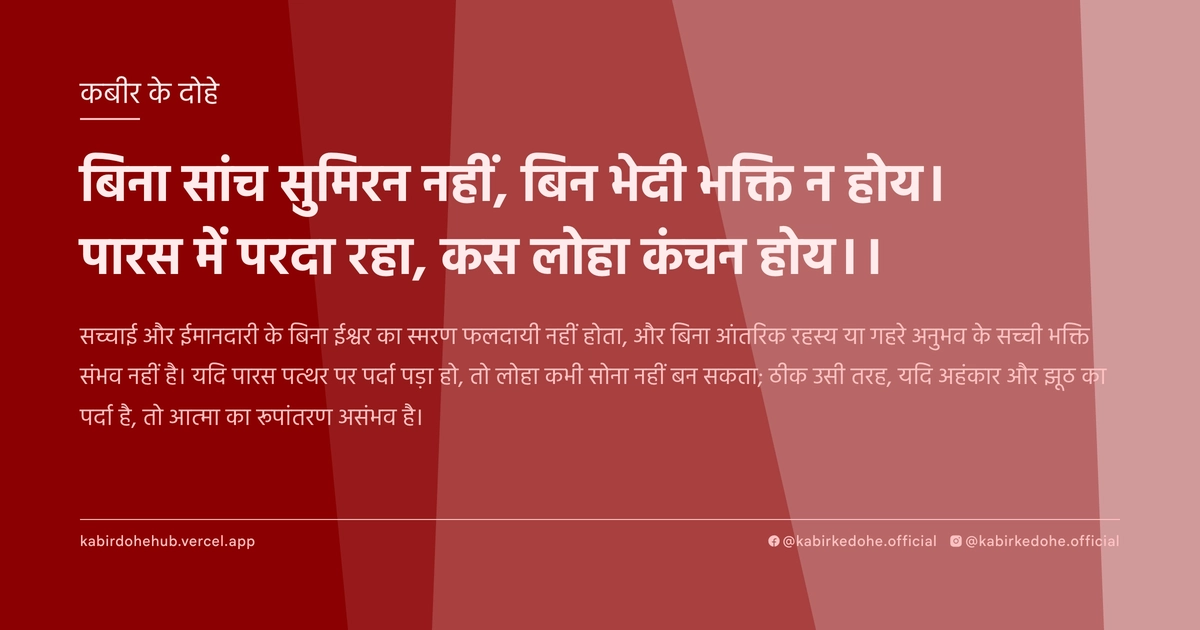
बिना सांच सुमिरन नहीं, बिन भेदी भक्ति न होय।
पारस में परदा रहा, कस लोहा कंचन होय।।
Bina saanch sumiran nahi, bin bhedi bhakti na hoye. Paras me parda raha, kas loha kanchan hoye.
इस पृष्ठ पर इस कबीर दोहे का अर्थ (meaning), हिंदी व्याख्या और अंग्रेज़ी अनुवाद, दार्शनिक विश्लेषण और व्यावहारिक जीवन सीख दी गई है। यह दोहा सत्य (Truth) विषय से जुड़ा है — Kabir doha meaning and explanation in Hindi and English.
अर्थ (Meaning):
सच्चाई और ईमानदारी के बिना ईश्वर का स्मरण फलदायी नहीं होता, और बिना आंतरिक रहस्य या गहरे अनुभव के सच्ची भक्ति संभव नहीं है। यदि पारस पत्थर पर पर्दा पड़ा हो, तो लोहा कभी सोना नहीं बन सकता; ठीक उसी तरह, यदि अहंकार और झूठ का पर्दा है, तो आत्मा का रूपांतरण असंभव है।
Remembrance of the Divine is fruitless without absolute truth and sincerity, and devotion remains superficial without a piercing, experiential insight into the Truth. Just as iron cannot turn into gold if a veil covers the philosopher's stone, the soul cannot be transformed if the veil of ego and falsehood remains.
व्याख्या (Interpretation):
कबीर यहाँ 'सांच' (सत्य) को आध्यात्मिक प्रगति की अनिवार्य शर्त बताते हैं। 'भेदी भक्ति' का अर्थ है वह भक्ति जो केवल बाहरी अनुष्ठान नहीं, बल्कि आत्मा के भेदन वाली अंतर्दृष्टि है। वे पारस पत्थर का रूपक उपयोग करते हैं, जो लोहे को सोने में बदल देता है, लेकिन यहाँ शर्त है कि पारस और लोहे के बीच कोई 'परदा' नहीं होना चाहिए। यह परदा माया, पाखंड और अहंकार है। जब तक साधक स्वयं को सत्य के प्रति समर्पित नहीं करता, तब तक वह केवल शब्दों का जाप करता है, अनुभव का नहीं। यह अद्वैत वेदांत के उस सिद्धांत को दर्शाता है जहाँ आत्मा और ब्रह्म के बीच केवल अज्ञान का पर्दा है।
Kabir establishes 'Saanch' (Truth) as the non-negotiable prerequisite for spiritual evolution. 'Bhedi Bhakti' refers to a piercing devotion—one that transcends ritual to penetrate the core of existence. The metaphor of the 'Paras' (Philosopher's Stone) illustrates the potential for alchemy; however, the 'parda' (veil) represents the psychological and spiritual obstructions of ego, hypocrisy, and illusion (Maya). If the veil persists, the iron (the dense, impure human ego) cannot be transmuted into gold (the pure, liberated Atman). This aligns with Advaita Vedanta, suggesting that the Divine is already present, but obscured by a thin yet stubborn layer of ignorance.
दार्शनिक विश्लेषण (Philosophical Analysis):
कबीर का यह दोहा उनके जीवन दर्शन के मूल स्तंभ—सत्य और अनुभव—पर आधारित है। उनके समय में धर्म केवल कर्मकांडों और बाहरी दिखावे तक सीमित था। कबीर ने इस 'पर्दे' को चुनौती दी, जो पंडितों और मौलवियों ने धर्म के नाम पर बनाया था। वे कहते हैं कि यदि आपका जीवन सत्य पर आधारित नहीं है, तो माला जपना या मस्जिद जाना व्यर्थ है।
दार्शनिक रूप से, यह सूफी मत के 'फना' (अहंकार का विनाश) और अद्वैत के 'माया' विलोपन से जुड़ा है। जब तक 'मैं' (अहंकार) मौजूद है, वह सबसे बड़ा पर्दा है। 'भेदी भक्ति' वह प्रहार है जो इस अहंकार को तोड़ता है। यह केवल बौद्धिक समझ नहीं, बल्कि एक भावनात्मक और आध्यात्मिक विस्फोट है।
कबीर यहाँ यह स्पष्ट करते हैं कि ईश्वर कोई बाहरी सत्ता नहीं है जिसे खोजा जाए, बल्कि वह एक आंतरिक वास्तविकता है जिसे 'सांच' के माध्यम से प्रकट किया जाना है। वे ritualism (कर्मकांड) को एक बाधा मानते हैं क्योंकि वह अक्सर सत्य को छिपाने का साधन बन जाता है।
मनोवैज्ञानिक स्तर पर, यह दोहा संज्ञानात्मक विसंगति (cognitive dissonance) की बात करता है। जब हमारी कथनी और करनी अलग होती है, तो हम एक मानसिक पर्दे के पीछे होते हैं। रूपांतरण तभी होता है जब हम अपनी छाया (shadow) को स्वीकार करते हैं और पूर्ण ईमानदारी के साथ स्वयं का सामना करते हैं।
अंततः, यह संदेश है कि आध्यात्मिक उपलब्धि कोई बाहरी पुरस्कार नहीं है, बल्कि एक आंतरिक रसायन विज्ञान (Alchemy) है। लोहा (अशुद्धता) सोने (शुद्धता) में तभी बदलता है जब सत्य का स्पर्श सीधा और बिना किसी मध्यस्थ के होता है।
This couplet is anchored in Kabir's fundamental pillars of Truth and Direct Experience. During his era, spirituality had devolved into mere ritualism and performative piety. Kabir challenged this 'veil' created by the religious orthodoxy of his time, asserting that without a life rooted in truth, the act of chanting or visiting shrines is an exercise in futility.
Philosophically, this connects to the Sufi concept of 'Fana' (annihilation of the self) and the Advaitic dissolution of 'Maya'. The ego is the primary veil. 'Bhedi Bhakti' is the piercing insight that shatters this ego. It is not an intellectual acquisition but an existential breakthrough—a direct encounter with the Formless (Nirgun).
Kabir emphasizes that the Divine is not an external entity to be sought through intermediaries but an internal reality to be unveiled through 'Saanch'. He views ritualism as a distraction, often serving as a psychological shield that prevents the seeker from facing their own internal void.
From a psychological perspective, the doha addresses the tension between the persona (the mask) and the true self. When there is a gap between one's internal truth and external projection, a 'veil' exists. Transformation occurs only when this dissonance is resolved through radical honesty and self-awareness.
Ultimately, the teaching posits that spiritual attainment is not a reward granted by a deity, but an internal alchemy. The 'iron' of the conditioned human mind is transmuted into the 'gold' of pure consciousness only when the touch of Truth is direct, unmediated, and absolute.
मूल संदेश (Core Message):
- पाखंड का पर्दा हटाओ, तभी सत्य का साक्षात्कार होगा।
- ईश्वर शब्दों में नहीं, बल्कि ईमानदारी के आचरण में बसते हैं।
- बाहरी अनुष्ठान केवल तैयारी हैं; वास्तविक रूपांतरण आंतरिक सत्य से आता है।
- अहंकार वह अवरोध है जो दिव्य स्पर्श को रोकता है।
- सत्य का मार्ग कठिन है, लेकिन यही एकमात्र मार्ग है जो लोहे को सोने में बदलता है।
- Remove the veil of hypocrisy to encounter the Absolute Truth.
- The Divine resides not in words, but in the practice of integrity.
- External rituals are mere preparations; true transformation is born of internal truth.
- The ego is the primary obstruction that blocks the Divine touch.
- The path of truth is arduous, yet it is the only alchemy that turns iron into gold.
व्यावहारिक उदाहरण (Practical Example):
एक समय की बात है, वाराणसी के घाटों पर माधव नाम का एक वृद्ध बुनकर रहता था। माधव अपनी कला में निपुण था, लेकिन उसका मन हमेशा अशांत रहता था। वह प्रतिदिन घंटों मंदिर में बिताता, लंबी मालाएं जपता और शहर के सबसे बड़े धर्मगुरुओं के चरणों में झुकता। उसे विश्वास था कि उसकी यह 'भक्ति' उसे मोक्ष दिलाएगी।
लेकिन माधव के जीवन में एक गहरा विरोधाभास था। वह मंदिर में तो बहुत विनम्र था, लेकिन अपने घर में अपनी पत्नी और बच्चों के साथ अत्यंत कठोर और क्रूर था। वह अपनी दुकान पर ग्राहकों से झूठ बोलता और कपड़ों की गुणवत्ता छिपाकर अधिक पैसे वसूलता। वह मानता था कि उसकी पूजा उसके इन 'छोटे पापों' को धो देगी।
एक दिन, उसकी मुलाकात एक घुमक्कड़ फकीर से हुई, जिसने माधव को माला जपते देखा। फकीर ने मुस्कुराकर पूछा, "माधव, तुम इस पत्थर की माला से किसे याद कर रहे हो?"
माधव ने गर्व से कहा, "मैं ईश्वर को याद कर रहा हूँ, ताकि मेरा जीवन सोने जैसा शुद्ध हो जाए।"
फकीर ने माधव के हाथों को देखा, जिनमें अभी भी कपड़ों की चोरी और झूठ की गंध थी। फकीर ने कहा, "तेरी माला और तेरे ईश्वर के बीच एक पर्दा है, माधव। वह पर्दा है तेरा झूठ। तू लोहे जैसा है, और ईश्वर पारस है। लेकिन तूने अपने झूठ का पर्दा इतना मोटा कर लिया है कि पारस का स्पर्श तुझ तक पहुँच ही नहीं पा रहा।"
माधव को पहले तो गुस्सा आया, लेकिन फकीर की आँखों की गहराई ने उसे झकझोर दिया। उसने महसूस किया कि उसकी सारी पूजा केवल एक मुखौटा थी, एक दिखावा था ताकि वह अपनी आंतरिक कुरूपता को छिपा सके।
अगले कुछ महीनों तक, माधव ने माला जपना छोड़ दिया। इसके बजाय, उसने 'सांच' का अभ्यास शुरू किया। उसने अपने ग्राहकों को उनके पैसे लौटाए, अपनी पत्नी से क्षमा मांगी और अपने व्यवहार में ईमानदारी लानी शुरू की।
शुरुआत में यह बहुत कठिन था। उसका अहंकार उसे बार-बार पुराने ढर्रे पर ले जाना चाहता था। लेकिन उसने तय किया कि वह अब कोई पर्दा नहीं रखेगा। वह जो भी कहता, वही करता।
धीरे-धीरे, माधव ने महसूस किया कि अब उसे मंदिर जाने की ज़रूरत नहीं थी। जब वह ईमानदारी से धागा बुनता, तो उसे उसी धागे में ईश्वर की उपस्थिति महसूस होती। उसकी शांति अब बाहरी अनुष्ठानों पर नहीं, बल्कि उसके आंतरिक सत्य पर टिकी थी।
उसका जीवन वास्तव में 'सोना' बन गया था—न कि इसलिए कि उसने कोई जादुई मंत्र पढ़ा था, बल्कि इसलिए कि उसने सत्य को अपना आधार बनाया और अहंकार का पर्दा हटा दिया।
In the ancient lanes of Varanasi lived an elderly weaver named Madhav. Madhav was a master of his craft, yet his mind was a storm of unrest. He spent hours daily at the temple, chanting long rosaries and bowing before the city's most renowned priests. He believed his rigorous adherence to ritual would guarantee him salvation.
However, Madhav lived a profound contradiction. While he was the epitome of humility in the temple, he was harsh and cruel to his wife and children at home. In his shop, he frequently lied about the quality of his fabrics to overcharge customers, believing his religious rituals would wash away these 'minor sins'.
One day, he encountered a wandering fakir who observed Madhav chanting. The fakir asked with a smile, "Madhav, whom are you remembering with those beads?"
Madhav replied proudly, "I am remembering the Divine, so that my life may become as pure as gold."
The fakir looked at Madhav's hands, which still carried the residue of deceit. He said, "There is a veil between you and your God, Madhav. That veil is your lie. You are like iron, and the Divine is the Paras stone. But you have woven a veil of falsehood so thick that the touch of the Paras cannot reach you."
Madhav was initially offended, but the piercing depth of the fakir's gaze shook him. He realized that his piety was merely a mask, a strategic performance to hide his internal ugliness.
For the next few months, Madhav stopped the mechanical chanting. Instead, he began the practice of 'Saanch' (Truth). He returned the overcharged money to his customers, sought forgiveness from his wife, and committed himself to absolute honesty in every interaction.
It was grueling. His ego fought back, urging him to return to the comfort of ritualistic piety. But he vowed to keep no more veils. Whatever he spoke, he acted upon.
Slowly, Madhav realized he no longer needed the temple to find peace. As he wove his threads with honesty, he felt the Divine presence within the very act of weaving. His tranquility was no longer dependent on external rites but on his internal integrity.
His life had truly become 'gold'—not because of a magical mantra, but because he replaced the veil of hypocrisy with the transparency of truth.
अभ्यास मार्गदर्शन (Practice Guidance):
- प्रतिदिन 15 मिनट 'मौन आत्म-निरीक्षण' करें: विचार करें कि आज मैंने कहाँ झूठ बोला या कहाँ मेरा व्यवहार मेरी मान्यताओं के विपरीत था।
- एक 'सत्य पत्रिका' (Truth Journal) बनाएँ: उन क्षणों को लिखें जब आपने अपने अहंकार (पर्दे) को सत्य के सामने झुकते देखा।
- व्यवहार परिवर्तन: किसी एक ऐसे व्यक्ति से माफ़ी मांगें जिससे आपने अनजाने में या जानबूझकर झूठ बोला हो, बिना किसी शर्त के।
- निदान चेकलिस्ट: क्या मैं प्रार्थना करते समय वही व्यक्ति हूँ जो मैं अकेले में हूँ? क्या मेरी धार्मिक पहचान मेरे वास्तविक चरित्र को छिपाने का साधन है? यदि हाँ, तो पर्दा अभी भी मौजूद है।
- Daily 15-minute 'Silent Self-Inquiry': Reflect on where you lied today or where your behavior contradicted your stated values.
- Maintain a 'Truth Journal': Document moments where you witnessed your ego (the veil) surrender to the truth.
- Behavioral Shift: Offer a sincere, unconditional apology to someone you have deceived, regardless of how small the lie was.
- Diagnostic Checklist: Am I the same person during prayer as I am in solitude? Is my religious identity a shield to hide my actual character? If yes, the veil persists.
चिंतन प्रश्न (Reflection Questions):
- मेरी सार्वजनिक छवि और मेरे निजी अंधेरे के बीच कितना बड़ा अंतर है?
- क्या मैं धर्म का उपयोग अपनी गलतियों को सही ठहराने के लिए एक ढाल की तरह करता हूँ?
- वह कौन सा 'सत्य' है जिसे स्वीकार करने से मैं सबसे ज्यादा डरता हूँ?
- यदि मेरे जीवन के सभी सामाजिक और धार्मिक मुखौटे हटा दिए जाएं, तो क्या बचेगा?
- क्या मेरी भक्ति मुझे दूसरों के प्रति अधिक करुणामयी बना रही है, या अधिक श्रेष्ठ (Superior) महसूस करा रही है?
- How vast is the chasm between my public persona and my private shadows?
- Do I use religion as a shield to justify my flaws or avoid accountability?
- What is the one 'Truth' about myself that I am most terrified to acknowledge?
- If all my social and religious masks were stripped away, what would actually remain?
- Is my devotion making me more compassionate toward others, or simply making me feel superior?