
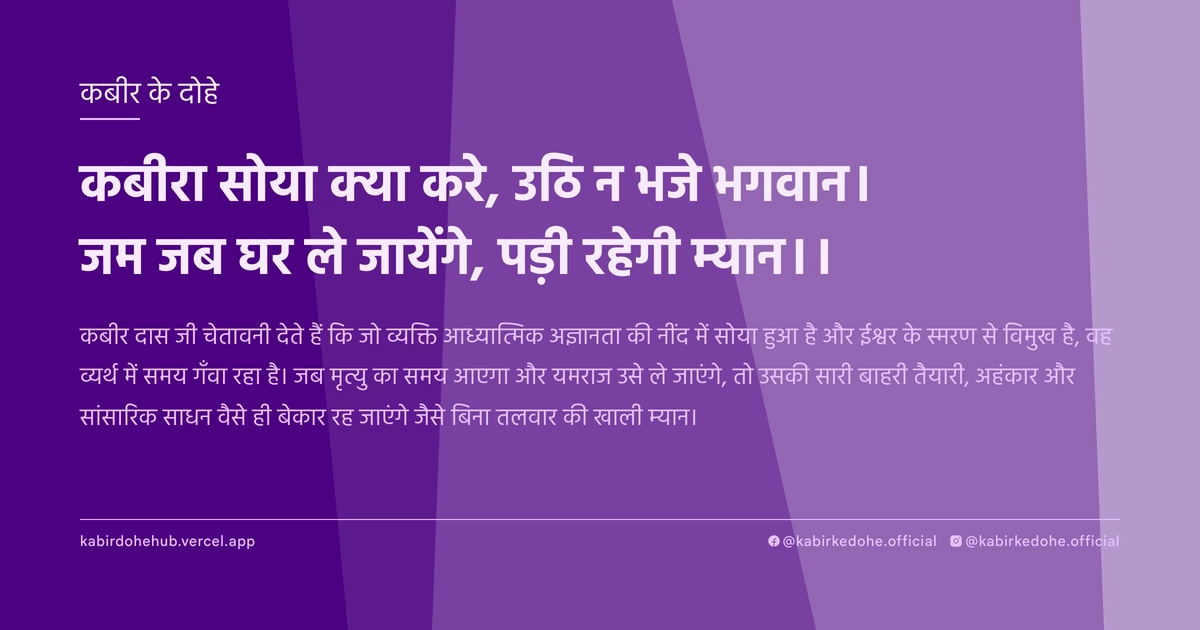
कबीरा सोया क्या करे, उठि न भजे भगवान।
जम जब घर ले जायेंगे, पड़ी रहेगी म्यान।।
Kabira soya kya kare, uthi na bhaje bhagwan. Jam jab ghar le jayenge, padi rahegi myaan.
इस पृष्ठ पर इस कबीर दोहे का अर्थ (meaning), हिंदी व्याख्या और अंग्रेज़ी अनुवाद, दार्शनिक विश्लेषण और व्यावहारिक जीवन सीख दी गई है। यह दोहा जागृति (The Wake-up Call) विषय से जुड़ा है — Kabir doha meaning and explanation in Hindi and English.
अर्थ (Meaning):
कबीर दास जी चेतावनी देते हैं कि जो व्यक्ति आध्यात्मिक अज्ञानता की नींद में सोया हुआ है और ईश्वर के स्मरण से विमुख है, वह व्यर्थ में समय गँवा रहा है। जब मृत्यु का समय आएगा और यमराज उसे ले जाएंगे, तो उसकी सारी बाहरी तैयारी, अहंकार और सांसारिक साधन वैसे ही बेकार रह जाएंगे जैसे बिना तलवार की खाली म्यान।
Kabir warns that the person slumbering in the sleep of spiritual ignorance, neglecting the remembrance of the Divine, is wasting precious time. When the moment of death arrives and the Lord of Death claims the soul, all outward preparations, ego-driven achievements, and worldly possessions will remain useless, much like a scabbard left behind without its sword.
व्याख्या (Interpretation):
यहाँ 'सोना' शारीरिक निद्रा नहीं, बल्कि 'माया' के प्रभाव में होने वाली चेतना की जड़ता है। कबीर कहते हैं कि मनुष्य सांसारिक मोह-माया में इतना लीन है कि वह अपनी वास्तविक आत्मा (Atman) को भूल गया है। 'भगवान' यहाँ किसी मूर्ति रूप में नहीं, बल्कि उस निर्गुण ब्रह्म (Nirgun Brahman) के रूप में हैं जो हमारे भीतर ही व्याप्त है। 'म्यान' का रूपक अत्यंत गहरा है; म्यान बाहरी आवरण है और तलवार वास्तविक शक्ति। यदि व्यक्ति ने आंतरिक साधना नहीं की, तो केवल बाहरी धार्मिक दिखावा (म्यान) रह जाएगा, जबकि वास्तविक आध्यात्मिक उपलब्धि (तलवार) गायब होगी। यह अद्वैत वेदांत के उस सत्य को दर्शाता है जहाँ केवल आत्म-साक्षात्कार ही अंतिम सत्य है, बाकी सब नश्वर है।
Here, 'sleep' does not refer to physical slumber, but to the inertia of consciousness caused by 'Maya' (illusion). Kabir suggests that humanity is so immersed in worldly attachments that it has forgotten its true essence, the Atman. 'Bhagwan' here is not a sculpted deity, but the Nirgun Brahman—the formless Absolute residing within. The metaphor of the 'myaan' (scabbard) is profound; the scabbard is the external shell, while the sword is the actual power. If one does not engage in internal alchemy, only the outward ritualistic shell remains, while the actual spiritual realization—the sword—is missing. This aligns with Advaita Vedanta, emphasizing that only self-realization is the ultimate truth, while all else is transient.
दार्शनिक विश्लेषण (Philosophical Analysis):
कबीर का यह दोहा मध्यकालीन भारत के उस सामाजिक परिवेश में रचा गया जहाँ धर्म केवल कर्मकांडों और बाहरी दिखावे तक सीमित हो गया था। कबीर ने पुरोहितवाद और रूढ़िवादिता पर कड़ा प्रहार किया, यह तर्क देते हुए कि मोक्ष किसी मंदिर, मस्जिद या तीर्थयात्रा से नहीं, बल्कि अंतर्मन की जागृति से मिलता है।
दार्शनिक स्तर पर, यह दोहा 'अविद्या' (ignorance) के विनाश की बात करता है। जब कबीर 'सोने' की बात करते हैं, तो वे उस मनोवैज्ञानिक स्थिति की ओर इशारा कर रहे हैं जहाँ अहंकार (Ahamkara) स्वयं को शरीर और मन मान लेता है। यह स्थिति सूफीवाद के 'नफ़्स' (lower self) के समान है, जिसे मिटाकर ही 'फ़ना' (annihilation in God) की स्थिति प्राप्त की जा सकती है।
निर्गुण भक्ति का मूल सिद्धांत यह है कि ईश्वर किसी एक धर्म या जाति की बपौती नहीं है। कबीर का विद्रोह इस बात पर था कि लोग बाहरी प्रतीकों (जैसे म्यान) को सहेजने में समय बिताते हैं, लेकिन उस शक्ति (तलवार) को विकसित नहीं करते जो उन्हें जन्म-मृत्यु के चक्र से मुक्त कर सके।
यह विश्लेषण हमें बताता है कि मृत्यु केवल शरीर का अंत नहीं है, बल्कि एक दर्पण है जो यह दिखाता है कि हमने अपने जीवन में वास्तव में क्या अर्जित किया। यदि हमने केवल सामाजिक प्रतिष्ठा और भौतिक संपदा जुटाई है, तो मृत्यु के समय वे सब 'खाली म्यान' की तरह निरर्थक सिद्ध होंगे।
अंततः, कबीर मनोवैज्ञानिक रूपांतरण पर जोर देते हैं। वे चाहते हैं कि साधक अपनी तंद्रा को त्यागे और 'साक्षी भाव' (witness consciousness) में आए। यह केवल ईश्वर की प्रार्थना नहीं है, बल्कि स्वयं के वास्तविक स्वरूप की खोज है, जो कि अद्वैत दर्शन का चरम लक्ष्य है।
This couplet was composed during a medieval Indian era where religion had devolved into mere rituals and outward displays. Kabir launched a fierce critique against priestly hegemony and orthodoxy, arguing that liberation (Moksha) is not attained through temples, mosques, or pilgrimages, but through the awakening of the inner self.
Philosophically, this verse addresses the eradication of 'Avidya' (spiritual ignorance). When Kabir speaks of 'sleeping,' he refers to the psychological state where the ego (Ahamkara) mistakenly identifies itself with the body and mind. This mirrors the Sufi concept of the 'Nafs' (the lower self), which must be transcended to achieve 'Fana' (annihilation in the Divine).
The core tenet of Nirgun Bhakti is that the Divine is not the monopoly of any specific religion or caste. Kabir’s rebellion lay in the observation that people spend their lives polishing external symbols (the scabbard) while neglecting to forge the internal power (the sword) capable of cutting through the cycle of birth and death.
This analysis reveals that death is not merely a biological end, but a mirror reflecting what was truly earned in life. If one has accumulated only social prestige and material wealth, these will prove as useless as an empty scabbard at the moment of transition.
Ultimately, Kabir emphasizes a psychological transformation. He urges the seeker to shake off their stupor and enter the state of 'Sakshi Bhava' (witness consciousness). This is not a call for simple prayer, but a demand for the discovery of one's true nature, which is the ultimate goal of Advaita philosophy.
मूल संदेश (Core Message):
- आध्यात्मिक आलस्य ही सबसे बड़ा बंधन है।
- बाहरी धार्मिकता बिना आंतरिक रूपांतरण के शून्य है।
- मृत्यु केवल शरीर का अंत है, चेतना का नहीं।
- अहंकार की म्यान को त्यागकर सत्य की तलवार धारण करें।
- ईश्वर बाहर नहीं, जागृत चेतना के भीतर है।
- Spiritual lethargy is the greatest bondage of the soul.
- External religiosity is void without internal transformation.
- Death is the end of the body, not the consciousness.
- Discard the scabbard of ego to wield the sword of truth.
- The Divine is not outside, but within awakened consciousness.
व्यावहारिक उदाहरण (Practical Example):
वाराणसी के घाटों पर रहने वाली एक वृद्ध विधवा, जानकी, का जीवन केवल परंपराओं के पालन में बीता। उसने दशकों तक कठोर व्रत रखे, हर दिन घंटों माला जपी और समाज की नजरों में एक 'आदर्श सती' बनी रही। उसकी पूरी पहचान उसकी सफेद साड़ी और उसके कठोर अनुशासन की 'म्यान' थी।
जानकी को विश्वास था कि उसकी ये बाहरी साधनाएं उसे मोक्ष दिलाएंगी। वह दूसरों को उपदेश देती थी कि कैसे नियमों का पालन करना चाहिए, लेकिन उसके भीतर क्रोध और दूसरों के प्रति निर्णय लेने की प्रवृत्ति (judgmental nature) कभी कम नहीं हुई।
एक दिन, घाट पर एक फकीर आया जिसने जानकी की माला और उसके कठोर नियमों को देखकर मुस्कुराते हुए कहा, 'माँ, तुम म्यान को बहुत चमका रही हो, पर क्या तलवार की धार जाँची?'
जानकी को पहले तो यह अपमान लगा, लेकिन उस रात उसे एक सपना आया। उसने देखा कि वह यमराज के सामने खड़ी है और अपनी मालाएं और व्रत उन्हें भेंट कर रही है, लेकिन यमराज उन्हें कचरे की तरह फेंक रहे हैं क्योंकि उनमें प्रेम और करुणा की कोई गंध नहीं थी।
वह अचानक जाग गई और उसे महसूस हुआ कि उसने धर्म को एक 'कर्तव्य' मान लिया था, 'प्रेम' नहीं। उसने महसूस किया कि उसकी सारी धार्मिकता केवल एक सामाजिक मुखौटा थी, एक खाली म्यान।
उस दिन के बाद, जानकी ने माला जपना नहीं छोड़ा, लेकिन उसने अपना ध्यान 'दिखावे' से हटाकर 'सेवा' पर लगाया। उसने घाट पर आने वाले असहायों की मदद करना शुरू किया, बिना यह सोचे कि वे किस जाति या धर्म के हैं।
उसने अपने भीतर के क्रोध को पहचाना और उसे क्षमा में बदला। अब उसकी प्रार्थनाएं केवल शब्दों का दोहराव नहीं थीं, बल्कि हृदय की पुकार थीं।
जब जानकी का अंतिम समय आया, तो उसके चेहरे पर एक असीम शांति थी। अब उसके पास केवल एक खाली म्यान नहीं थी, बल्कि आत्म-बोध की वह तलवार थी जिसने उसके अहंकार को काट दिया था।
उसका रूपांतरण यह सिखाता है कि धार्मिकता तब तक व्यर्थ है जब तक वह हृदय को कोमल और अहंकार को शून्य न कर दे।
Janaki, an elderly widow living on the ghats of Varanasi, spent her entire life adhering strictly to traditions. For decades, she observed rigorous fasts, spent hours chanting beads, and maintained the image of an 'ideal ascetic' in the eyes of society. Her entire identity was the 'scabbard' of her white saree and rigid discipline.
Janaki believed that these outward practices would guarantee her salvation. She lectured others on following rules, yet the anger and judgmental nature within her never diminished.
One day, a wandering fakir arrived at the ghat. Seeing Janaki’s beads and her stern adherence to rules, he smiled and asked, 'Mother, you are polishing the scabbard brilliantly, but have you checked the edge of the sword?'
Janaki initially felt insulted, but that night she had a vivid dream. She saw herself standing before Yama, offering her beads and fasts as tributes, but Yama discarded them like trash because they lacked the fragrance of love and compassion.
She woke up abruptly, realizing she had treated religion as a 'duty' rather than 'love.' She understood that her entire religiosity was merely a social mask—an empty scabbard.
From that day on, Janaki did not stop her chanting, but she shifted her focus from 'display' to 'service.' She began helping the destitute on the ghats, regardless of their caste or creed.
She recognized the anger within her and transformed it into forgiveness. Her prayers were no longer mere repetitions of words, but cries of the heart.
When Janaki’s final moment arrived, there was an infinite peace on her face. She no longer possessed just an empty scabbard, but the sword of self-realization that had severed her ego.
Her transformation teaches that religiosity is futile unless it softens the heart and nullifies the ego.
अभ्यास मार्गदर्शन (Practice Guidance):
- प्रतिदिन 20 मिनट 'साक्षी ध्यान' करें: अपने विचारों को बिना किसी निर्णय के देखें, जैसे आप किसी और को देख रहे हों। यह 'सोने' की अवस्था से जागने का पहला कदम है।
- आत्म-पूछताछ जर्नल: हर रात लिखें कि आज आपने कितनी बार 'बाहरी पहचान' (म्यान) को अपनी 'वास्तविक आत्मा' (तलवार) से ऊपर रखा।
- अहंकार का विसर्जन: सप्ताह में एक बार ऐसा कार्य करें जिसमें आपको कोई श्रेय न मिले और आपकी पहचान गुप्त रहे, ताकि केवल सेवा का भाव बचे।
- निदान चेकलिस्ट: क्या मैं दूसरों को सुधारने की कोशिश कर रहा हूँ? (यदि हाँ, तो आप अभी भी म्यान में हैं)। क्या मैं अपनी शांति के लिए बाहरी परिस्थितियों पर निर्भर हूँ? (यदि हाँ, तो आप अभी भी सो रहे हैं)।
- Practice 20 minutes of 'Witness Meditation' daily: Observe your thoughts without judgment, as if you are watching someone else. This is the first step in waking up from the 'sleep' of ignorance.
- Self-Inquiry Journaling: Every night, record instances where you prioritized your 'external identity' (the scabbard) over your 'true essence' (the sword).
- Ego Dissolution: Once a week, perform an act of service where you receive no credit and your identity remains anonymous, ensuring only the spirit of selfless love remains.
- Diagnostic Checklist: Am I trying to 'fix' others? (If yes, you are still clinging to the scabbard). Is my peace dependent on external circumstances? (If yes, you are still asleep).
चिंतन प्रश्न (Reflection Questions):
- मेरे जीवन की वह 'म्यान' क्या है जिसे मैं दुनिया के सामने चमकाने में सबसे अधिक समय बिताता हूँ?
- यदि आज मेरी सारी सामाजिक प्रतिष्ठा और पद छीन लिए जाएँ, तो मेरे भीतर क्या बचेगा?
- क्या मेरी प्रार्थनाएँ वास्तव में ईश्वर से मिलन का माध्यम हैं, या केवल मेरे डर और लालच को शांत करने का तरीका?
- मैं किन सूक्ष्म पूर्वाग्रहों के कारण दूसरों को 'सोया हुआ' मानता हूँ, जबकि मैं स्वयं उसी भ्रम में हूँ?
- मेरी डिजिटल पहचान (Social Media Ego) मेरी वास्तविक आत्मा को कितनी गहराई से ढक रही है?
- What is the 'scabbard' in my life that I spend the most time polishing for the world to see?
- If all my social prestige and titles were stripped away today, what would actually remain within me?
- Are my prayers truly a medium for union with the Divine, or just a way to soothe my fears and greed?
- Which subtle biases lead me to perceive others as 'asleep,' while I myself remain in the same illusion?
- To what extent does my digital identity (social media ego) obscure my authentic soul?