
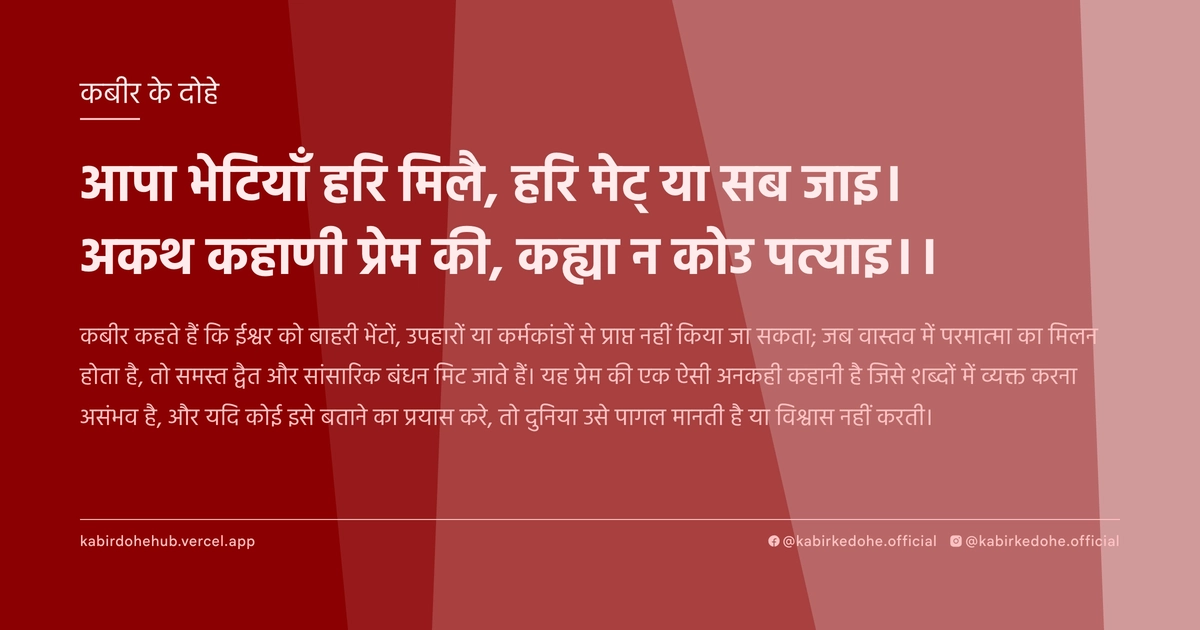
आपा भेटियाँ हरि मिलै, हरि मेट् या सब जाइ।
अकथ कहाणी प्रेम की, कह्या न कोउ पत्याइ।।
Aapa bhetiyan hari milai, hari met ya sab jaai. Akath kahaani prem ki, kahya na kou patyai.
इस पृष्ठ पर इस कबीर दोहे का अर्थ (meaning), हिंदी व्याख्या और अंग्रेज़ी अनुवाद, दार्शनिक विश्लेषण और व्यावहारिक जीवन सीख दी गई है। यह दोहा भक्ति (Bhakti) विषय से जुड़ा है — Kabir doha meaning and explanation in Hindi and English.
अर्थ (Meaning):
कबीर कहते हैं कि ईश्वर को बाहरी भेंटों, उपहारों या कर्मकांडों से प्राप्त नहीं किया जा सकता; जब वास्तव में परमात्मा का मिलन होता है, तो समस्त द्वैत और सांसारिक बंधन मिट जाते हैं। यह प्रेम की एक ऐसी अनकही कहानी है जिसे शब्दों में व्यक्त करना असंभव है, और यदि कोई इसे बताने का प्रयास करे, तो दुनिया उसे पागल मानती है या विश्वास नहीं करती।
Kabir asserts that the Divine cannot be attained through external offerings, ritualistic gifts, or transactional piety; rather, when the true union with the Divine occurs, all dualities and worldly attachments are obliterated. This is an untold saga of transcendental love, an experience so profound that it defies linguistic expression, and those who attempt to describe it are often met with skepticism or disbelief by the worldly-minded.
व्याख्या (Interpretation):
इस दोहे का शाब्दिक अर्थ है कि ईश्वर को वस्तुओं से नहीं खरीदा जा सकता। गहराई में, यह 'निर्गुण भक्ति' का उद्घोष है जहाँ ईश्वर किसी मूर्ति या मंदिर में नहीं, बल्कि शुद्ध चेतना में स्थित है। 'हरि मेट' का अर्थ है अहंकार का पूर्ण विलोपन, जहाँ आत्मा और परमात्मा का भेद समाप्त हो जाता है। यह अद्वैत वेदांत की उस स्थिति को दर्शाता है जहाँ 'मैं' और 'तू' का अंतर मिट जाता है। माया का पर्दा तब गिरता है जब प्रेम केवल भावना नहीं, बल्कि एक अस्तित्वगत अवस्था बन जाता है। यह विरोधाभास है कि सत्य सबसे सरल है, फिर भी सबसे कठिन है क्योंकि यह तर्क से परे है। अंततः, यह अनुभव 'अकथ' है क्योंकि शब्द सीमित हैं और सत्य असीम है।
Literally, the verse claims that the Divine is not accessible via material offerings. Metaphorically, it is a proclamation of Nirgun Bhakti, where the Divine resides not in idols or temples, but within pure consciousness. 'Hari Met' signifies the total annihilation of the ego, where the distinction between the Atman and Brahman dissolves. This aligns with Advaita Vedanta, illustrating the state of non-duality where the 'I' and 'Thou' cease to exist. The veil of Maya falls only when love transcends emotion to become an ontological state of being. The central paradox lies in the fact that while Truth is the simplest reality, it is the hardest to grasp because it defies the logic of the intellect. Ultimately, this experience is 'Akath' (ineffable) because language is finite, while the Truth is infinite.
दार्शनिक विश्लेषण (Philosophical Analysis):
कबीर का यह दोहा उनके युग के धार्मिक पाखंड और कर्मकांडीय आडंबरों पर एक तीखा प्रहार है। उस समय समाज में यह धारणा व्याप्त थी कि महंगे दान, तीर्थयात्रा और कठिन अनुष्ठानों के माध्यम से ईश्वर को प्रसन्न किया जा सकता है। कबीर इस 'लेन-देन' वाली आध्यात्मिकता को सिरे से नकारते हैं। उनके लिए भक्ति कोई सौदा नहीं, बल्कि पूर्ण आत्म-समर्पण है।
दार्शनिक स्तर पर, यह सूफी मत के 'फना' (अस्तित्व का मिटना) और अद्वैत वेदांत के 'अहं ब्रह्मास्मि' का संगम है। सूफीवाद में प्रेमी का प्रेमी में विलीन हो जाना ही चरम लक्ष्य है, ठीक वैसे ही जैसे कबीर 'सब जाइ' (सब कुछ मिट जाने) की बात करते हैं। यहाँ 'प्रेम' का अर्थ कामुक या भावनात्मक लगाव नहीं, बल्कि वह ब्रह्मांडीय आकर्षण है जो आत्मा को उसके स्रोत की ओर खींचता है।
कबीर यहाँ मनोवैज्ञानिक रूपांतरण की बात कर रहे हैं। जब तक मनुष्य अपनी पहचान (नाम, जाति, पद) को पकड़े रहता है, वह ईश्वर से अलग रहता है। जैसे ही यह पहचान या 'अहंकार' मिटता है, वह अनुभव करता है कि जिसे वह बाहर खोज रहा था, वह उसके भीतर ही था। यह 'अकथ' अनुभव इसलिए है क्योंकि हमारी भाषा द्वैत (Dualism) पर आधारित है—विषय और वस्तु। जब द्वैत ही समाप्त हो जाए, तो भाषा अर्थहीन हो जाती है।
यह दोहा जाति व्यवस्था और सामाजिक ऊंच-नीच के विरुद्ध एक सशक्त तर्क है। यदि ईश्वर को किसी भेंट या विशेष कुल की आवश्यकता नहीं है, तो बाहरी पहचान का कोई मूल्य नहीं रह जाता। केवल हृदय की शुद्धता और प्रेम ही एकमात्र पात्रता है।
अक्सर लोग इस दोहे को केवल एक कविता मान लेते हैं, लेकिन यह एक आध्यात्मिक विज्ञान है। यह बताता है कि सत्य का अनुभव बौद्धिक विमर्श से नहीं, बल्कि अनुभवजन्य बोध से होता है। जो व्यक्ति केवल शास्त्रों को पढ़कर सत्य को खोजने का दावा करता है, वह वास्तव में माया के एक और जाल में फँसा हुआ है।
This couplet is a piercing critique of the religious hypocrisy and ritualistic ostentation prevalent during Kabir's era. The societal belief held that the Divine could be appeased through expensive donations, pilgrimages, and rigorous rituals. Kabir categorically rejects this 'transactional spirituality,' asserting that devotion is not a bargain but a total surrender of the self.
Philosophically, this is a convergence of the Sufi concept of 'Fana' (annihilation of the self) and the Advaita Vedanta realization of 'Aham Brahmasmi' (I am Brahman). In Sufism, the ultimate goal is for the lover to be absorbed into the Beloved, mirroring Kabir's phrase 'sab jai' (everything vanishes). Here, 'Love' does not refer to romantic or emotional attachment, but to the cosmic gravity that pulls the soul back to its primordial source.
Kabir addresses a profound psychological transformation. As long as a human clings to their identity—name, caste, or status—they remain separate from the Divine. The moment this identity, or 'ego,' is extinguished, they realize that the entity they were searching for externally was always within. This experience is 'Akath' (ineffable) because human language is predicated on duality—subject and object. When duality vanishes, language becomes obsolete.
Furthermore, this verse serves as a powerful argument against the caste system and social hierarchies. If the Divine requires no offerings or specific lineage, then external identities hold no value. Purity of heart and love are the only prerequisites for union.
Common literalist misconceptions often reduce this to a simple poem, but it is actually a spiritual science. It posits that Truth is not found through intellectual discourse but through experiential realization. One who claims to find Truth solely through the study of scriptures is merely trapped in another layer of Maya.
मूल संदेश (Core Message):
- ईश्वर कोई वस्तु नहीं जिसे उपहारों से खरीदा जा सके।
- सच्ची भक्ति अहंकार के पूर्ण विसर्जन में निहित है।
- प्रेम वह मौन भाषा है जिसे तर्क नहीं समझ सकता।
- बाहरी अनुष्ठान केवल मन को बहलाने के साधन हैं।
- जब 'मैं' मिटता है, तभी 'वह' प्रकट होता है।
- सत्य का अनुभव शब्दों से परे, केवल अनुभूति में है।
- The Divine is not a commodity to be bought with offerings.
- True devotion lies in the total dissolution of the ego.
- Love is the silent language that logic cannot comprehend.
- External rituals are merely distractions for the mind.
- When the 'I' vanishes, the 'All' manifests.
- Truth is found in experience, far beyond the reach of words.
व्यावहारिक उदाहरण (Practical Example):
वाराणसी के एक पुराने घाट पर रहने वाली एक वृद्ध विधवा, जानकी, का जीवन केवल मंदिर की सीढ़ियों और दूसरों की सेवा में बीता। वह मानती थी कि यदि वह हर दिन सबसे महंगा प्रसाद चढ़ाएगी और सबसे कठिन व्रत रखेगी, तो अंत में उसे मोक्ष मिलेगा। उसका पूरा अस्तित्व 'भेंट' और 'पाप-पुण्य' के गणित में उलझा था।
एक दिन, घाट पर एक फकीर आया जिसने जानकी के महंगे प्रसाद को देखा और मुस्कुराते हुए कहा, 'माँ, तुम पत्थर को मिठाई खिला रही हो, जबकि वह भूखा तुम्हारे भीतर बैठा है।' जानकी को यह बात अपमानजनक लगी, लेकिन फकीर की आँखों में एक अजीब सी शांति थी।
अगले कुछ दिनों तक जानकी ने देखा कि वह फकीर बिना किसी मंदिर जाए, केवल मौन रहकर लोगों के दुखों को सुनता था। उसके चेहरे पर वह आनंद था जिसे जानकी ने वर्षों के अनुष्ठानों के बाद भी नहीं पाया था।
एक शाम, जानकी ने क्रोध में पूछा, 'तुम कौन सा मंत्र पढ़ते हो कि इतना शांत रहते हो?' फकीर ने उत्तर दिया, 'मैं मंत्र नहीं पढ़ता, मैं बस उस 'मैं' को मिटा देता हूँ जो मुझसे और ईश्वर से अलग होने का दावा करता है। जब 'मैं' नहीं रहता, तो केवल प्रेम बचता है।'
यह शब्द जानकी के भीतर एक बिजली की तरह कौंधे। उसने महसूस किया कि उसकी सारी भेंटें वास्तव में उसके अहंकार को संतुष्ट करने का तरीका थीं—यह दिखाने के लिए कि वह कितनी 'धार्मिक' है।
उस रात, जानकी ने पहली बार अपनी आँखें बंद कीं और किसी देवता से कुछ माँगा नहीं। उसने बस अपने भीतर की उस तड़प को महसूस किया जो उसे किसी बाहरी वस्तु से नहीं, बल्कि एक अज्ञात पूर्णता से जोड़ रही थी।
धीरे-धीरे, उसकी मंदिर जाने की मजबूरी खत्म हो गई। अब वह मंदिर जाती थी, लेकिन प्रसाद चढ़ाने के लिए नहीं, बल्कि उस शांति को साझा करने के लिए जो उसने अपने भीतर पा ली थी।
उसने देखा कि अब उसे मोक्ष की चिंता नहीं थी, क्योंकि वह वर्तमान क्षण में ही पूर्ण महसूस कर रही थी। उसका जीवन अब एक 'भेंट' बन गया था, जो वह बिना किसी शर्त के दुनिया को दे रही थी।
जानकी की कहानी यह दर्शाती है कि जब हम ईश्वर को 'पाने' की कोशिश छोड़ देते हैं और स्वयं को 'मिटाने' का प्रयास करते हैं, तब वह प्रेम प्रकट होता है जिसे शब्दों में नहीं कहा जा सकता।
अंततः, वह वृद्ध महिला जिसे दुनिया एक 'बेचारी विधवा' समझती थी, एक ऐसी रहस्यमयी शांति की प्रतिमूर्ति बन गई जिसे देखकर लोग अब उससे पूछने लगे थे कि उसका 'मंत्र' क्या है।
Janaki, an elderly widow living on the ancient ghats of Varanasi, spent her entire life on temple steps and in the service of others. She believed that by offering the most expensive prasad and observing the strictest fasts, she would eventually attain moksha. Her entire existence was entangled in the mathematics of 'offerings' and 'sin-merit.'
One day, a wandering fakir arrived at the ghat. Seeing Janaki's lavish offerings, he smiled and said, 'Mother, you are feeding sweets to a stone, while the Hungry One sits starving within you.' Janaki found this insulting, yet there was an unsettling peace in the fakir's eyes.
Over the next few days, Janaki observed that the fakir never visited a temple, yet he listened to the sorrows of people with a profound, silent presence. He possessed a joy that Janaki had failed to find despite years of rigorous rituals.
One evening, Janaki asked in frustration, 'What mantra do you recite to remain so serene?' The fakir replied, 'I recite no mantra; I simply erase the "I" that claims to be separate from the Divine. When the "I" vanishes, only Love remains.'
These words struck Janaki like a bolt of lightning. She realized that all her offerings were actually tools to feed her ego—a way to prove how 'pious' she was.
That night, for the first time, Janaki closed her eyes and asked for nothing from any deity. She simply felt the longing within her—a longing not for a thing, but for an unknown wholeness.
Gradually, her compulsion to visit the temple vanished. She still went, but no longer to offer prasad, but to share the peace she had discovered within herself.
She noticed that she no longer worried about salvation, for she felt complete in the present moment. Her very life became an 'offering,' given unconditionally to the world.
Janaki's story illustrates that when we stop trying to 'attain' God and instead strive to 'erase' the self, a love emerges that defies linguistic description.
Ultimately, the elderly woman whom the world saw as a 'pitiful widow' became an embodiment of a mystical serenity, leading others to seek the secret of her transformation.
अभ्यास मार्गदर्शन (Practice Guidance):
- प्रतिदिन 20 मिनट 'शून्य ध्यान' का अभ्यास करें, जहाँ आप किसी भी विचार या इच्छा को पकड़ने के बजाय केवल अपनी श्वास के साथ स्वयं के अस्तित्व के मिटने का अनुभव करें।
- एक 'अहंकार पत्रिका' (Ego Journal) बनाएँ। दिन भर में जब भी आपको लगे कि आप अपनी धार्मिकता, ज्ञान या पद का प्रदर्शन कर रहे हैं, उसे लिखें और विश्लेषण करें कि वह 'भेंट' क्या थी जो आप दुनिया को दे रहे थे।
- बिना किसी अपेक्षा के एक गुप्त सेवा कार्य करें। यह सुनिश्चित करें कि किसी को पता न चले कि यह आपने किया है, ताकि 'कर्ता' होने का भाव समाप्त हो सके।
- निदान चेकलिस्ट: क्या आप अभी भी ईश्वर को प्रसन्न करने के लिए सौदेबाजी कर रहे हैं? क्या आपकी शांति बाहरी परिस्थितियों या अनुष्ठानों पर निर्भर है? यदि हाँ, तो आप अभी भी 'भेंट' के स्तर पर हैं, 'प्रेम' के नहीं।
- Practice 20 minutes of 'Shunya Meditation' daily, where instead of clinging to thoughts or desires, you simply experience the dissolution of your separate identity through the breath.
- Maintain an 'Ego Journal.' Whenever you feel yourself performing your piety, knowledge, or status for others, record it and analyze what 'offering' you were trying to trade for validation.
- Perform a secret act of service without any expectation of reward. Ensure that no one knows you did it, effectively annihilating the sense of being the 'doer.'
- Diagnostic Checklist: Are you still bargaining to please the Divine? Is your peace dependent on external rituals or conditions? If yes, you are still operating at the level of 'offerings' rather than 'Love.'
चिंतन प्रश्न (Reflection Questions):
- मेरे जीवन में वे कौन से 'धार्मिक मुखौटे' हैं जिन्हें मैं दुनिया को दिखाने के लिए पहनता हूँ?
- यदि मेरी सारी उपलब्धियाँ और पहचान छीन ली जाएँ, तो क्या मेरे भीतर कुछ ऐसा बचेगा जो ईश्वर से जुड़ा हो?
- क्या मेरा प्रेम वास्तव में निस्वार्थ है, या यह एक सूक्ष्म सौदा है जिसमें मैं बदले में शांति या मान्यता चाहता हूँ?
- मैं किन शब्दों या परिभाषाओं के पीछे छिपकर सत्य के वास्तविक अनुभव से बच रहा हूँ?
- क्या मैं वास्तव में सत्य को खोजना चाहता हूँ, या मैं केवल 'सत्य खोजने वाले' की छवि से प्रेम करता हूँ?
- What are the 'religious masks' I wear to project a certain image of piety to the world?
- If all my achievements and identities were stripped away, would anything remain within me that is connected to the Divine?
- Is my love truly selfless, or is it a subtle transaction where I seek peace or validation in return?
- Behind which words or definitions am I hiding to avoid the raw, unfiltered experience of Truth?
- Do I truly desire to find the Truth, or am I merely in love with the image of being a 'seeker'?